Brahma is the creator god of the Hindu Trimurti, the cosmic trinity he forms with Vishnu the preserver and Shiva the destroyer. Traditionally depicted with four heads facing the cardinal directions and four arms holding the Vedas, a water pot (kamandalu), a rosary (mala), and a lotus, Brahma is credited in the Puranas with bringing the manifest universe into being from the cosmic golden egg, the Hiranyagarbha. Despite this foundational role, Brahma occupies a strange and much-discussed place in living Hindu practice: he is honored in scripture and myth but almost never worshipped in temples, a paradox the tradition itself explains through several attested curse narratives rather than leaving unaddressed.
Origins and the Work of Creation
In Vedic cosmology, Brahma is described as self-born (Svayambhu), emerging from a golden egg that floated on the primordial waters, or in other tellings from a lotus that grew from the navel of Vishnu as he slept upon the serpent Shesha on the cosmic ocean. From this egg or lotus, Brahma set about the work of secondary creation — not creation from nothing, which many Puranic accounts reserve for a more abstract, unmanifest Brahman, but the ordering and population of the universe: the mental sons known as the Manasaputras, the sages (rishis), the Manus who father the human race, and the basic architecture of days, nights, and cosmic ages (yugas and kalpas) that structure Hindu time. Each of Brahma's "days" is said to last 4.32 billion human years, followed by a night of equal length in which the universe dissolves back into potential before the cycle begins again — a scale of time distinctive to Hindu cosmology and often cited as remarkably close to modern estimates of cosmic and geological ages, though the traditions developed independently of scientific cosmology.
Shatarupa and the Four Heads
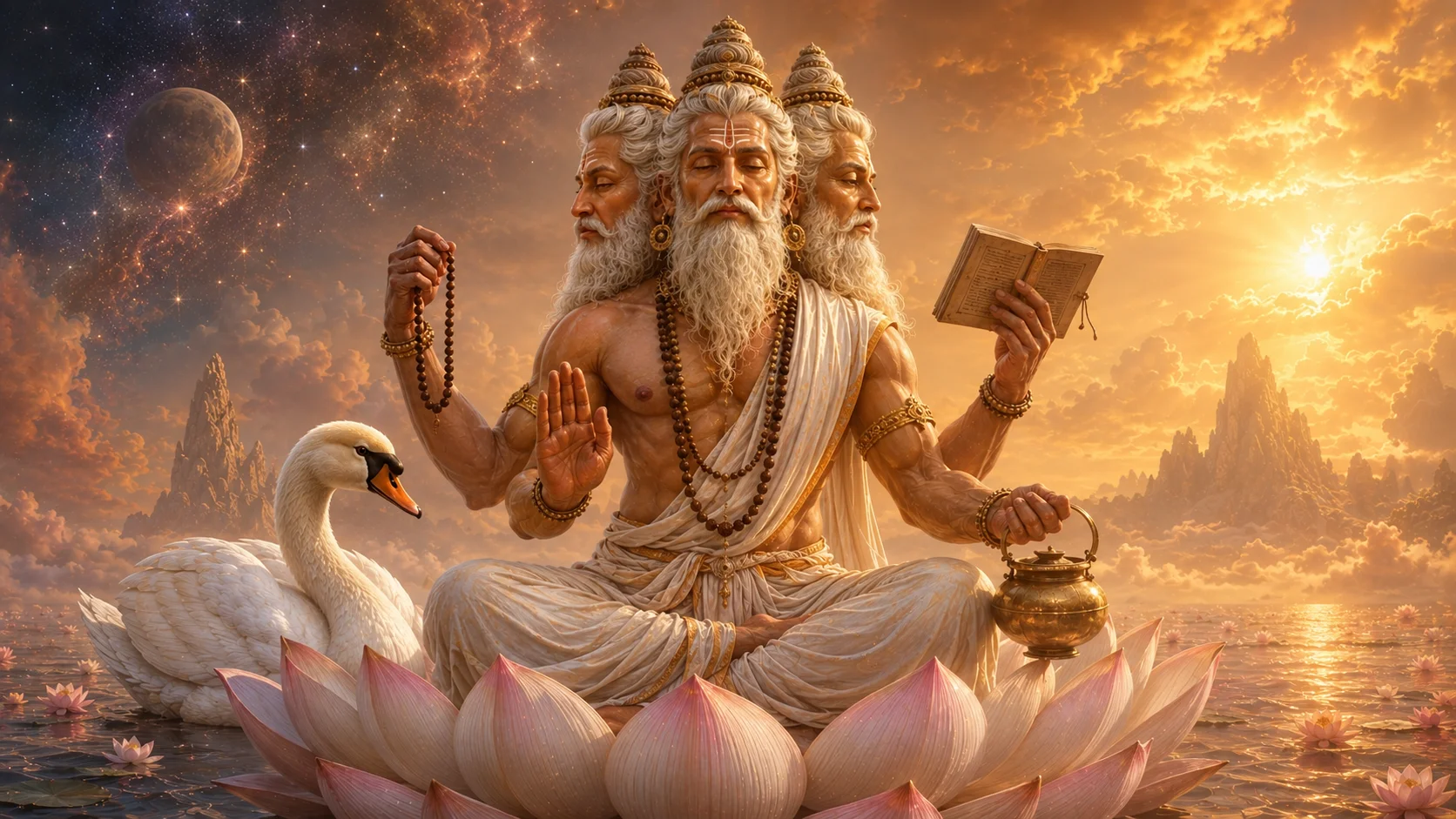
The most celebrated myth explaining Brahma's iconography also explains the beginning of his troubles. Having created the universe, Brahma next created a female being of extraordinary beauty called Shatarupa ("she of a hundred forms"), who is identified in various Puranic sources with Saraswati, Savitri, and Gayatri — the tradition treats these as names or aspects of a single primal feminine principle emanating from Brahma himself, which is one reason Saraswati is reckoned his consort despite in a sense being his own creation. Brahma became so infatuated with Shatarupa that as she circled him to avoid his gaze, he grew a new head to keep watching her in every direction — north, south, east, and west — and when she tried to escape upward, a fifth head sprouted atop the other four. Shiva, appalled at what he judged an incestuous and unholy obsession by a father-creator toward his own creation, severed Brahma's fifth head with his trident or with the nail of his thumb, leaving him with the four heads by which he is recognized today, and cursed him for his transgression.
The Curses That Explain an Empty Temple
Hindu tradition preserves more than one account of why Brahma, despite his cosmic stature, receives almost no temple worship — the traditions do not agree on a single cause, and the texts themselves present competing versions. One version holds that the curse followed directly from the Shatarupa episode: Shiva, having beheaded Brahma's fifth head for his lust, decreed that Brahma would never again be worshipped on earth, since he had let carnal desire overtake the discipline proper to his cosmic office. A separate and equally well-known account, tied to the Jyotirlinga myth in which Vishnu and Brahma raced to find the top and bottom of an infinite pillar of light manifested by Shiva, has Brahma falsely claiming victory — he enlists a flower, the screw-pine (ketaki), to lie on his behalf that he reached the summit. Shiva, angered by the deceit, curses Brahma that he shall have no place of worship, and separately curses the ketaki flower that it may never be offered in worship either. A third tradition, rooted specifically in the founding legend of the Pushkar temple in Rajasthan, tells that Brahma, needing a consort at hand to complete an urgent yajna (fire sacrifice) when his wife Savitri was delayed, married a local girl named Gayatri in her place; the enraged Savitri, arriving late, cursed Brahma that he would be worshipped nowhere in the world except at Pushkar, the very site of the sacrifice. These are not treated by the tradition as mutually exclusive fabrications to be resolved into one "true" account, but as layered explanations, each carried by different regional and sectarian lines of the same underlying puzzle: a creator god whose creative work is complete and, in the theology of Vaishnavism and Shaivism alike, whose active cosmic role has therefore receded relative to the ongoing, still-unfolding work of preservation and destruction/transformation.
Sectarian Standing and the Trimurti
Within the Trimurti, Brahma is assigned the office of creation, Vishnu of preservation, and Shiva of destruction and renewal, together forming a description of the universe's full cycle of birth, maintenance, and dissolution. But this trinity has never functioned as a shared, cross-sectarian theology the way it is sometimes popularly summarized. Vaishnava tradition, which holds Vishnu as the supreme, transcendent reality, generally regards Brahma (and Shiva) as functionaries or even emanations arising from Vishnu rather than independent supreme beings; some Vaishnava texts describe Brahma as born from the lotus growing out of Vishnu's navel and thus subordinate to him by origin. Shaiva tradition, correspondingly, treats Shiva as the ultimate reality from whom Brahma's creative function derives, sometimes narrating Shiva as the one who appoints or empowers Brahma to create. Shakta tradition reassigns the three creative-preservative-destructive offices to goddess forms altogether — Mahasarasvati, Mahalakshmi, and Mahakali — treating the male Trimurti as itself an expression of a prior, feminine Shakti. Brahma, in short, is the one member of the classical Trimurti that no major living sect claims as its supreme deity, which scholars of Hinduism regularly note as the deeper explanation for his general absence from temple worship, independent of any single curse story.
Iconography and Attributes
Brahma is shown with four faces, understood to correspond to the four Vedas he is credited with uttering into being, and four arms bearing the Vedas themselves (as sacred books), a kamandalu of water representing the primal substance of creation, a rosary used to keep count of cosmic time, and often a lotus or a sacrificial ladle. His vehicle (vahana) is the swan or goose, Hamsa, prized in Hindu symbolism for its supposed ability to separate milk from water — representing the discernment (viveka) between truth and illusion that a creator-mind must possess. His consort Saraswati is regularly depicted seated beside or near him, underscoring that creation in Hindu thought is inseparable from knowledge and articulate speech (vak), the domain over which Saraswati presides.
Worship Today
The Brahma Temple at Pushkar in Rajasthan remains the most famous of the extremely small number of temples dedicated to Brahma anywhere in the world, and it draws pilgrims especially during the Kartik Purnima period, when the adjoining Pushkar Lake and its associated camp fair also take place. A handful of other Brahma shrines exist in India and beyond — including at Uthrapathiswaraswamy temple in Tamil Nadu and a few sites tied to local tradition — but none approach the scale of devotion paid daily to Vishnu, Shiva, or the great goddesses. Brahma nonetheless remains fully present in Hindu cosmology, ritual recitation, and temple sculpture: his name and function are invoked in creation narratives, in the Puranas read and recited across sectarian lines, and in the architecture of major temples, where his image commonly appears among the eight guardian deities of the directions (dikpalas) or in narrative friezes depicting the churning of the ocean and other cosmic events, even where he is not the deity to whom worship (puja) is formally addressed.
Sources & traditions
- EncyclopediaWikipedia — Brahma
- TraditionHindu texts, oral tradition and village tellings (South Asia)
Myths change from area to area and from time to time. This chronicle follows the most widely told versions; tellings in other villages, regions and eras may differ.