Jatayu is the aged demigod vulture of the Ramayana, son of Aruna the sun-god's charioteer and nephew of the great Garuda, who gave his life in single combat against the demon-king Ravana in a doomed attempt to save the abducted Sita. Grievously wounded, his wings severed, Jatayu lived only long enough to name Ravana and point Rama and Lakshmana southward before dying in Rama's arms — an act of loyalty and self-sacrifice that made him one of the most venerated figures of the epic and, in later centuries, an object of devotion in his own right across South India.
Born of the Sun's Own Charioteer
Jatayu's lineage places him at the edge of the solar dynasty's own household without belonging to it by blood. He is the son of Aruna, who drives the chariot of Surya the sun-god across the sky each dawn, and this makes Jatayu nephew to Garuda, the great eagle who serves as Vishnu's mount and stands among the mightiest of divine birds in the wider tradition. Jatayu is himself described as a vulture-king, sometimes rendered as a divine eagle depending on the telling, and he carries the epithet Gridhraraja — king of vultures — a title that marks him as sovereign among his kind rather than merely one bird among many. He has a brother, Sampati, also a vulture, and the two of them are bound by a shared and formative childhood misfortune that shapes both their fates long before either one enters the main action of the Ramayana.
The Brother Who Flew Too Near the Sun
Long before Jatayu's battle with Ravana, he and Sampati were young and reckless enough to fly upward together toward the sun itself, testing how high a bird might climb. As the heat grew unbearable, it was Sampati who spread his own wings wide to shield his younger brother Jatayu from the sun's scorching force — and in doing so, Sampati's own wings were burned, leaving him grounded and flightless for what the tradition describes as the whole of his subsequent life. Jatayu was spared by his brother's sacrifice, though the two are separated by it: Sampati falls out of the story for a long stretch, unable to fly, while Jatayu goes on to live a full and active life as a bird still capable of the sky. The two brothers thus mirror each other across the Ramayana in a way that gives Jatayu's own fate an added resonance — one brother loses his wings protecting the other from the sun, and the other will lose his wings protecting a queen from a demon-king, each sacrifice made without hope of return.
Friend to the House of Ayodhya
Jatayu's bond with Rama's family did not begin with the crisis that would end his life. He is established in the Ramayana as a friend and ally of King Dasharatha of Ayodhya, Rama's father, a relationship formed well before Ravana's abduction of Sita ever takes place. This prior friendship matters to how Jatayu is later understood: when he intervenes to try to save Sita, he is not acting as a stranger who happens upon the scene but as an old ally of the royal house, a figure whose loyalty predates the tragedy and gives his final act the weight of a debt honoured rather than a chance heroism.
Ravana's Chariot Crosses the Sky
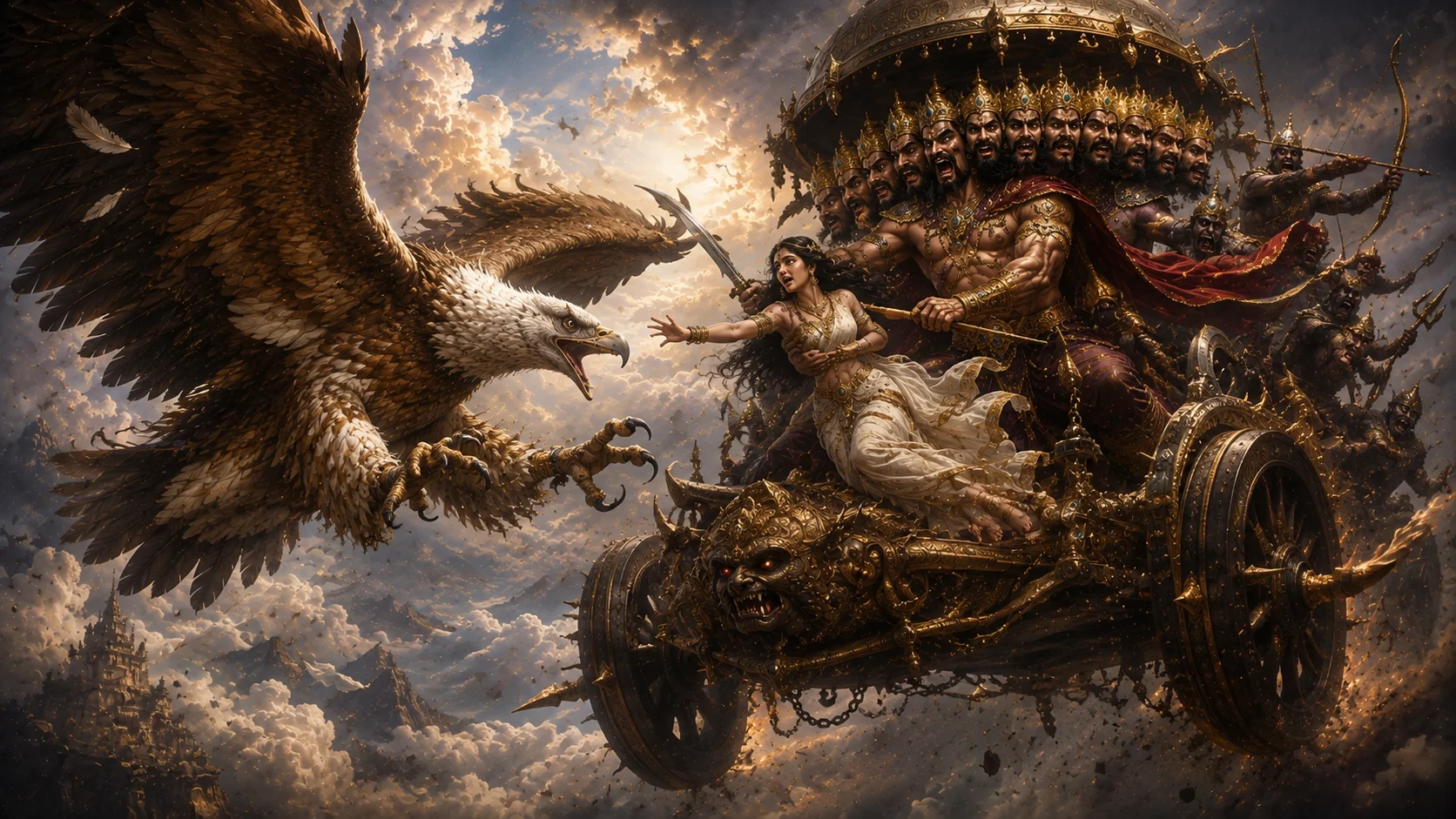
The central crisis of Jatayu's story begins when Ravana, the demon-king of Lanka, abducts Sita from the forest hermitage where she lives in exile with Rama and Lakshmana, and carries her away through the air in his flying chariot, the Pushpaka Vimana. It is in this moment, as the chariot passes overhead bearing the captive Sita toward the south, that Jatayu — old by now, but still a being of great and divine strength — chooses to act. He does not stand aside on account of his age, nor does he hesitate at the mismatch between an aging bird and a demon-king of Ravana's power. He rises to intercept the chariot in the open sky, placing himself directly between Ravana and escape.
An Old Bird's Last Battle
The fight that follows is fierce and entirely one-sided in its stakes, if not at first in its intensity. Jatayu attacks Ravana's chariot itself, striving to break it apart and halt its flight, and presses the demon-king in open aerial combat with everything his great age-worn strength can still summon. For a time the old vulture-king holds his own against a warrior who commands vast and terrible power, a testament to how formidable Jatayu remains even in his final years. But the contest cannot end any other way: Ravana is simply too strong, and the battle turns decisively against Jatayu. Wielding his sword, Ravana cuts off Jatayu's wings, inflicting mortal wounds upon him in the same stroke. Flightless and dying, Jatayu falls from the sky to the earth below, while Ravana flies on toward Lanka with Sita still his captive. Jatayu's intervention has failed to free her — but it has not been in vain, though he does not yet know it as he lies broken on the ground.
Found by the Searching Princes
Rama and Lakshmana, discovering Sita gone from the hermitage, set out in anguished search of her, and it is in the course of this search that they come upon Jatayu — grievously wounded, his wings gone, his strength nearly spent. The meeting is one of the great turning points of the epic's early books: a friend of the family, broken and dying, found by the very princes whose wife he had tried and failed to save. There is no ambiguity in the encounter for Rama and Lakshmana about who this fallen bird is or what he has attempted on their behalf; the old alliance with Dasharatha's house and Jatayu's evident wounds tell the story before a word is spoken.
The Message That Set the Search Southward
With the last of his strength, Jatayu tells Rama what has happened: that Ravana abducted Sita and carried her away to the south. This single piece of information — the identity of the abductor and the direction of his flight — is the crucial thread that will guide the entire search to come. Without it, Rama and Lakshmana would have no notion of where to begin looking for Sita or whom precisely they were seeking to overcome. Jatayu's dying report is thus not merely an act of loyalty performed for its own sake; it is the hinge on which the rest of the rescue turns, the one clear fact that transforms a desperate, directionless search into a journey with a heading and a named enemy.
Death in Rama's Arms
Having delivered his message, Jatayu dies in Rama's arms. Rama, moved by the old bird's sacrifice and by the depth of a loyalty that had cost him everything, performs funeral rites for Jatayu personally — the honour due not to a mere ally but to a figure treated with something close to the reverence owed a father. This act of Rama's, tending to the funeral of a bird who died attempting to protect his wife, is itself part of what elevates Jatayu within the tradition: it marks him as more than an incidental helper in the narrative, and casts the relationship between the two as one of genuine and mutual devotion, honoured in death exactly as it had been trusted in life.
A Cremation Site Remembered on the Ground
Devotional and traditional geography associates the place of Jatayu's cremation with the region near Panchavati, the forest area central to this stretch of the Ramayana's story. Such identifications of legendary sites with specific present-day locations belong to devotional and traditional memory rather than to any fixed textual geography, but they matter nonetheless to how Jatayu is remembered — his death is not left as an abstract event but is tied, in the minds of the faithful, to an actual place on the earth where his sacrifice is still recalled.
Sampati's Answering Debt
Jatayu's death does not close the story of the two vulture brothers. Later in the Ramayana, during the search for Sita conducted by the vanaras of Kishkindha, Sampati reappears — still flightless from the injury he took shielding young Jatayu from the sun long before — and it is he who helps the vanaras locate Sita, using knowledge and sight that his long, grounded years have given him even though he cannot join the search in the air himself. The two brothers thus complete a kind of symmetry across the epic: Sampati's early sacrifice cost him his wings and kept him earthbound, unable to fly to his brother's aid when Jatayu fell; but decades later it is Sampati who, in his own limited way, carries forward the work Jatayu died attempting, helping to finally locate the queen that Jatayu could not save. Neither brother completes the rescue of Sita alone, and neither could have contributed what he did without the other's earlier loss.
An Exemplar of Dharma Against Impossible Odds
Within the moral architecture of the Ramayana, Jatayu stands as an exemplar of dharma understood as duty carried out regardless of the odds of success. He does not intervene against Ravana because he believes he can win; nothing in the story suggests Jatayu expected to prevail against a demon-king of that magnitude. He intervenes because Sita is in danger and because his loyalty to Dasharatha's house and his own sense of right conduct demand that he act, whatever the cost. This willingness to risk and ultimately give everything in defence of another, with no expectation of victory, is precisely what the tradition holds up as the heart of his virtue — courage measured not by the likelihood of success but by the refusal to stand by.
Venerated Still on the Ground Where He Fell
Jatayu's reception did not remain confined to the pages of the epic. In parts of South India, and especially in Kerala, he is venerated as a folk deity in his own right, a later regional devotion that builds directly on the Ramayana episode of his sacrifice. The site known as Jatayu Earth's Center at Chadayamangalam stands as one expression of this continuing regard, a place where the memory of the old vulture-king's final battle and death is kept alive in living devotional practice rather than left solely to recitation of the epic's verses. This ongoing veneration marks Jatayu as a figure whose story crossed, over time, from epic narrative into lived regional worship.
The Wings That Bought Rama His Direction
What endures most clearly of Jatayu is the shape of the exchange at the centre of his story: an old ally who owed nothing beyond friendship placed himself between a queen and a demon-king with power far beyond his own, lost the fight decisively, and used what little life remained to him afterward not for anything of his own but to give Rama the one fact — the direction south, the name of the abductor — that made the rescue of Sita possible at all. Gridhraraja, king of vultures, friend of Dasharatha's house, brother of Sampati, dying in the arms of the prince he served: Jatayu's place in the Ramayana rests on that single, costly act of devotion, honoured by Rama's own funeral rites and, long after, by worship still offered on the ground where he is remembered to have fallen.
Sources & traditions
- EncyclopediaWikipedia — Jatayu
- TraditionHindu texts, oral tradition and village tellings (South Asia)
Myths change from area to area and from time to time. This chronicle follows the most widely told versions; tellings in other villages, regions and eras may differ.