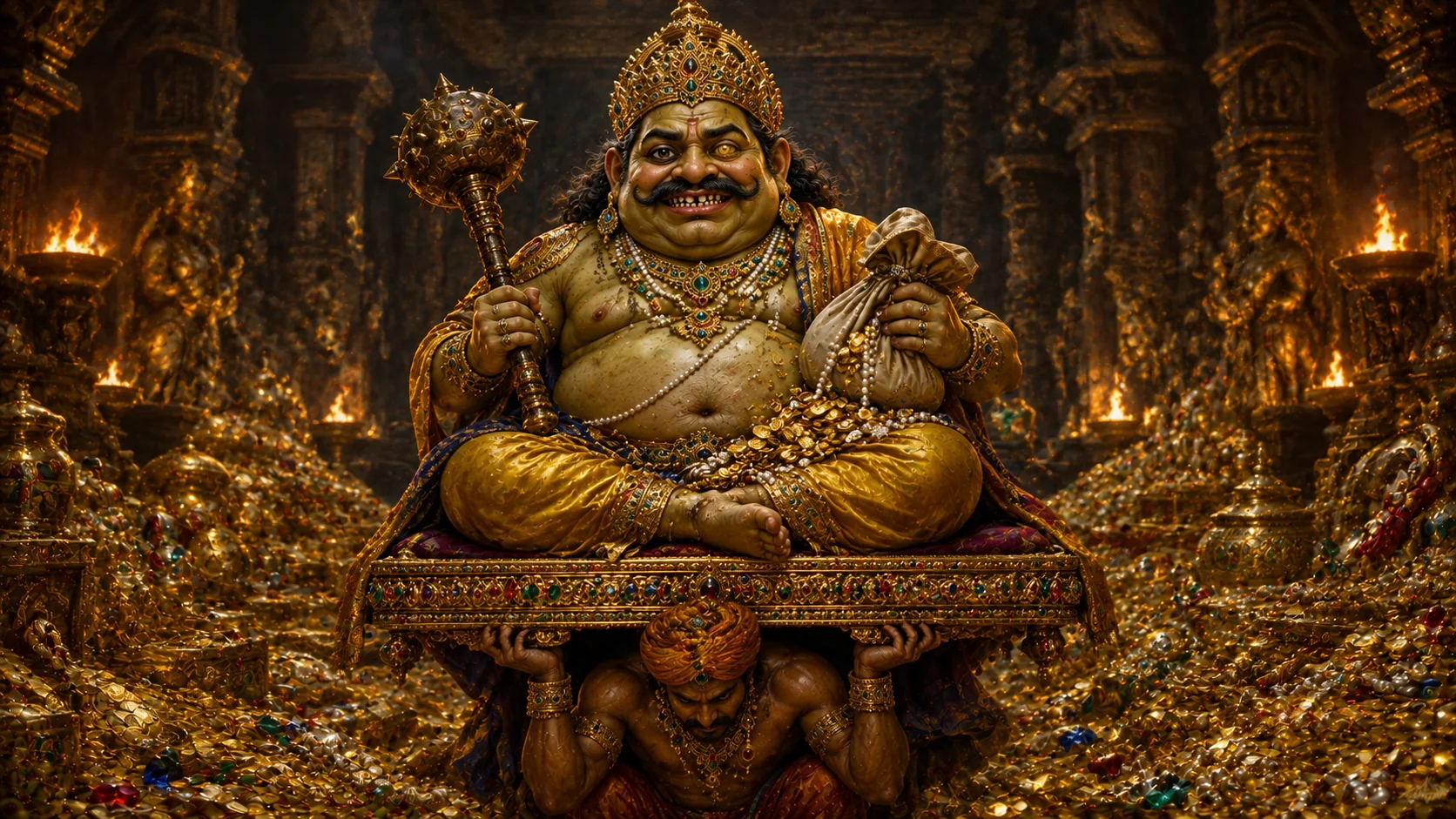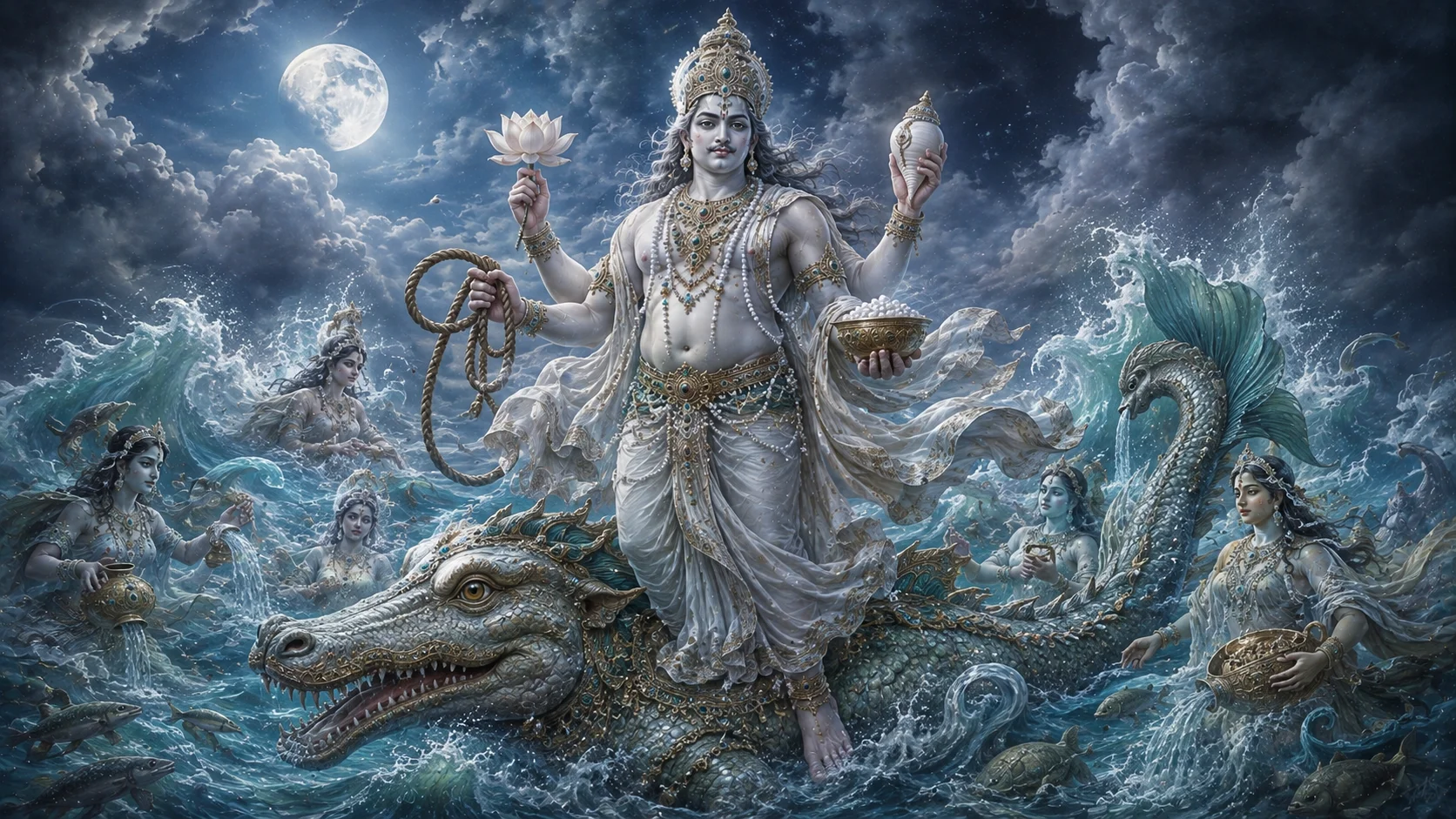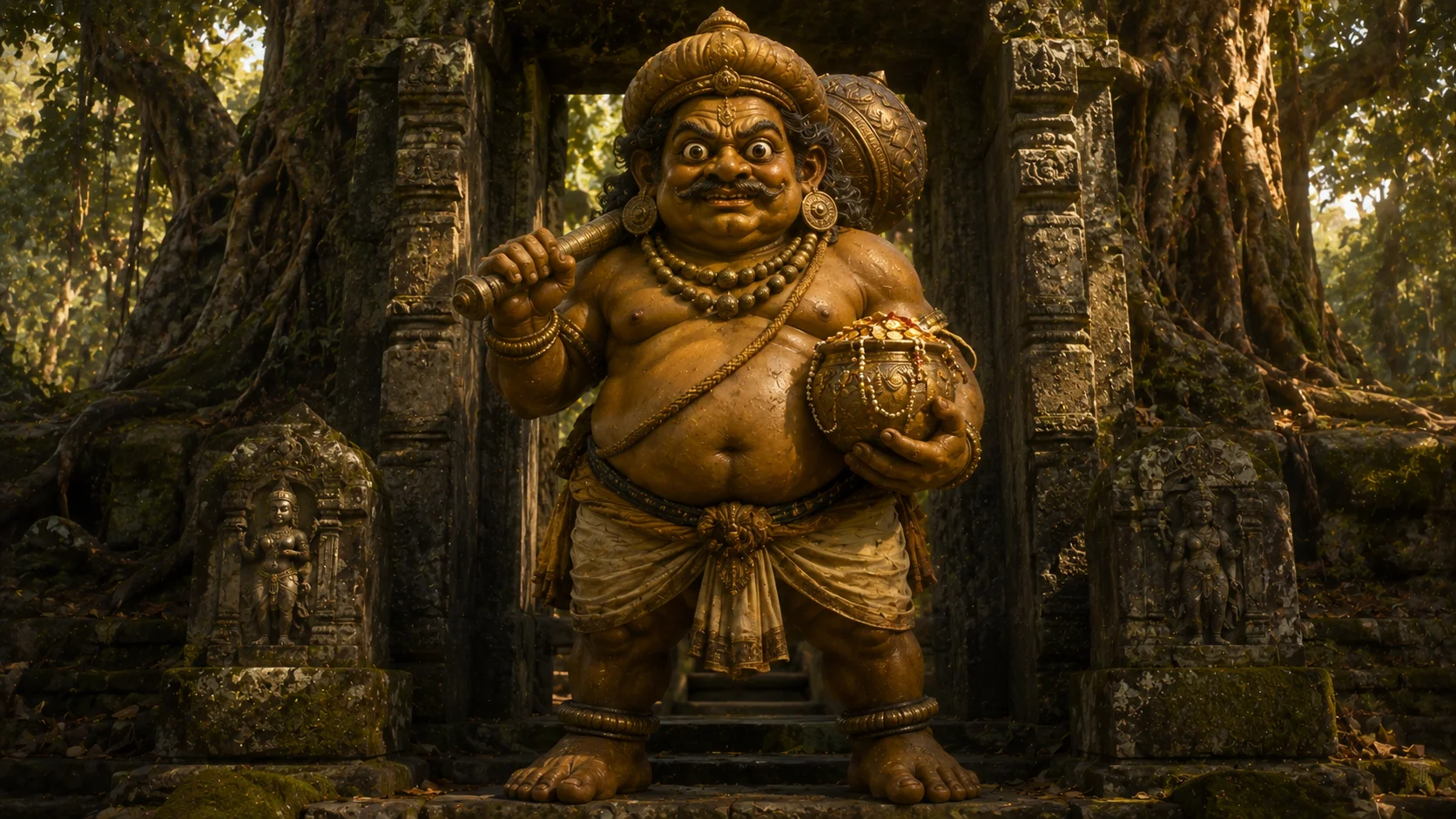
Yaksha — Yakṣa — is the broad class of Hindu (and Buddhist and Jain) nature-spirit: guardians of the earth’s hidden treasures, of forests, trees, wells, and wild places, attendants of the wealth-god Kubera. Ambivalent beings — benevolent custodians and gentle tree-spirits in one aspect, dangerous flesh-eating ogres in another — the yakshas are among the oldest objects of worship on the subcontinent, predating the great gods in popular devotion.
Guardians of Treasure and Earth
The yakshas serve Kubera, lord of wealth and king of the yakshas, who rules from the golden city of Alaka in the Himalayas. As his attendants they guard buried treasure, mineral wealth, and the riches of the earth — for hidden gold and gems are their especial charge. They are spirits of place: a yaksha may inhabit a particular banyan or peepal tree, a pool, a mountain, or a city, and as the guardian-genius of that spot must be honoured by those who would use it. The benevolent yaksha brings fertility, prosperity, and protection; village shrines and tree-altars across India still receive offerings to such local guardian-spirits.
The Riddling Yaksha of the Lake
The most famous yaksha in literature is the guardian of a forest lake in the Mahabharata — the Yaksha Prashna, “the questions of the yaksha.” When the thirsty Pandavas come one by one to drink, the yaksha (in truth the god Dharma/Yama in disguise) forbids them until they answer his questions; four brothers ignore him and fall dead. Only the wise Yudhishthira stops to answer, and his replies to the yaksha’s profound riddles — “What is the greatest wonder?” (“That each day death strikes, and yet the living believe themselves immortal”) — constitute one of the great wisdom-dialogues of the epic. Pleased, the yaksha restores the dead brothers to life.
The Cloud-Messenger’s Exile
A yaksha is also the hero of one of Sanskrit’s most beloved poems, Kalidasa’s Meghaduta (“The Cloud Messenger”): a yaksha banished by Kubera from Alaka, pining for his distant wife, who begs a passing monsoon cloud to carry his love-message across all India to her. Here the yaksha is wholly tender and human — the lovelorn exile whose longing maps the geography of the subcontinent.
The Dark Aspect and the Sacred Sculpture
Yet the yaksha has a fearsome face. In its malign aspect it is a man-eater haunting lonely roads and forests, kin to the rakshasa and the pishacha; some yakshas are demonic ogres who must be appeased or fought. The female yakshinis are likewise double-natured. In art, the colossal yaksha statues of the Mauryan age are among the earliest monumental sculptures of India, and the yaksha’s benevolent fertility-aspect deeply shaped the iconography of later Hindu and Buddhist deities. Worshipped before the Vedic gods and still honoured at countless tree-shrines, the yaksha is the enduring spirit of the wild, sacred, treasure-keeping earth itself.
The Yaksha Who Humbled the Gods
Before it haunts forest roads or breaks a lover’s heart, the yaksha interrupts a victory party. One of the oldest surviving yaksha episodes in Sanskrit literature sits in the third and fourth sections of the Kena Upanishad, deep in the philosophical layer of the Vedic corpus. The gods, fresh from a battle won against the asuras, are congratulating themselves on their own might when a strange, luminous being appears before them: a yaksha none of them recognise. Agni, god of fire, is sent to find out what it is. Asked what power he holds, he answers that he can burn everything upon the earth — so the yaksha sets a single blade of straw before him, and Agni cannot so much as singe it. Vayu, god of wind, who claims he can carry off everything upon the earth, cannot stir the blade an inch. Only when Indra himself approaches does the yaksha vanish, and in the space where it stood there appears a woman of great radiance, Uma Haimavati, daughter of the snow-mountain, who tells him plainly that the being was Brahman, the ground of all being, and that the victory the gods were celebrating had never been theirs. Here the yaksha is neither treasure-keeper nor ogre but something older and stranger — an unplaceable power that exposes divine pride for what it is: a test dressed as a stranger.
Alavaka’s Riddles
Buddhist scripture keeps its own riddling yaksha. In the Sutta Nipata — and again in the Samyutta Nikaya’s collection of dialogues with yakkhas — the yaksha Alavaka rules a stretch of wilderness near the city of Alavi with open menace; later commentary makes him a devourer of travellers, owed a human victim by the terrified king of the place, until the reckoning comes round at last to the king’s own son. When the Lord Buddha spends a night in his territory, Alavaka first tries to drive him out by force, then, failing that, sets him a string of questions in the old riddle-contest form: what is a person’s finest wealth, what practised well brings happiness, what is the sweetest of all savours, and what manner of life is reckoned best. The Lord Buddha answers each in a single line — faith is the finest wealth, the teaching well practised brings happiness, truth is the sweetest taste, and the life lived by wisdom is the best — and Alavaka, converted rather than defeated, takes refuge and becomes a follower instead of a devourer. The shape is the Yaksha Prashna’s exactly: a hostile guardian who cannot be got past by force, only by wisdom. What differs is the ending — here it is the guardian himself who is changed by the exchange.
Guardians of the Tirthankaras
Jainism gave the yaksha a formal office. Each of the twenty-four tirthankaras, the enlightened teachers who anchor Jain cosmology, came in later tradition to be assigned a pair of attendant guardian deities — a yaksha and a yakshini — who flank the tirthankara’s image in temple sculpture and watch over the teaching he founded. The best known of these pairings belongs to Parshvanatha, the twenty-third tirthankara: the yaksha Dharanendra and the yakshini Padmavati. Jain narrative tells how the two, serpent-king and serpent-queen, came to the meditating Parshvanatha when a malevolent rival loosed a torrential storm against him — Dharanendra spreading a canopy of cobra-hoods above his head, Padmavati raising a lotus beneath him. It is the scene that fixes Parshvanatha’s image in Jain art, unmistakable among the twenty-four for the serpent hoods arched over him. Unlike Kubera’s yakshas, bound to treasure and to place, the tirthankara-yakshas are bound to a person and a teaching: the same ancient office of watchful spirit, reassigned to a newer faith.
From Yaksha to Yaka
Carried south, the Sanskrit yaksha became the Pali yakkha and, in Sri Lanka, the Sinhala yaka (plural yakku) — and the balance between the being’s two faces tipped hard towards the fearsome one. Where the Indian yaksha is as often a tree-spirit offering fertility as it is a threat, the yakku of Sinhalese village religion are overwhelmingly dangerous: disease-bringing, nightmare-sending spirits who must be identified and placated rather than simply honoured. The belief still supports a living ritual tradition. In yaktovil, an all-night healing ceremony held for a person afflicted by a yaka, masked and elaborately costumed dancers perform the spirit’s own character to drum and firelight, drawing it out of the sufferer and negotiating its departure with offerings. In the sanni yakuma, the eighteen sanni demons — each blamed for its own affliction — come forward one after another, each in its own mask. The carved and brightly painted demon-masks of the southern coast, still made by hereditary carving families for ritual use and for craft alike, descend directly from that iconography. The line from the guardian of buried gold to the Sinhalese healer’s masked adversary is one word’s journey across a very long distance.
What the Yaksha Guards Against
Underneath the treasure and the riddles sits a plainer anxiety. Early South Asian settlement pushed constantly against forest, and forest was neither empty nor safe — it held wealth in timber, water, game, sometimes in literal ore and gems, that no one had yet tamed into a village or a field. The yaksha personifies exactly that unclaimed abundance: land and resource that reward the respectful and punish the careless, that must be asked before they are taken. It is why the yaksha so often stands at a threshold — a lake’s edge, a forest border, a treasure-hoard, a lonely road at nightfall — refusing passage until the traveller proves worthy of what lies beyond. Kubera’s court and the nameless stranger of the Kena Upanishad, the lovelorn exile of the Meghaduta and the disease-yaka of a Sinhalese exorcism, are one idea worn into very different shapes: that the wild, wealthy, unowned parts of the world are watched, and that they answer only to humility.
Sources & traditions
- EncyclopediaWikipedia — Yaksha
- TraditionHindu texts, oral tradition and village tellings (South Asia)
Myths change from area to area and from time to time. This chronicle follows the most widely told versions; tellings in other villages, regions and eras may differ.