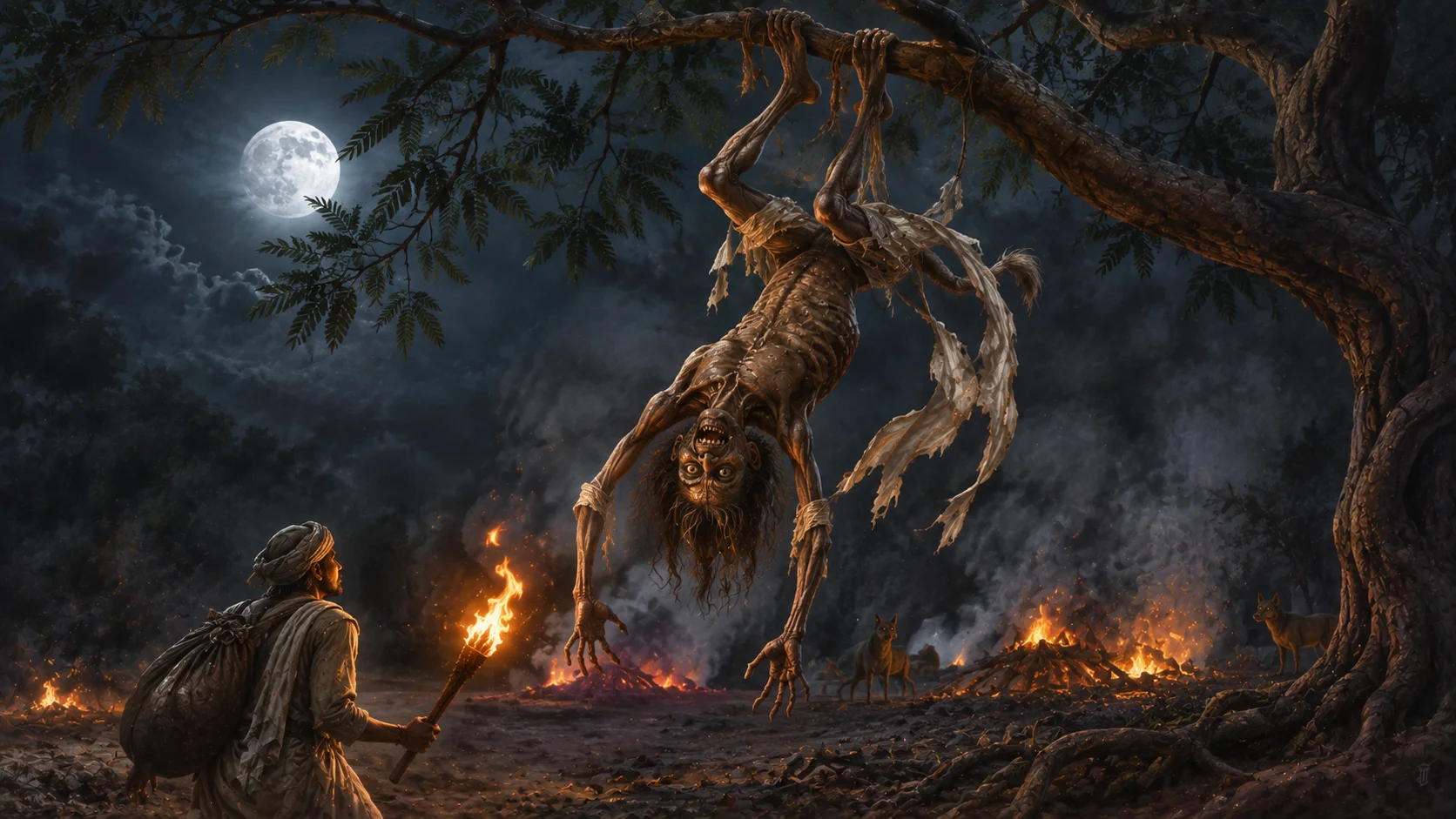
Vetala — Vetāla, anglicised Baital — is the corpse-haunting spirit of Hindu myth: a ghostly being that occupies and animates dead bodies, hanging upside-down from trees in cremation grounds, neither living nor truly dead. Caught between worlds, the vetala possesses uncanny knowledge of past, present, and future, and is best known as the riddling, story-telling specter of one of the most famous frame-tales in all of Indian literature.
The Animator of Corpses
A vetala is a spirit — sometimes a kind of bhuta — that enters and reanimates a corpse, using the dead body as a vehicle while remaining itself bodiless. Because it stands outside the cycle of life and death, suspended between the two, the vetala is unaffected by the laws of time: it can see all that has been and will be, knows the secrets of the living, and cannot be killed in the ordinary way. Vetalas haunt charnel grounds, hang inverted like bats from the branches of trees among the funeral pyres, and are mastered by tantric sorcerers (and by Shiva, lord of the cremation ground) who seek to compel their service and their knowledge.
The Vetala Panchavimshati
The vetala’s fame rests on the Vetala Panchavimshati — “the Twenty-Five Tales of the Vetala,” known in Hindi as Baital Pachisi and embedded in the great story-ocean of the Kathasaritsagara. In it, the noble King Vikramaditya (Vikrama) is bidden by a sorcerer to fetch a corpse hanging from a tree in a cremation ground — a corpse inhabited by a vetala. Each time the king cuts it down and carries it on his shoulder in silence, the vetala tells him a clever story ending in a subtle riddle of law, ethics, or human nature, and demands an answer — warning that if the king knows the answer and stays silent, his head will burst. Each time, the king cannot help but answer correctly — and the instant he speaks, the vetala and the corpse fly back to the tree, and the king must begin again. Twenty-four times this repeats; on the twenty-fifth the king is finally stumped, and the vetala, won over by the king’s persistence and wisdom, warns him that the sorcerer means to murder him and tells him how to turn the trap on its author. The frame is a masterpiece of the storytelling-within-storytelling that Indian literature gave the world.
The Riddle-Keeper of the Dead
The vetala is thus a uniquely intellectual monster — not a mere devourer but a keeper of paradoxes, a being whose horror is bound up with wisdom. Its tales pose genuine moral dilemmas (who is the rightful husband when a woman’s head and body are mistakenly rejoined to the wrong men? who is more honourable in a chain of sacrifices?) that have no easy answer, making the vetala a teacher disguised as a haunting. The figure passed into the wider world through Richard Burton’s Victorian rendering and into modern Indian comics, film, and the character of the jungle-hero “Betal.”
Between the Living and the Dead
The vetala endures as the embodiment of liminality — the spirit that is neither alive nor at rest, hanging upside-down in the smoke of the pyres, holding all knowledge precisely because it belongs to no world. To master a vetala is the dark ambition of the sorcerer; to outwit one, as Vikramaditya does, is the mark of the truly wise king. It remains one of Hindu myth’s most distinctive creations: the corpse that talks, and tells the truth.
Roots in a Lost Language
Before the vetala ever hung from a tree in a Sanskrit verse, it hung from one in a language almost nobody alive can read. The tale-cycle’s ultimate source is the Brihatkatha, “the Great Story,” attributed to Gunadhya and composed in Paishachi, a Prakrit dialect that has otherwise vanished from the record. The original does not survive. What survives are two Sanskrit retellings made in eleventh-century Kashmir: Kshemendra’s Brihatkathamanjari and, a little later, Somadeva’s Kathasaritsagara, written between roughly 1063 and 1081 for Suryavati, queen of King Ananta of Kashmir — a book of sorcerers and riddling corpses produced, in the first instance, to divert one woman at court. The vetala’s twenty-five tales sit in the twelfth book of that ocean. There is a neatness to this that the tales themselves would enjoy: a cycle about a corpse that refuses to stay where it is put has outlived the body of the work it came from.
The riddle-cycle also had a life of its own, outside any frame. Two further Sanskrit recensions circulated independently, attributed to Shivadasa and to Jambhaladatta, and it is Shivadasa’s version rather than Somadeva’s from which most modern translations ultimately descend. Audiences evidently wanted the twenty-five tales as a self-contained book, not as one current in a much larger sea of stories.
A King Borrowed by Every Storyteller
Vikramaditya is less a man than a role that Indian storytelling kept recasting. No single historical ruler matches the legendary emperor of Ujjain cleanly, and the name behaves like a magnet for wisdom-tales. The same figure anchors the Simhasana Dvatrimshika, “the Thirty-Two Tales of the Throne,” in which the eleventh-century king Bhoja unearths Vikramaditya’s lost throne and finds it supported by thirty-two statues — apsaras turned to stone by a curse. Each time Bhoja moves to sit, one of them wakes, tells a story of Vikramaditya’s generosity or courage, and asks whether he can match it.
Even the calendar attached itself to him after the fact. The era reckoned from 57 BCE is now called the Vikrama Samvat and remains in civil use in Nepal, yet its earliest inscriptions do not mention Vikramaditya at all: they call it the Krita era, or the era of the Malava tribe. The name Vikrama is fixed to it only centuries afterwards. The king of the vetala tales is therefore not a memory that faded into legend; he is a legend that kept acquiring history. That is precisely why any dilemma he settles carries the full weight of righteous kingship behind the answer.
What the Sorcerer Was Actually Doing
The frame story would not have struck its first audience as fantasy so much as reportage. Rites performed in the burning ground are attested across tantric literature, and vetala-siddhi, the attainment won by mastering such a spirit, is a named goal within them — alongside the better-documented shava-sadhana, in which the practitioner conducts the rite seated upon a corpse. The cremation ground at night was a recognised ritual location long before Somadeva wrote, and it was already a literary set-piece as well: Bhavabhuti’s eighth-century play Malatimadhava stages a burning-ground scene of exactly this kind, with a sorcerer at work among the pyres. Readers meeting the sorcerer of the vetala tales were not being introduced to an invented villain. They were being shown a practitioner of something their own century took entirely seriously. That is the distance between a monster story and this one: its audience knew of people who claimed to be attempting it.
The Corpse That Travelled
The riddle-frame proved unusually portable. It moved out of Sanskrit into the vernaculars — the Hindi Baital Pachisi is only the best known of them — and then out of Hindu literature altogether. Carried north into the Tibetan Buddhist textual world, the cycle became the Ro-sgrung, literally “corpse tales”; from there it passed into Mongolian as the Siditü kegür, the corpse endowed with magical power, and into Oirat as the Siddhi Kür. The machinery survived the journey intact: a hero must carry a knowing corpse and must not speak, the corpse tells a story precisely in order to make him speak, and the moment he does it is gone and the walk begins again. A device invented in a lost Prakrit epic was still running centuries later and a continent away, in a Buddhist idiom that shared none of its gods.
Cousins Among the Restless Dead
Hindu tradition is crowded with spirits that linger near the dead, and the vetala is easy to mistake for its neighbours until you ask what each of them wants.
- The pisacha is a flesh-eating demon of battlefields and burning grounds, driven by hunger. It has no riddles, only appetite.
- The preta, the hungry ghost, is a soul denied its proper funeral rites and held fast by a craving it can never satisfy.
- The churel, born of a woman who dies in pregnancy or childbirth, is driven by grievance, and turns it most often on the men of her own family.
Each of these is a thing to be placated, exorcised, or avoided, and each arrives uninvited. The vetala alone is something people deliberately go out and find — sought by sorcerers for what it knows, and by kings for the chance to be measured against it. The others are problems. The vetala is an opportunity, which is why it is the only one of them with a literature.
From Doordarshan to Netflix
The frame story never dropped out of Indian popular culture long enough to need reviving. Ramanand Sagar’s Vikram Aur Betaal — twenty-six episodes broadcast on Doordarshan from October 1985, and re-telecast in 1988 on the strength of his Ramayan — put the king-and-corpse riddles in front of a national audience that had never opened the Kathasaritsagara, and it is the version most viewers of that generation still carry in their heads. The name has since outlasted the plot: the 2020 Netflix series Betaal borrowed the word for a horror story about an undead East India Company officer and his battalion of redcoats, keeping the reanimated dead and discarding the riddles entirely. Nothing of the twenty-five tales remains in it. That the name alone can still do the work — that “betaal” can be set on a poster and be understood — is the clearest measure of how far the corpse has travelled from the tree it was cut down from.
Sources & traditions
- EncyclopediaWikipedia — Vetala
- TraditionHindu texts, oral tradition and village tellings (South Asia)
Myths change from area to area and from time to time. This chronicle follows the most widely told versions; tellings in other villages, regions and eras may differ.