Yakshini — Yakṣiṇī, also Yakshi — is the female yaksha: the nature-spirit and tree-goddess of Hindu, Buddhist, and Jain tradition, at once a benevolent fertility-genius and a dangerous, seductive demoness. Beautiful, voluptuous, and intimately bound to trees and the fecund earth, the yakshini is one of the most ancient and enduring feminine spirit-figures of the subcontinent — worshipped for boons, dreaded as a man-luring vampire, and sculpted on temple walls as the very emblem of life’s abundance.
The Tree-Goddess of Abundance
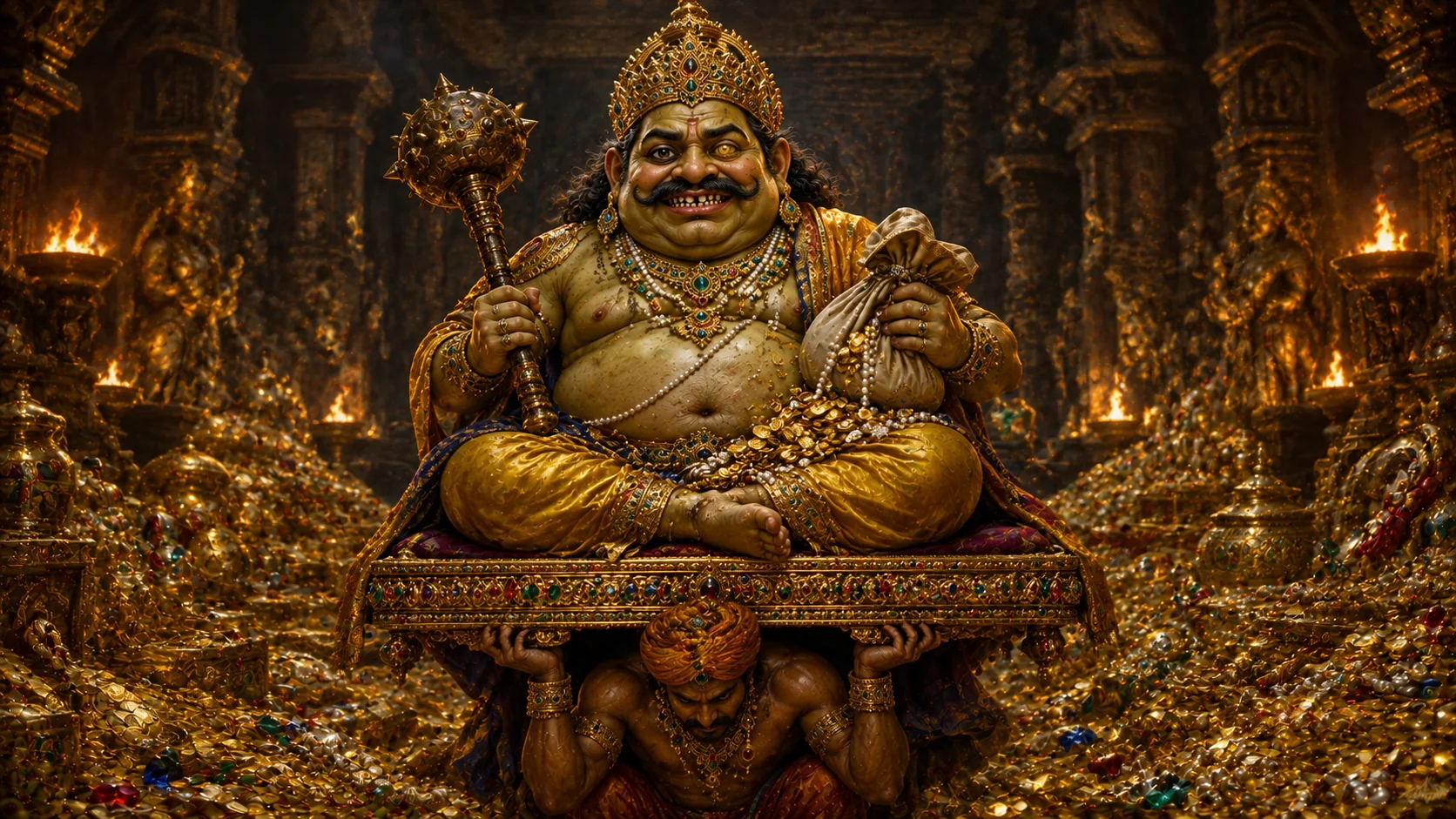
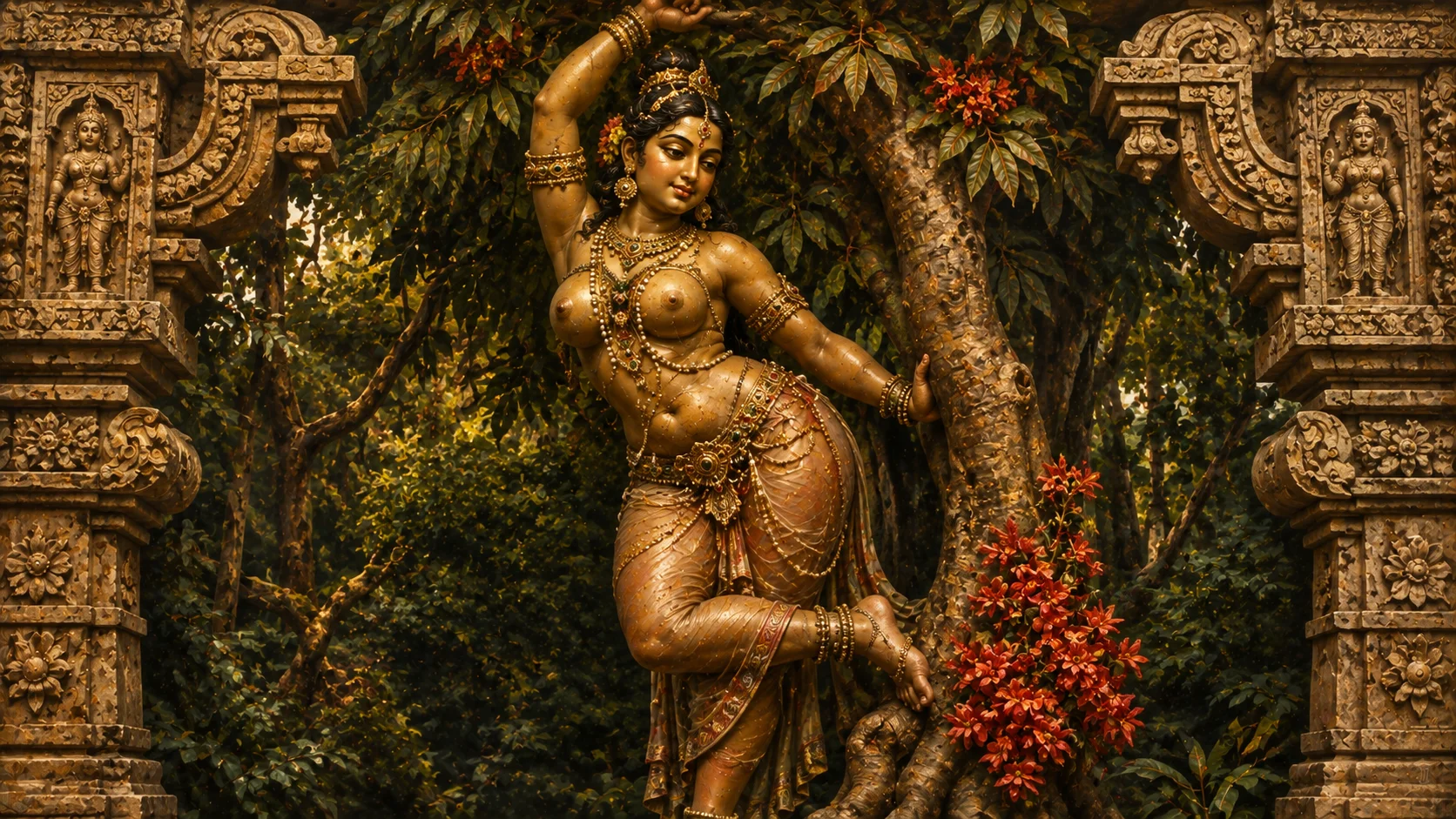
In her benevolent aspect the yakshini is a spirit of fertility, growth, and prosperity. The shalabhanjika — the sculpted maiden grasping the branch of a flowering sal or ashoka tree, her touch causing it to blossom — is a yakshini, and one of the most beloved motifs of Indian art, adorning the great Buddhist gateways of Sanchi and Bharhut and countless temple brackets. She represents the auspicious union of woman and tree, the life-giving sap of the world. As attendants of Kubera the yakshinis, like their male counterparts, guard hidden treasure and grant wealth; tantric texts list thirty-six (or sixty-four) named yakshinis whose worship can win a devotee riches, beauty, or a celestial lover.
The Seductress in the Tree
But the yakshini has a darker, far more famous face in folklore — especially in Kerala and the south, where she is a feared night-spirit. In this aspect she haunts solitary trees (the palmyra and the pala/devil-tree above all), appearing as a ravishingly beautiful woman who lures lone male travellers with her perfume and her request for betel-leaf or lime, then drains their blood and devours them, leaving only hair, nails, and bones beneath her tree by morning. The Keralan Yakshi of legend is a vampire-temptress, the spirit (often) of a woman who died unfulfilled or by violence, and tales of her victims are a staple of South Indian ghost-lore. She can be bound and pacified by a sufficiently powerful sorcerer or by nailing her to her tree with an iron spike.
The Jain and Buddhist Guardian
In Jainism the yakshinis are elevated to dignified guardian-deities: each of the twenty-four Tirthankaras has an attendant yakshini (such as Ambika, Chakreshvari, and Padmavati) who protects the faith and the faithful, and these are objects of serious devotion. In Buddhism too the yakshini appears as both protector and peril. Across all three traditions she keeps her essential doubleness — the spirit who can bestow a child, a fortune, or a lover, and the spirit who can lure a man to a bloody death.
The Eternal Double Nature
The yakshini endures because she holds two truths in one body: the generative power of nature is also its devouring power; the beauty that gives life is the beauty that takes it. Sculpted as the blossoming tree-maiden and whispered of as the blood-drinking spirit of the lonely palmyra, she is fertility and death entwined — the feminine face of the wild, sacred, perilous earth that the yakshas guard.
Before the Temples: How Old Her Worship Really Is
Long before a single stone temple rose to Vishnu or Shiva, India was already carving her. In 1917, at Didarganj on the bank of the Ganges near Patna, a life-size sandstone woman was dug out of the riverbank, her surface finished with the near-mirror gloss that marks the finest Mauryan workmanship — heavy-breasted, wide-hipped, a fly-whisk raised over her shoulder. She is traditionally dated to the Mauryan period, around the third century BCE, though some art historians have argued for a date several centuries later; either way she is held in Patna today as one of the great treasures of early Indian sculpture. Whether she was carved as a yakshini proper or as a royal attendant is still argued, but her form — the ample body, the frank sensuality, the stillness of someone standing guard — is the template sculptors would use for the yakshini for the next thousand years. The category is older still: the word yakṣa appears already in the Atharvaveda, where it names something closer to a mysterious presence or a wondrous thing than the tree-spirit of later art, and the beings it came to denote were attached to particular trees, pools and stretches of wilderness rather than to any temple. That older, animistic layer of belief was never replaced by the arrival of Brahmanical, Buddhist and Jain religion. It was absorbed into all three, and the yakshini’s cult is one of its clearest fossils: the worship of a local, embodied nature-spirit surviving intact inside three religions built on far more abstract theology.
Hariti: The Devourer the Lord Buddha Chose Not to Kill
Of all the individually named yakshinis, none has a stranger or more influential story than Hariti. Buddhist tradition remembers her as a yakshini of Rajagriha — modern Rajgir — who had five hundred children of her own and fed them by stealing and devouring the children of the city’s human mothers. The grieving parents appealed to the Lord Buddha, who did not strike her down. Instead he hid her youngest and best-loved son, Priyankara, and let her search for him in a panic that mirrored exactly what she had inflicted on a thousand other mothers. When she finally came to him for help, he asked her to weigh the grief of losing one child out of five hundred against the grief of parents left with none. She converted on the spot, vowed never to harm a child again, and was promised that she and her children would be fed by the monastic community instead. Hariti did not fade into a cautionary tale — she was promoted. Gandharan sculpture shows her enthroned with a child on her lap, worshipped as a protector of children and of safe childbirth, usually paired with the yaksha general Panchika as her consort. As Buddhism travelled east her cult travelled with it: she is venerated in Japan as Kishimojin and in China as Guizimu, the “mother of demon children,” and in that East Asian iconography she holds a pomegranate, understood by later tradition as the substitute she accepted for human flesh. Few figures in the whole yaksha family show the type’s doubleness so plainly: the same being, worshipped first out of terror and afterwards out of gratitude, without ever ceasing to be what she was.
Kuveni: The Yakkhini at the Founding of a Kingdom
Sri Lanka’s own foundation legend, preserved in the Mahavamsa, opens with a yakkhini. When the exiled prince Vijaya lands on the island with his followers, the first figure he meets is Kuveni, seated beneath a tree in the guise of an ascetic woman, quietly spinning — and in truth a ruler among the island’s yakkhas. She has already made his companions disappear, and only when he overpowers her and threatens her life does she give them back. Kuveni then chooses accommodation over war: she helps Vijaya destroy the yakkha stronghold, becomes his consort, and bears him a son and a daughter. The ending is the part Sri Lankan tradition has never softened. Once Vijaya needs a queen of acceptable royal blood, he sends to the Pandya country for a princess and casts Kuveni out with her children; her own kin, who count her a traitor for having helped the newcomer at all, turn on her and kill her. The children flee into the hill country, and the chronicle traces from them the island’s forest-dwelling people — a line that tradition identifies with the Vedda, who hold their own identity and customs to this day. Whatever lies beneath the legend historically, its shape is unmistakable: a native yakkhini’s knowledge and power make the newcomer’s kingdom possible, and the founding myth of that kingdom is also the story of her betrayal.
The Grammar of the Pose
The tree-maiden is not only a motif but a whole visual grammar, and once it is learned she is unmistakable wherever she appears. She stands in tribhanga, the “thrice-bent” posture that breaks the body at neck, waist and knee, and which Indian art would use for centuries afterwards to signal living, fertile grace. Her ankle is often hooked around the trunk, her weight thrown into the branch she grips. She wears the jewellery of abundance rather than austerity: heavy anklets, layered girdles low on wide hips, armlets, a fullness of body meant to read as ripeness rather than mere prettiness. And her placement is deliberate. On the gateways at Sanchi, on the railing pillars of Bharhut and of Mathura, she stands at thresholds — at the precise point where ordinary ground becomes sacred ground, which is exactly where a spirit of fertility and protection belongs. Centuries later, when Hindu temple architecture developed its own guardians for the doorway, the river-goddesses Ganga and Yamuna took up that post in the same tribhanga, with the same womanly abundance, at the same threshold. The yakshini’s iconographic grammar outlived the yakshini’s name.
The Yakshi on the Screen
The Keralan Yakshi never left popular culture; she changed medium. Malayalam literature and cinema returned to her across the twentieth century, and one novel in particular shaped how modern audiences meet her: Malayattoor Ramakrishnan’s Yakshi, published in the 1960s and filmed soon afterwards, in which a disfigured man’s conviction that his wife is not human is left genuinely unresolved between psychological collapse and the old legend made flesh. That refusal to settle the question became the template for a run of Malayalam horror built on the same premise — a beautiful stranger whose true nature neither the protagonist nor the audience can confirm until it is too late. The seductress of the palmyra and the woman in the film frame are doing identical cultural work: dramatising the terror of a desire that turns out to be predatory, dressed in whatever medium a given generation trusts to frighten it.
What the Betrayal Stories Are Really About
Set Hariti and Kuveni side by side and a pattern appears that the tree-maiden alone never shows: the yakshini’s story is, again and again, about what happens when her power is put to someone else’s use and then no longer needed. Hariti is turned into a protector once she submits to a higher authority; Kuveni wins a kingdom for a man who discards her the moment a socially acceptable queen becomes available. The seductress met on the road at night works the same anxiety from the other end — a female power unattached to household or lineage is close to the most dangerous thing this tradition can picture. Her abundance was always double-edged, and not only in the obvious way: the untamed fertility that grants a devotee wealth or a child is the same untamed independence that a patriarchal order must domesticate, marry off, or destroy. She has survived millennia of retelling not because she is a monster, but because every age finds a fresh reason to be uneasy about a powerful woman who answers to no household.
Sources & traditions
- EncyclopediaWikipedia — Yakshini
- TraditionHindu texts, oral tradition and village tellings (South Asia)
Myths change from area to area and from time to time. This chronicle follows the most widely told versions; tellings in other villages, regions and eras may differ.