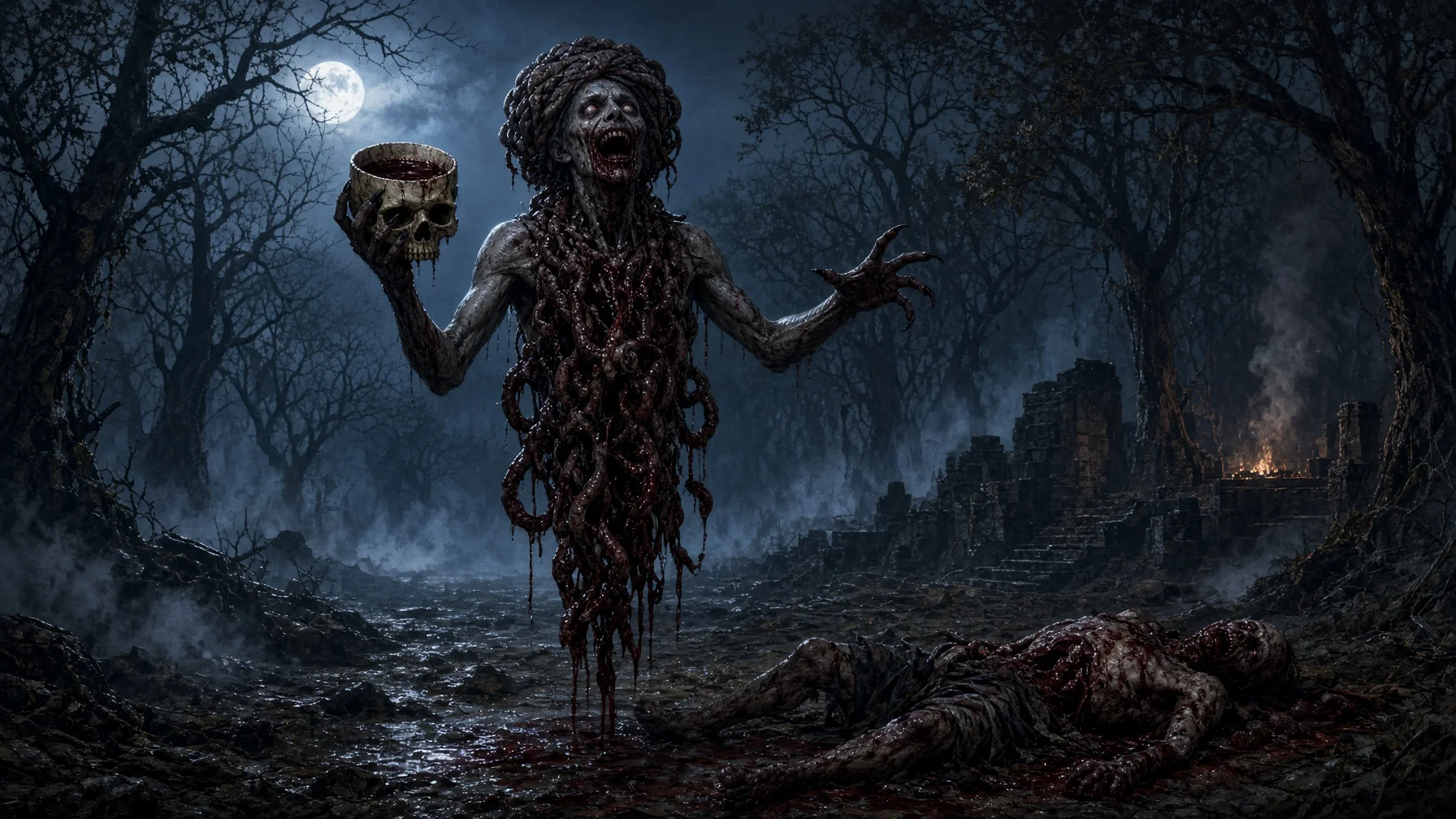
Brahmaparusha — sometimes rendered Brahmaparush or Brahmapurusha, a variation in spelling that itself signals how this figure has traveled mainly through regional and compiled sources rather than a single fixed text — is counted among the most gruesome of the rakshasas in Hindu demonology: a savage, blood-drinking demon-ghoul of the cremation ground, a devourer of human beings who wears its victims' entrails and drinks their blood from a skull. It is described in the lore of north India, where the demonological catalogues that preserve it were compiled, and that regional anchor matters for the same reason the spelling variation does — this is a figure known through localized tradition and compendium rather than a pan-Indian scriptural fixture. It belongs to the dark company of the pishachas, bhutas, and vetalas — the carrion-spirits of the charnel ground — and is reckoned one of the most ferocious among them. Unlike the great named rakshasas of epic narrative, Brahmaparusha does not stride through the Ramayana or the Mahabharata as a speaking antagonist with a court, a lineage, or a war to lose. It survives instead in the demonological catalogues — the compendia that Hindu tradition kept alongside its epics to enumerate the ranks of night-wandering horrors — and that placement should be read plainly: this is a minor or regional type, attested with far less textual weight than Ravana, Kumbhakarna, or Hidimba, and its details should be handled as catalogue-lore rather than scripture.
A Ghoul Assembled From Death Itself
Where many demons are described by what they do, Brahmaparusha is described by what it wears. The Puranic-derived tradition dresses it in the wreckage of its own killing: a garland of skulls and entrails looped about its neck, human intestines draped over its body like a stole, and a kapala — a skull cut into a drinking bowl — raised to its mouth to take blood straight from the dead. It is a figure built entirely out of the aftermath of violence, as though the demon does not merely kill but curates the remains into an ongoing costume. Nothing about this decoration is incidental. In Hindu iconography a garland of skulls and a skull-cup are recognizable motifs, most famously associated with the fierce, tantric aspects of the divine — forms linked to Kali or to Bhairava, the terrifying manifestation of Lord Shiva. Brahmaparusha borrows that visual vocabulary without belonging to it. It is not a deity wearing symbols of transcendence over death; it is a demon wearing the literal wreckage of the deaths it has caused. The resemblance is a warning as much as a description — a lesser, malevolent double of imagery that in divine hands means mastery over death, and in this rakshasa's hands means only appetite.
The Skin It Does Not Own
Beyond the general repertoire of the flesh-eating dead, the demonological catalogues attach one distinctive motif to Brahmaparusha specifically: having devoured a victim's flesh and drunk their blood, it is said to take the skin of the dead and wear it as a garment. This is not a generic embellishment borrowed from the wider rakshasa type — it is the detail by which Brahmaparusha is remembered as a specific figure rather than an interchangeable ghoul. Where the entrail-garland and the skull-cup place it within a shared iconographic family of fierce and tantric imagery, the skin-wearing motif stands alone: an act of impersonation as much as predation, the demon literally clothing itself in what was once a living human. It is worth being honest about the sourcing here — this motif, like the rest of Brahmaparusha's profile, is attested mainly in secondary demonological compendia rather than a single fixed Sanskrit verse, and no primary text should be assumed to spell it out in those exact words. But within that lower-confidence tradition, it is the detail that gives the figure its edge.
Guarding the Threshold: Iron, Fire, and Mantra
Because Brahmaparusha is remembered as a hunter of the freshly dead and dying rather than merely a scavenger of the already-buried, the same tradition that describes its appetite also describes the household defenses raised against it. The living — especially the dying, the newly dead, and women in childbirth — must be guarded against exactly this kind of predation, since these are the moments the tradition treats as most porous, when the boundary between the living body and the corpse-eating dark is thinnest. The protective repertoire recorded alongside such rakshasa-lore is practical and elemental rather than exotic: cold iron laid near the vulnerable body, a fire kept burning through the night to hold the dark at bay, and mantras recited as a verbal ward where physical barriers cannot reach. Worship of Lord Shiva in his aspect as lord of the burning-grounds belongs to this same defensive register — an appeal to the deity who already presides over the cremation ground and its dangers, invoked precisely because a being like Brahmaparusha claims that same territory. None of this describes a rite performed for Brahmaparusha or to it; it describes the vigilance kept against it, the ordinary countermeasures a household used when death, birth, or the space between them left someone exposed.
Kin Among the Rakshasas, by Class Alone
As a rakshasa, Brahmaparusha belongs to the same broad demon-class as figures as prominent as Ravana, Kumbhakarna, Hidimba, and Putana — beings who share an origin in Hindu cosmology as opponents of dharma, of the sages, and of the Vedic sacrifice. That shared classification is real and worth stating plainly: it places Brahmaparusha inside a recognizable lineage of adversarial beings rather than treating it as a freestanding invention. What is not attested, and should not be implied, is any specific kinship myth naming Brahmaparusha alongside those figures — no genealogy, no court appointment under a rakshasa king, no direct encounter with a named hero. The connection is taxonomic, not narrative: a shared shelf in the catalogue of demons, not a shared story.
Disruption of the Sacred Rite
Rakshasas as a class are remembered above all for their opposition to Vedic ritual — the disruption of the yajna, the sacrifice that bound gods, sages, and the ordered cosmos together. Brahmaparusha inherits that role by classification even where no specific episode names it doing so. A being defined by blood, corpse-flesh, and the wearing of the dead is, by its very nature, the negation of everything a purifying sacrifice was meant to accomplish. Where the yajna sanctifies through fire and correct utterance, Brahmaparusha's whole existence is an argument for the opposite condition: unpurified death, appetite instead of offering, the corpse instead of the oblation. It need not be shown storming a specific rite for that opposition to be legible — it is written into what the figure is.
The Weight Carried in Its Name
The name itself invites a reading, though it should be held as informed inference rather than settled fact. "Brahma" may point toward the Brahminical, priestly sphere — or toward the god Brahma himself — while "parusha" is a Sanskrit term meaning harsh or cruel. Read together, the name plausibly signals a being defined against priestly purity: a violence that stands in the place sanctity should occupy, a cruelty wearing the vocabulary of the sacred. This reading is strengthened by the visual logic of the figure — the intestine-garland where a Brahmin would wear the sacred thread, the skull-cup where a priest would hold a ritual vessel. The demon's whole appearance can be read as a corrupted mirror of Brahminical dress and function. None of this is stated outright in a single canonical gloss; it is an interpretive thread running through the iconography and the name alike, offered as illumination rather than proof.
A Haunter of the Burning Ground
Rakshasas in general are described as nishachara — night-wandering — creatures at home in cremation grounds, forests, and the liminal spaces between the ordered world and the wild. Brahmaparusha's associations with blood and corpses place it squarely within that cosmological role: a being that does not merely tolerate the burning ground but belongs to it, drawn to exactly the places where death is freshest and the boundary between the living and the dead is thinnest. This is consistent with the wider architecture of Hindu demonology, in which the crematorium functions as both a literal geography and a symbolic threshold — the place where impurity concentrates, and where beings like Brahmaparusha are most at home precisely because everywhere else regards them as intrusions.
A Figure of the Compendium, Not the Stage
It matters how Brahmaparusha survived into the present. Classical dramatic tradition, devotional literature, and folk performance — the channels that kept Ravana, Hidimba, and Putana vivid across centuries of retelling — did not carry this figure forward in the same way. Brahmaparusha appears chiefly in modern encyclopedic and demonological compendia: bestiary-style references cataloguing the population of Hindu myth's darker corners rather than works of devotion or drama built around this specific being. That transmission history should shape how the figure is read. It is not that Brahmaparusha is fictional in some special sense that other rakshasas are not — all of them are figures of belief and story rather than historical record — but that its textual footing is comparatively thin, its details compiled rather than performed, and its fixed points fewer than those of the rakshasas who became household names.
What the Catalogue Cannot Confirm
Honesty about that transmission also means being honest about what remains uncertain. There is no single, universally cited Puranic verse that establishes Brahmaparusha as a fixed, stable figure the way there is for the epic rakshasas — no anchor text against which every later account can be checked. The garland of skulls, the skin-wearing, the skull-cup: each is attested mainly through secondary demonological catalogues, not through one primary Sanskrit source that a reader could point to as the figure's origin. This does not make Brahmaparusha a lesser subject of study, only a different kind of one — a figure best approached as a type circulating through compilation and cross-reference rather than as a character with a single authoritative telling.
Kin to the Vetala and the Pishacha, Distinguished by Violence
Within the broader company of the cremation ground's carrion-spirits, Brahmaparusha keeps particular company. The pishacha is remembered as a gibbering, corpse-feeding scavenger; the vetala, a spirit that inhabits and animates the dead rather than actively hunting the living. Brahmaparusha's place among them is defined by the same trait that runs through every detail above it: it is not a passive presence in the burning ground but an active, blood-drinking predator, marked out by trophies rather than mere proximity to the dead. That distinction — hunter among scavengers — is part of what the entrail-garland and skull-cup communicate at a glance: this is a rakshasa that killed for what it wears, not one that merely lingered where killing had already happened. It is precisely this active, threshold-hunting character — a predator drawn to the newly dead and to the vulnerable living beside them — that the iron, fire, and mantra defenses described above were kept to answer.
The Shape of a Corrupted Purity
Taken together, Brahmaparusha's attributes cohere around a single symbolic center: ritual pollution, and the horror of a death that Hindu cosmology regarded as improperly met. Its skull-cup and intestine-garland do not simply signal savagery in a general sense — they specifically invert the vocabulary of Vedic and Brahminical purity, dressing violence in the visual language of the sacred. Where sanctity in Hindu tradition is repeatedly marked by fire, the sacred thread, and correct ritual vessel, Brahmaparusha is marked by their grim opposites: the corpse's own remains repurposed as regalia. It stands as one expression, among the many the tradition produced, of the fear that death handled wrongly — unburned, unmourned, ritually incomplete — does not simply end but turns hungry, and reaches back toward the living wearing the shape of what it has already destroyed.
Sources & traditions
- TraditionHindu texts, oral tradition and village tellings (South Asia)
Myths change from area to area and from time to time. This chronicle follows the most widely told versions; tellings in other villages, regions and eras may differ.