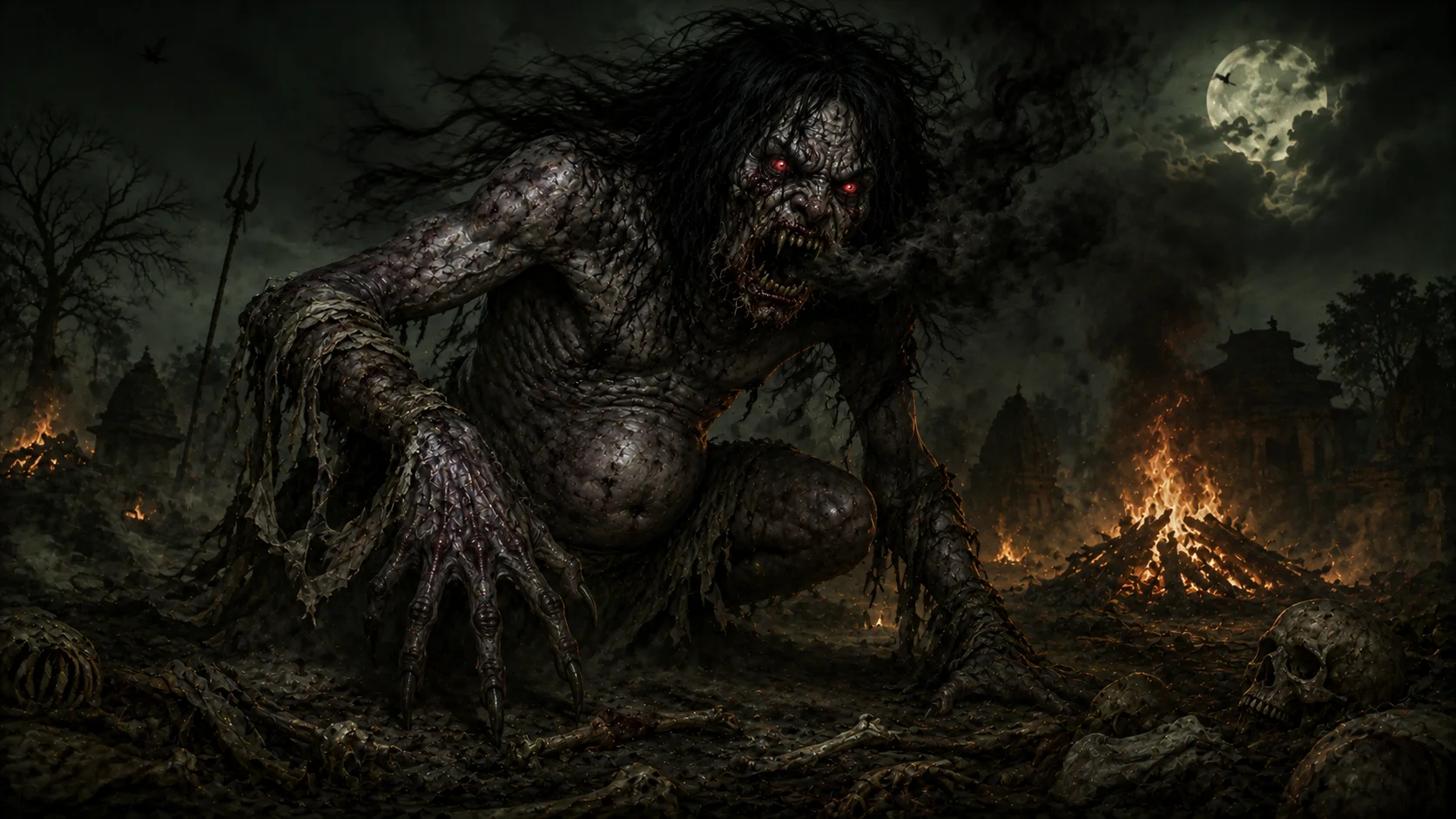
Pishacha — Piśāca — is the lowest and most repulsive class of Hindu flesh-eating spirit: the ghoul of the cremation ground, the corpse-eater, the carrion-demon that haunts charnel houses, crossroads, and battlefields where the dead lie unburned. If the rakshasa is the lordly man-eater and the vetala the corpse-animating ghost, the pishacha is the gibbering, gluttonous bottom of the demonic hierarchy — degraded, half-mad, and feared for the diseases and madness it spreads.
Origin and Lineage
The Puranas trace the pishachas, like the yakshas and rakshasas, to the daughters of Daksha wed to the sage Kashyapa — the pishachas born of Pishacha or of Krodhavasha, “the brood of anger.” Another tradition makes them creatures Brahma fashioned when, in a fit of distraction, beings of darkness slipped out of him. They are often listed in the great triad of malign night-spirits — rakshasa, pishacha, bhuta — that the living must be guarded against, especially the newly dead, the sick, and women in childbirth.
Nature and Menace
Pishachas are described as dark, emaciated, veined with protruding blood-vessels, with bulging red eyes and a hunger that is never sated. They feed on human flesh and on the vital energy of the living. Their special menace is intrusion: a pishacha can enter a body through food, through wounds, or through a moment of ritual impurity, causing wasting sickness, fits, fever, and insanity — many traditional explanations of madness and possession name the pishacha as cause. They are creatures of impure places and impure times; cleanliness, fire, mantras, and the worship of Shiva (lord of the cremation ground who masters such beings) are the classical defences.
The Pishacha Tongue
Curiously, the pishachas left a mark on the history of language: an entire family of ancient Prakrit dialects of the northwest was called Paishachi, “the speech of the pishachas,” reputedly the language in which the lost Brihatkatha — the vast story-collection that seeded the Kathasaritsagara and a thousand Indian tales — was first composed. That a literature of demons’ tongue should be the fountainhead of so much storytelling is one of the stranger ironies of Indian letters.
The Lowest Rung
In the moral and cosmic ladder of Hindu beings, the pishacha marks the floor: a soul so consumed by gluttony, cruelty, or unclean death that it has fallen below even the rakshasa into mindless hunger. To be reborn as a pishacha was a fate threatened for the gravest sins, especially the theft of food, the breaking of vows, and violence against the helpless. Yet like all such beings it could, in the long turning of karma, eventually be released — for in Hindu thought even the corpse-eater is a soul on its long road home.
The Oldest Layer of the Fear
The Rigveda has a thousand hymns and an opinion about almost everything under the sun, and it mentions the pishacha exactly once — a single line asking Indra to crush the piśāca to nothing. Then silence. The Atharvaveda is a different world altogether. That collection of charms, cures and counter-curses preserves the religion of the household rather than the religion of the fire-altar, and there the pishachas are everywhere: named in the same breath as the rakṣas, driven off with herbs and smoke and formulae, blamed for the fever in the hut and for whatever is eating the child from the inside. The pattern is worth pausing on, because it repeats across the world’s mythologies. The literature of gods and kings barely registers the ghoul. The literature of frightened people in the dark is full of it.
Even the name refuses to sit still. Piśāca is most often connected to piśita — cut flesh, raw meat — not the cooked portion offered to a god but the wet red thing itself. Whether that is the true derivation or a later rationalisation by people who already knew what a pishacha did, it records exactly how Sanskrit speakers heard the word. Not spirit. Not demon. Eater.
What the Physicians Made of It
Classical Indian medicine did not file the pishacha under folklore. It filed it under diagnosis. Ayurveda organises itself into eight limbs, and one of them — bhūtavidyā, the knowledge of beings — is given over entirely to disorders whose cause is held to be another creature inside the patient. A physician trained in it was expected to do something a modern one is not: to determine which kind of being had taken hold.
The great medical compendia describe some eight classes of graha — “seizers,” from the root meaning to grasp — among them gods, ancestors, gandharvas, yakshas, rakshasas and pishachas, each producing its own recognisable pattern of behaviour in the person seized. A patient taken by a god is radiant and sleepless, speaks in an elevated register, dispenses blessings. A patient taken by a pishacha is the exact inversion: filthy, restless, wandering, weeping without cause, tearing at clothing, eating whatever comes to hand or refusing food altogether, drawn to solitude and to unclean ground. The texts are candid that this is among the worst of the seizures and the hardest to shift. Treatment was correspondingly aggressive — fumigations, medicated oils, restraint where restraint was needed, recitation, and an offering laid out for the seizer at a crossroads to tempt it out of the patient with something it wanted more.
What is striking, read now, is how much of it is observation. Strip away the aetiology and the descriptions gathered under unmāda — the classical category covering what a modern clinic would scatter across psychosis, mania and catatonia — are careful, specific and immediately recognisable. The pishacha was not an excuse to stop looking at the patient. It was the name for what the physician was looking at.
The Pishacha as a Minor God
Step across the boundary into Jain cosmology and the corpse-eater is promoted. Jain thought sorts the lower divinities into the vyantara, the “in-between” or peripheral gods, who live not in high heavens but in earth and trees and caves and the interstices of the ordinary world — and the eight classes of vyantara include the yakshas, the rakshasas, the bhutas and the pishachas side by side. In that scheme a pishacha is not a fallen thing at all. It is a birth: long-lived, powerful, capable of great mischief and great generosity, and not one step closer to liberation than a human being is. That is the sting in it, because for a Jain, godhood is a comfortable dead end.
Buddhist tradition carries the pishacha along too, counting it among the classes of non-human beings that share the road with monks and travellers; Tibetan translators rendered the word bluntly as sha za, “flesh-eater.” The Buddhist answer to it is characteristic. Not a weapon, not a purification, but a recitation — protective verses whose force lies in what they say rather than in the ritual purity of whoever is saying them.
Bhūta, Preta, Piśāca, Vetāla
South Asian tradition is often accused of having too many ghosts. In truth it has one funeral, and several ways for that funeral to fail.
A Hindu death rite is a manufacturing process. Over a fixed sequence of days the survivors take a corpse and, by fire and food and formula, convert the dead person into a pitṛ — an ancestor, a settled being with a place in the family, who receives offerings and returns protection. Until that work is complete the dead person is a preta: literally “departed,” a being in transit, hungry, without a body to eat with, wholly dependent on the living to finish what they began. That is the ordinary case, and it resolves. The other categories are what happens when it does not. A bhūta is the generic ghost, the one that simply stays. A vetāla is a spirit that enters a corpse from outside and walks it about — a dead body driven by something that was never its occupant. And a pishacha is the endpoint: appetite that has outlived not merely the body but the person, gone to live in the one place where flesh is reliably to be found.
Understood that way, these are not four monsters. They are four failure modes of a single social machine, and every one of them is an argument for performing the rites properly and on time.
Were the Piśācas a People?
The epics complicate matters by putting the Pishachas on the map. The Mahabharata’s long catalogues of the peoples of the subcontinent list them not as spirits but as a tribe of the far north-west, in company with the Darads, the Kambojas and other mountain nations at the edge of the Sanskrit world — the same frontier that gave Paiśācī its name. Colonial-era philology pushed the identification much further: George Grierson, in a study published in 1906, labelled the entire Dardic group of the Hindu Kush and the upper Indus the “Piśāca languages.” The label has since been abandoned, and rightly: Kashmiri, Shina, Khowar and their relatives are living languages with nothing demonic about them.
Whether there was ever a people who called themselves Pishacha is unsettled, and probably unsettleable. What is not in doubt is the mechanism. Mountain neighbours who spoke unintelligibly, ate what others would not, and disposed of their dead by unfamiliar means were prime candidates for the oldest slander in the human repertoire: they eat the dead. Nearly every culture on earth has aimed that accusation at whoever lived one valley beyond the last village it recognised.
The Burning Ground
The Mahabharata does not leave the aftermath of its battles to the imagination. When the fighting stops at Kurukshetra the poem lingers on what comes out to feed: jackals and crows first, then rakshasas and pishachas exulting among the fallen, drinking, dancing, glutted. It is one of the most honest passages in the epic. A pre-modern battlefield really did become, within hours, a landscape of carrion animals and unburnt corpses, and whoever first described pishachas was describing something that had been smelled.
The cremation ground works the same way. It was never an abstraction but a specific, visible piece of land at the edge of every settlement, usually beside water: pyres in various states of completion, ash, bone that would not burn, and the dogs and jackals that live wherever such things are left. A creature answering the pishacha’s description needed no inventing by anyone who had walked past such a place at dusk. It only needed noticing.
Shiva’s lordship over that ground is the obvious next move, and the interesting part is what it implies. The god who wears its ash does not merely master such creatures — he keeps them on staff, in a retinue of gaṇas, goblin attendants of exactly this stamp. In stone, the fierce goddesses of the same territory, above all the emaciated Chāmuṇḍā seated on a corpse, are shown ringed by little starved ghouls. Tantric traditions then push the logic further than most religions dare to go: the most polluted place is the place of greatest power, and an ascetic who can sit through a night in a cremation ground without flinching has cut the cord between purity and fear. Ascetics still sit there. For them the pishacha is not a threat but a neighbour.
Feeding What You Cannot Fight
The everyday defence was never exorcism. It was hospitality.
Among the classical householder’s daily obligations is the bhūta-yajña, the offering to beings: a small portion of the family’s own food set down outside the house, at the threshold or in the yard, for the creatures that have no share in the proper sacrifice and no way of asking. It is addressed to bhūtas in the broad sense — the unhoused and unfed, the family of beings to which the pishacha belongs. The theology behind it is unsentimental and rather generous: these things are hungry, hunger is what makes them dangerous, and a household that feeds them every evening is a household with less to fear. The same reasoning governs the offerings left at crossroads and boundary stones, at the points where a settlement stops being itself.
Where appeasement fails, a protector’s name is invoked. The line most South Asians know by heart comes from the Hanuman Chalisa, traditionally ascribed to Tulsidas and recited daily by millions of people: bhūt piśāch nikaṭ nahiṃ āvai — ghosts and pishachas do not come near — Mahābīr jab nām sunāvai, when the name of Hanuman is spoken. That one couplet has almost certainly done more to keep the pishacha alive in common memory than every Purana combined. It is a piece of demonology recited every morning by people who would never dream of calling it that.
Nor has the traffic in possession stopped. At Mehandipur in Rajasthan the temple of Balaji — Hanuman under a local name — receives a continuous stream of families seeking relief for relatives held, as they understand it, by bhūt-pret, and what happens there is the living continuation of what the Sanskrit medical texts set down in prose. Whatever one concludes about the cause, the institution is real, the distress is real, and the tradition treats it as something that can be treated.
The Word That Outlived the Creature
The pishacha survives most robustly as vocabulary. In Hindi piśāch remains a serviceable insult for someone monstrous in appetite or cruelty; Bengali piśāc does the same work; and in Tamil the borrowed pisāsu has widened into the ordinary everyday word for a ghost or devil of any kind — which is how a Tamil film could take the name Pisaasu and hand it to a gentle, grieving spirit, the ghoul turned neatly inside out. Elsewhere it persists as a catalogue entry: Japanese demon-collecting games keep a Pisaca on their rosters, Hindi television has built serials around a pishachini, and most fantasy bestiaries that raid Sanskrit for names help themselves to this one, generally without noticing that it already had a job in a medical textbook.
Why the Corpse-Eater Will Not Die
Set the pishacha beside its betters and the reason becomes obvious. A rakshasa has a kingdom, a lineage, a grievance and a plan; you can fight one, bargain with one, marry one, and in more than one story you can redeem one. A vetala, in the famous cycle where a king carries it on his back through the night, tells riddles and is arguably the better conversationalist of the two. The pishacha has none of this. No politics, no pride, no name worth learning, and nothing it wants beyond the next mouthful.
That is the entire horror, and it is a specifically human one. The pishacha is the picture of a person with the person taken out and the appetite left running — which is what famine looks like, and what late disease looks like, and what a mind coming apart looks like from the outside, to a family who love the body in front of them and can no longer find anybody inside it. Three of the oldest terrors available to our species, given one shape and one address.
And the address is the argument. The pishacha lives at the burning ground not merely because that is where the bodies are, but because that is the one place where the difference between a person and a piece of meat is settled in public, over a fire, in front of everyone who loved them. The rites exist to make that difference hold. The pishacha is what waits at the edge of the firelight to see whether it will.
Sources & traditions
- EncyclopediaWikipedia — Pishacha
- TraditionHindu texts, oral tradition and village tellings (South Asia)
Myths change from area to area and from time to time. This chronicle follows the most widely told versions; tellings in other villages, regions and eras may differ.