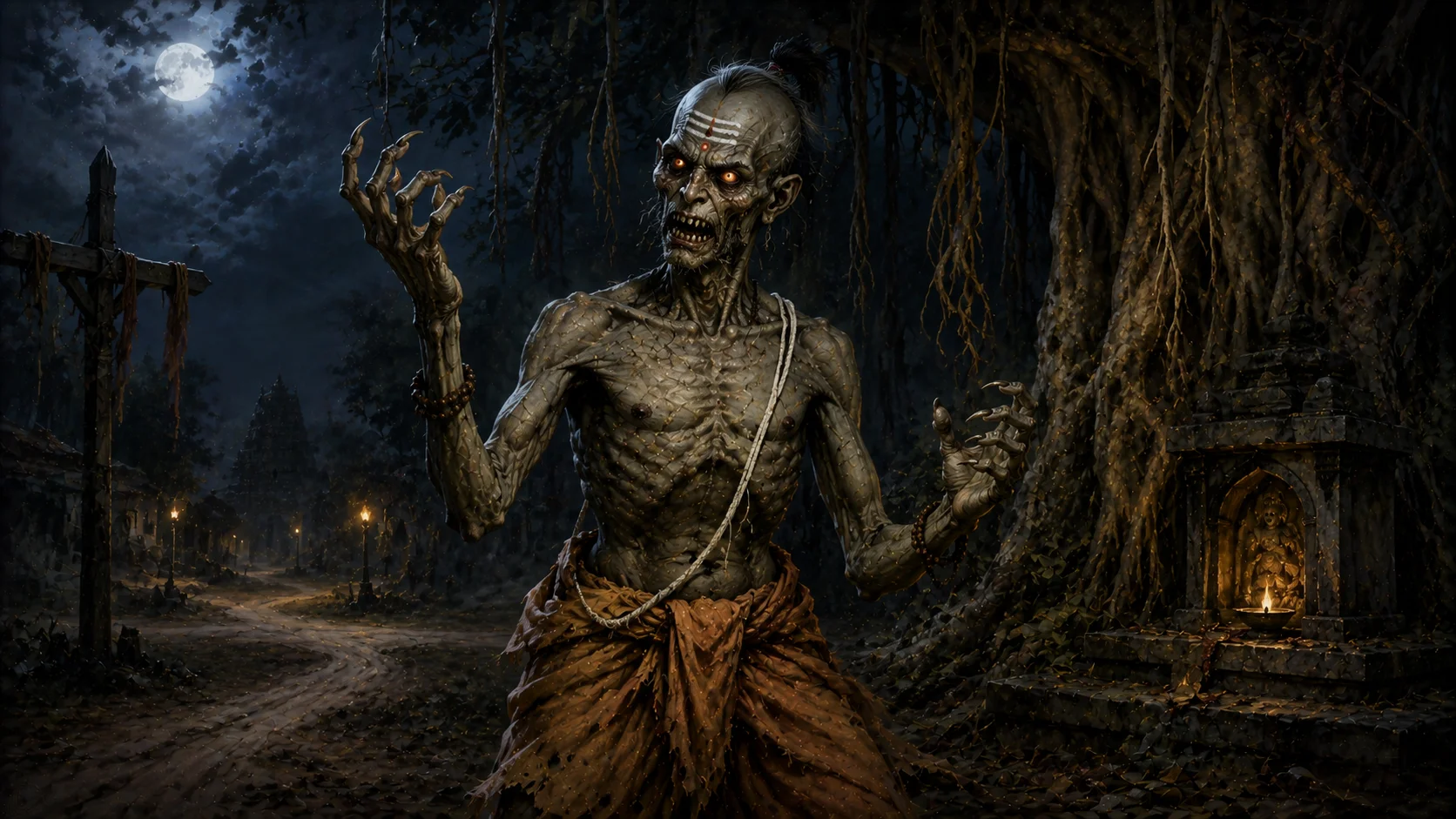
Brahmarakshasa — Brahmarākṣasa — is among the most feared of all Hindu ghost-demons: the restless, malevolent spirit of a brahmin who in life misused his sacred knowledge. More powerful and more terrible than the common rakshasa or pishacha precisely because it retains the learning and spiritual force of a high-caste scholar, the brahmarakshasa is a cautionary figure — learning without virtue turned into a curse.
How a Brahmin Becomes a Demon
A brahmarakshasa is born when a learned brahmin dies carrying grave sin: one who hoarded his knowledge and refused to teach, who misused mantras for harm, who broke his vows, betrayed a guru, stole, or died with unfulfilled desires and unatoned wrongs. Such a soul cannot pass on; the very power it accumulated in life binds it to earth as a wrathful spirit. The result is a being that combines the appetite and cruelty of a rakshasa with the intellect, eloquence, and occult mastery of a Vedic scholar — and so it is far harder to defeat than a brute demon.
Haunts and Habits
Brahmarakshasas are said to dwell in peepal and banyan trees, in ruined temples, on the banks of sacred tanks, and at lonely crossroads. They are often described as towering, dark, with matted hair and the sacred thread still across the chest, sometimes wearing a garland of entrails. They guard hidden treasure, pose riddles, demand offerings, and prey especially on travellers and on brahmins who err in ritual. Yet because they remember dharma, they can be bargained with, reasoned with, and even redeemed — many South Indian and folk tales turn on a hero who answers a brahmarakshasa’s questions correctly or performs the rites that free its trapped soul.
The Redeemable Demon
This redeemability sets the brahmarakshasa apart. In one famous pattern of story, the demon was once a great scholar and, freed by a virtuous encounter, gratefully grants boons or wisdom before departing for a better birth. The path to release is usually the performance of the proper death-rites (shraddha) the spirit never received, the repayment of a debt it left, or the teaching at last of the knowledge it had selfishly withheld. In this the brahmarakshasa is the mirror of its own sin: it is freed only by the generosity, truth, or learning it once denied.
Meaning and Memory
The brahmarakshasa endures as one of Hindu folklore’s sharpest moral instruments — the proof that spiritual attainment without humility and virtue is not merely wasted but actively dangerous, capable of outliving death as a curse. It haunts the imagination of South India especially, where village shrines and tree-spirits are still propitiated, and it remains a stock figure of Indian ghost stories, comics, and films: the learned ghost in the old tree, who will reward the worthy and destroy the false.
The Sin Beneath the Sin: Brahmahatya
Long before anyone sorted the restless dead into types, tradition had already fixed the killing of a brahmin as the worst thing a person could do — brahmahatya stands at the head of the mahapatakas, the great sins, above the theft of a brahmin’s gold and above violating a teacher’s bed. The gods were not exempt. In one of the oldest versions of the story, Indra kills Trishiras — also called Vishvarupa — the three-headed son of the artificer Tvashtri, who was, inconveniently, a brahmin. However justified the god believed himself, killing a brahmin was killing a brahmin, and the sin refused to stay abstract. The Puranic telling gives it the shape of a haggard old woman who hunts Indra across the world until, cornered, he divides her into four portions and gives each away: to the earth, to the waters, to the trees, and to women, each accepting a quarter of a god’s guilt in exchange for a boon. The sin never vanished. It is said to surface still — in barren, salt-bitten ground, in the foam on water, in the sap that bleeds from a cut tree, in a woman’s monthly courses.
That myth is far older than the brahmarakshasa, but it is the reason a spirit like it was ever thought necessary. If killing a brahmin ranks among the worst crimes that can be committed against one, then a brahmin who fails from within — hoarding what he should have taught, twisting the mantras entrusted to him — needs an afterlife severe enough to answer for it. The same arithmetic that made the brahmin’s life the most protected makes his death the most dangerous: the higher the rung, the further there is to fall, and the more force the falling soul carries down with it.
The Learned Monster Before the Name
The combination the brahmarakshasa depends on — Vedic learning housed inside a monster — was in the tradition long before the compound word was. Ravana, the antagonist of the Ramayana, is the son of the brahmin sage Vishrava and the rakshasi Kaikasi, half of each by birth. He is no brute. He is a master of the Vedas, a musician whose veena flies on his own banner, an ascetic whose penances wrung boons out of Brahma; his ten heads are commonly explained as the four Vedas and the six shastras rather than as ten appetites. What ruins him is not ignorance but the use he puts his knowledge to. That is the brahmarakshasa’s thesis in epic scale — and the later ghost is simply the same failure relocated from Lanka to the tree at the edge of a village.
Cousins Among the Restless Dead
A king walks alone into a cremation ground at night, cuts down a corpse hanging from a tree, and slings it over his shoulder — and the corpse begins to talk. That is the premise of the Vetala Panchavimshati, the twenty-five tales of the vetala preserved in Somadeva’s eleventh-century Kathasaritsagara and carried into English by Richard Burton as Vikram and the Vampire. Night after night the king hauls the animated spirit down from its tree; night after night the vetala tells a story ending in a riddle, the king cannot stop himself answering, and the vetala slips back to the branch. It is the brahmarakshasa’s nearest relative: a dead thing whose mind outlasted its body, fixed to a tree and a burning-ground rather than roaming, dangerous through cleverness rather than appetite. Where the two part company is identity. A vetala occupies a corpse the way a hand occupies a glove — the body is furniture, borrowed. The brahmarakshasa is nobody but itself. It is the dead man, and the grievance is his own.
Bengal keeps a gentler cousin. The brahmadaitya of Bengali household ghost stories is likewise a dead brahmin and likewise a tree-dweller, but where the brahmarakshasa is built to frighten, the brahmadaitya is nearly companionable: a dhoti-clad, thread-wearing spirit who keeps to his banyan or bel tree, mutters his Sanskrit, and is counted the most respectable and best-tempered of the Bengali ghosts — one to be greeted politely rather than fled, and generous to those who do. The same premise, a brahmin’s soul refusing to move on, hardens into a monster in one region and settles into a cranky learned neighbour in another. Which of the two a place produces says more about the place than about the ghost.
Why the Thread Stays On
Of everything the brahmarakshasa keeps from its old life, the yajnopavita is the detail no telling drops — the cord looped over the left shoulder at a boy’s initiation, the physical proof that he is twice-born and entitled to the Veda. It is worth pausing on how strange that is, because a ghost has no use for it. The thread is not a weapon; it grants the spirit nothing; it does not help it hunt. It is there to be read by whoever meets it. Before a word is spoken it announces that this thing was handed the highest office the society had and betrayed it. Every other feature of the figure — the height, the fangs, the reek, the tree — could belong to any demon in the repertoire. The cord is the indictment, worn exactly where it was once the honour.
A Shrine for the Dangerous Dead
At the edge of some South Indian villages, past the last house and before the fields properly begin, there is a low stone platform under a tree — unremarkable to a stranger, carefully tended by the people who live nearby. Kerala goes further and gives the brahmarakshasa a place inside the temple compound itself, a subsidiary shrine among the attendant deities, with offerings made at their appointed hours. Neither arrangement is an attempt to drive the spirit off. Both are attempts to settle it — the same unsentimental instinct that raises a nagakkal, a serpent stone, beneath a tree instead of pretending the snakes away.
The logic follows from the redemption stories the figure already carries. A brahmarakshasa remembers dharma, which means it can be reasoned with, and a spirit that can be reasoned with is safer stationed than left wandering. Rice, flowers, and a lamp at the right hour convert the most feared ghost in the hierarchy into a boundary guard. It is applied theology of a very practical kind: if you cannot be rid of it, give it a post.
From Tree Ghost to Screen Villain
Put an ordinary fanged monster in a horror serial and all it can do is chase. Put a brahmarakshasa in one and it can talk its way into the house, quote scripture back at the priest sent to remove it, and negotiate terms. Indian television took that offer: Zee TV built a supernatural drama around the figure in Brahmarakshas, which began airing in 2016 and returned for a second run some years later. The title alone did the work of exposition, because the audience already knew what kind of ghost this was going to be — the clever one.
Which is the quiet reason it has lasted. A monster that can only tear is beaten by a locked door and a bright morning. A monster that can argue has to be answered — and answering it means knowing at least as much as the man it used to be.
Sources & traditions
- EncyclopediaWikipedia — Brahmarakshasa
- TraditionHindu texts, oral tradition and village tellings (South Asia)
Myths change from area to area and from time to time. This chronicle follows the most widely told versions; tellings in other villages, regions and eras may differ.