Drona — Droṇāchārya, "Drona the Teacher" — is the great brahmin warrior-preceptor of the Mahabharata: the master of arms who trained both the Pandavas and the Kauravas, the supreme archer-teacher of his age, and a tragic figure whose loyalty, pride, and partiality lead him to a dark end in the war at Kurukshetra. Born of an extraordinary birth and raised in the discipline of the sages, he is the rare brahmin who set aside the hermit's calm for the warrior's bow and made war his vocation.
Born of a Vessel, Named for It
Drona's origin is one of the epic's stranger begetting-stories. His father was the sage Bharadwaja, a seer of formidable austerity. According to the tale told of him, Bharadwaja's seed fell — upon his beholding the apsara Ghritachi — into a drona, a pot or trough, and from that vessel the child was born. He was named for the container that had cradled his coming into the world: Drona, "the pot-born." It is a birth that marks him from the outset as someone shaped by vessel and container — fitting for a life that would later be spent containing, shaping, and pouring martial knowledge into others.
A Boyhood Bound to a Prince
As a young man Drona studied alongside Drupada, prince of Panchala, both of them pupils under the sage Agnivesha (in some tellings it is Parashurama from whom Drona receives his weapons-lore). The two boys became close friends in the way of shared hardship and shared ambition, and Drupada, in the easy generosity of youth, promised Drona that when he came to the throne he would share his kingdom with him as an equal. It was a promise made in friendship and never meant, on Drona's side at least, to be tested. It would be tested, and it would break.
A Household of His Own
Drona married Kripi, sister of the warrior-sage Kripacharya, and from that marriage came a son, Ashwatthama — a child born, by every account, into his father's own obsession with arms and honor. Ashwatthama grows through the epic to become the fixed point around which much of Drona's later life turns: his pride, his one indulgence, and eventually the instrument of the deception that ends his father's life. The household Drona built was a small, poor one for a man of his gifts; poverty is the constant backdrop to the years before he found a court to serve.
The Insult That Would Not Heal
Years later, reduced to want and remembering the vow of his boyhood friend, Drona sought out Drupada, now king of Panchala, and asked him to make good on the old promise of shared rule. Drupada, secure on his throne, refused to recognize the friendship of poorer days — a king, he said, does not share his kingdom with a beggar, however dear an old companion. The humiliation cut deep and did not fade. Drona left Panchala carrying an injury that would, in time, reorder the fates of two kingdoms.
Preceptor to the House of Kuru
From that humiliation Drona turned toward Hastinapura and the court of the Kurus, where he was received and made royal preceptor — guru in arms to the hundred Kaurava princes and the five Pandavas together. It was the making of his second life: no longer a poor brahmin nursing an old grudge, but the most sought-after teacher of weaponcraft in the land, entrusted with shaping the very princes who would one day divide the realm between them.
The Making of a Peerless Archer
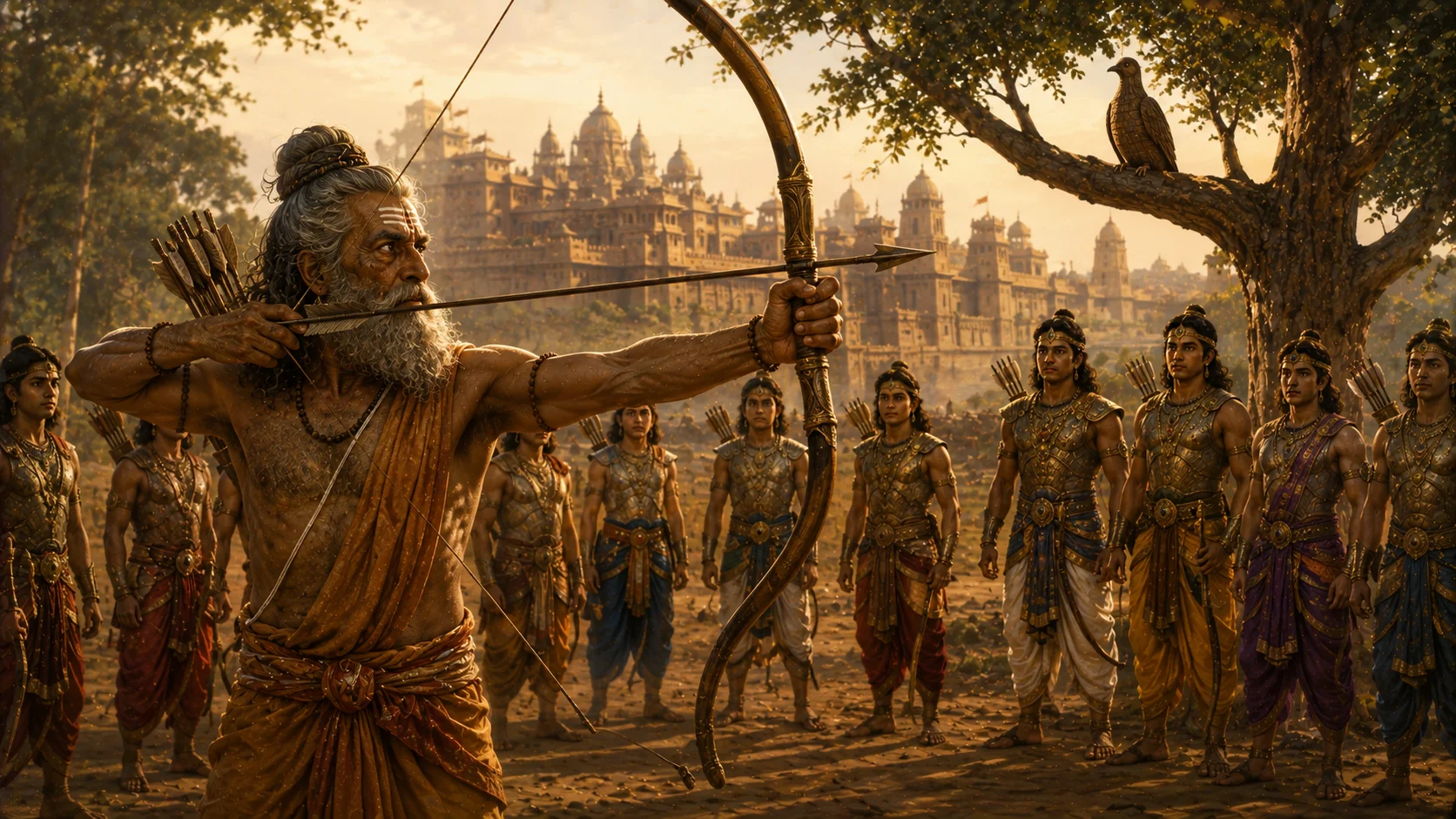
Among his many royal pupils, Drona's favor fell most heavily on Arjuna, whom he resolved to make the finest archer of the age — and did. Their bond became famous for its intensity: extra instruction, private attention, a teacher's open partiality toward one pupil that the other princes noticed and, in some cases, resented. It was in testing his students' focus that Drona set them his celebrated exercise of the wooden bird, asking each in turn what he saw before he loosed his arrow at its eye — a test of concentration that separated the merely skilled from the singular, and that Arjuna alone answered as his teacher wished.
The Thumb of Ekalavya
Not every seeker of Drona's teaching was received. Ekalavya, a prince of the forest-dwelling Nishada people, came to Drona and was turned away because of his birth. Undeterred, Ekalavya built a clay image of Drona in the forest and, worshipping it as his guru, taught himself archery before it until his skill outstripped even Arjuna's. When Drona learned of this self-made mastery, he went to Ekalavya and, invoking a teacher's right to guru-dakshina — the fee owed a master by a student, even one never formally accepted — demanded Ekalavya's right thumb. Ekalavya gave it without protest, and with it went his archery forever. It is one of the most argued-over episodes in the whole epic, read by generation after generation as the plainest evidence of caste bias written into the text's own celebrated teacher, a wound the story never asks anyone to explain away.
A Fee Collected in Blood and Land
From his royal pupils Drona asked a different price. As guru-dakshina from the Kuru princes, he sent them against Drupada: Arjuna led the campaign, defeated the king of Panchala in battle, and brought him captive before his old friend and rival. Drona then divided Drupada's kingdom in two, keeping half for himself and returning the other half to its former king — fulfilling, at last and by force, the equal partnership Drupada had once promised and then denied him. It was revenge dressed as fairness, and it settled nothing so much as it planted the next injury.
A Yajna for Vengeance
The humiliation of defeat and dismemberment of his kingdom drove Drupada to a yajna performed for the sole purpose of siring a child who could kill Drona. From the sacrificial fire came Dhrishtadyumna, born already fated to be his enemy's death, and, in the same rite, Draupadi, who would become wife to the Pandavas. Drona's old debt to Drupada had, without either man intending it quite this way, produced the instrument of his own end and one of the epic's central women in a single act of grief-driven ritual.
Commander of a Falling House
When the long rivalry between the cousins broke into open war at Kurukshetra, Drona's bond to the Kuru court held: he fought for Duryodhana's side against the very pupils he had shaped and loved, Arjuna chief among them. After Bhishma fell, Drona was raised to commander-in-chief of the Kaurava army, and for several days he led it with the same mastery he had once poured into his teaching — a strategist without equal, credited with devising intricate battle formations, or vyuhas, of a complexity that only his own trained pupils could hope to counter, the Chakravyuha among them.
A Half-Truth on the Field
Drona's death came not by force of arms but by grief and deception. Knowing the old commander would lay down his weapons only at word of his son Ashwatthama's death, his enemies contrived to make him believe exactly that. Yudhishthira — a man renowned through the epic for never speaking falsehood — was brought to confirm the report, and did so in words built to deceive without, strictly, lying: "Ashwatthama is dead" — followed by a qualifier, "the elephant," spoken so quietly it went unheard. Drona, hearing only the declaration he dreaded, believed his son slain, set down his bow, and sat upon his chariot in stricken meditation.
The Guru Undefended
It was in that moment of unguarded grief that Dhrishtadyumna, the son Drupada had raised for this single purpose, struck him down — the pupil-turned-enemy fulfilling the vow written into his own birth. Drona died disarmed, in mourning, at the hands of the man born expressly to end him, and the death closed a chain of injury that had begun decades earlier with a broken promise between two boys.
The Argument the Story Leaves Open
Few deaths in the epic are debated as fiercely as Drona's. That Yudhishthira — dharma's own exemplar — was made to speak a truth built to deceive troubles every generation of readers who return to the scene, and the text offers no easy resolution: only the fact that it happened, that it worked, and that it is remembered as one of the war's deepest wounds to the very idea of righteous conduct. Drona himself is remembered in the same double light — as the greatest of teachers, whose instruction made heroes of ordinary princes, and as a man whose favoritism, pride, and old grudges cost a devoted student his thumb and cost the teacher himself, in the end, his life.
Sources & traditions
- EncyclopediaWikipedia — Drona
- TraditionHindu texts, oral tradition and village tellings (South Asia)
Myths change from area to area and from time to time. This chronicle follows the most widely told versions; tellings in other villages, regions and eras may differ.