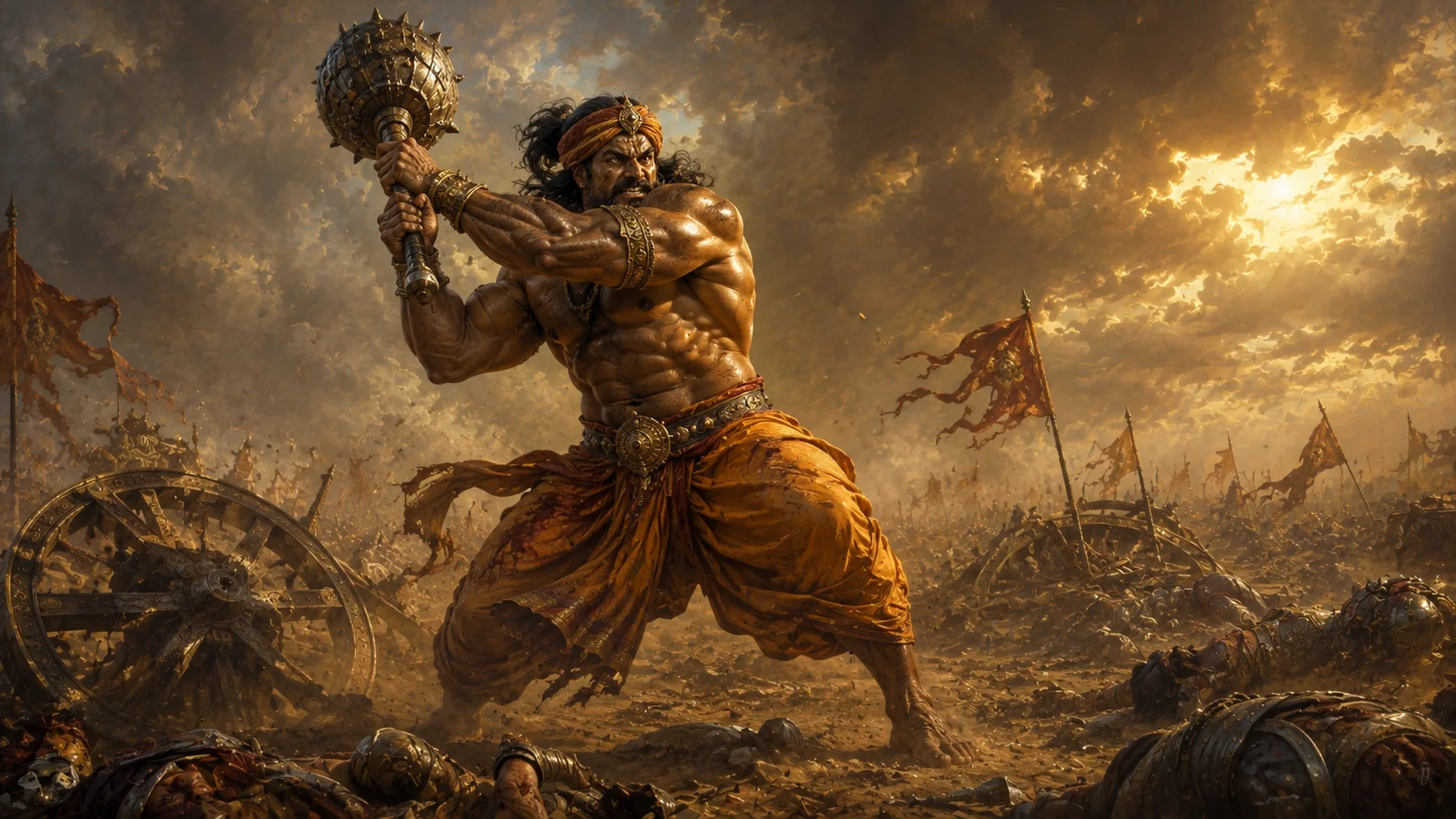
Bhima — Bhīma, "the terrible" — is the strongman of the Mahabharata: second of the five Pandava brothers, son of the wind-god Vayu, and the mightiest mortal of his age. Where his brother Arjuna embodies skill and his brother Yudhishthira embodies law, Bhima is raw power, ferocious appetite, and a fierce, protective love — the avenger who personally fulfils the bloodiest vows of the epic.
Born of the Wind's Invocation
Bhima came into the world through Kunti's mantra-born invocation of Vayu, the wind god, and from that conception he carries the patronymic epithets Vayuputra, "son of the wind," and Pavana-tanaya, the same title in another form. He is, by descent, the second of the five Pandava brothers, standing between Yudhishthira's claim of law and Arjuna's mastery of the bow — his own inheritance from Vayu is simpler and more elemental: strength without measure. From earliest boyhood he was marked by immense size, immense physical power, and an appetite to match, the trait that named him Vrikodara, "wolf-bellied," a hunger as legendary as his might.
Poison, the River, and the Serpents Below
Bhima's boyhood strength made him a target before he was old enough to defend himself against intrigue rather than muscle. Duryodhana, resentful of his cousin's power even as a child, fed him poisoned food and had him thrown into the river Ganga. Bhima did not drown and he did not die of the poison — he sank instead into the world of the Nagas, the serpent-folk of the underworld, and there was bitten repeatedly by their venomous kind. Where venom should have finished what the poison began, the bites instead delivered a countervailing nectar, and Bhima rose from the underworld not weakened but strengthened, his childhood ordeal transmuted into an early proof that he could not be undone by conventional means. The Adi Parva preserves this episode as the first sign that Bhima's life would be defined by surviving what was meant to kill him and returning larger for it.
Hidimba, Hidimbi, and a Son Born to Two Worlds
In the depths of the forest, during the family's flight and concealment, Bhima met the rakshasa Hidimba, a cannibal demon, and killed him. It was in the same encounter that he met Hidimba's sister, the rakshasi Hidimbi, and married her — a union that crossed the boundary between the human Pandava line and the rakshasa world entirely. From that marriage came Ghatotkacha, a son who inherited a share of both his father's Pandava blood and his mother's rakshasa nature, and who would grow into one of the most formidable warriors connected to the Pandava cause. Bhima's second marriage came later and was shared: with his brothers, he wed Draupadi, and by her he fathered a son of his own, Sutasoma. Between Hidimbi and Draupadi, Bhima's family stood at the meeting point of two very different worlds — the wild and the courtly — in a way none of his brothers' households did.
The Demon of Ekachakra
During the Pandavas' period of hiding, the family took shelter in the town of Ekachakra, which lived under a standing terror: the rakshasa Bakasura demanded that the town supply him with food and, in effect, a resident to consume, on a weekly rotation, or he would descend on the town himself. Bhima took the burden onto himself, confronting and killing Bakasura and freeing Ekachakra from the arrangement entirely. It is characteristic of Bhima's role across the epic — he is the brother dispatched wherever a monstrous threat stands between ordinary people and their safety, the human bulwark set against the inhuman, doing by main force what diplomacy or cunning could not.
The Cook Vallabha and the Death of Kichaka
The year of concealment at the court of King Virata — the Agyatavasa, undertaken so the Pandavas could not be recognized and sent back into exile — placed each brother under a disguise suited to hide his true nature. Bhima's was among the most implausible: he served as Vallabha, the royal cook, a role that let his enormous appetite pass without remark while his strength stayed hidden behind an apron. The disguise held until General Kichaka assaulted Draupadi, who was serving in the court under her own concealment. Bhima acted in secret, killing Kichaka in retribution, protecting Draupadi at the risk of unmasking the entire family's hidden year — a risk he accepted without hesitation, as he would again and more publicly after the war's provocations were done with concealment altogether.
The Oaths Sworn Over a Dishonoured Queen
The dice-hall humiliation of Draupadi produced two vows from Bhima that would govern much of the war to come. He swore that he would break the thigh of Duryodhana, who had bared his own thigh to insult her, and he swore that he would drink the blood of Dushasana, who had dragged her by the hair and attempted to strip her before the assembly. These were not idle threats spoken in anger and left to cool — they were oaths the epic tracks deliberately toward their fulfillment, and Bhima carried them through years of exile and into the war itself, where both were kept with a precision that left no ambiguity about whether the debt had been paid.
A Vow Against the Hundred
Beyond the two oaths tied directly to Draupadi's humiliation, Bhima carried a broader vow: to kill every one of the hundred sons of Dhritarashtra, the full brood of Kauravas of which Duryodhana and Dushasana were only the eldest and most prominent. Over the course of the Kurukshetra war, Bhima worked through this vow methodically, killing brother after brother until the entire line Dhritarashtra had fathered against the Pandavas' claim was extinguished by his hand. It is the single largest body count attributed to any one vow in the war, and it fell to Bhima specifically because his strength made the promise credible in a way it would not have been from any of his brothers.
The Duel That Ended a War
Duryodhana's body had been rendered invulnerable everywhere except one place by a blessing from his mother Gandhari. That single unguarded place was his thigh, and it was there that Bhima's mace found him in their climactic duel, a mace fight fought between the two greatest masters of the weapon in that generation. The blow that broke Duryodhana's thigh came below the navel, a strike that violated the accepted rules of fair combat, delivered at a covert signal from Krishna who recognized that no rule-bound blow could reach the one place Duryodhana could actually be hurt. The duel closed the war's central rivalry and fulfilled, in the same stroke, the oldest of Bhima's vows.
Blood Kept as a Promise
The killing of Dushasana carried its own severity, distinct even among the brutal reckonings of the war's final battles. Bhima did not merely kill him — he fulfilled the oath in its literal terms, drinking Dushasana's blood as he had sworn over Draupadi's dishonoured hair years before. It stands as the most visceral single act attributed to Bhima in the entire epic, the moment where a vow spoken in fury in a courtly hall was carried, unaltered, into an act performed on the battlefield exactly as promised.
Jarasandha and the Wrestler's Reckoning
Among Bhima's epithets is Jarasandha-jit, "conqueror of Jarasandha," earned through his defeat and killing of Jarasandha, the tyrant king of Magadha, in a wrestling duel rather than a battle of arms. It was Bhima's raw physical strength, not weaponry, that decided the contest — a fitting match for a warrior whose reputation across the epic rests less on tactics than on the sheer, irresistible force of his body. The victory removed one of the era's most feared kings and stands alongside the killings of Hidimba and Bakasura as proof that Bhima's preferred battlefield was always the one where strength alone could settle the outcome.
The Mace-Master Trained by Balarama
Bhima's signature weapon was the gada, the great war-mace, and his skill with it was trained in part by Balarama, Krishna's brother, himself renowned as a master of the weapon. That training placed Bhima and Duryodhana — his lifelong rival — among the supreme mace-fighters of their age, a rough camaraderie of mutual respect and mutual enmity that ran through the epic and culminated in the duel that ended Duryodhana's life. The mace suited Bhima precisely because it demanded nothing but strength, endurance, and will, the three qualities the epic gives him in greater measure than any other character.
The Fall on the Mountain Road
In the Mahaprasthanika Parva, the Pandavas' final journey together toward the Himalayas, the brothers fell one by one as they climbed, each fall attributed to a particular flaw carried from life. Bhima was the second to fall, and Yudhishthira, walking on ahead, named the cause as Bhima's own pride in his strength and his gluttony — the same appetite and power that had defined him from infancy returned, at the very end, as the weight that brought him down. It is a quiet, almost understated close for a figure whose life had been measured in demons killed, vows kept, and kingdoms broken by his hand.
The Storm-Wind's Son Remembered
For all his violence, Bhima endures in memory as more than a destroyer. He is the brother who carried his family through danger by main force, the husband who crossed into the rakshasa world and back without renouncing either wife, the cook who hid a warrior's strength behind a ladle for a year rather than see his family's exile undone, and the avenger who kept every oath he swore to the letter. Vrikodara, Bhimasena, Vayuputra, Jarasandha-jit — each epithet marks a different face of the same nature: terrifying to his enemies, immovable in his loyalties, and, in the epic's own reckoning, undone in the end not by any foe but by the same hunger and pride that had made him unstoppable in life.
Sources & traditions
- EncyclopediaWikipedia — Bhima
- TraditionHindu texts, oral tradition and village tellings (South Asia)
Myths change from area to area and from time to time. This chronicle follows the most widely told versions; tellings in other villages, regions and eras may differ.