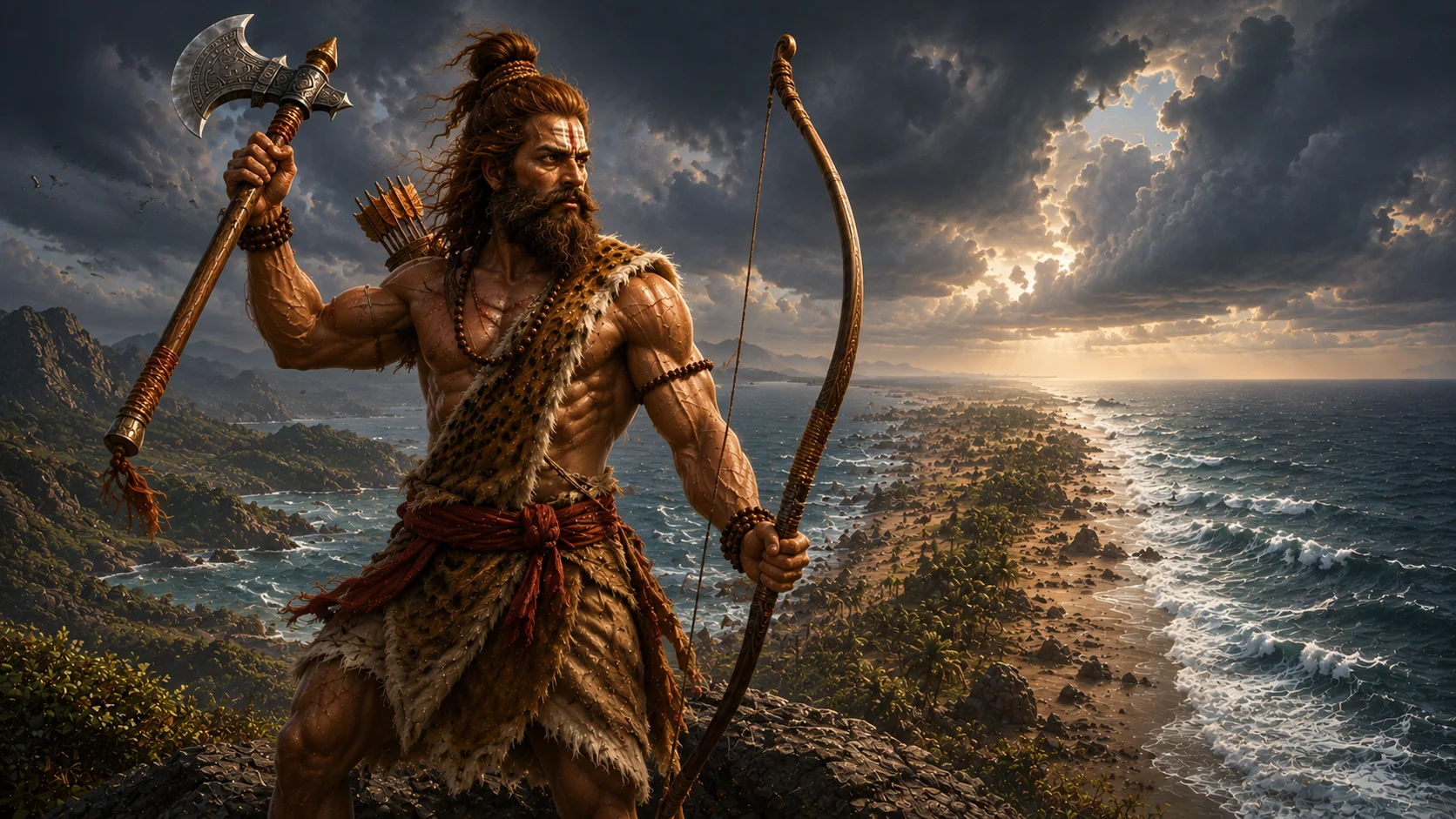
Parashurama, "Rama with the axe," is the sixth avatar of Vishnu — a Brahmin sage born to wield a warrior's fury, who annihilated the tyrannical Kshatriya warrior class from the earth twenty-one times over in vengeance for his father's murder, and who is unique among the Dashavatara in being described as an immortal, chiranjivi, still living in austerity somewhere on earth even as later avatars came and went. He embodies righteous fury turned against the abuse of power by those sworn to wield it justly, and stands as a bridge figure whose story reaches into the very epics that the later avatars Rama and Krishna themselves inhabit.
Birth to a Sage and a Warrior Princess
According to the Vishnu Purana, the Bhagavata Purana, and the Mahabharata's own extended retellings of his story, Parashurama was born to the sage Jamadagni, a Brahmin of formidable ascetic power, and Renuka, a princess of Kshatriya (warrior-caste) birth. This dual heritage — priestly discipline from his father's line, warrior blood from his mother's — is often read as foreshadowing the paradox at the heart of his story: a Brahmin, whose class is traditionally defined by renunciation of violence, who becomes the deadliest warrior of his age.
An early episode already shows the uncompromising severity that defines him. When Jamadagni, through his ascetic powers, perceived an impure thought in Renuka's mind, he ordered his sons in succession to behead their own mother as punishment; only Parashurama obeyed without hesitation. Pleased, Jamadagni granted his son a boon, and Parashurama immediately asked that his mother be restored to life with no memory of her death, that he himself bear no sin for the act, and that his brothers — who had refused the order — be restored to full health. The episode, difficult and unsettling as later readers have often found it, is presented within the texts as an illustration of absolute obedience to dharmic and paternal authority overriding even the most painful of personal attachments, though the moral complexity of the episode is one that many modern commentators and retellings continue to wrestle with rather than smooth over.
The Murder of Jamadagni and the Kshatriya Massacres
The central and defining episode of Parashurama's story begins with the powerful king Kartavirya Arjuna (also called Sahasrarjuna, "thousand-armed Arjuna," for the boon that gave him a thousand arms), who visited Jamadagni's hermitage and was lavishly hosted through the miraculous provisions of the sage's wish-fulfilling cow, Kamadhenu. Coveting the cow, Kartavirya Arjuna seized it by force. In Parashurama's absence, or in some tellings after his return and subsequent confrontation and defeat of the king, Kartavirya Arjuna's sons returned to the hermitage and murdered Jamadagni in retaliation.
Finding his father's body, Parashurama swore a terrible vow: he would rid the earth of the Kshatriya warrior class, whom he held collectively responsible for the abuse of power his father's murder represented. The Puranas describe him marching across the earth and annihilating the Kshatriyas twenty-one times in successive campaigns — a repetition explained by the surviving Kshatriya women bearing new generations of sons each time, whom Parashurama would again destroy once they came of age, until the vow was considered fulfilled. Several Puranic accounts describe him filling five sacred lakes, Samanta-panchaka, with the blood of his slain enemies, a site later associated in the Mahabharata with the battlefield of Kurukshetra itself, linking Parashurama's ancient purge to the later, greater war fought there.
The Axe and Its Divine Origin
Parashurama's signature weapon, the axe (parashu) from which his name derives, was given to him, in most Puranic accounts, by Shiva himself, after Parashurama underwent severe austerities and combat training under the god's tutelage on Mount Kailasa. He is also closely associated in some traditions with training later heroes in the arts of warfare, including, in certain retellings, instructing figures who would go on to play major roles in the Mahabharata, such as Bhishma, Drona, and Karna — a detail that further threads his story into the fabric of the later epic even though his own principal narrative predates it by generations.
Reclaiming Land From the Sea: The Origin of the Konkan and Malabar Coasts
A distinct and widely told strand of Parashurama's legend, especially prominent in the coastal regions of Western and Southern India, credits him with reclaiming a strip of land from the sea — commonly identified with the present-day Konkan coast of Maharashtra and Goa, and in some regional traditions extending to the Malabar coast of Kerala — by shooting an arrow into the ocean and commanding the waters to recede, creating new habitable territory that he then settled with Brahmin families. This geological-origin legend is treated in local tradition as a matter of regional identity and pride rather than pan-Indian Puranic canon, and versions of it differ considerably between Maharashtra, Goa, and Kerala as to the exact details and communities involved.
Encounters With Later Avatars
Parashurama's status as an immortal sage allows him a rare distinction: he appears directly within the narratives of two later avatars. In the Ramayana, he confronts the young Rama after Rama breaks the great bow of Shiva at Sita's wedding-contest, challenging him to string an even mightier bow of Vishnu; Rama's effortless success in doing so causes Parashurama to recognize Rama as a fellow, and in that moment supreme, manifestation of Vishnu, and he withdraws to continue his own ascetic life. In the Mahabharata, he plays a significant role as a teacher and, in the case of Karna, a source of a fateful curse, further entwining his long life with the unfolding of dharmic history across multiple ages.
Why Vishnu Took This Form
Parashurama answers a crisis unlike the demon-kings of earlier avatars: not a single overreaching tyrant, but the systemic corruption of an entire class entrusted with worldly power and the duty to protect rather than oppress. His story is frequently read as a warning that even a divinely sanctioned social order — the Kshatriya's role as protector and administrator of justice — can decay into the very abuse it exists to prevent, and that dharma's restoration in such a case may require a ferocity that does not distinguish cleanly between the guilty individual and the corrupted institution as a whole, a moral severity that later tradition has continued to debate rather than simply celebrate.
Parashurama Among the Chiranjivis
Hindu tradition names a small group of beings, the chiranjivi, believed to remain alive throughout the ages until the end of the current cosmic cycle, and Parashurama is consistently counted among them alongside figures such as Hanuman, Ashwatthama, Vibhishana, and the sage Markandeya. This status sets him apart structurally from every other member of the Dashavatara, whose stories are each bounded within a single lifetime and a single era: Parashurama's story has no closing chapter within the Puranic timeline, and several traditions hold that he continues his austerities today on Mahendragiri, a mountain associated with him in the Puranas and located in the Eastern Ghats. Some devotional traditions further hold that Parashurama is destined to serve as the guru who trains Kalki, the tenth and final avatar, in the martial arts he will need at the close of the Kali Yuga — a belief that, if accepted, would make him the one figure within the Dashavatara whose story directly bridges the sixth avatar to the tenth.
Worship and Living Tradition
Parashurama is venerated at temples across the western coastal regions most associated with his land-reclamation legend, including notable shrines in Maharashtra, Goa, and Kerala, and Parashurama Jayanti is widely observed on the third day of the bright half of the lunar month of Vaishakha, a date that coincides with the auspicious festival of Akshaya Tritiya, considered favorable for new beginnings and large undertakings. Several Brahmin communities along the western coast, including groups in Goa, Konkan, and Kerala, trace their own settlement history and lineage traditions directly to the account of Parashurama resettling the reclaimed coastal land, giving his legend a continuing role in regional communal identity that goes well beyond devotional worship alone. As an immortal, chiranjivi figure believed by many devotees to remain in ascetic seclusion to this day, Parashurama occupies a distinctive place among the Dashavatara: not a story confined to a completed past, but one whose central figure is held, within the tradition, to still be present somewhere in the world.
Sources & traditions
- EncyclopediaWikipedia — Parashurama
- TraditionHindu texts, oral tradition and village tellings (South Asia)
Myths change from area to area and from time to time. This chronicle follows the most widely told versions; tellings in other villages, regions and eras may differ.