Kumbhakarna — Kumbhakarṇa, "pot-eared" — was the colossal younger brother of the demon-king Ravana and one of the most poignant figures in the Ramayana. A giant of mountainous size cursed to sleep for half the year, he is remembered both as an unstoppable engine of destruction and as the rare rakshasa-giant who told his king the truth.
A House of Fearsome Children
Kumbhakarna was born to the sage Vishrava and the rakshasi Kaikasi, and so shared blood with some of the most consequential figures of the epic. Ravana, eldest of the siblings, would become the mighty and ambitious lord of Lanka; Kumbhakarna followed him, matched to him in raw might if not in cunning; after him came the gentle Vibhishana, who would eventually break from his brothers on a matter of conscience, and their sister Shurpanakha, whose own grievance would help set the war in motion. From this one household came a king, a giant, a righteous exile, and a wronged sister — the whole tangled machinery of the Lanka campaign traced back to a single set of parents.
Vast Beyond Reckoning
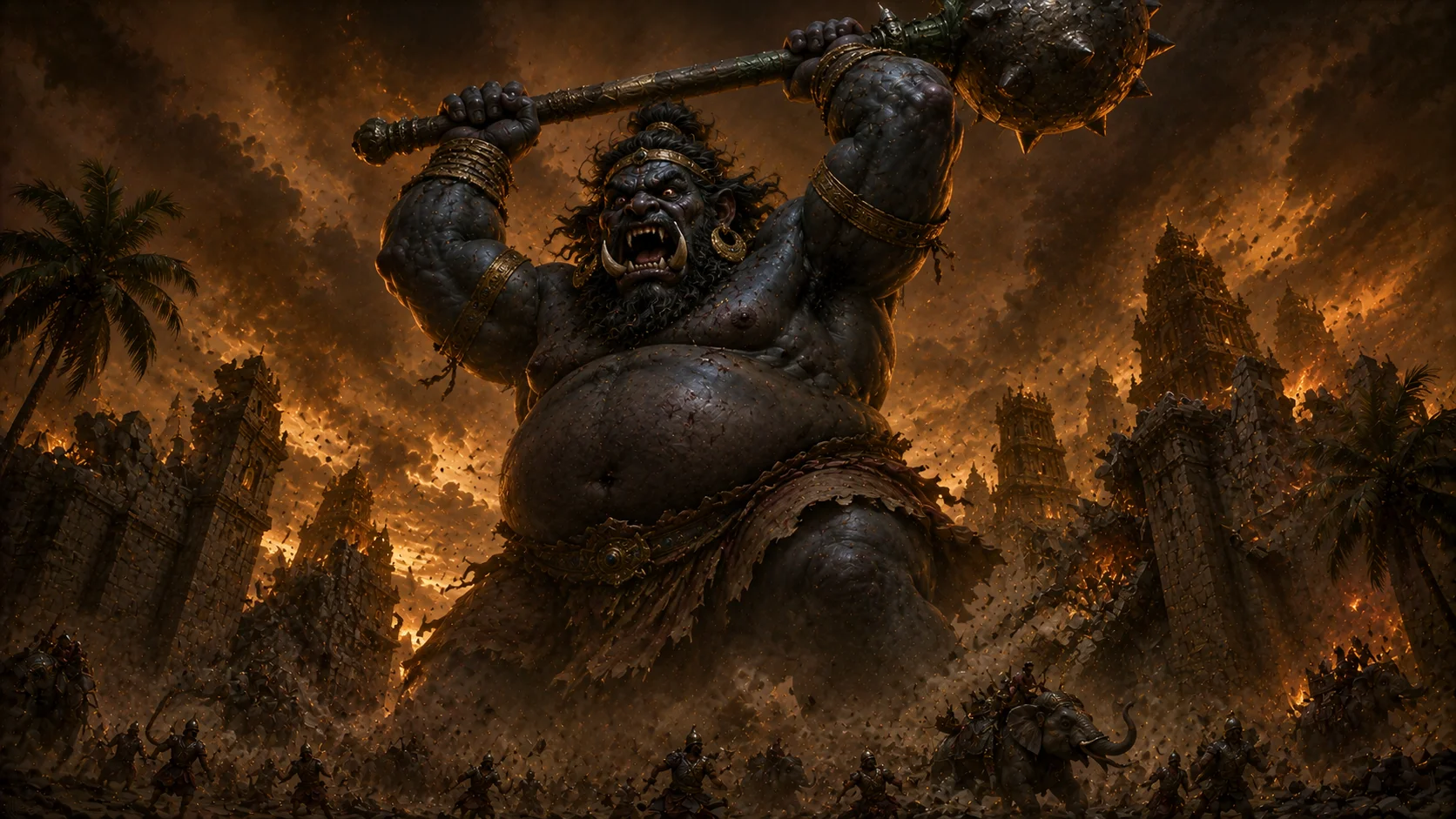
Even among rakshasas, a lineage never short of monstrous size, Kumbhakarna was singular. The Ramayana lingers on his scale with something close to awe: a body like a moving mountain, an appetite that could empty granaries, a strength that needed no weapon to be dangerous. He was less a warrior in the ordinary sense than a force of nature wearing the shape of a rakshasa — and that scale, played for both terror and pathos, is the engine of everything that happens to him afterward.
Words Twisted on the Tongue
His most famous story begins with ambition and ends in humiliation. Kumbhakarna performed fierce penance and won the right to ask Brahma for any boon, and what he intended to ask for was staggering: Indrasana, the throne of Indra himself, sovereignty over the gods' own seat of power. The gods, watching a being of his hunger and strength reach for that throne, were terrified of what he might do if he ever held it. At their urging, tradition holds, the goddess Saraswati — mistress of speech — came to rest upon his tongue at the exact moment he spoke his wish. What left his mouth was not Indrasana but Nidrasana: not the seat of Indra, but the seat of sleep. Brahma, bound to honor the words as spoken rather than the wish behind them, granted it. Different tellings frame the mechanics of the trick differently — some, including versions outside Valmiki's Sanskrit original, vary the details of exactly how the slip was engineered — but the outcome across tradition is the same: a warrior built to be unstoppable was instead condemned to spend most of his existence unconscious.
Six Months of Silence
The curse settled into a grim rhythm. Kumbhakarna would sleep for six months at a stretch, an entire season passing over his motionless body, and then wake for a single day before sinking back into slumber. It was, by some accounts, as much mercy as punishment — a being who might otherwise have devoured the three worlds out of sheer appetite was rendered harmless for all but one day in every season. He became, in effect, a sleeping catastrophe: not gone, not diminished, simply paused, waiting in the dark beneath Lanka for a day that would eventually matter.
Waking a Mountain
That day came when Rama's siege of Lanka turned disastrous for the rakshasas and Ravana, running out of champions, ordered his brother roused out of season. Waking Kumbhakarna was itself a labor worthy of an army. Drums were beaten and conches blown directly against his ears; elephants were driven across his sleeping body to shake him into consciousness; mountains of food and strong drink, dishes chosen for their overpowering smell, were piled beside him to drag his senses up out of sleep. Only after this assault of noise, weight, and scent did the giant finally stir, blinking awake into a war he had slept straight through.
A Brother's Honest Reckoning
What Kumbhakarna did next is the moment that separates him from every other monster in the epic. Told why he had been woken — that Ravana had abducted Sita and brought the vanara armies of Rama to Lanka's gates — he did not simply arm himself and march out. He turned on his brother with plain, unflinching counsel: the abduction was adharmic, against the moral order itself; Sita ought to be returned; Ravana had brought this ruin on their house through his own wrongdoing. It is a striking scene precisely because of who is speaking it — the most physically terrifying figure in the rakshasa ranks, delivering the epic's clearest rebuke of its villain, without a trace of self-interest in the saying of it.
Duty Chosen Over Rightness
Having spoken his conscience in full, Kumbhakarna did not then abandon his king. He honored the bond of kinship and the duty owed to his sovereign, and went to the battlefield anyway, fighting for a cause he had just condemned with his own mouth. This is the hinge on which his whole character turns: not ignorance of the moral stakes, and not indifference to them, but a conscious choice to place loyalty above what he knew to be right. Later tradition would seize on exactly this — reading him not as malicious like Ravana, whose war was born of personal desire, but as a figure bound by family duty and the obligations of rajadharma, kingly and kinship order, even against his own better judgment.
Ruin Among the Vanara Ranks
On the field, the giant that duty had committed became the catastrophe the gods had once feared. Kumbhakarna tore through the vanara army in numbers that shook Rama's entire host, engaging its foremost champions directly. He met Sugriva, king of the vanaras, in combat; he clashed with the young and valiant Angada; he came up against Lakshmana himself, Rama's own brother, in one of the fiercest exchanges of the war. Against a being of his size and fury, ordinary valor bought only casualties, and the vanara ranks paid heavily for every hour he remained on the field.
The Reckoning with Rama
It fell, in the end, to Rama alone to end him. In one of the Ramayana's great set-piece combats, Rama met the giant with divine arrows — astras carrying power beyond ordinary weaponry — and cut him down piece by piece rather than in a single stroke. First the arms fell, vast limbs that had crushed whole ranks of soldiers; then the legs, and the mountain of a body could stand no longer; and at last, with the celestial force fit for such an opponent, the head itself, severed and sent down to strike the earth with the weight of everything that had come before it. It was not a quick death, and the epic does not treat it as a small one.
The Turning of the War
Kumbhakarna's fall did more than remove one warrior from the field. It was a hinge point in the whole Lanka campaign — the moment Ravana's forces understood, in the plainest possible terms, that even their mightiest could be broken by Rama's hand. The demoralization that followed rippled through the rakshasa ranks in the run-up to the war's climactic duel, a sense that if the giant who had once nearly claimed Indra's own throne could be felled, no one in Lanka was truly safe. His death is remembered less as a single battle lost than as the moment the war's outcome began to feel inevitable.
Sons Who Followed Him to the Field
Later Puranic material and regional retellings across South and Southeast Asian Ramayana traditions add further branches to his story, including sons — named in some versions as Kumbha and Nikumbha — who are said to have taken up arms in the same war and met their own ends there. The genealogical detail shifts from text to text, a reminder that the Ramayana was never a single fixed document but a living tradition retold and reshaped as it traveled, each region adding its own threads to a story that already spanned gods, giants, and kings.
A Name That Outlived the War
Kumbhakarna's afterlife in ordinary speech has little to do with combat at all. Across Indian vernacular usage, his name became proverbial for a person who sleeps to excess or who can only be roused with tremendous effort — the six-month curse distilled into a single household comparison, invoked for anyone who will not get out of bed. It is an odd inheritance for a figure who, when he finally did wake, spoke one of the epic's clearest moral judgments and then died defending the very brother he had judged.
The Weight of a Mountain's Grief
What lingers about Kumbhakarna is the tension he embodies between what a person knows to be right and what loyalty asks of them anyway. He was not deceived about Ravana's wrong, and the epic does not let him off that hook by pretending otherwise — he said the truth aloud, to his king's face, before ever lifting a weapon. And still he fought, and still he fell, because the bond of brother to brother and subject to sovereign outweighed, in the end, even his own certainty. He remains, beneath the size and the appetite and the six-month sleeps, a figure defined by that single, deliberate choice — a tragedy scaled, like everything else about him, to the size of a mountain.
Sources & traditions
- EncyclopediaWikipedia — Kumbhakarna
- TraditionHindu texts, oral tradition and village tellings (South Asia)
Myths change from area to area and from time to time. This chronicle follows the most widely told versions; tellings in other villages, regions and eras may differ.