Hiranyakashipu is a great demon-king of Hindu myth — the tyrant asura who, made nearly invincible by a cunningly-worded boon, conquered the cosmos and demanded to be worshipped as god, persecuting his own devout son Prahlada, until he was destroyed by Vishnu's man-lion avatar Narasimha through the loophole in his boon. The tyrant of the unbreakable boon, Hiranyakashipu is the proud demon-king whose seemingly perfect invincibility was undone by the man-lion.
Twin Sons of Kashyapa's House
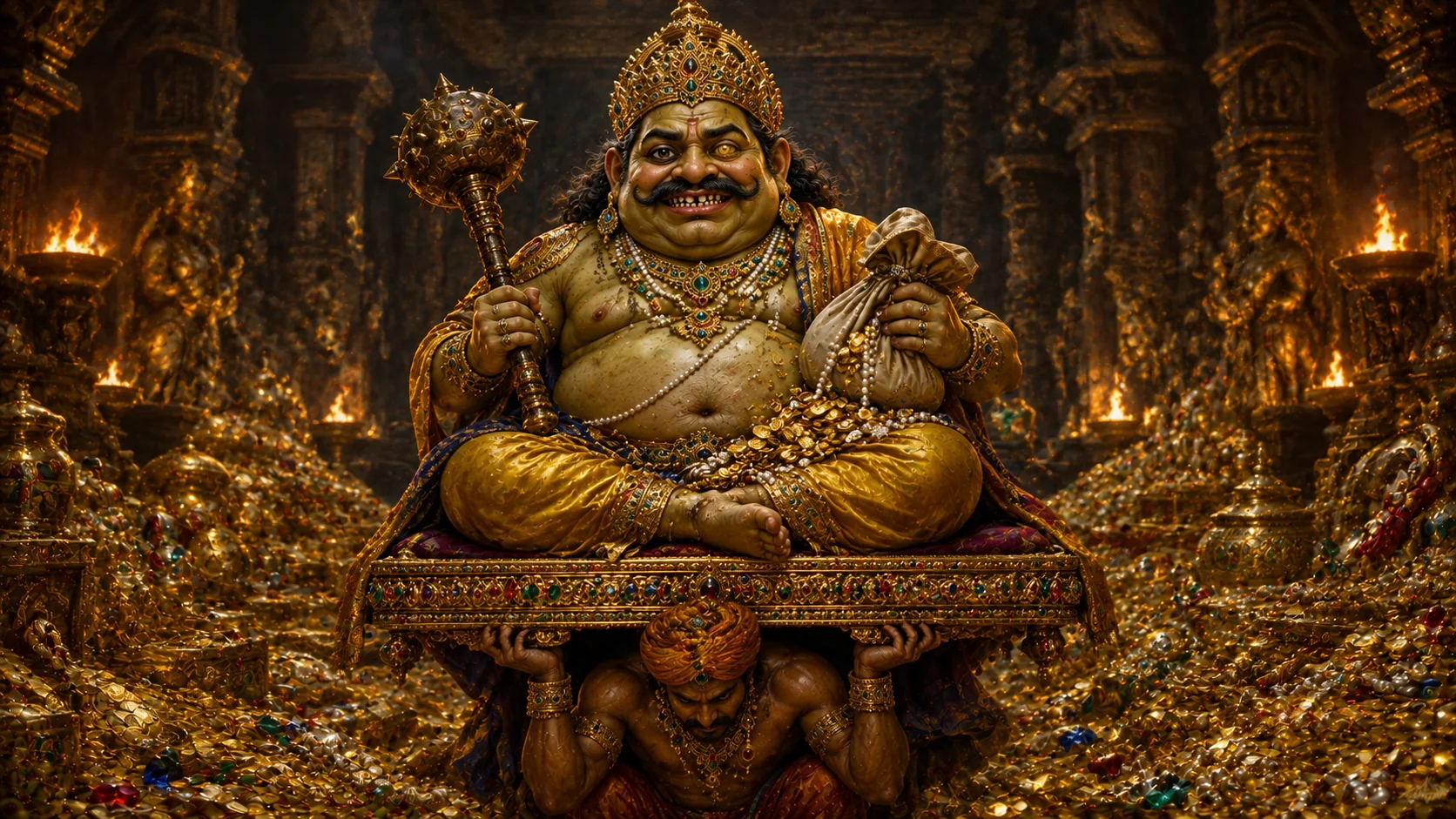
Hiranyakashipu (Sanskrit Hiraṇyakaśipu, "clothed in gold," a name reflecting the immense wealth and worldly dominion he came to hold) was born an asura, one of two sons of the great sage and progenitor Kashyapa and his wife Diti. His twin brother was Hiranyaksha, and the two were bound together from birth — in lineage, in ambition, and ultimately in the manner of their undoing at the hands of the same god in different forms. Where Hiranyaksha's story ended at the tusks of Varaha, the boar-avatar of Vishnu who raised the earth from the cosmic waters, Hiranyakashipu's story begins in the grief and fury that followed his brother's death.
Tapas Born of a Brother's Death
The slaying of Hiranyaksha by Vishnu did not humble Hiranyakashipu — it hardened him. Determined both to avenge his twin and to place himself beyond the reach of any power that could do to him what had been done to his brother, Hiranyakashipu turned to the most extreme means available to a being of his order: he performed tremendous austerities (tapas) directed at Brahma, the creator god, withdrawing from the world in single-minded pursuit of a boon that would make him untouchable. The intensity of his penance was such that Brahma himself was compelled to appear and grant his request.
The Boon Engineered to Deceive
What Hiranyakashipu asked for, and received, was not simple immortality — he understood, perhaps from his brother's fate, that even the gods could not grant that outright. Instead he requested a boon constructed as a set of exclusions, each clause closing off one avenue of death while leaving what seemed like every other avenue closed as well: he could not be killed by man or by beast; not indoors or outdoors; not during day or during night; not on the earth or in the sky; not by any weapon; and not by any being living or dead. To Hiranyakashipu, and to every being who heard the terms recited, this was not a boon with a loophole — it was the abolition of every category through which death could ever reach him. He believed, with the pride of a being who had out-argued fate itself, that he had made himself absolute.
The King Who Would Be Worshipped
Armed with what he took to be true invincibility, Hiranyakashipu set about proving it. He conquered the three worlds, subduing gods and mortals alike and installing himself as their sovereign. But conquest was only the beginning of his ambition. Where an ordinary tyrant might have been content to rule, Hiranyakashipu demanded something no king before him had claimed outright: he ordered that he himself be worshipped as god, and he banned devotion to Vishnu throughout his dominion — the god who, in the form of Varaha, had ended his brother's life. Altars that had once carried offerings to Vishnu were turned instead toward the throne of the golden-clad king.
A Son Who Would Not Bow
It was in Hiranyakashipu's own household that his authority met the one resistance his boon could not touch. His son Prahlada grew into a steadfast devotee of Vishnu — the very god his father had outlawed — and no command, however absolute, could move him from it. Where every other subject in the three worlds bent to Hiranyakashipu's decree, Prahlada would not, and the contradiction of a king who could not be killed by anything in existence being defied by his own child became the central torment of Hiranyakashipu's reign.
Poison, Elephants, Fire, and the Cliff
Hiranyakashipu's response to his son's devotion escalated with his fury. He had Prahlada given poison. He had him cast before wild elephants to be trampled. He had him thrown from cliffs. He had him set upon by fire. Each attempt was, by every measure a king of his power could apply, certain to succeed — and each time, Prahlada survived, protected by the very god his father had forbidden him to worship. The repeated failure of methods that should have killed any ordinary being only deepened Hiranyakashipu's rage without once shaking his son's devotion.
The Question of Where Vishnu Dwells
Pressed past patience, Hiranyakashipu turned on his son directly and demanded that Prahlada show him where his god resided — expecting either a confession that Vishnu was nowhere to be found, or a location he could destroy. Prahlada answered instead that Vishnu was not confined to any single place at all, but pervaded everything — present in the world, in the air, and in the very hall where they stood, including, he said, in the pillar beside them.
The Pillar Struck in Scorn
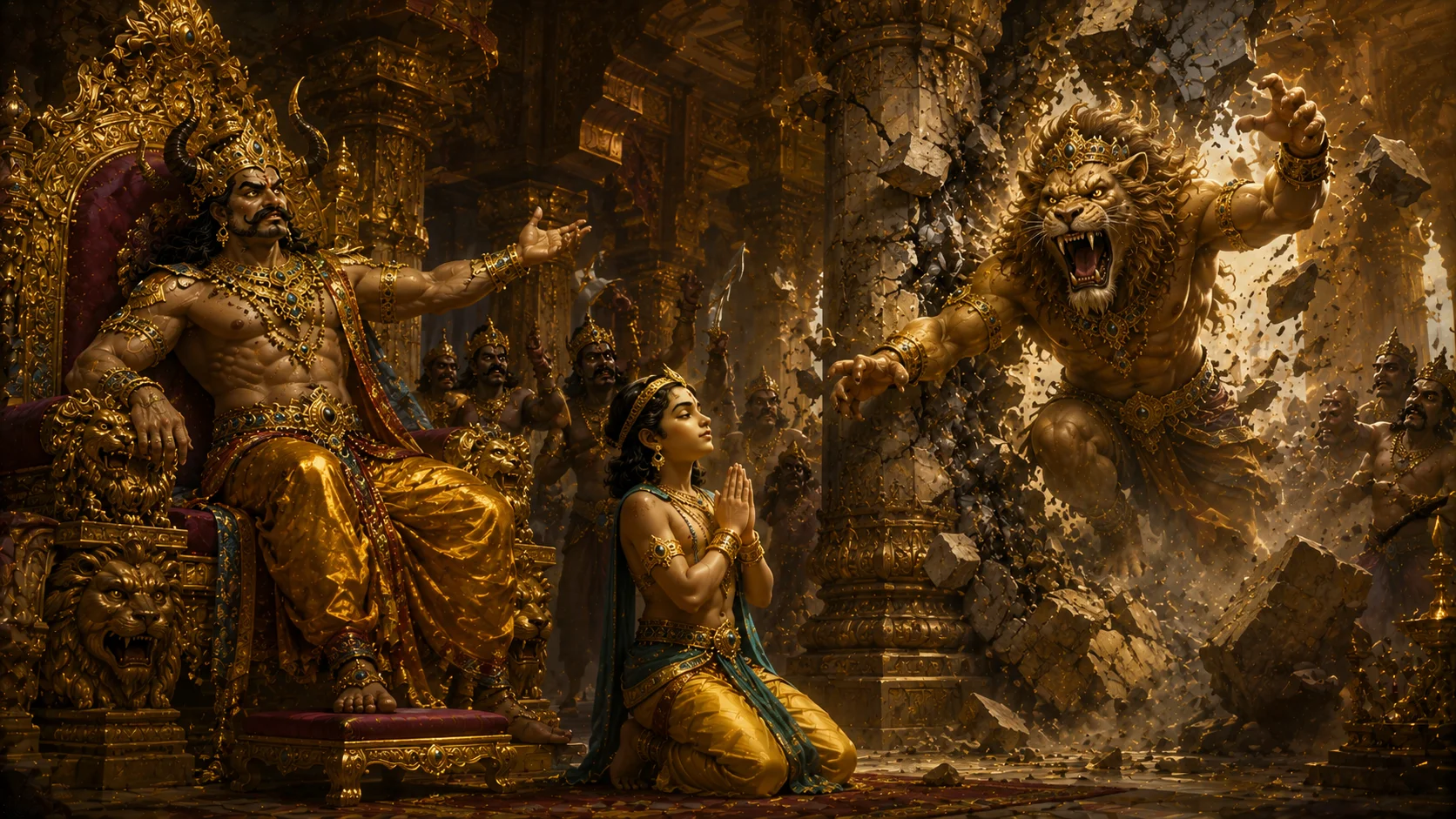
Hiranyakashipu seized on the claim as proof of his son's folly. If Vishnu truly filled a mere pillar of stone, then striking it would settle the matter once and for all. In a fit of contempt for what he took to be a child's naive faith, he struck the pillar — and the hall that had been built to declare Hiranyakashipu the only god now split open to reveal that Prahlada had been telling the truth all along.
Narasimha Breaks the Pillar
From the shattered column emerged Narasimha, Vishnu's avatar in the form of a being with the body of a man and the head of a lion — a form that had never existed before that instant, and one that no clause of Hiranyakashipu's boon had ever accounted for. Narasimha was neither wholly man nor wholly beast, and so satisfied, in a single body, the very first condition that the golden-clad king had believed made him safe.
The Threshold at Twilight
What followed was not a battle so much as the methodical closing of every door Hiranyakashipu had thought he had sealed. Narasimha seized the demon-king not within the hall and not beyond it, but at its threshold — neither indoors nor outdoors. The hour was neither day nor night, but the grey interval of twilight between them. Narasimha raised Hiranyakashipu onto his own lap, a place that was neither the earth beneath nor the open sky above. He tore into him with his bare claws, wielding no weapon at all. And because Narasimha was a form of the eternal, undying Vishnu even while embodied in a being freshly manifest, the killer belonged to neither the ranks of the strictly living nor the dead as Hiranyakashipu had understood the term. Clause by clause, the boon that had seemed to abolish every category of death was fulfilled to the letter — and undone by it.
Every Clause Honored, Every Defense Broken
What makes the death of Hiranyakashipu one of the most told episodes of the Dashavatara, and a centerpiece of the seventh canto of the Bhagavata Purana, is precisely this quality of exactness. Narasimha did not overpower the boon or set it aside — every single condition Hiranyakashipu had extracted from Brahma was honored in full. The god's ingenuity lay not in breaking the promise but in occupying the narrow, impossible space between its clauses that a being of overwhelming pride had never thought to guard, because he had never imagined such a space could exist.
Pride Undone, Devotion Honored
The episode carries a meaning beyond the mechanics of the boon itself. Hiranyakashipu stands as the embodiment of asura ahamkara — demonic pride and self-regard carried to the point of demanding the worship due to the divine — and his destruction represents that pride meeting an intelligence it could never out-negotiate. Just as significant is what the story preserves alongside the tyrant's fall: it was not fought to punish Hiranyakashipu for its own sake, but to protect Prahlada, whose devotion never wavered through poison, trampling, fire, and the cliff's edge. The god's ingenuity and the son's faith are two halves of the same act.
A Devotee's Day, Not a Demon's
The memory of this episode is kept alive each year at Narasimha Jayanti, an observance held in honor of the myth — and it is telling that the day commemorates the god's protection of his devotee rather than the death of the king who demanded worship. What is celebrated is not the fall of Hiranyakashipu but the faithfulness that outlasted him: a son who would not call his father god, and a god who came, in a form no boon had anticipated, to make sure he never had to.
The proud demon-king whose cunning boon made him unkillable by man or beast, by day or night, inside or out — undone, in the impossible space between all his defences, by the man-lion Narasimha, to save his devout son Prahlada.
Sources & traditions
- EncyclopediaWikipedia — Hiranyakashipu
- TraditionHindu texts, oral tradition and village tellings (South Asia)
Myths change from area to area and from time to time. This chronicle follows the most widely told versions; tellings in other villages, regions and eras may differ.