Prahlada — Prahlāda — is the child-saint of Hindu devotion: the boy who loved Vishnu so unshakeably that not even his own father, the demon-king Hiranyakashipu, could break him — and whose torment summoned the man-lion avatar Narasimha to tear the tyrant apart. He is the supreme example of bhakti triumphing over power, and the rare asura who is honoured as one of the greatest devotees in all of Hindu tradition.
A Devotee Born Into the Demon's Line
Prahlada's lineage runs straight through the heart of the conflict he was born to embody. He was the son of Hiranyakashipu, the asura-king, and his wife Kayadhu, and through his father he was the grandson of the sage Kashyapa and Diti — the mother of the daitya line. By blood he was demon through and through. By devotion he was something else entirely: a lifelong worshipper of the very god his family had every reason to despise, since Vishnu had already slain Hiranyakashipu's brother Hiranyaksha. That contradiction — asura by birth, Vaishnava by heart — is the whole of Prahlada's story compressed into a single fact of parentage.
A Faith Planted Before Birth
According to the Bhagavata Purana, Prahlada's devotion was not something he grew into as a child; it was instilled while he was still unborn. While Hiranyakashipu was away performing the great austerities that would win him his near-invincibility from Brahma, the sage Narada took his mother Kayadhu under his guidance and instructed her in the practice of Vishnu-bhakti. The teaching reached the child in her womb. By the account the tradition keeps, Prahlada therefore entered the world already formed in devotion, before he had ever seen his father's court or heard his father's ban — a saint before he was a son.
Treason in His Father's House
Hiranyakashipu's decree was absolute: no deity but himself was to be worshipped anywhere in his domain, and Vishnu least of all. Prahlada refused. He would not renounce his devotion, would not bow to his father as a god, and would not be silenced even as the one child of the royal house who stood against the throne's own law. To a king who had bent heaven and earth to his boon, a small son's quiet refusal was the one thing his power could not immediately answer — and it was treason of the most intimate kind, committed inside his own walls by his own blood.
Poison, Elephants, Fire, and the Cliff
What followed was a father's campaign to destroy his own child. Hiranyakashipu ordered Prahlada poisoned. He had him thrown before charging elephants to be trampled. He had him cast into fire. He had him hurled from a cliff. He set venomous serpents on him. Each attempt failed, not through any resistance Prahlada offered — he offered none — but because Vishnu's protection answered every method the king devised. The boy endured each trial in the same untroubled devotion, and each time he emerged from what should have killed him, the record of the attempt itself became further proof of the very god his father was trying to erase from his house.
Holika's Fire
The most enduring of these episodes is the one still marked every year at the season's turn. Hiranyakashipu's sister Holika possessed a boon that made her immune to fire, and she used it in an attempt to end the matter herself: she took Prahlada into her lap and sat with him inside a blazing pyre, trusting her immunity to protect her while the flames consumed the boy. It did not work as she intended. Her boon could not be turned to harm the innocent, and the protection failed her precisely because her purpose was wicked — Holika burned in the fire she had lit, and Prahlada walked out of it untouched. It is this episode, not any other, that the bonfire ritual of Holika Dahan re-enacts on the eve of Holi: the burning of Holika, and the survival of the devotee she tried to destroy.
Is Your God in This Pillar?
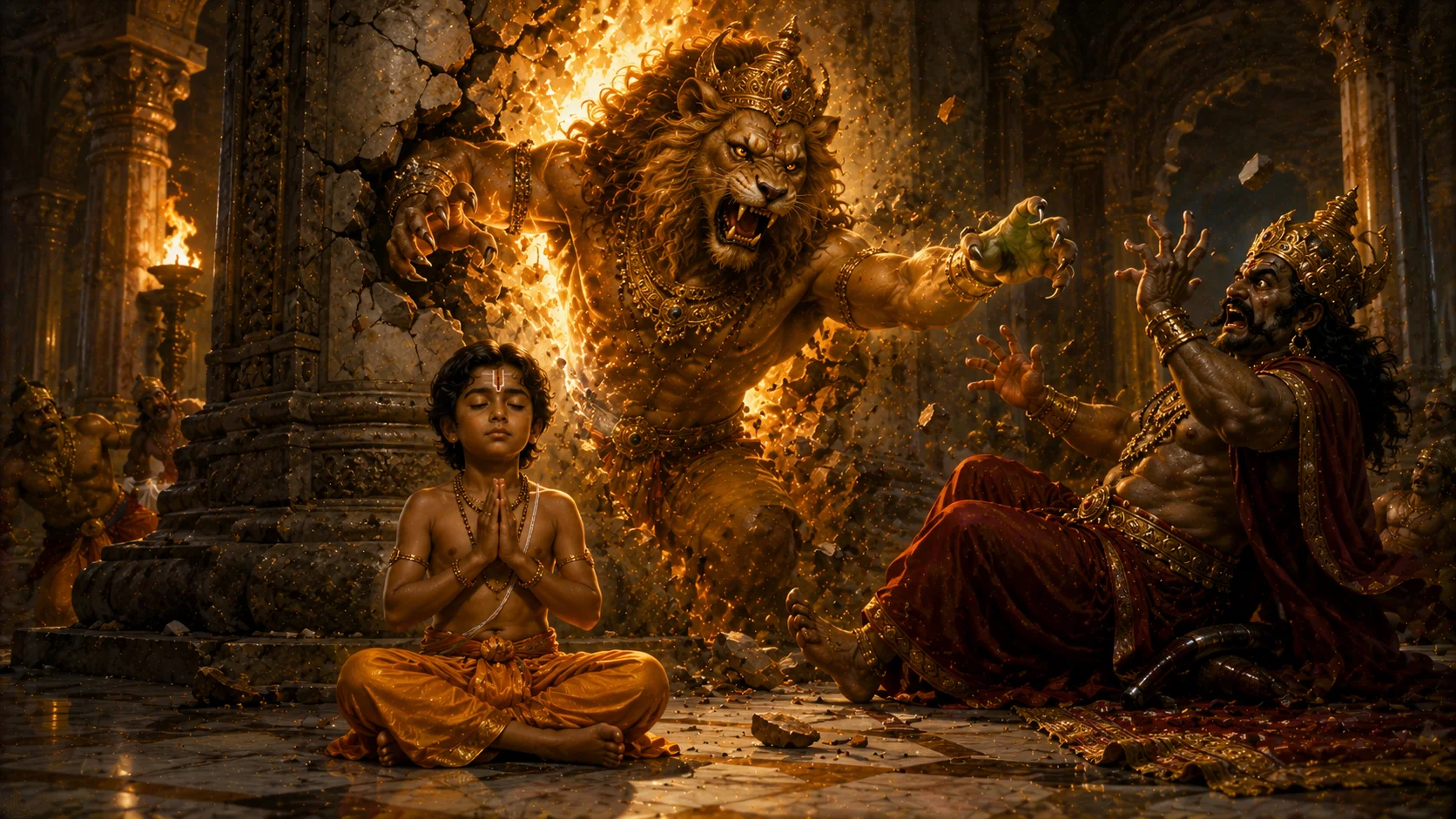
Hiranyakashipu's fury finally reached the point of open confrontation. He demanded to know whether Vishnu, whom Prahlada insisted was present everywhere, could truly be found in the palace hall itself — in a pillar, an ordinary column of stone. Prahlada's answer was as steady as everything else about him: yes, Vishnu is there too. Hiranyakashipu struck the pillar in rage and contempt, daring the god his son worshipped to show himself in the one place a king's own hand could reach. It was this single act — the demand made of a child, and the child's calm refusal to soften his claim — that brought the confrontation to its breaking point and called the avatar into being.
The Man-Lion Answers
The pillar split, and from within it came Narasimha — the man-lion, a form that belonged to no category Hiranyakashipu's boon had accounted for. Not man, not beast, and so untouched by every clause the king had extracted from Brahma to make himself unkillable. What Prahlada's declaration had provoked, the avatar now completed: Hiranyakashipu was struck down by the very form his son's unwavering faith had summoned, a death made possible only because the boy would not recant even to save his own life.
Crowned in His Father's Place
With the tyrant dead, Prahlada was installed as the new king of the asuras and daityas — his father's throne passing not to another conqueror but to the son who had survived every attempt to remove him from it. He ruled as a devotee-king, his kingship an extension of the same devotion that had nearly cost him his life rather than a reward separate from it. It is a striking inversion: the demon lineage, having tried everything to extinguish a rival faith within itself, ends up ruled by that faith instead.
A Line That Reaches Bali
Prahlada's devotion did not end with his own generation. His son was Virochana, and Virochana's son was Bali — the great asura-king Mahabali, whose own story unfolds in the tale of the Vamana avatar. Through this line, Prahlada stands as grandfather to one of the other pivotal figures in Vishnu's mythology, so that two of the tradition's most consequential avatar narratives, Narasimha's and Vamana's, are bound together by a single family descending from one devoted child.
Counted Among the Twelve
Later tradition does not treat Prahlada as an isolated wonder-story but places him formally among the Mahajanas — the twelve great devotees recognised in the Bhagavata Purana as authorities on dharma and bhakti. He is named there alongside figures such as Narada and Bhishma and Dhruva, a company of teachers and exemplars whose lives are held up as models of how devotion is to be lived. For Prahlada specifically, that model is endurance under persecution rather than triumph through strength — his authority rests on what he survived and what he refused to renounce, not on any power of his own.
The Meaning Carried in His Name
Even his name is read as part of the same portrait. Prahlada is interpreted to mean "one who brings joy" or "supreme joy," and devotional tradition takes this as a description as much as a label — the boy's serenity did not waver even while he was being poisoned, trampled, burned, and thrown from cliffs. That steadiness, joy held constant through torment, is precisely what later Vaishnava literature returns to again and again when it needs a paradigm of what a child-devotee's faith looks like under the worst possible pressure.
Rites That Still Remember Him
Two observances trace their ritual meaning directly back to Prahlada's ordeal. Narasimha Jayanti marks the day of the avatar's emergence from the pillar to end Hiranyakashipu's reign. Holika Dahan, the bonfire lit the night before Holi, marks the burning of Holika and the boy who survived her flames. Neither festival is a general celebration borrowed for the occasion — both exist because of what happened to Prahlada specifically, and both are still kept as living observance rather than as history.
The Proof Bhakti Doesn't Ask Permission
What makes Prahlada endure as a figure of devotion, more than any single episode of his persecution, is what his whole story insists on: that the protection and regard of the divine answer to the sincerity of the one who calls, not to birth, not to power, and not to the will of whoever happens to rule. He was born into the household built to oppose Vishnu most completely, and it changed nothing in him. That is the entire claim his story makes, repeated once for every attempt made on his life, and it is why he remains the reference point for anyone persecuted for a faith they will not set down.
Sources & traditions
- EncyclopediaWikipedia — Prahlada
- TraditionHindu texts, oral tradition and village tellings (South Asia)
Myths change from area to area and from time to time. This chronicle follows the most widely told versions; tellings in other villages, regions and eras may differ.