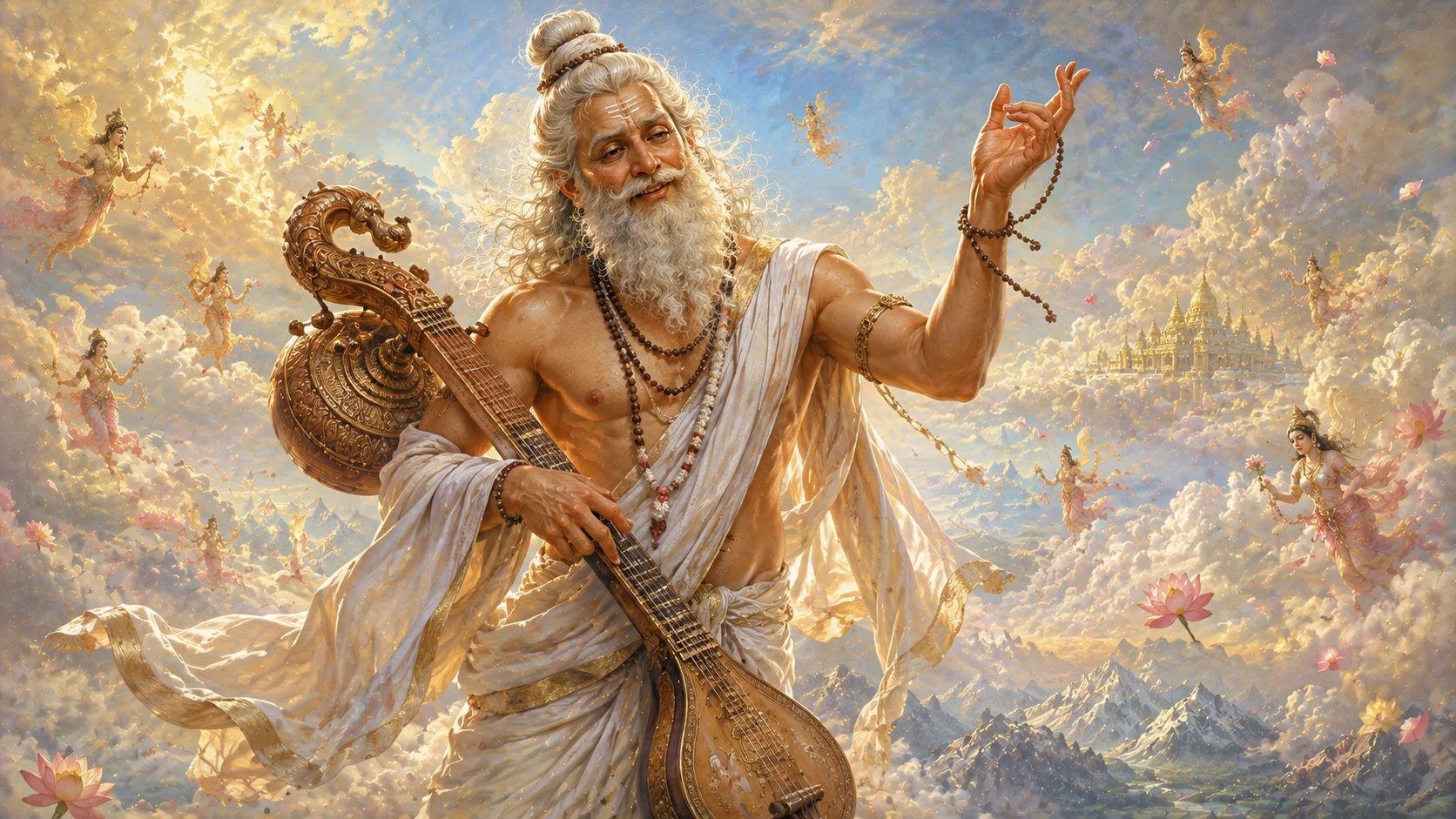
Narada — Nārada Muni — is the wandering divine sage of Hindu tradition: messenger of the gods, master musician, eternal traveller of the three worlds, and the great instigator whose mischief and music move countless myths. Strumming his vina and singing the name of Vishnu — "Narayana, Narayana" — he drifts between heaven, earth, and the underworld, carrying news, stirring trouble that turns out for the good, and serving as one of the foremost devotees of the Lord.
The Mind-Born Son of Brahma
Narada is counted among the manasaputras, the mind-born sons of Brahma, born directly from the creator's thought — a Prajapati among Prajapatis, one of the celestial rishis who came into being not through birth from a womb but through the sheer will of the world's maker. He is a brahmarshi, a brahmin-sage of the highest order, and a devarishi, a sage among the gods, ranked alongside — though not always numbered among — the Saptarishi, the great seven. He carries always his vina, named Mahati, and the small hand-cymbals or kartals that mark his ceaseless song, so that wherever Narada goes, music arrives with him.
A Voice Heard Across the Scriptures
Few figures in Hindu literature appear in as many places as Narada. He threads through the Vedas, moves through the great sweep of the Puranas, and steps into both epics as advisor, messenger, and moral instructor. This is not incidental cameo work — Narada's presence across such a span of text is itself part of his character: he is the itinerant transmitter of divine knowledge, the one figure equally at home reciting hymns to the gods, counselling a king, or narrating a parable to a grieving mortal. Wherever the tradition needed a bridge between worlds, Narada was already standing on it, vina in hand.
The Sage Who Set Valmiki Writing
Among Narada's most consequential appearances is the one that gives the world the Ramayana itself. It is Narada who comes to the sage Valmiki and narrates to him the story of Rama — the prince's virtue, his exile, his trials, and his triumph — and it is this narration that moves Valmiki to compose the epic that would become foundational to the whole of Hindu literature. In this role Narada is not a character within the story of Rama so much as the very reason the story exists in written, sung form at all: the sage who heard the tale from the gods and carried it down to the poet who would give it lasting shape.
Counsel in the Court of the Pandavas
In the Mahabharata, Narada appears again and again as advisor and messenger to the Pandavas and their kin. He counsels Yudhishthira directly, offering guidance in moments when the eldest Pandava wrestles with questions of duty and kingship, and he narrates moral tales to illustrate his teaching — among them the story of King Ambarisha, told to draw out a lesson about devotion, patience, and the protection the Lord extends to those who surrender to him. In every such episode Narada's method is the same: not command, but story — he teaches through narrative, trusting the tale itself to carry the lesson home.
Shaping a Devotion Before Birth
Narada's role in the Bhagavata Purana reaches further still. He is the one who instructs King Yudhishthira and others in the path of bhakti yoga, devotional surrender to the divine, and he stands at the very center of the Prahlada narrative — not merely as an observer of the boy-devotee's later trials, but as the sage who instructed Prahlada's mother during her pregnancy, planting the seed of unwavering devotion to Vishnu before the child was even born. In this telling, Prahlada's famous steadfastness against his own demon father's persecution has its origin in words spoken by Narada to a mother carrying her unborn son — devotion transmitted before the world had even met the one who would embody it.
The Wandering Chant of Narayana
Above every other trait, Narada is remembered as a devotee — perhaps the supreme devotee of Vishnu in the whole of Hindu tradition. He travels ceaselessly between the worlds of gods, mortals, and the underworld, and wherever he goes he is heard before he is seen, chanting "Narayana, Narayana," the name of the Lord repeated as both prayer and identity. This chant is so bound up with his character that it has become emblematic of him: to imagine Narada is to imagine that phrase on his lips, the vina Mahati under his arm, moving restlessly from one world to the next.
The Sage Who Humbles the Proud
Narada is equally famous for a very different function — instigating the episodes that humble the vanity of the gods themselves. He provokes rivalries among deities and stirs the pride of gods and mortals alike, but always toward an end that reveals rather than destroys: pride exposed, arrogance tested, a moral truth made plain through the friction he causes. It is a role that sits at the heart of what tradition calls "Narada's mischief" — his apparent delight in setting one party against another — yet the mischief is never separated from purpose. The tension he stirs is always, in the end, in service of Vishnu's cosmic design, whether that design is the humbling of a proud deity or the setting in motion of a destined chain of events among mortals.
Between Instigation and Instruction
The duality at the center of Narada's character — mischief-maker and devoted teacher in the same figure — is not a contradiction the tradition tries to resolve so much as one it holds up as instructive in itself. He instigates conflicts and spreads gossip among gods and mortals, earning a reputation as a celestial troublemaker, and yet every account of his interference circles back to the same destination: service to Vishnu's cosmic plan, or to dharma more broadly. Whether he is carrying a rumor between courts or narrating a parable to a king, the underlying current is constant even when the surface behavior looks like meddling.
Composer and Keeper of a Teaching on Love
Narada's authority is not confined to what he witnesses or narrates — tradition credits him as composer or narrator-transmitter of several texts, chief among them the Narada Bhakti Sutra, a foundational work on the path of loving devotion. The text bearing his name treats bhakti not as one path among many but as a complete and sufficient way to the divine, and portions of the Puranas carry his voice or his transmission as well. In later Vaishnava tradition, and especially within Gaudiya Vaishnavism, Narada is revered as the exemplar of pure bhakti — the archetypal spiritual teacher, or guru, of devotional practice, a status that flows directly from both the content of the Bhakti Sutra and the example of his own unceasing devotion.
A Mediator of the Three Worlds
Underneath every individual episode lies a single symbolic role: Narada as the mediator who bridges heaven, earth, and the underworld. He is not attached to any one realm the way most deities and sages are; his defining motion is travel itself, carrying divine knowledge in one direction and news — or gossip — in the other. This is what allows him to appear so often at the hinge point of a story: he is, structurally, the figure whose whole function is to connect what would otherwise remain separate, whether that means bringing the gods' concerns to mortals or carrying a mortal's story back up to become scripture.
An Enduring, Restless Presence
Across the Vedas, the epics, and above all the Puranas, Narada endures as one of the most vivid and best-loved figures in the tradition — not a distant, static deity but a restless, singing, ever-arriving presence. He is honoured as a patron of music, invoked by musicians who see in his vina and his endless traveling song a model for their own art. He is teacher to kings and children alike, narrator of the epic that shaped a civilization's imagination, and the sage whose interference in the affairs of gods and mortals is remembered less as trouble than as instruction — the holy wanderer whose every intrigue, in the end, serves the will of the Lord he never stops naming.
Sources & traditions
- EncyclopediaWikipedia — Narada
- TraditionHindu texts, oral tradition and village tellings (South Asia)
Myths change from area to area and from time to time. This chronicle follows the most widely told versions; tellings in other villages, regions and eras may differ.