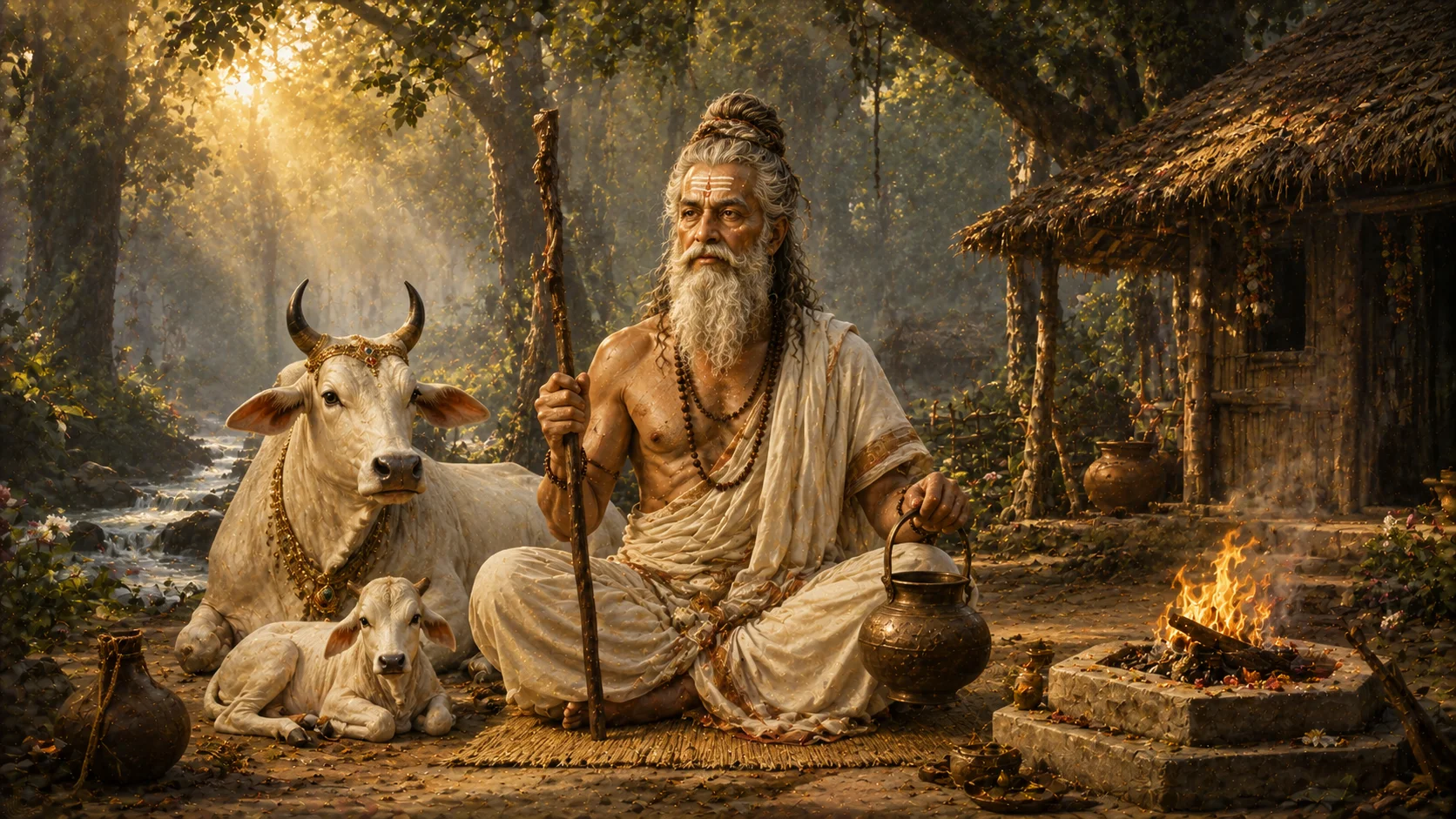
Vasishtha — Vasiṣṭha — is the foremost of the saptarishi, the seven great sages, and the archetypal rajaguru, preceptor of kings. Owner of the wish-granting cow Nandini (daughter of Kamadhenu), guru of the solar dynasty into which Rama was born, and the great rival of the warrior-turned-sage Vishvamitra, Vasishtha embodies the perfected brahmin: serene, immovable, and possessed of a spiritual power no king's army can overcome.
The Sage With Two Births
Even the manner of Vasishtha's arrival in the world is told two ways, and the tradition has never troubled itself to settle the contradiction. In one account he is manasaputra — a mind-born son of Brahma, conjured directly from the creator's will rather than any womb. In another, older strand, he shares his origin with Agastya: both sages are said to spring from the seed of the gods Mitra and Varuna, spilled into a single vessel, making the two rishis brothers of the pitcher rather than of blood. Puranic redactors never forced a choice between the two stories, and later tradition simply lets both stand — a mind-born seer in one telling, a jar-born one in another, equally Vasishtha in either case.
Arundhati, the Star That Cannot Be Lost
Vasishtha is wedded to Arundhati, held up across the tradition as the very model of the devoted, chaste wife. Their union is written into the sky itself: Vasishtha is identified with the star known in the West as Mizar, in the handle of the Great Bear, and Arundhati with its faint companion, Alcor, orbiting so close to its partner that the two are all but a single point of light. At a Hindu wedding, the officiating priest still turns the newly married couple to face this pair of stars — the husband asked to see Arundhati beside her Vasishtha as the emblem of a marriage that time and distance cannot part. Few rishis are remembered as much through their wives as through their own austerities; Vasishtha is one, and Arundhati's fidelity is inseparable from his own authority.
Keeper of the Cow That Refuses No One
At the heart of Vasishtha's fame sits Nandini, the wish-fulfilling cow born of the celestial Kamadhenu and kept at his forest hermitage. The Puranas describe Nandini's power in terms of pure, effortless abundance: at a word from her keeper she can conjure a feast, an army, or an entire treasury out of nothing. She belongs to no king and asks nothing of the world; she gives because Vasishtha, and only Vasishtha, commands her. It is this cow — not land, not wealth, not any weapon — that becomes the single object over which the sage's entire life is thrown into conflict with a king who cannot accept that a hermit's cattle-shed outmatches his throne.
The King Who Coveted a Cow
The rivalry with Vishvamitra begins, in every version the tradition preserves, at Vasishtha's own hermitage. Vishvamitra, still a reigning king rather than the sage he would become, arrives with his army and is astonished when Nandini feeds the entire host from nothing. Where hospitality should have ended the matter, covetousness took over: the king tried to seize the cow by force. Nandini, at Vasishtha's bidding, answered force with force, producing warriors of her own who scattered the king's soldiers. For a king whose entire identity rested on martial supremacy, the humiliation was total — his armies had been broken not by another army but by an animal obeying a hermit's word. Vishvamitra's response was not retreat but transformation: he abandoned his throne and turned to penance, determined to win by austerity what he could not take by force.
A Rivalry That Outlived a Kingdom
What began over a cow widened, across the accounts, into the defining enmity of both sages' lives. Vishvamitra, kshatriya-born, pursued spiritual power the way he had once pursued conquest — relentlessly, and in direct competition with the brahmin who had bested him. The Puranas and the Mahabharata record that in the course of this long war between them, Vishvamitra brought about the deaths of Vasishtha's hundred sons — the exact means differ from telling to telling, sorcery in some, curse in others — a wound that struck at the one thing austerity cannot easily repair. And yet the tradition's emphasis falls less on the injury than on what Vasishtha did not do with it: he possessed spiritual force sufficient to destroy Vishvamitra outright and never used it. That restraint, sustained through decades of provocation, is remembered as harder-won and more telling than any curse Vishvamitra could produce.
The Word Brahmarishi
Vishvamitra's ambition was never simply power for its own sake — it was recognition, specifically the title Brahmarishi, the rank of a fully realized sage, which by birth alone he could never claim. Across trial after trial, austerity after austerity, he pressed toward that title, and it was Vasishtha — the very rival whose authority he had set out to rival — who eventually acknowledged it. The moment carries the weight of the whole story: a title that could not be seized is finally given, and given by the one man whose judgment on the matter could not be disputed. Hindu tradition reads the pairing of these two sages as its clearest statement on what brahminhood actually is — not an accident of birth and not a trophy of willpower alone, but something that only self-mastery, tested against real loss, can prove.
Priest to a Line of Kings
Long before Rama's birth, Vasishtha already held the office of kula-guru — family priest and preceptor — to the Ikshvaku dynasty, the solar line ruling from Ayodhya. He served King Dasharatha in this capacity, presiding over the rites of the royal household and holding the position of trusted counsel that a dynasty's priest occupies across generations, not merely a single reign. It is in this inherited role, rather than as a stranger arriving late in the story, that Vasishtha enters the life of Dasharatha's sons.
Teacher to the Prince of Ayodhya
Vasishtha's guidance of Rama and his brothers runs through their upbringing and instruction in dharma, the sage functioning as the family's moral and ritual anchor as much as its priest. When Rama returns to Ayodhya at the end of his exile, it is Vasishtha who holds a central, ceremonial place in the coronation that restores the prince to his throne — the same office that had guided Dasharatha now consecrating his son. Across the Ramayana, Vasishtha's presence at the court is less an isolated appearance than the continuation of a relationship the dynasty had relied on for generations.
A Dialogue on the Unreal World
Tradition also credits Vasishtha as the voice on one side of the Yoga Vasishtha, an extensive philosophical dialogue conducted with the young Rama on the nature of reality, consciousness, and liberation — a text firmly within the tradition of Advaita Vedanta. Scholars studying the work's language and ideas generally place its actual composition much later than the Vedic period in which Vasishtha himself is set, treating the sage less as its historical author than as the dialogue's chosen frame — a figure whose stature as Rama's own teacher made him the natural voice to carry such a conversation, whatever hand actually wrote it down.
Verses of the Seventh Mandala
Vasishtha's oldest and most secure claim to fame lies not in epic or Purana but in the Rigveda itself, where he is counted among the seers credited with composing its hymns — his name and that of his school concentrated especially in the seventh mandala. Tradition further holds him among the major redactors who helped shape the Rigveda into the form it has been transmitted in. This place in the Veda's own authorship is what anchors everything told of him later: the epic guru and the rival of Vishvamitra is, before any of that, a hymn-maker whose verses were sung at the fire.
Lawgiver for a Lineage
Beyond hymn and epic, Vasishtha is also named as the author of the Vasishtha Dharmasutra, one of the ancient sources contributing to Hindu law and conduct, and is separately associated with a Vasishtha Samhita, a dharma-shastra text bearing his name. Together with his standing as a Vedic seer, this gives him a double authority rare even among the saptarishi: the voice behind sacred verse and, in a related but distinct tradition, a voice behind the codes governing how life should be lived by it. His gotra, the lineage traced back to him, remains among the major Brahmin gotras still claimed by descendants today — a continuity that makes Vasishtha not only a figure of old story but a living line of descent.
One of the Seven Who Watch Every Age
As one of the saptarishi, Vasishtha is not confined to a single epoch; Puranic cosmology holds that a set of seven great sages presides over each cosmic age in turn, with Vasishtha counted among their recurring number. This cyclical presence, layered on top of his fixed roles as Vedic seer, royal guru, and rival of Vishvamitra, is part of what gives him his particular stature — a sage attached not to one moment of myth but to the turning of time itself, visible nightly, still, in the stars that carry his and Arundhati's names.
The Stillness at the Center of the Storm
Set beside Vishvamitra — a king who clawed his way to sagehood through raw effort and will — Vasishtha represents the opposite path to the same summit: authority born and then proven, tested by grief, provocation, and decades of a rival's hostility, and never once answered with the destructive power it could easily have wielded. That is the image the tradition finally settles on him: not a warrior-sage hurling curses, but a calm, unmovable figure at court and hermitage alike, a preceptor whose power needed no display because it had already survived every test put to it.
Sources & traditions
- EncyclopediaWikipedia — Vasishtha
- TraditionHindu texts, oral tradition and village tellings (South Asia)
Myths change from area to area and from time to time. This chronicle follows the most widely told versions; tellings in other villages, regions and eras may differ.