Kamadhenu is the divine wish-fulfilling cow of Hindu myth — the sacred mother of all cattle, the cow of plenty who grants every wish and desire, who arose from the churning of the cosmic ocean, the embodiment of abundance, nourishment and the sacred cow. The wish-fulfilling cow, Kamadhenu is the divine mother-cow of abundance who grants every wish and feeds the world.
The Wish-Fulfilling Cow
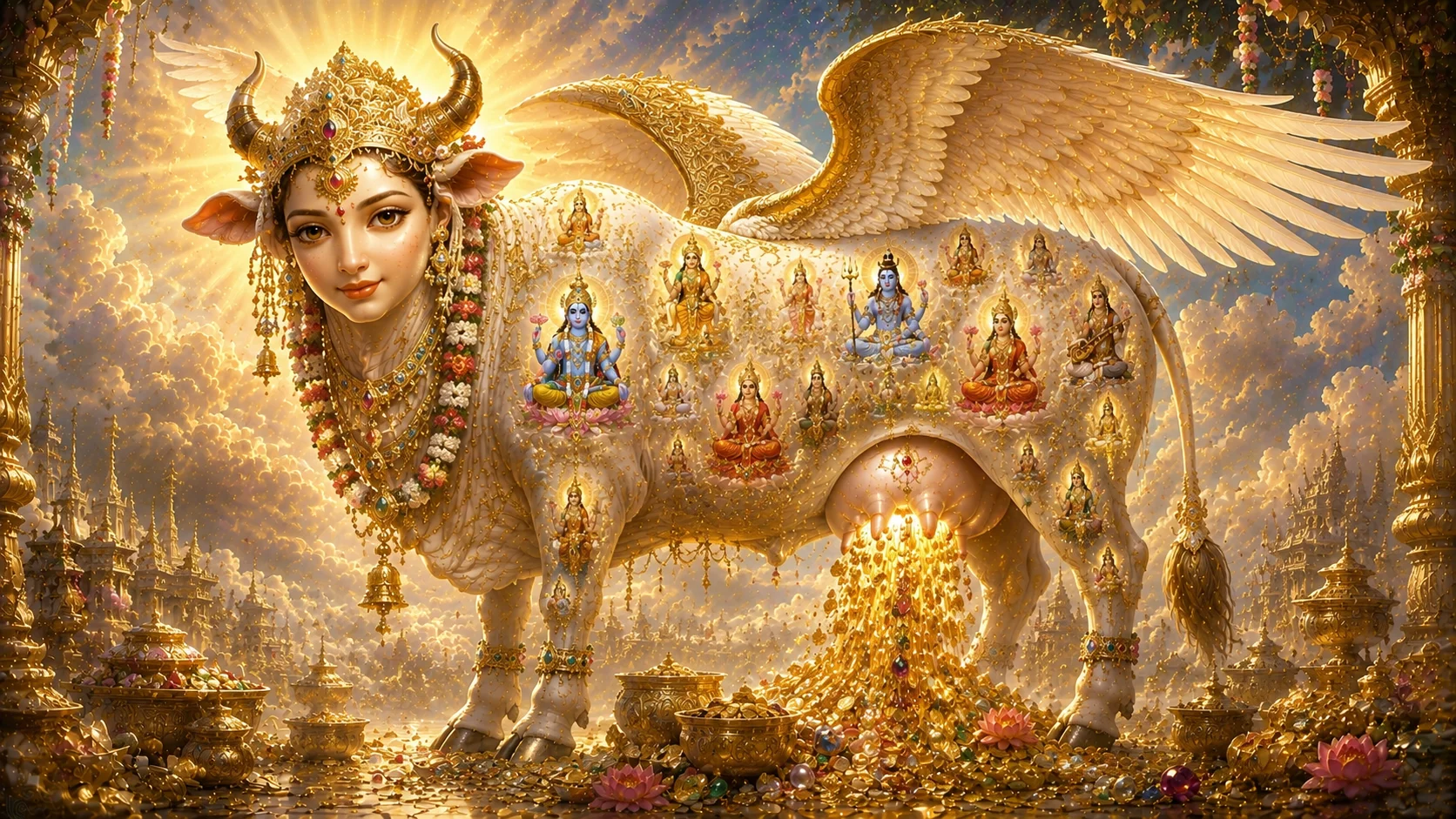
Kamadhenu (Sanskrit Kāmadhenu, “the wish-fulfilling cow” — from kama, “desire, wish,” and dhenu, “cow”) is the divine cow of plenty, the wish-granting cow who can grant any wish and provide whatever is desired. She is the sacred mother of all cattle, the source of abundance and nourishment, who from her udder pours forth not only milk but all that one might wish for — food, wealth, prosperity, anything desired. She is often depicted as a beautiful cow, sometimes with the head or features of a woman, with wings, or with deities residing in her various parts (for she is said to contain all the gods within her body). She is the embodiment of the sacred cow, abundance, and the fulfilment of all desires.
Born of the Churning Ocean
Kamadhenu, like the other great treasures, arose from the churning of the ocean of milk (the Samudra Manthana) — one of the wondrous treasures that emerged from the churned cosmic deep, the divine wish-fulfilling cow given to the world (or to the sages) as a source of abundance and the fulfilment of wishes. She is thus one of the divine treasures of the churning, the cow of plenty born from the cosmic ocean.
The Cow of the Sages
Kamadhenu (and her famous daughter or form Nandini, and the cow Surabhi) appears in many tales as the treasured wish-fulfilling cow of great sages — possessed by sages such as Vasishtha and Jamadagni, providing them with all they needed and the means to perform great hospitality and rituals. Her possession by a sage often led to conflict: kings, coveting the wish-granting cow, tried to seize her by force — as when King Vishvamitra (then a king) tried to take Vasishtha's cow Kamadhenu/Nandini by force, and the cow, by her divine power, produced armies that defeated the king's forces, a humiliation that led Vishvamitra to abandon his throne and become a great sage. These tales show Kamadhenu's immense power and the abundance and even military might she could produce, the divine cow whose wish-granting power was coveted by kings and treasured by sages.
The Sacred Cow of Abundance
Kamadhenu endures as the divine wish-fulfilling cow of Hindu myth — the sacred mother of all cattle, the cow of plenty who grants every wish, who arose from the churning of the cosmic ocean, the embodiment of abundance and the sacred cow. She embodies the Hindu reverence for the cow as a sacred source of nourishment and abundance, the fulfilment of all desires, and the divine motherhood of plenty; and she stands as the wish-fulfilling cow — the divine mother-cow who pours forth all that is desired, the sacred cow of abundance who grants every wish, feeds the world, and contains all the gods within her.
The divine wish-fulfilling cow, mother of all cattle, who pours forth from her udder all that is desired — the sacred cow of plenty, born of the churning ocean, who grants every wish and contains all the gods within her.
The Cow Before the Goddess
To understand why India dreamed a cow who grants wishes, begin with what a cow was worth. In the world of the Rigveda, cattle were not one asset among several; they were the measure against which everything else was counted, the thing a family owned, inherited, quarrelled over and prayed for. One of the hymns’ ordinary words for a wealthy man is gomat, “possessed of cattle.” The Vedic word for a raid is gaviṣṭi, literally “the seeking of cows.” The word for a lineage, gotra, is literally a cow-pen: your ancestry was the enclosure your herd shared. And when the hymns want an image for the first light of morning, they reach for cattle again — the rays of dawn are cows released from a dark byre, and one of Indra’s signature feats is splitting the Vala rock to drive out the herds the Paṇis had hidden inside it. The sun comes up, in that imagery, because a god recovered stolen cows.
Into that same body of hymns comes an epithet that would outlast the religion which coined it: the cow is aghnya, “she who is not to be slain.” A wish-fulfilling cow is not, in such a world, an exotic invention. She is the logical extreme of an ordinary observation — that a single animal quietly produced milk, curds, butter for the fire-offering, dung for fuel and floors, calves for the plough, and did it again next year without being consumed. Kamadhenu is what happens when a people who already believe abundance walks on four legs push that thought as far as it will go.
Surabhi, the Fragrant One — and the Trouble With Her Name
Kamadhenu is less a name than a job description: the cow (dhenu) of desire (kāma). The older and more properly personal name is Surabhi, “the fragrant one” — a title that says something about how the sacred was recognised, by the warm sweet smell of a well-kept byre rather than by any blaze of light. In the Puranic genealogies Surabhi is counted among the daughters of Daksha and given to the sage Kashyapa, and from that union descend the cattle of the world; almost every cow alive is, in this reckoning, her child.
But the texts refuse to keep her singular. The wish-cow of the sage Vasishtha is called Nandini in the Mahabharata and Shabala in the Ramayana; elsewhere Nandini is Surabhi’s daughter rather than Surabhi herself. Some passages set her in Goloka, the cow-world above the heavens; others place her far below, in Rasatala, among the deepest of the underworlds. This inconsistency is not sloppiness. Kamadhenu behaves in the literature less like a character with a biography than like a capacity — the wish-granting power that any sufficiently holy cow may turn out to possess. Ask which cow she is and the answer keeps coming back: whichever one a sage has been given, and a king is about to try to take.
She should not be confused with Nandi, the bull who kneels before every Shiva shrine. He is a doorkeeper and a mount; she is a source. The similarity of the names has muddled more than one modern retelling.
The Cow Theft That Set the Mahabharata Running
The longest poem in the world begins, if you follow the causes back far enough, with a stolen cow.
The Mahabharata tells how the eight Vasus, minor gods of the natural elements, came upon Vasishtha’s cow Nandini while wandering with their wives. One wife wanted the cow — not for milk, but because a mortal friend of hers would be made ageless by drinking it. Her husband, Dyaus, took the animal. Vasishtha returned to an emptied hermitage, understood at once what had happened, and cursed the eight of them to be born as men, which for a god is the cruellest sentence available.
The Vasus begged for mitigation and got a bargain: seven would be released almost at once, but Dyaus, who had actually laid hands on the cow, must live out a full human life. So they arranged to be born to the river-goddess Ganga, who married King Shantanu on the condition that he never question what she did. She drowned seven newborn sons in her own waters, releasing them; when Shantanu finally broke and cried out at the eighth, that son was left alive — Devavrata, who would be called Bhishma. His terrible vow of celibacy, the succession crisis it created, the whole slow catastrophe that ends at Kurukshetra: all of it is set running because a god coveted a cow he had no right to.
Jamadagni’s Cow and the Axe of Parashurama
The other great cow-theft is bloodier and more explicit about what it means. The sage Jamadagni kept a wish-fulfilling cow, and with her he could feed any guest who arrived, however large the retinue. The Haihaya king Kartavirya Arjuna, a thousand-armed conqueror, came to the hermitage and was entertained on a scale no royal kitchen could match. He worked out where the food was coming from, decided that so useful an animal belonged to a king rather than to a forest ascetic, and took her by force. In the tellings, Jamadagni was killed — by the king or by his sons, depending on the version — and the sage’s son Parashurama, Rama-with-the-axe, answered by destroying the warrior class twenty-one times over.
Read the cow-thefts side by side and a single grammar emerges. The wish-cow is always in the keeping of someone with no army. Someone with an army always wants her. And the seizure never, in any version, works: it produces armies out of the cow’s own body, or a curse, or an avatar with an axe. In the Ramayana’s account of Vishvamitra’s raid — the confrontation that ended his kingship — the warriors Shabala pours out to defend herself are named for real peoples on the northwestern edge of the Sanskrit world: Yavanas, Shakas, Pahlavas, Kambojas. The cow’s defenders are drawn, in other words, from the roll of outsiders the poem’s first audience actually knew.
The Earth Herself Is a Cow
The wish-cow is not an isolated fancy; she is one instance of a much larger habit of thought, in which anything that yields is imagined as something that can be milked. When King Prithu found the earth barren and hoarding her seed, she fled him in the form of a cow, and he pursued her with his bow until she consented to be milked instead of destroyed. Every order of being then took its turn at her udder, each with its own calf and its own vessel, each drawing out what it needed: the sages drew forth sacred learning, the gods their vigour, human beings grain, the serpents their venom. The earth is called Prithvi after the king who bargained with her rather than plundered her.
The same image returns at the darkest hour of the epics, when the earth, overloaded by the cruelty of her rulers, goes up to the gods in cow-form to complain of the weight she carries — and the answer to her lowing is an incarnation. Abundance in this tradition is never a hoard to be broken open. It is a flow, and it comes on the condition that you approach the source as a milker and not as a butcher.
How to Recognise Her
The image most people now picture — a white cow with the face and bust of a woman, a peacock’s fanned tail, sometimes wings, deities packed into her flanks and legs and horns — is largely a creature of the last century and a half, carried by lithographed devotional prints, calendar art and temple posters rather than by ancient stone. Older sculpture and painting are content to show her simply as a cow, and usually with a calf at her side. The calf is the point. She is shown mid-act, in the moment of giving, not posed as a treasure.
The crowded modern print is nonetheless doing honest theological work, because the claim it illustrates is old: that the gods dwell in the cow, one to each part of her. Rendering that as anatomy turns a devotional statement into an argument — to strike her is to strike all of them at once.
Living With the Cow-Mother
Kamadhenu is not a closed chapter of mythology, and it would be a mistake to write about her only in the past tense. The reverence she personifies is practised daily. The five products of the cow — milk, curd, clarified butter, urine and dung — are combined as panchagavya and used in rites of purification and consecration. Go-dana, the gift of a cow to a brahmin or a temple, is ranked among the highest acts of giving, and in funerary practice a cow may be gifted so that the dead can cross the fearful river Vaitarani holding fast to her tail.
Cows are honoured by name in the festival calendar: at Gopashtami in the month of Kartika, when herds are washed, painted and garlanded; at Govatsa Dvadashi, which venerates cows with calves in the run-up to Diwali; at Mattu Pongal in the Tamil south, when working cattle are bathed, their horns polished and coloured, and they are fed from the new harvest. Goshalas — refuges where aged and unproductive cattle are kept until they die of their own accord — exist across India and Nepal and are sustained by ordinary donation. The sanctity has civic force as well: Article 48 of the Constitution of India, among the Directive Principles, asks the states to take steps towards prohibiting the slaughter of cows and calves and of other milch and draught cattle. Its modern politics are bitterly contested; its wording, notably, argues in the language of agriculture rather than of scripture.
Her Siblings in Abundance
Indian myth kept several answers to the question of what infinite plenty would look like, and it is worth seeing Kamadhenu among them. There is the Kalpavriksha, the wish-granting tree that rose from the same churned ocean she did, which yields whatever is asked of it. There is the Chintamani, the thought-jewel that fulfils a desire the moment it is held in mind. And there is the Akshaya Patra, the inexhaustible vessel given to Yudhishthira in his forest exile, which produced food each day until the queen had eaten — a bowl with a rule attached to it.
The differences are instructive. A tree is rooted and cannot be carried off. A jewel is portable, and anything that fits in a hand can change hands. The bowl runs on a schedule. Only the cow is alive; only the cow has to be looked after; only the cow can refuse — which is precisely why she is the one the moral tales choose. You cannot mistreat a jewel.
Why the Wish-Cow Endures
Every civilisation dreams of endless plenty, and each one reveals itself in the shape it gives to the dream. Europe imagined a purse that never emptied and a table that laid itself; the modern world imagines a machine. India imagined an animal that has to be fed, sheltered, protected and loved before it will give anything at all — and then gives more than it was given.
That is the quiet argument inside every Kamadhenu story. She is not treasure, because treasure can be seized and divided; she is a relationship, and the whole plot of her myths is what happens to people who mistake the one for the other. Kings keep making that mistake. They see the milk and reason that owning the cow means owning the flow, and every time the flow turns into armies, or curses, or an axe. The sages who keep her, meanwhile, are conspicuously poor. They possess a source of infinite wealth and use it to feed guests.
Underneath sits an anxiety no technology has retired: that the thing keeping you alive is fragile, breathing, and somebody else’s to take. A herd could be raided in a night, and with it went milk, ploughing, dung for the fire, everything. Kamadhenu is that fear turned inside out and made into a promise — the herd that cannot be lost, the udder that cannot run dry, the mother who does not stop. She survives because the fear did, and because the moral she carries is one every generation has to be taught again: that abundance is not what you take, but what you are trusted with.
Sources & traditions
- EncyclopediaWikipedia — Kamadhenu
- TraditionHindu texts, oral tradition and village tellings (South Asia)
Myths change from area to area and from time to time. This chronicle follows the most widely told versions; tellings in other villages, regions and eras may differ.