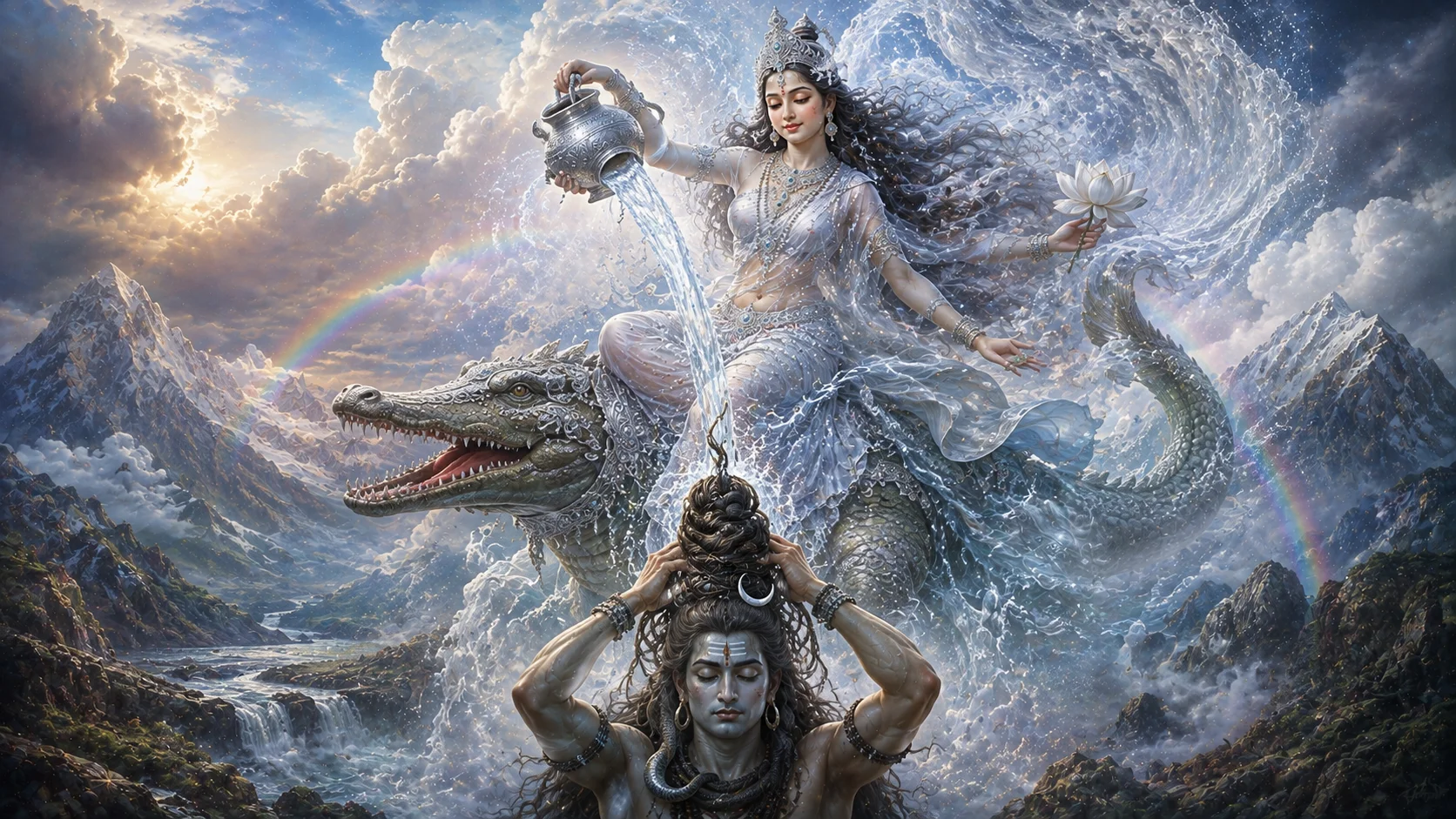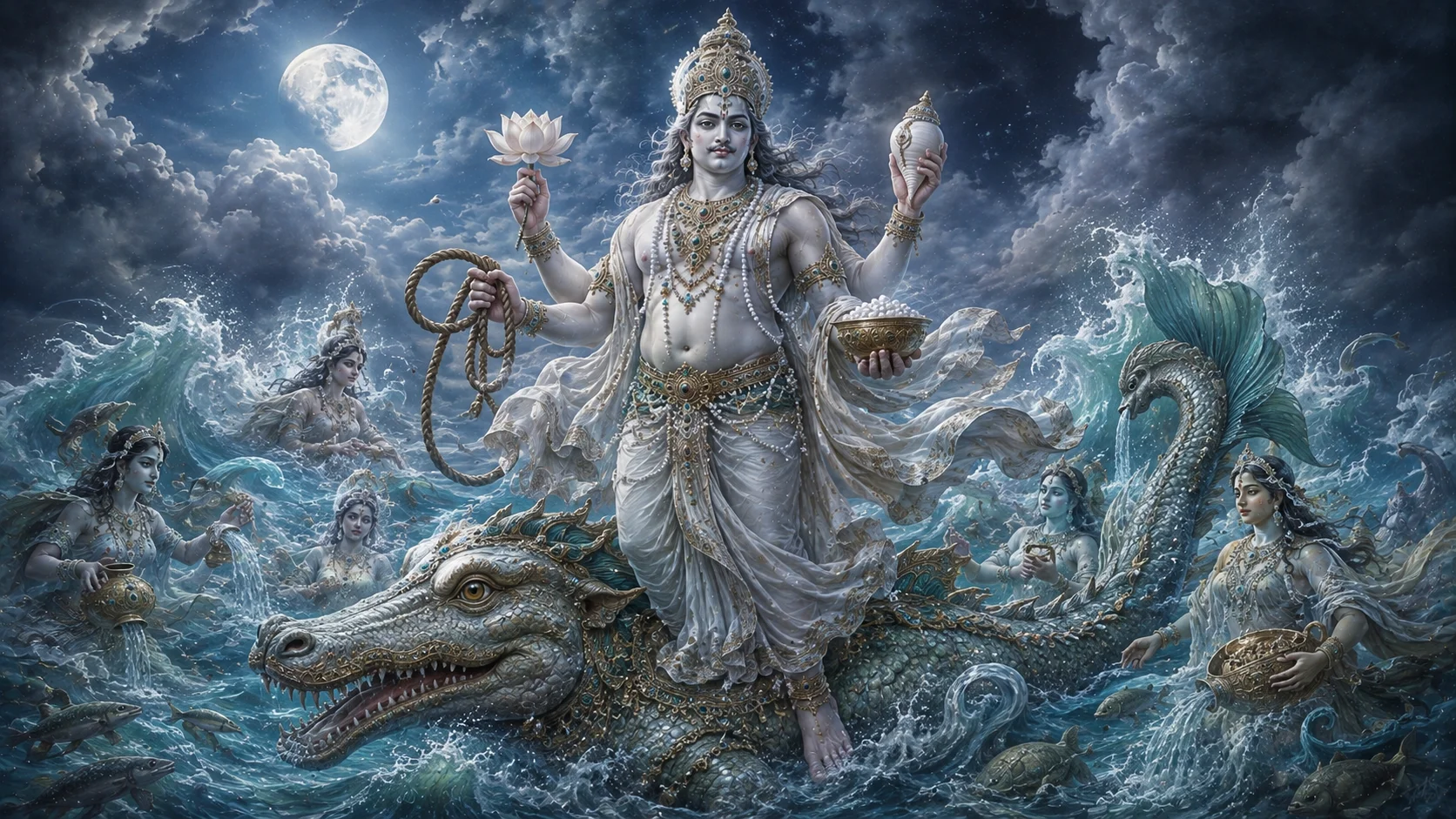
Markandeya — Mārkaṇḍeya — is the immortal boy-sage of Hindu legend: a devotee of Shiva so perfect that he conquered death itself and was granted eternal youth at sixteen. Forever a teenager across all the ages of the cosmos, he is the great witness-survivor of Hindu myth — the one being who lives through the dissolution of the universe and beholds the infant form of Vishnu floating on the cosmic waters.
A Son Bargained Out of Silence
Markandeya's story begins not with him but with his parents' longing. The sage Mrikandu, of the Bhrigu lineage, and his wife Marudvati — called Dharini in some tellings — had no child, and so they turned to austerity, fixing their devotion on Shiva until the god relented. What Shiva offered them was not a gift but a bargain, and a cruel one: a foolish son who would live to a great age, or a brilliant, virtuous son fated to die at sixteen. Mrikandu and his wife chose the second without hesitation, and the boy born to them was named Markandeya. He grew up knowing his own expiry date the way other children know their birthday, and the shadow of it shaped everything that followed.
The Embrace That Outlasted the Noose
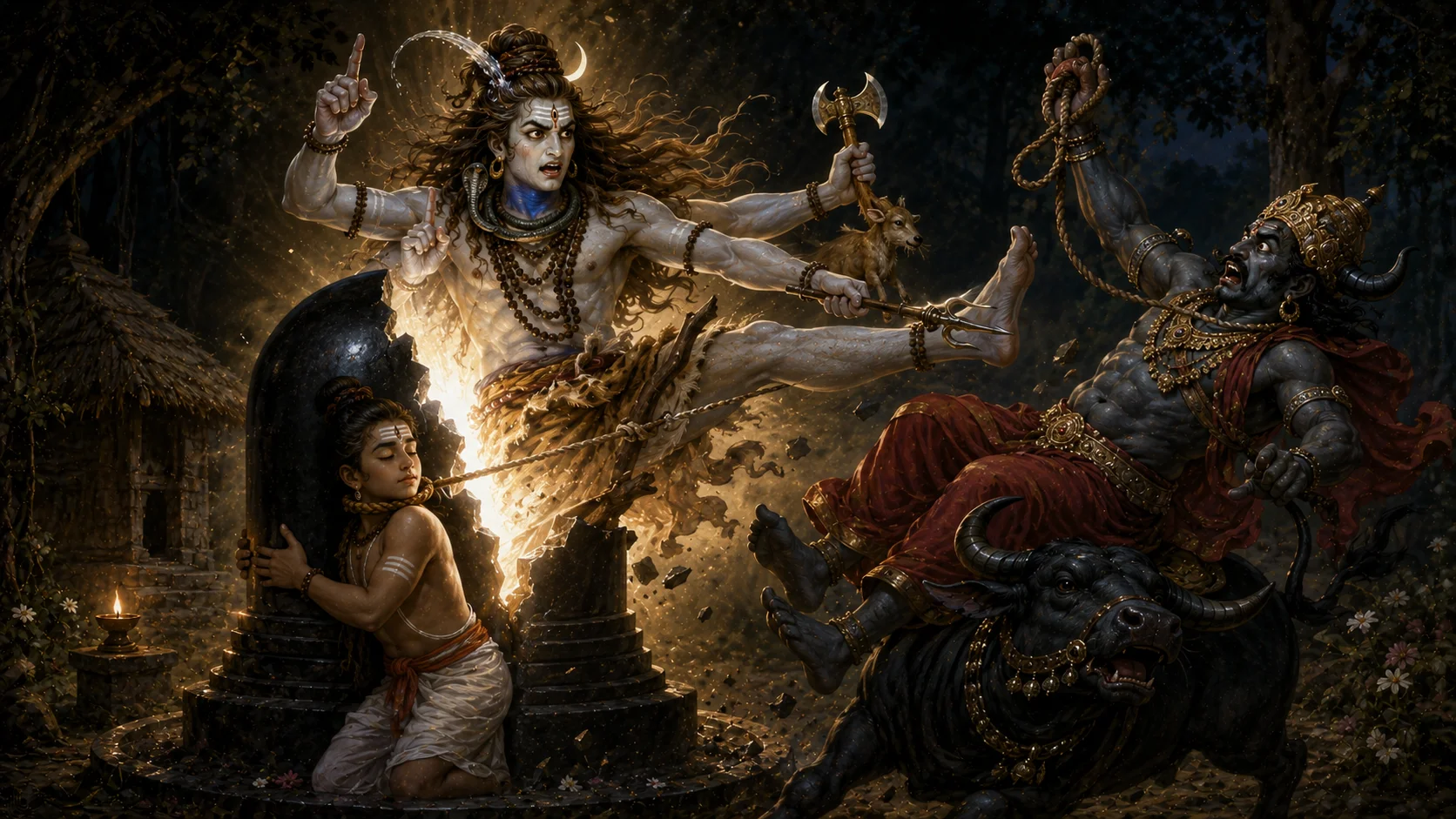
As the sixteenth year closed in, Markandeya did not flee or bargain or weep. He went to the temple and wrapped his arms around a Shiva lingam, pouring every fiber of his devotion into the stone, and there he remained as the fatal hour arrived. Yama, lord of death, came in person to claim him. Yama cast his noose, the pasha with which he claims every mortal life, but Markandeya would not release the lingam, and the noose closed around the boy and the stone together. It was this — the god's own emblem seized by Death's rope — that broke the moment open.
Kalantaka: The Ender of Endings
Shiva burst from the linga in a fury that has no equal in the god's iconography of restraint. He struck Yama down — in the most repeated form of the tale, with a single kick — and stood over the god of death as the one being who could overrule him. From this act Shiva earned one of his most feared and beloved epithets: Kalantaka, the Ender of Time, also rendered Kala-samhara-murti, the form that destroys Death itself. It is a strange and telling paradox at the heart of Shaiva theology — that the god most associated with dissolution and the ash of burnt worlds is also the one who, once, refused to let dissolution touch a single devoted boy. For Markandeya's sake, Shiva overturned the order that governs every other mortal life, and granted the boy not rescue but permanence: eternal youth, unaging, unending. Markandeya would remain sixteen forever.
Counted Among the Deathless
That single act of divine intervention placed Markandeya among the chiranjivis — the small company of beings in Hindu tradition who are said to live on beyond the death of ordinary mortals, untouched by the passage of ages. The canonical lists vary slightly by source, but Markandeya is named there alongside figures such as Hanuman, the sage Vyasa, and Ashwatthama, each counted among the immortals in their own right. Markandeya's place in that company traces directly to Shiva's intervention at the lingam — love for the god taken to its furthest, most literal extreme.
Alone on the Shoreless Water
Deathlessness, for Markandeya, is not a quiet gift. It makes him the sole witness to horrors and wonders no other being lives long enough to see, foremost among them the pralaya — the dissolution that closes a cosmic age, when every world drowns beneath a single shoreless ocean and nothing remains standing. Markandeya alone survives it, adrift and exhausted on that endless water, the last conscious being in a universe that has otherwise been unmade. It is in this desolation, wandering without shore or star to orient by, that he comes upon a great banyan leaf resting on the flood, and upon it an infant of impossible radiance: the newborn form of Vishnu as Narayana, the divine sustained in the void between the death of one universe and the birth of the next.
Swallowed by the Infant God
In the fullest telling of the episode, the infant inhales, and Markandeya is drawn inside its body — and there, within the child who should be smaller than he is, he finds the entire universe held whole: every mountain and sea, every god and being, every world he had watched drown moments before, all intact within Narayana's form. He is breathed out again onto the same cosmic ocean, returned to the flood he had just left, but changed by what he has seen. The episode stands, in the tradition, as an illustration of divine immanence beyond time — proof that creation rests inside the Lord rather than the other way around.
The Sage Who Remembers Every Age
Later tradition recasts Markandeya not merely as a devotee who was spared but as a rishi in his own right — a seer whose authority rests on visionary and cosmological witness rather than on lineage, conquest, or rule. He is a repository of ages, the one voice in the tradition that can speak of what happened before with the certainty of having been there. This standing is what allows the literature to place enormous bodies of sacred narrative directly in his mouth.
Comfort in the Forest Exile
In the Mahabharata, within the Vana Parva and its extended Markandeya Parva, it is Markandeya who comes to the exiled Pandavas in the forest and eases their long years of hardship with story after story drawn from the deep past — among them his own account of the deluge and the vision of the infant Narayana. His presence in the epic is that of an elder recounting ancient narrative to the sons of Pandu during their years of hardship in the wilderness.
The Purana That Bears His Name
The Markandeya Purana is named for him and, within its own frame, presented as his discourse — carried further still by being narrated to the sage Jaimini, so that the text arrives twice removed from its origin, ancient testimony relayed through ancient testimony. Embedded within it is the Devi Mahatmya, also known as the Chandi, one of the foundational scriptures of Goddess worship in the entire tradition. That the supreme text of the Devi should be transmitted through the deathless boy who once clung to a Shiva lingam is one of the tradition's quieter ironies: the witness spared by Shiva becomes the vessel through which the Goddess's own glory is preserved and handed forward.
Carved Into Stone: The Protector's Pose
The moment of rescue became one of the most enduring devotional images in South Indian temple sculpture, formalized as the Markandeya-anugraha-murti — Shiva shown in the act of granting grace, standing protectively over the boy as Yama's noose falls short. Temples associated with Shiva across Tamil Nadu, Kalahasti prominent among them, retell the episode not as a curiosity of myth but as a living devotional exemplar: the moment carved and recarved to remind worshippers that unwavering bhakti can suspend even the most fixed of cosmic laws.
The Mantra That Answers Death
Markandeya's story sits at the root of a wider devotional current around Shiva as conqueror of death, gathered under the theme of Mrityunjaya. Popular tradition attributes the Mahamrityunjaya mantra to the sage Markandeya himself, even though its deeper roots lie in the Vedic corpus, in the Rigveda and Yajurveda. The attribution says less about textual history than about how completely Markandeya's legend has come to stand for the idea that death can be met, and answered, rather than simply endured.
What the Deathless Boy Still Means
Markandeya endures in devotional memory as bhakti's clearest proof of power over death: a boy whose love for his god was total enough that the god broke the order of the universe rather than let death collect what it was owed. As a chiranjivi he is held, in belief, to be living still — eternally sixteen, an unbroken thread of memory stretched across the border between one dissolved universe and the next. To invoke him is to invoke fearlessness in the face of death itself, and to remember the boy who would not loosen his arms from the lingam even as the noose of Yama closed around him.
Sources & traditions
- EncyclopediaWikipedia — Markandeya
- TraditionHindu texts, oral tradition and village tellings (South Asia)
Myths change from area to area and from time to time. This chronicle follows the most widely told versions; tellings in other villages, regions and eras may differ.