Durga is the warrior form of the Hindu Great Goddess, created by the combined power of the gods to destroy a buffalo-demon no male deity could defeat, and worshipped across the subcontinent, above all in Bengal, as the supreme protector against evil and the embodiment of righteous, victorious feminine power (Shakti). Riding a lion or tiger and wielding an arsenal of weapons contributed by the gods themselves, Durga stands in Hindu tradition as proof that ultimate power, when evil grows beyond what the male gods alone can contain, resides in the goddess.
The Devi Mahatmya and the Rise of Mahishasura
Durga's central myth is recorded in the Devi Mahatmya (also called the Durga Saptashati), a text embedded in the Markandeya Purana and composed roughly in the fifth or sixth century CE, though drawing on much older goddess traditions. The demon Mahishasura, a shape-shifting buffalo-demon, had won from Brahma a boon that no man or god could kill him, and used this near-invulnerability to conquer heaven itself, driving the gods from their thrones. Unable to defeat him by their own individual powers, the gods — Brahma, Vishnu, Shiva, and the rest of the pantheon — combined their collective energies (tejas) into a single blazing light, from which Durga emerged fully formed and fully armed. Each god armed her further with a replica of his own signature weapon: Shiva gave his trident, Vishnu his discus, Indra his thunderbolt and a bell, Varuna a conch, Agni a spear, Vayu a bow, and Himavan, king of the mountains, gave her a lion to ride into battle.
The Battle and the Slaying of the Buffalo-Demon
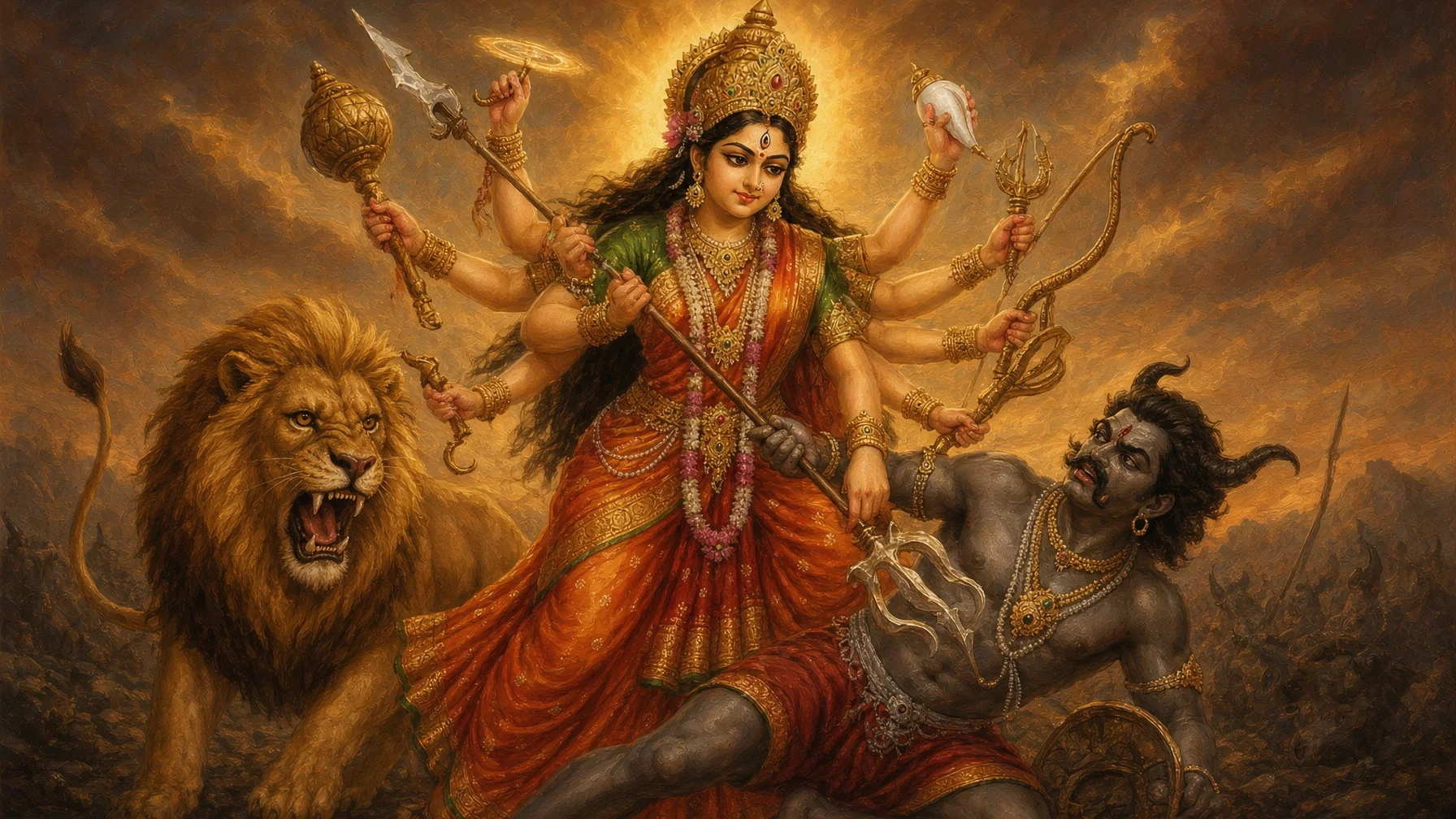
Durga confronted Mahishasura's armies alone, and after a prolonged battle in which the demon repeatedly shifted between animal and human forms to evade her, she pinned him in his half-emerged buffalo form beneath her foot and drove her trident through him, decapitating him as he tried to escape from the buffalo's throat in human shape. This victory, commemorated as Mahishasuramardini — "she who slew the buffalo demon" — is Durga's single most iconic act and the image most associated with her worship, and it is re-enacted symbolically each year in the climactic days of Durga Puja and Navaratri.
Iconography and Weapons
Durga is depicted with between eight and eighteen arms, according to region and tradition, each hand bearing a different weapon or symbolic object: the trishula (trident), the sudarshana chakra (discus), a sword (khanda), bow and arrow, a mace (gada), a conch (shankha), a bell (ghanta), and a shield, among others, along with hand gestures of blessing. She rides a lion or tiger, an animal that in her myths often fights alongside her as an active combatant rather than a passive mount, symbolizing her mastery over raw, ferocious power rather than mere control of it. Her face, unlike some of the goddess's fiercer forms, is typically calm and serene even in the act of battle, expressing the idea that righteous power exercised in defense of dharma need not be marked by rage.
Relationship to Parvati and Kali
In the Shaktism that treats Devi as the supreme reality, Durga is one of the principal forms of the same goddess who appears gently as Parvati and fiercely as Kali, together spanning the full range of feminine divine power from nurture to combat to annihilation. Yet Durga retains her own distinct mythology — she is not simply Parvati angry, nor is she Kali restrained; the Devi Mahatmya presents her as arising independently from the combined energy of the male gods to meet a specific crisis, with her own weapons, her own battles (including the subsequent defeat of the demons Shumbha and Nishumbha), and her own dedicated festival cycle, distinguishing her narrative identity even within a shared theological frame of the one Devi.
Worship Today: Durga Puja and Navaratri
Durga Puja, celebrated with particular grandeur in West Bengal, Odisha, Assam, and among Bengali communities worldwide, spans several days in the Hindu month of Ashwin (September–October) and centers on elaborately crafted clay images of Durga slaying Mahishasura, installed in temporary pavilions (pandals) and worshipped with recitation of the Devi Mahatmya, before being ceremonially immersed in rivers or the sea at the festival's close (Bisarjan) on Vijayadashami. Across most of the rest of India, the same period is observed as Navaratri, "nine nights," honoring the Devi in nine forms (Navadurga) over nine nights, culminating in Vijayadashami/Dussehra, which in North India is celebrated as Rama's victory over Ravana — a convergence of two great mythic triumphs of good over evil within a single festival season. Regional variations abound: Gujarat marks the nights with the Garba and Dandiya Raas dances, Mysuru holds a famous royal Dussehra procession, and Kolkata's Durga Puja pandals have themselves become major works of public art, drawing millions of visitors each year.
Durga's Other Battles: Shumbha and Nishumbha
The Devi Mahatmya recounts a second major cycle of battles beyond the Mahishasura episode, in which the demon brothers Shumbha and Nishumbha, having likewise conquered heaven, attempt to force the goddess (here appearing as Durga in her form as Ambika, later manifesting Kali from her own fury) into marriage, having heard of her unmatched beauty. Her refusal, and the ensuing war against their generals Chanda and Munda (whom Kali beheads, earning the epithet Chamunda) and finally against Raktabija, whose multiplying blood only Kali could contain, forms the narrative core of the text's later chapters and is recited across the nine nights of Navaratri, with the Devi's various forms — Durga, Kali, Chamunda, and the Matrikas — understood as different faces of one continuous, escalating campaign against tyranny.
Durga in Regional and Household Worship
Beyond her grand public festivals, Durga is invoked continuously in daily and household worship as a source of protection, courage, and strength, particularly for women, and is frequently the presiding deity of household shrines even in families whose primary devotion lies with Vishnu or Shiva, since her protective function is regarded as necessary and universally applicable regardless of sectarian affiliation. Regional forms of the Devi worshipped as manifestations or close relatives of Durga include Vaishno Devi in Jammu, whose cave shrine draws millions of pilgrims annually and is closely identified with Durga's own mythology, and Chamundeshwari in Karnataka, patron goddess of the historic Mysore kingdom, whose temple atop Chamundi Hill remains a major pilgrimage site and gives the Mysuru Dussehra procession its royal, goddess-centered character.
The Nine Forms: Navadurga
The nine nights of Navaratri are traditionally mapped onto nine distinct forms of the goddess collectively called the Navadurga, each honored on a specific night and associated with a particular stage of spiritual or worldly life: Shailaputri (daughter of the mountain, her form as a young Parvati), Brahmacharini (the ascetic, recalling her penance to win Shiva), Chandraghanta (the warrior adorned with a crescent moon bell), Kushmanda (the creator of the cosmic egg through her smile), Skandamata (mother of Skanda/Kartikeya), Katyayani (the warrior form born of the sage Katyayana's household and closely identified with the Mahishasura myth in some tellings), Kalaratri (the fierce, dark form associated with the destruction of ignorance), Mahagauri (the radiant, purified form), and Siddhidatri (the giver of spiritual accomplishment). This nine-fold schema, rather than diluting Durga's distinct identity, is understood by the tradition as unfolding the full range of her power and character across a single festival, moving from daughter to ascetic to warrior to mother to bestower of ultimate spiritual attainment.
Durga's continuing cultural weight in contemporary India extends well beyond religious observance: Durga Puja in Kolkata was inscribed on UNESCO's Representative List of the Intangible Cultural Heritage of Humanity in 2021, in recognition of the festival's scale, its role in sustaining traditional craft communities of idol-makers and pandal artisans, and its function as a genuinely citywide, cross-community civic event rather than a strictly private devotional one. The image of Durga as an independent, weapon-bearing woman who defeats a threat the assembled male gods could not, arising at the exact moment their combined power proved insufficient, continues to be invoked in modern India well beyond the immediate context of temple worship, as a widely recognized symbol of female strength and moral courage.
Sources & traditions
- EncyclopediaWikipedia — Durga
- TraditionHindu texts, oral tradition and village tellings (South Asia)
Myths change from area to area and from time to time. This chronicle follows the most widely told versions; tellings in other villages, regions and eras may differ.