Mahishasura is the great buffalo-demon of Hindu myth — the shape-shifting asura who, made invincible against all males by a boon, conquered the heavens and could be slain only by the warrior-goddess Durga, born of the combined power of all the gods.
A Son Born of Beast and Asura
Mahishasura's name is drawn directly from his signature form: mahisha, "buffalo" or "water buffalo," joined to asura, "demon." He was, by the account preserved in the Devi Mahatmya and the Devi Bhagavata Purana, the son of the asura Rambha and a she-buffalo — a union that gave him, from birth, the theriomorphic nature that would define his entire career. He was not merely a demon who could wear a buffalo's shape as a disguise; the buffalo was woven into his ancestry as much as his human or asura aspect, and he moved between human, buffalo, and hybrid forms as easily as other beings move between rooms. This shape-shifting nature was not incidental showmanship — it was the core of what made him, eventually, so difficult to end.
Austerities Offered to the Creator
Like so many of the great demon-kings of Puranic literature, Mahishasura did not seize his power by force alone; he earned its foundation through tapas — the severe, sustained austerities that Hindu cosmology permits any being, however dark its intent, to direct toward the gods in exchange for boons. He performed his tapas toward Brahma, the creator, with the discipline and endurance the god demands of petitioners before he grants anything of consequence. Brahma, satisfied by the intensity of that devotion, granted Mahishasura an extraordinary boon: he could not be killed by any man, and he could not be killed by any god. In the logic of the myths, such a boon is never absolute — it is a door left open by the very shape of the request — but Mahishasura, having asked only about men and gods, did not think to close the gap through which his death would eventually come.
The Boon That Answered Every Threat but One
Armed with near-invulnerability, Mahishasura became something the heavens had not faced before: a power that could not be met on the terms the heavens knew how to fight on. Every warrior the devas could send was, by definition, either a man or a god, and every one of them was therefore powerless against him from the outset. The boon did not make him merely strong — it made him structurally unbeatable within the categories of being that the gods themselves occupied. It was a flaw that would prove fatal only because it was invisible to its own holder: Mahishasura had secured himself against every kind of opponent he could imagine facing, and in doing so had left exactly one door unlocked.
The Fall of Indra's Heaven
With that boon behind him, Mahishasura turned his strength outward. He made war on the devas directly, and the campaign did not stay contained to a single skirmish — he pressed the assault until he had defeated Indra and the assembled gods outright. Where Indra had ruled, Mahishasura now sat; where the devas had held their offices and their honors, he usurped them one by one, installing himself in the seats of heaven's own governance. It was not a raid but a conquest, complete and humiliating, and it left the gods who had once commanded the cosmos as exiles from their own domain, with no answer to a power their own rules of engagement could not touch.
A Radiance Gathered from Every God
The devas could not out-fight Mahishasura, because fighting him meant sending a man or a god, and his boon closed that door before it opened. The one condition his invulnerability did not cover was the one nobody among the gods could supply on his own: he could be slain only by a woman. So the gods did the only thing left to them — they combined their collective energies, their tejas, pouring the radiance of their own divine power into a single convergence. From that fused brilliance, according to the Devi Mahatmya of the Markandeya Purana, the goddess Durga was born — not created from clay or blessing alone, but assembled from the very substance of the gods who needed her, a being who answered the one condition Mahishasura's boon had never named.
Weapons Drawn from Every Hand in Heaven
Durga did not go to war unarmed or unequipped by those who had made her. Each god who had contributed to her birth gave her something of his own arsenal to carry into the field. Shiva gave his trident; Vishnu gave his discus; Indra, the very god Mahishasura had dethroned, gave his vajra — and other devas added weapons of their own beyond these, until the goddess stood equipped with the combined instruments of heaven's own power, a warrior built and armed entirely by the beings her enemy had already proven he could defeat.
Generals Sent Ahead of the King
Mahishasura did not meet Durga alone at the first sign of her arrival. As was proper for a ruler who now commanded the machinery of heaven's former throne, he sent his generals and demon captains against her first — among them Chikshura and Chamara, commanders entrusted with turning back this new threat before it could reach the king himself. Durga met them in turn, and where Mahishasura's armies fell before her, the battle only closed the distance between the goddess and the demon she had been made to face.
A Battle Fought Across Many Shapes
When Mahishasura finally met Durga directly, he did not fight her in a single body. True to the shape-shifting nature that had been his since birth, he moved through form after form in the course of the struggle — buffalo, lion, elephant, man — shifting each time the battle turned against whichever shape he currently wore, searching for an angle that might spare him what his boon on gods and men could not. Durga matched him through every transformation, refusing to let any one of his forms buy him the advantage he was reaching for.
The Slaying in the Buffalo's Body
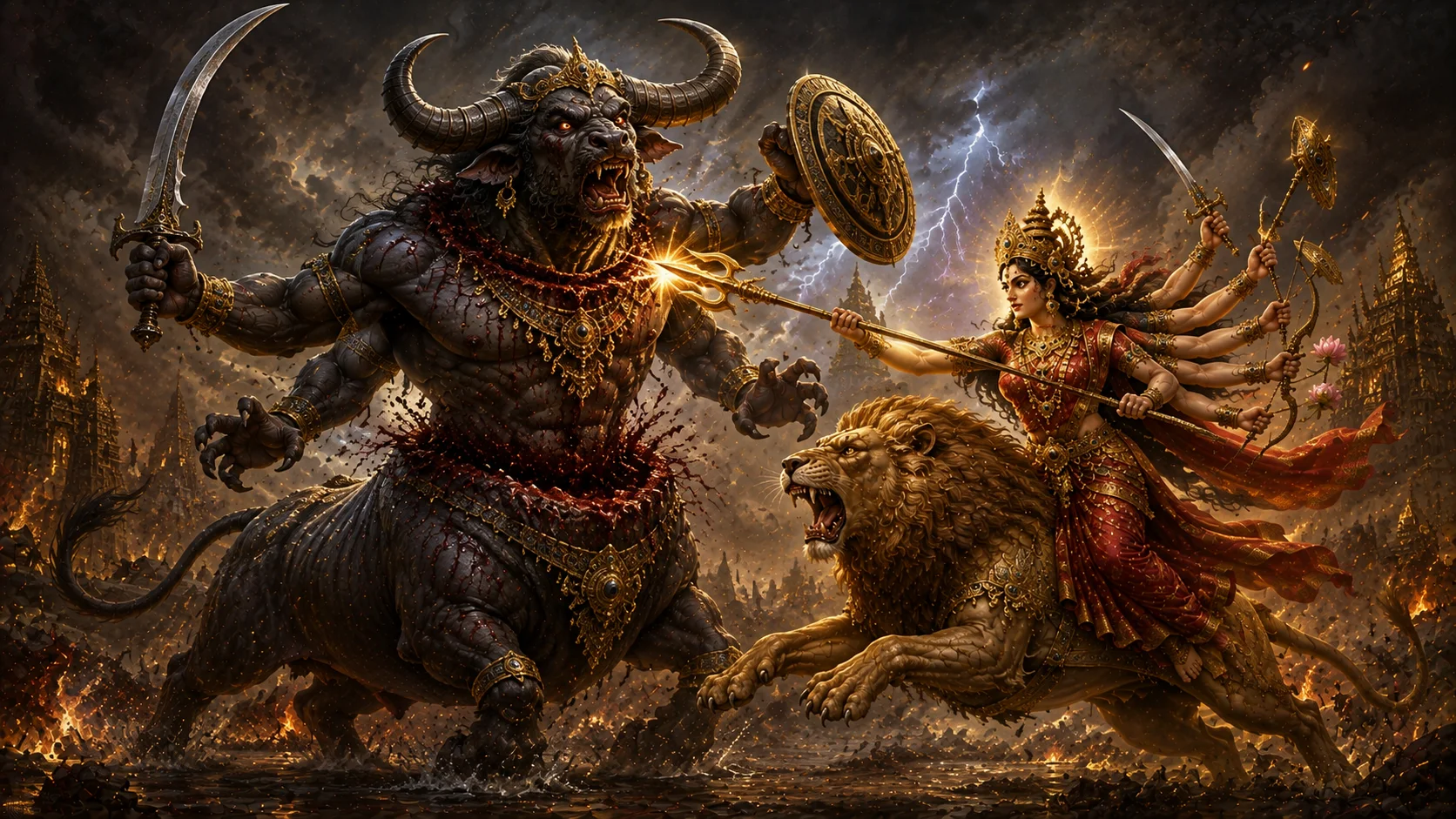
It was in his buffalo form — the shape that had named him from the beginning — that Durga finally overcame Mahishasura and ended him. The episode is known by its own name in the tradition: Mahishasuramardini, "the slayer of Mahisha," and it forms the central narrative of the Devi Mahatmya's third episode, the climactic turn on which the whole scripture pivots. The demon whose boon had made him untouchable by any man or any god fell, at last, to the one power his own request had never accounted for.
An Image Carved Across the Subcontinent
The moment of that slaying became one of the most widespread images in all of Hindu iconography. Durga is shown piercing Mahishasura with her trishula while her lion — or in some renderings her tiger — the vahana that carries her into battle, attacks the demon alongside her. This composite image, the goddess mid-strike with her mount already engaged, is instantly recognizable across shrines, festival pandals, and temple art wherever the Devi Mahatmya is honored, and it carries the entire narrative in a single frozen instant: the boon defeated, the gods' combined gift vindicated, the buffalo-demon's long reach over heaven finally broken.
The Doctrinal Heart of Navaratri
This myth is not a peripheral tale in the calendar of Hindu festivals — it is the doctrinal core of the autumnal Navaratri and Durga Puja observances, and it is especially prominent in Bengal, where the climactic days built around Vijayadashami and the Mahalaya period commemorate exactly this defeat. The nine nights of Navaratri and the great communal Puja that follows are, at their root, a retelling and a re-honoring of the moment the gods' combined radiance overcame the demon their individual strength could not.
The Divine Feminine Answering Unchecked Conquest
Beyond the narrative details, Mahishasura's story carries a symbolic weight that the tradition returns to again and again: the triumph of Shakti, the divine feminine power, over demonic arrogance and the unchecked ambition of conquest. Mahishasura's downfall was written into the very boon he thought had made him safe — he secured himself against gods and men because those were the only categories of power he could picture threatening him, and in that narrowness of imagination lies the moral the myth is built to carry.
Voices Outside the Mainstream Telling
Alongside the Puranic account that dominates temple worship and festival practice, certain regional and tribal traditions in eastern India have preserved alternate, sympathetic readings of Mahishasura, recasting him as a wronged king rather than a demon deserving of his fate. These readings are localized and minority reinterpretations, distinct from and separate from the mainstream Devi Mahatmya narrative that anchors Navaratri and Durga Puja, but they exist alongside it as a reminder that even the most widely carved and celebrated of myths can carry more than one voice depending on who is telling it.
The Buffalo-Demon Who Called the Goddess Into Being
Mahishasura endures, finally, as the figure whose very existence made Durga necessary. He was invincible against every power the heavens knew how to raise against him, and the gods answered that impossibility not by finding a stronger man or a mightier god, but by pouring themselves together into something that had never existed before. His conquest of heaven is remembered because of what it provoked; his boon is remembered because of the one door it left open; and his death in the shape of the buffalo that named him is remembered, every autumn, as the moment the combined power of the gods took form as a woman and finished what none of them could finish alone.
Sources & traditions
- EncyclopediaWikipedia — Mahishasura
- TraditionHindu texts, oral tradition and village tellings (South Asia)
Myths change from area to area and from time to time. This chronicle follows the most widely told versions; tellings in other villages, regions and eras may differ.