Tarakasura — often simply Taraka — was the asura whose arrogance forced the gods to engineer the birth of a war-god. His story is, in essence, the reason Kartikeya exists. He is the demon whose death was decreed before his slayer was even conceived, and the whole machinery of one of Hinduism's most beloved divine births turns upon the boon he wrung from Brahma. The account is preserved chiefly in the Shiva Purana and the Skanda Purana, both of which frame him not as a mindless brute but as a strategist whose intelligence became the very hinge of his downfall.
Born of Vajranaka and Varangi
Tarakasura was the son of the asura Vajranaka — sometimes rendered Vajranga — and his wife Varangi. From an early stage he set his ambitions not merely on wealth or territory but on the outright subjugation of the three worlds. That ambition required power no asura could simply seize; it had to be won from the gods themselves, through the one channel even the mightiest of them could not refuse: tapas, ascetic austerity performed with such severity that Brahma the creator was compelled to answer it.
A Penance That Scorched the Three Worlds
Tarakasura undertook a penance of extraordinary ferocity, and Brahma appeared before him. Tarakasura, cunning in the manner of all great asuras, understood that outright immortality would never be granted. So he asked instead for something he believed amounted to the same thing.
The Clause Built to Be Impossible
The boon he requested was precise: that he could be slain only by a son of Shiva, and only if that son was born within seven days of his own birth. It was a calculated wager against a condition Tarakasura had every reason to believe could never be fulfilled. Shiva, at that time, was a widower consumed by grief after the self-immolation of Sati, sunk in ascetic withdrawal, indifferent to desire, to marriage, and above all to fatherhood. A son of Shiva born within so narrow a window was, by every visible sign, an impossibility conjured to look like a mere technicality. Tarakasura walked away from Brahma convinced he had purchased eternity through a loophole so narrow no one could ever thread it.
The Devas Driven from Their Own Heaven
Armed with his boon, Tarakasura made war upon the devas and conquered them outright. He expelled them from Swarga and ruled the three worlds as an oppressive tyrant, a conqueror who had turned the gods' own cosmic order against them. The rightful lords of heaven were made homeless petitioners in a universe they had once governed, and no force among them could unseat the demon who now held it.
An Appeal to the Creator
Unable to defeat Tarakasura by any strength or strategy of their own, the devas turned to Brahma, the very god whose boon had made their enemy unconquerable. Brahma's answer was not a solution but a confirmation of the trap they were already living inside: only a son of Shiva, born within seven days, could kill Tarakasura. He offered no shortcut and no alternative. The condition Tarakasura had engineered to be impossible was, in Brahma's own telling, the sole avenue left to the gods — which meant the impossible now had to be made to happen.
Kama's Arrow and Its Price
To bring that impossibility about, the devas sent Kama, the god of love, to awaken desire in Shiva — the one force that might turn an ascetic in mourning back toward the world of marriage and offspring. Kama loosed his flower-arrow at the meditating god. The result was immediate and severe: Shiva's third eye opened, and Kama was incinerated to ash on the spot for the presumption of disturbing his austerity. It is a moment the tradition treats with real weight — the price paid by a god acting on the devas' desperate behalf — and it stands as the precise turning point at which the gods' scheme very nearly failed outright rather than merely stalled.
Parvati's Own Austerity
Where Kama's arrow could not finish the work, another path opened. Parvati, understanding that desire alone would not win Shiva, performed her own tapas to win him as consort through devotion rather than seduction. Her austerities and the courtship that followed are the subject of Kalidasa's Kumarasambhava, the classical Sanskrit poem built around exactly this turn in the myth: not Kama's failed shortcut, but Parvati's patient, self-willed penance succeeding where a god's arrow had been burned away. Their eventual marriage supplied the one condition Tarakasura's boon had gambled would never be met.
A Child Who Grew in Days
From the union of Shiva and Parvati came Kartikeya, also known as Skanda or, in Tamil Shaivite tradition, Murugan. Raised by the six Krittika nymphs, the child matured with supernatural speed, reaching martial readiness in a span of days rather than years — a detail the Puranas treat as necessary rather than incidental, since Tarakasura's tyranny over the three worlds could not simply wait out an ordinary childhood, and the boon's own seven-day clause demanded nothing less. Kartikeya was made commander of the Deva armies, the child-god handed the one role his birth had been engineered to fill.
Single Combat and the Letter of the Boon
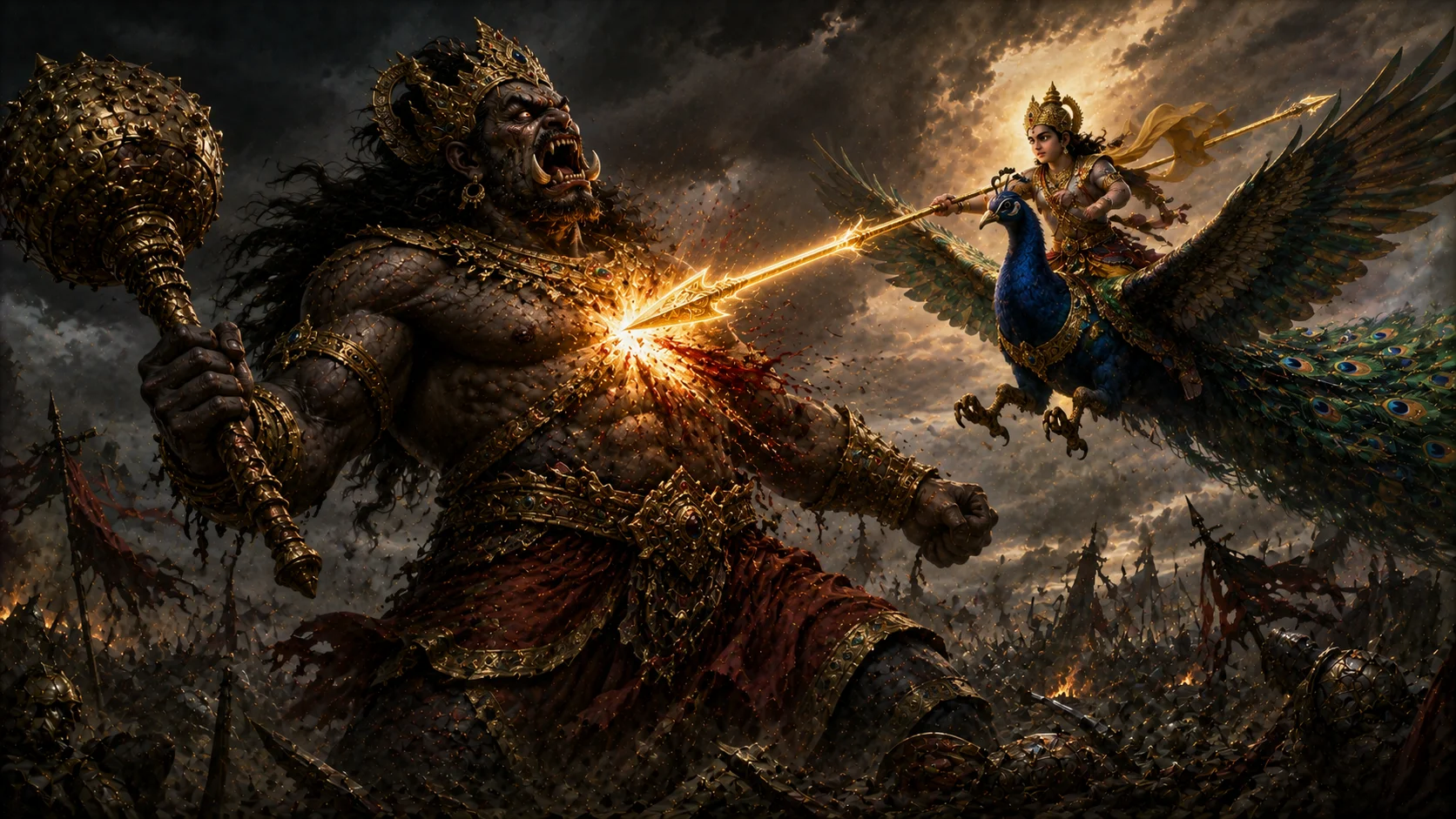
Kartikeya led the devas against Tarakasura and met him in single combat. He slew the asura with the vel, the divine spear or shakti-weapon that remains Kartikeya's defining attribute in devotional iconography to this day. The boon Tarakasura had extracted from Brahma was honoured to the letter — he had asked to be killed by no one but a son of Shiva born within seven days, and it was precisely such a being, and no other power in the three worlds, who ended him. The condition he had built to be unmeetable became, once met, absolute and unarguable.
A Lineage the Texts Cannot Agree On
Later retellings sometimes describe the Tripurasura demons — Tarakaksha, Kamalaksha, and Vidyunmali — as sons of Tarakasura, extending his story forward into another cycle of asura conquest and divine reprisal. This lineage link is inconsistent across the source texts and is treated by the tradition itself as disputed rather than settled fact. Tarakasura's own story, the one attested consistently across the Shiva Purana and Skanda Purana, ends with his death at Kartikeya's spear; the Tripurasura demons belong to a separate, later thread that later compilers sometimes, but not reliably, stitched onto his family line.
The Asura Who Out-Thought Himself
Tarakasura is the archetype of the asura whose intelligence becomes the instrument of his own destruction: the seeker who extracts a boon that looks flawless and is undone precisely through the loophole he failed to imagine as a real possibility. He shares this pattern with other great asuras of the tradition. Hiranyakashipu won a boon so exhaustively worded — unkillable by man or beast, by day or night, indoors or outdoors — that he never accounted for Narasimha, a being who was neither man nor beast, arriving at twilight on a threshold. Mahishasura secured immunity from any god or man, never imagining a goddess: Durga. In each such story the demon's own cleverness supplies the blueprint for his executioner; power gained through austerity, unmoored from dharma, calls forth the very intervention it thought it had foreclosed.
Murugan's Devotees and Skanda Sashti
Tarakasura's death remains central to the Kartikeya-Skanda mythos and holds particular prominence in Tamil Shaivite tradition, where Murugan is venerated as his slayer. The festival of Skanda Sashti commemorates this victory, observed by devotees as the celebration of the war-god's triumph over the tyrant whose own boon had been meant to guarantee he could never be born. In this devotional context, Tarakasura is remembered less as a villain in isolation than as the necessary counterweight to Murugan's glory — the immovable object whose very existence called the god of war into being.
A Tyranny That Restored What It Threatened
Read as a whole, Tarakasura's myth is a study in the Puranic logic of cosmic balance: adharmic power, however legitimately won through austerity and however airtight its guarantees appear, cannot stand permanently against the order it displaces. It required not brute force but the deliberate, costly engineering of a child-god's birth — a plan that consumed one god's incineration and another's solitary penance before it could be completed — to restore what Tarakasura's boon had taken. His conquest of the three worlds is remembered now chiefly as the crisis that made Kartikeya necessary, the demon whose triumph was, from its very first hour, the seed of the god who would end it.
Sources & traditions
- EncyclopediaWikipedia — Tārakāsura
- TraditionHindu texts, oral tradition and village tellings (South Asia)
Myths change from area to area and from time to time. This chronicle follows the most widely told versions; tellings in other villages, regions and eras may differ.