Kali is the fierce, dark goddess of time, death, and transformative destruction in Hinduism, whose terrifying appearance — a lolling tongue, a garland of skulls, a skirt of severed arms — conceals a theology of liberation rather than mere terror. Worshipped with deep devotion, especially in Bengal and Assam, as Kali Ma, "Mother Kali," she is understood by her devotees not as a goddess of evil but as the force that annihilates ego, illusion, and time itself, clearing the way for spiritual freedom.
Origin in Battle: The Raktabija Myth
Kali's most celebrated myth situates her as an emanation of Durga's own fury during the battle against the demon armies of Shumbha and Nishumbha, and specifically against the demon Raktabija, whose peculiar curse made every drop of his spilled blood sprout into a new demon identical to himself the instant it touched the ground. As the goddess and the Matrikas (a group of mother-goddesses) wounded Raktabija, his blood multiplied his forces faster than they could be defeated, until Kali sprang forth — in some tellings from Durga's own forehead or fury — and, opening her mouth wide, caught every drop of the demon's blood before it could reach the earth, devouring Raktabija and all his spawn until the battlefield fell silent and the threat was ended.
The Dance on Shiva
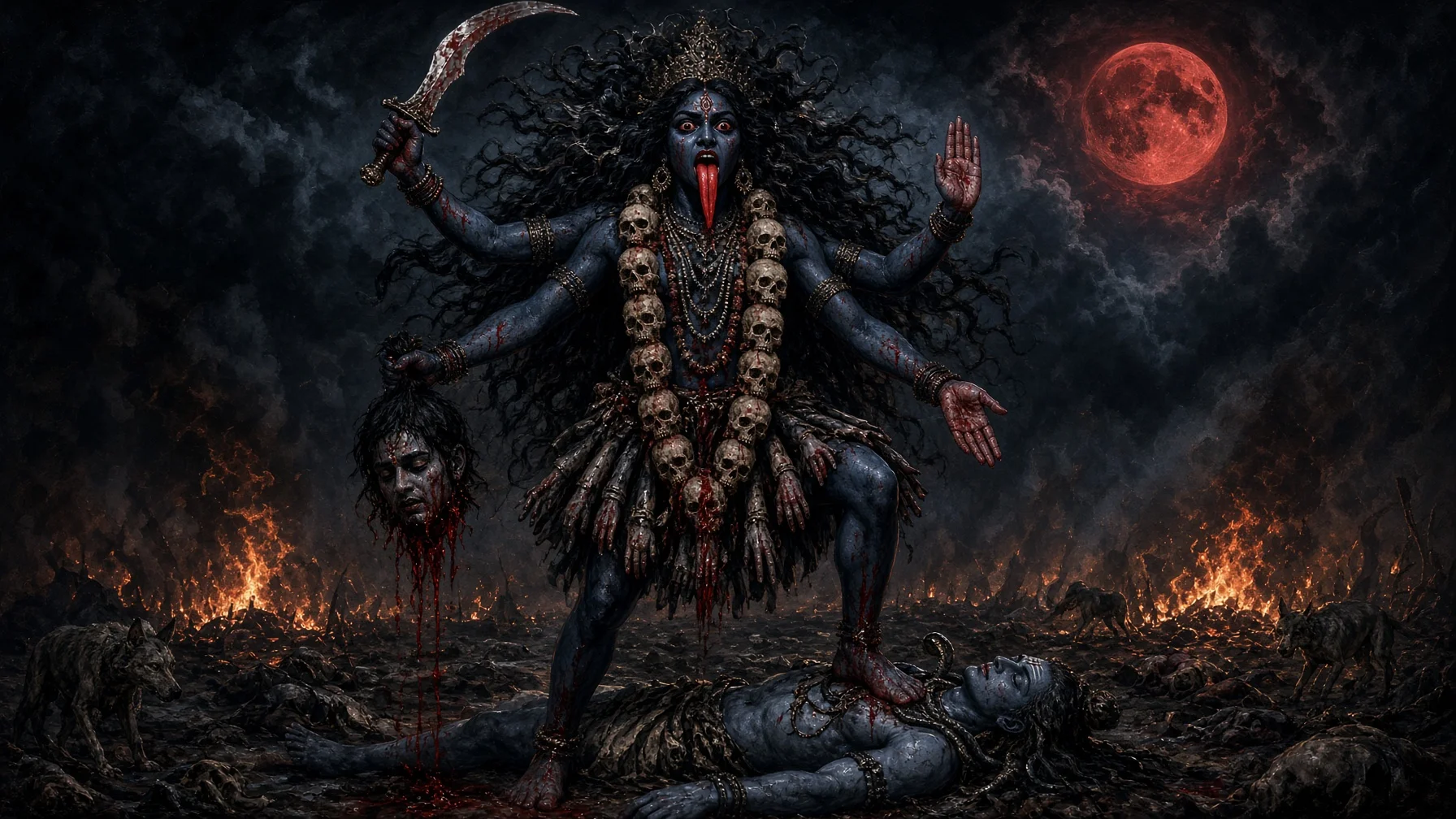
Having tasted blood and battle-frenzy, Kali is said to have entered an uncontrollable, world-threatening rampage, dancing across the field of the slain with such violent energy that creation itself seemed at risk of unraveling. To halt her, Shiva lay down directly in her path; when Kali, still lost in her fury, stepped upon her own husband, the shock of the realization broke her trance, and she bit her tongue in the culturally recognized Bengali and Odia gesture of shame and modesty (lajja) at the unintended transgression. This episode is the most common explanation offered within the tradition for Kali's protruding tongue in later iconography, though some devotional and tantric interpretations read the same gesture instead as an expression of gratified, playful triumph rather than embarrassment — the tradition holds both readings without insisting on one over the other.
Iconography
Kali is conventionally depicted with black or dark blue skin, symbolizing the all-consuming, all-encompassing nature of infinite time and space, standing or dancing, often atop the prone body of Shiva. She commonly has four arms: one holding a bloodied sword, another a severed demon head, while the remaining two make gestures of fearlessness (abhaya mudra) and boon-giving (varada mudra) toward her devotees, expressing that the same goddess who destroys demons offers protection and blessing to those who worship her. She wears a garland of severed heads or skulls, commonly interpreted as representing the fifty letters of the Sanskrit alphabet and, by extension, the totality of sound and language, and a skirt of severed arms, read as symbolizing the destruction of karma accumulated through action. Her wild, unbound hair signifies freedom from social convention and constraint.
Kali as Time and as Mother
The name Kali is linked etymologically to kala, "time," and she is understood in much of her theology as the personification of time itself, the force before which all created things, however powerful, must eventually dissolve — a role that connects her directly to Shiva's own destructive-transformative office and explains why she is so often depicted with him underfoot, not as his conquest but as the necessary partner without whom his stillness (consciousness) has no active, world-engaging power. Despite this fearsome cosmic role, Bengali devotional tradition, epitomized by saint-poets such as Ramprasad Sen, has cultivated an intensely intimate, maternal relationship with Kali, addressing her as a loving if sometimes inscrutable mother whose fierce exterior does not diminish, and may even express, her tenderness toward her devotee-children.
Relationship to Durga and Parvati
As with Durga, Kali is understood within Shaktism as one manifestation of the single Great Goddess who appears gently as Parvati and protectively as Durga, and among the ten Mahavidyas (wisdom goddesses) she is counted as the first and foremost. But Kali's worship, mythology, and regional character remain distinctly her own: she is rarely conflated in practice with Parvati's domestic gentleness, and her core myths, iconography, and devotional literature developed along partly independent lines, particularly within Bengal Shaktism and in the tantric traditions that treat her as a primary object of esoteric practice.
Worship Today
Kali is worshipped year-round but is honored above all at Kali Puja, observed on the new-moon night that coincides with Diwali in Bengal, Odisha, and Assam, when devotees offer red flowers, sweets, and (in some traditional temple contexts) animal sacrifice, and light lamps through the night. The temples at Kalighat and Dakshineswar in Kolkata, and the Kamakhya Temple in Assam — where she is venerated as one of the ten Mahavidyas at a major Shakta pilgrimage site — are among the most significant centers of her worship, drawing devotees who approach her not with fear but with the trust owed to a mother who destroys only what must be destroyed to protect her children.
Ramakrishna and the Bengali Devotional Tradition
Kali's modern devotional profile owes an enormous debt to the nineteenth-century Bengali saint Ramakrishna Paramahamsa, a priest at the Dakshineswar Kali temple, whose intense, often ecstatic personal devotion to Kali as a living, present mother reshaped how educated, urban Hindus — and eventually audiences well beyond India — came to understand her. Ramakrishna's teaching, carried forward by his disciple Swami Vivekananda, presented Kali not as a goddess of morbid terror but as ultimate reality experienced directly, a mother whose darkness was inseparable from boundless love, a reframing credited with substantially softening the goddess's reputation among audiences unfamiliar with her older tantric and Puranic contexts.
Kali in Tantra
Within the tantric traditions of Hinduism, Kali holds a place of particular importance as the foremost of the ten Mahavidyas, wisdom goddesses whose worship (often conducted through esoteric ritual, symbolic transgression of ordinary social boundaries, and meditation on cremation-ground imagery) is understood to accelerate the practitioner's confrontation with, and ultimate transcendence of, fear, death, and ego-attachment. Tantric depictions of Kali standing on a cremation ground, sometimes seated on a corpse or surrounded by jackals, are not meant as images of horror for its own sake but as deliberately unsettling meditative aids, designed to strip away the practitioner's comfortable illusions about permanence and selfhood, in service of the same underlying goal — liberation — sought by more conventionally serene forms of Hindu devotion and philosophy.
Dakshina Kali and Other Named Forms
Kali's iconography and worship vary across a set of named forms that emphasize different aspects of her character. Dakshina Kali, the form most commonly enshrined in Bengali temples including Dakshineswar, presents her right foot forward on Shiva's chest in a posture read as more benevolent and approachable, associated closely with Ramakrishna's maternal devotional theology. Bhadrakali, a more overtly protective and martial form, is worshipped particularly in Kerala, where elaborate temple festivals and ritual performances, including the Mudiyettu dance-drama depicting her battle with the demon Darika, keep her mythology alive as a living performing tradition rather than only a temple icon. Smashan Kali, associated specifically with cremation grounds, is worshipped by tantric practitioners as a direct confrontation with mortality, underscoring the range of devotional approaches — domestic and maternal at one end, esoteric and confrontational at the other — that coexist within Kali worship without either being considered more authentic than the other.
Sources & traditions
- EncyclopediaWikipedia — Kali
- TraditionHindu texts, oral tradition and village tellings (South Asia)
Myths change from area to area and from time to time. This chronicle follows the most widely told versions; tellings in other villages, regions and eras may differ.