Agastya — Agastya Muni — is one of the greatest of the Vedic saptarishi, the seven great sages, and the revered father of the Tamil south. A figure of immense and varied legend — he who drank the ocean dry, who humbled the Vindhya mountains, who carried Vedic civilisation across the Deccan and is credited with founding Tamil grammar — Agastya bridges the Sanskritic north and the Dravidian south as no other sage does. Short of stature but vast in spiritual power, he appears across the Rigveda, the epics, and the devotional traditions of the south, and by many accounts remains present still, an immortal sage dwelling in the hills he once tamed.
Born of a Pitcher, Twin to Vasishtha
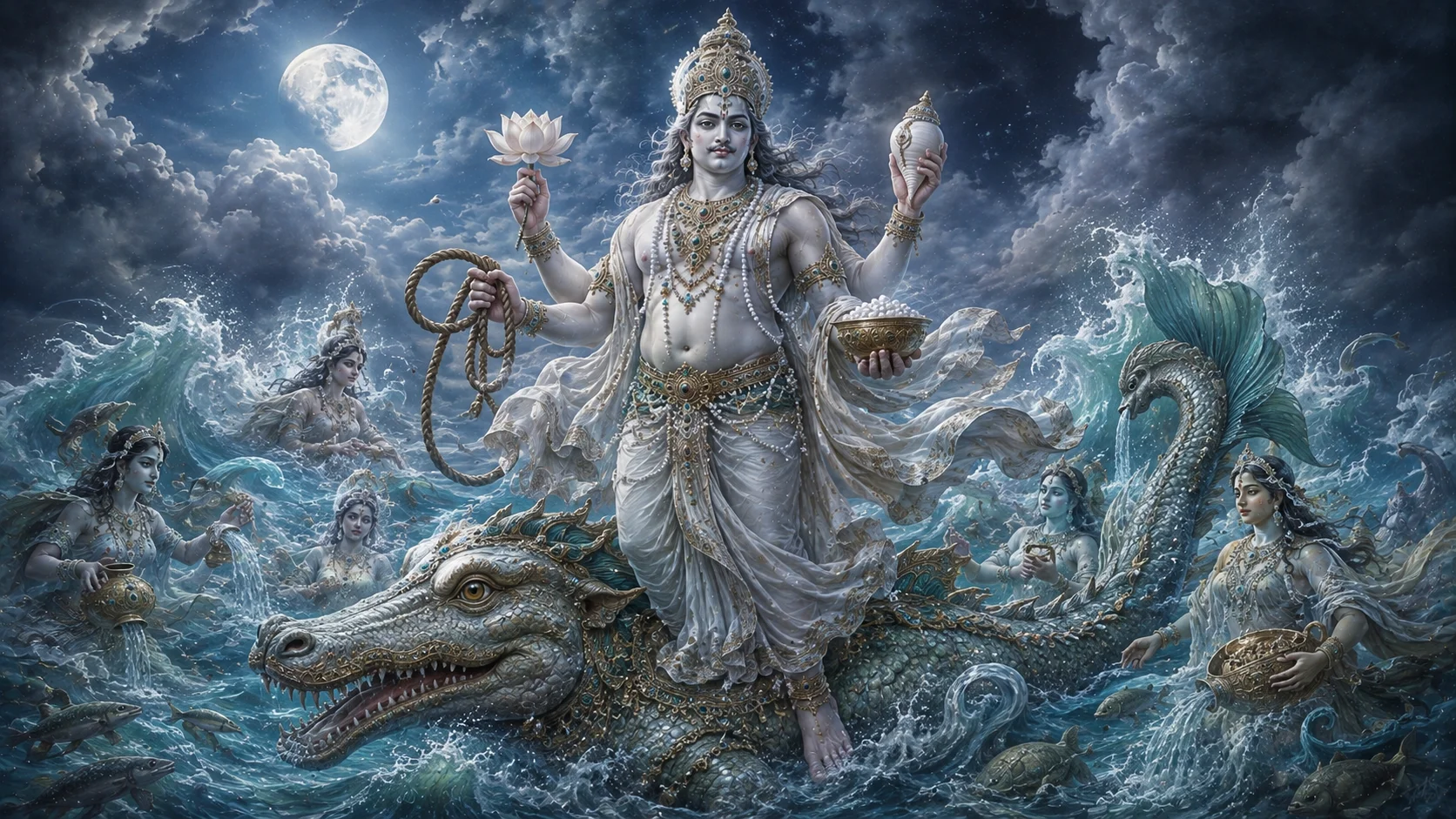
Agastya's very birth is miraculous. He is kumbhayoni — pitcher-born — created not from a mother's womb but from the combined seed of the gods Varuna and Mitra, gathered in a ritual vessel and shaped there into a rishi. Rigvedic and Puranic tradition holds that the sage Vasishtha shares this same extraordinary origin, the two of them born together from the pot. For this Agastya carries names such as Kalasaja, "born of the pitcher," a title that marks him from birth as a being outside the ordinary run of human descent, fashioned rather than begotten. His small frame and the vessel of his origin are woven into later legend as well, most memorably into the tale of how he came to swallow the sea.
Named Voice of the Rigveda
Agastya is not a figure known only through the stories told about him — he is, unusually among the sages, a named author within the Vedic corpus itself. Numerous hymns of the Rigveda, notably within its first Mandala, are directly attributed to him as seer and composer. This places him among a small company of rishis whose own voice, rather than only their legend, survives in the earliest layer of Sanskrit scripture — a distinction that gives his later reputation as bringer of Vedic learning to the south a foundation in something more concrete than folk memory.
Lopamudra, Wife and Fellow Verse-Maker
Agastya's wife, Lopamudra, is remembered as no ordinary consort. Tradition holds that she was specially created and chosen by the sage himself, fashioned to be a partner equal to the rigours of his ascetic life. Their marriage is no silent background detail — it enters the Rigveda directly, in a hymn (1.179) that preserves a dialogue between husband and wife, giving Lopamudra a rare standing among the learned women whose words survive in the Vedic hymns. She stands, in this telling, not merely as the sage's household companion but as a participant in the very verses that make up his legacy.
The Sea Swallowed in a Single Draught
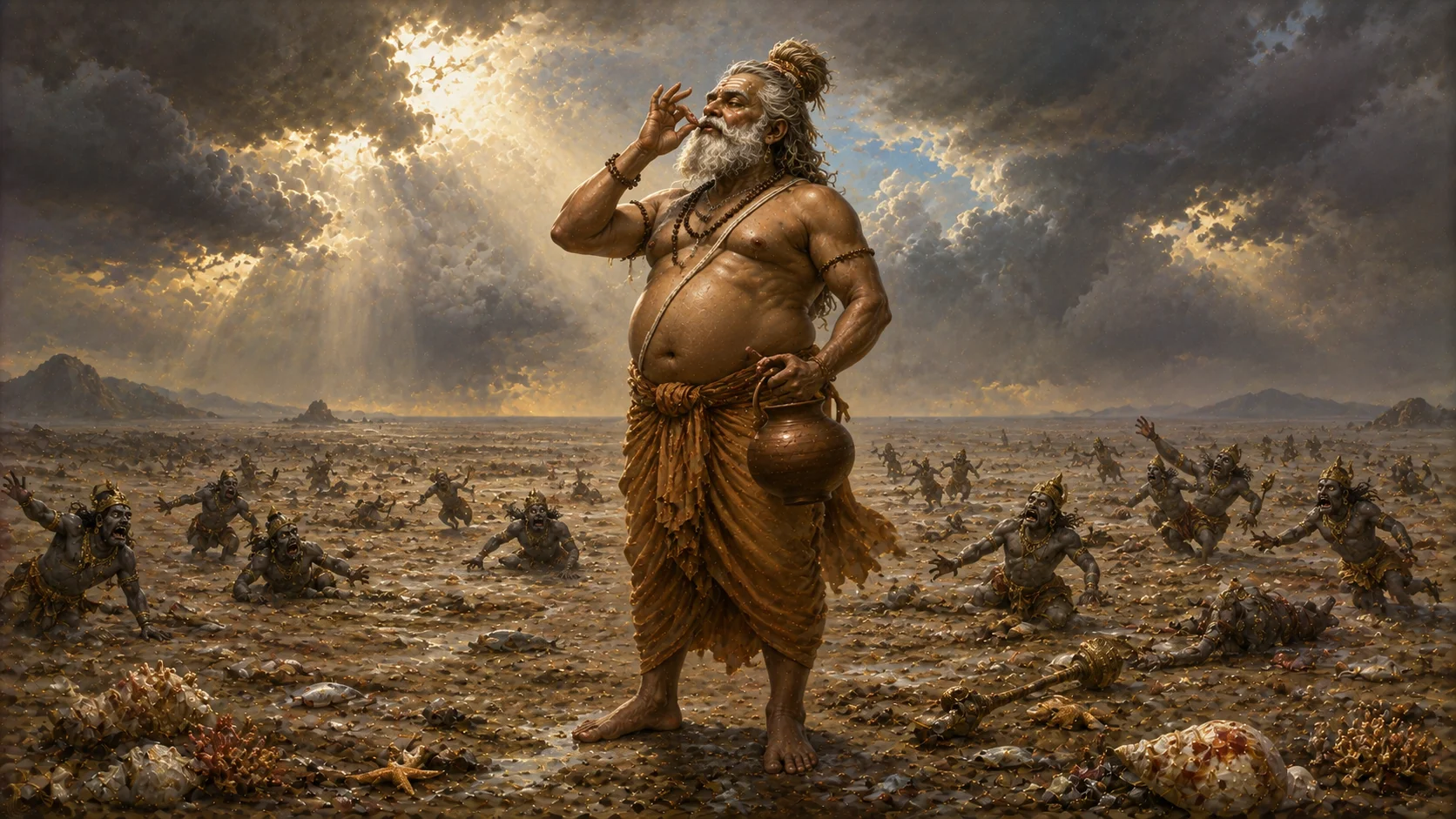
Among Agastya's most famous feats, recounted in the Mahabharata and the Puranas, is his drinking of the entire ocean. The asura brood known as the Kalakeyas had taken to hiding beneath the sea by day, safe from the gods, and emerging by night to slaughter sages and threaten the cosmic order. Appealed to by the Devas, Agastya drank the ocean to its bed in one draught, laying the seabed bare and exposing the Kalakeyas where they had hidden, so that they could be destroyed. Having accomplished the deed, the sage found himself unable to release the water back — an outcome later retellings use to explain the persisting salinity of the sea, or the long span of time before the ocean's waters were made whole again. The feat stands as one of the clearest expressions of Agastya's power: no army was needed, only the will and capacity of a single sage.
The Vindhyas That Bowed and Never Rose
The second of Agastya's defining deeds concerns the Vindhya mountain range. Jealous of Mount Meru's height, the Vindhyas began to grow without limit, swelling upward until they threatened to block the very path of the sun across the sky. The gods turned to Agastya, whom the Vindhyas revered as their teacher. The sage asked the range to bow low so that he might cross over it to the south, and to remain bowed until his return. Agastya, having crossed into the southern lands, never went back north — and so the Vindhyas, true to their word, have remained lowered ever since, awaiting a return that legend says has not yet come. The sun's path was preserved, and the Vindhyas never regained the height they once reached for.
Vatapi Digested Before He Could Rise Again
In the south Agastya also confronts the asura brothers Vatapi and Ilvala, who preyed on Brahmins through a cruel trick: Ilvala would transform Vatapi into a goat, serve his flesh as a meal to an unsuspecting guest, and then call his brother's name — at which Vatapi would tear his way back out of the diner's body, killing him. When the brothers attempted this on Agastya, the sage ate the goat-flesh and then, before Ilvala could call Vatapi forth, calmly declared that Vatapi had already been digested. The asura could not reconstitute himself, and Ilvala's ancient trick claimed no further victims. The episode is counted among the clearest demonstrations of Agastya subduing demonic threats through composure and spiritual mastery rather than any weapon.
Counsel and Gifts in the Dandaka Forest
Agastya's presence extends into the Ramayana, where he plays a quiet but consequential part in Rama's exile. Encountered in the Dandaka forest, the sage receives Rama, offers him counsel, and gifts him divine weapons that will serve him in the war to come against Ravana. It is a meeting between the wandering prince and the settled authority of the deep forest — Agastya, already established as lord of the southern wilds by the time Rama passes through, extends his protection and his power to the cause of dharma without needing to leave his own domain to do so.
Seer Who Carried the Vedas Across the Vindhyas
It is in the south that Agastya's legend grows to its fullest scale. Having crossed the bowed Vindhyas, he is remembered as the sage who first carried Vedic culture and Sanskrit learning into South India, settling there and instructing its peoples in the sciences and rites the north had cultivated. Where other rishis remain associated chiefly with the Gangetic heartland, Agastya's story is inseparable from the act of crossing over — of taking what had been confined to one region and carrying it, deliberately, into another, becoming in the process a bridge rather than a boundary between the Sanskritic and Dravidian worlds.
Father of Tamil, Author of the Lost Agattiyam
Within Tamil tradition specifically, Agastya's stature grows further still: he is honoured as the father of the Tamil language itself and credited as the author of its earliest grammar, the Agattiyam — a text that does not survive but that Tamil literary memory nonetheless holds as the foundation stone of its own grammatical tradition. This claim belongs to the Tamil textual tradition rather than to the Sanskrit Puranic corpus, and it marks a distinct layer of Agastya's legend — one in which he is remembered not merely as a visiting sage who brought an outside learning south, but as the very originator of the south's own literary voice.
Siddhar of the Southern Medical Arts
South Indian Siddha medical tradition adds yet another dimension to Agastya's identity, crediting him with Ayurvedic and medical treatises and revering him as a Siddhar — a master of the alchemical, yogic, and medical sciences particular to that tradition. This devotional and medical layer sits alongside, rather than replacing, his identity as a Sanskrit Vedic rishi: the same figure who composed Rigvedic hymns in the north is honoured in the south as a source of healing knowledge, a testament to how thoroughly his legend was absorbed and re-elaborated once it took root there.
Counted Among the Seven Great Sages
Agastya is counted among the Saptarishi, the seven great sages of Puranic tradition, though the exact composition of that sevenfold list varies somewhat across different texts. His inclusion places him in the company of the most exalted seers of the tradition — a recognition that, however his specific feats and regional associations differ from telling to telling, his standing as one of the foundational sage-figures of the Vedic world is not in question.
Canopus in the Southern Sky, Temples Across the South
Agastya's presence is not confined to narrative alone. The star known in the West as Canopus is identified in traditional astronomy as Agastya Nakshatra, a southern star bearing the sage's name. Across Tamil Nadu and the wider south, temples and sacred hills are dedicated to him, sites of ongoing veneration rather than mere memorials to a figure of the past. In this the two strands of his legend meet: the astronomical and the devotional both keep Agastya fixed in the south he is remembered as having civilised, a presence still visible overhead and still honoured on the ground.
The Sage Who Subdued Through Spirit, Not the Sword
Taken together, Agastya's feats form a single recognisable pattern. Whether the obstacle is a mountain range grown too proud, an ocean sheltering demons, or a pair of asuras preying on the unwary, Agastya's method is never martial. He does not fight the Vindhyas — he asks them to bow, and they obey out of reverence for their teacher. He does not battle the Kalakeyas directly — he drains the sea that hides them. He does not strike down Vatapi with a weapon — he digests him with composure. Agastya stands, across every telling, as the sage who extends Vedic dharma into new and difficult ground, and who overcomes both natural and demonic obstacles through the sheer authority of spiritual power rather than force of arms — a figure the Tamil south still honours as its own, and the wider tradition still counts among its greatest seers.
Sources & traditions
- EncyclopediaWikipedia — Agastya
- TraditionHindu texts, oral tradition and village tellings (South Asia)
Myths change from area to area and from time to time. This chronicle follows the most widely told versions; tellings in other villages, regions and eras may differ.