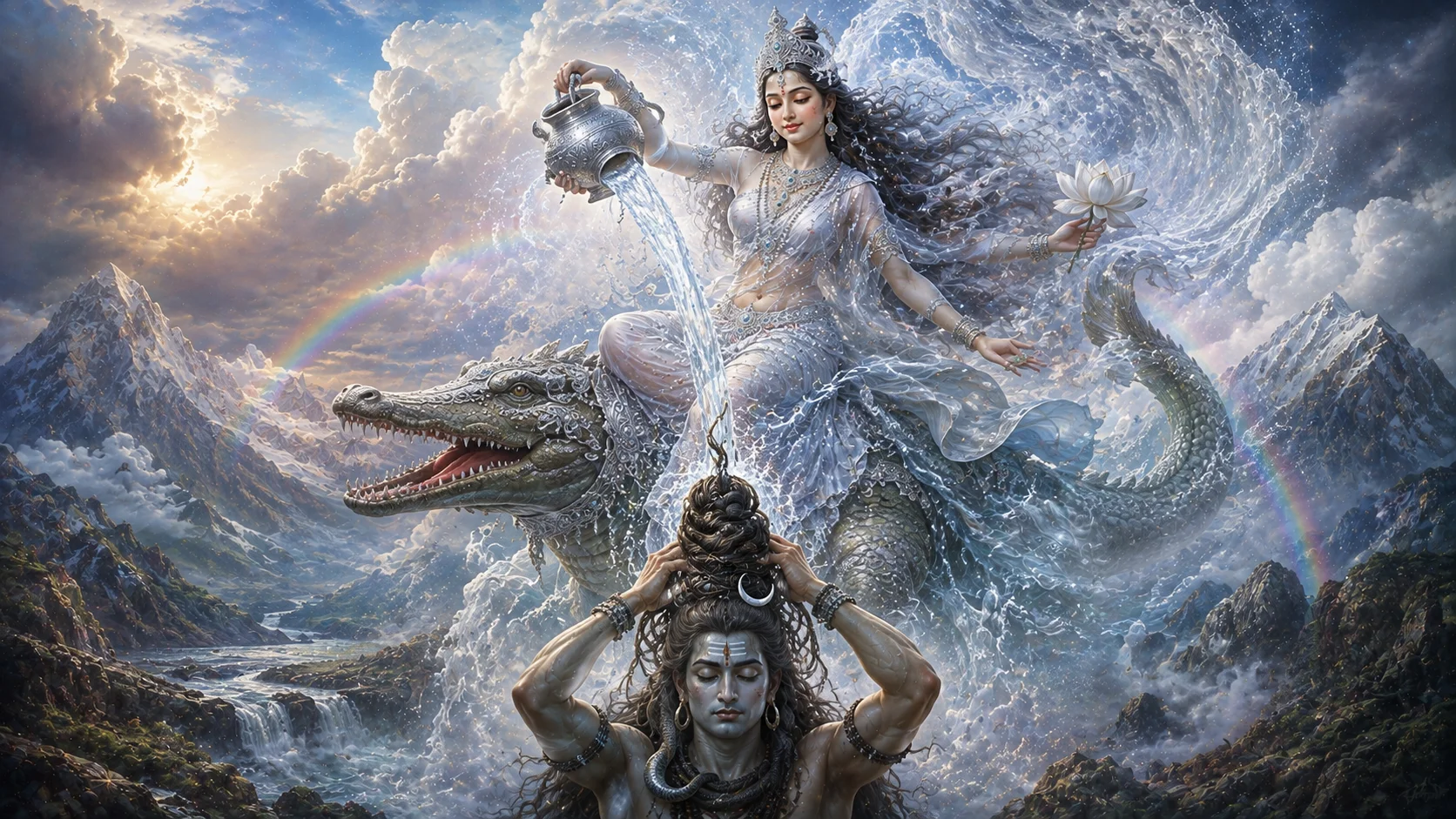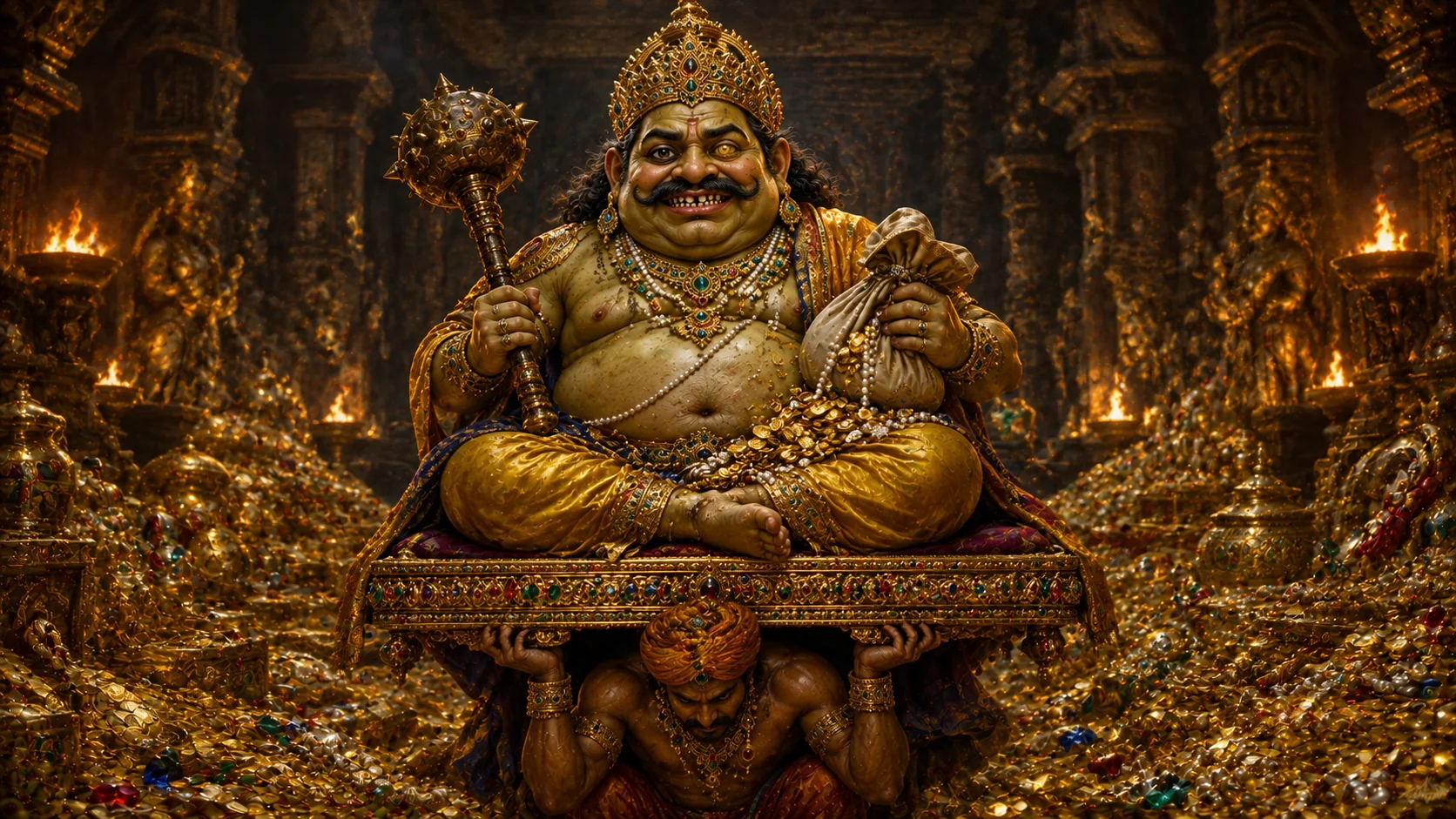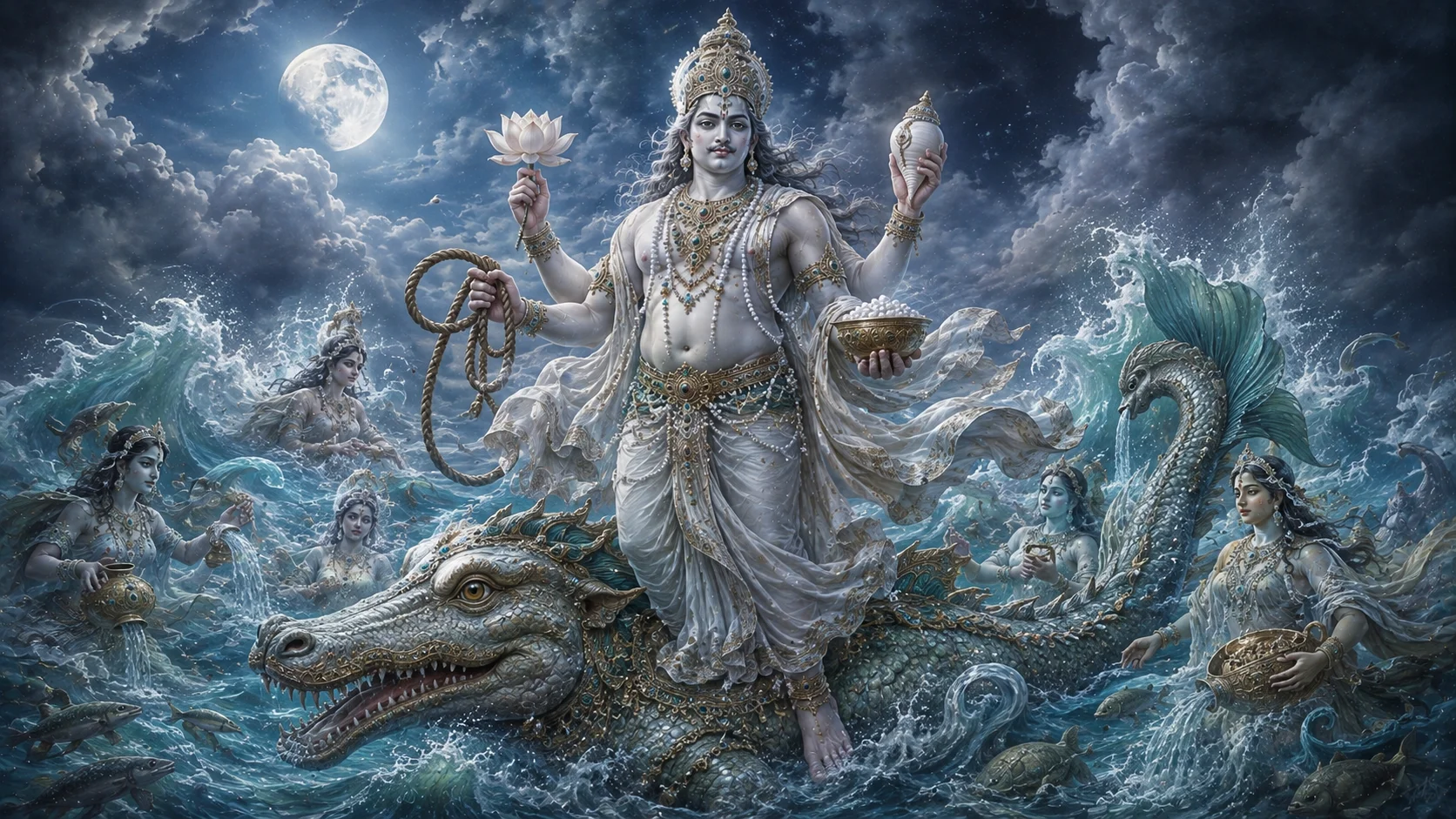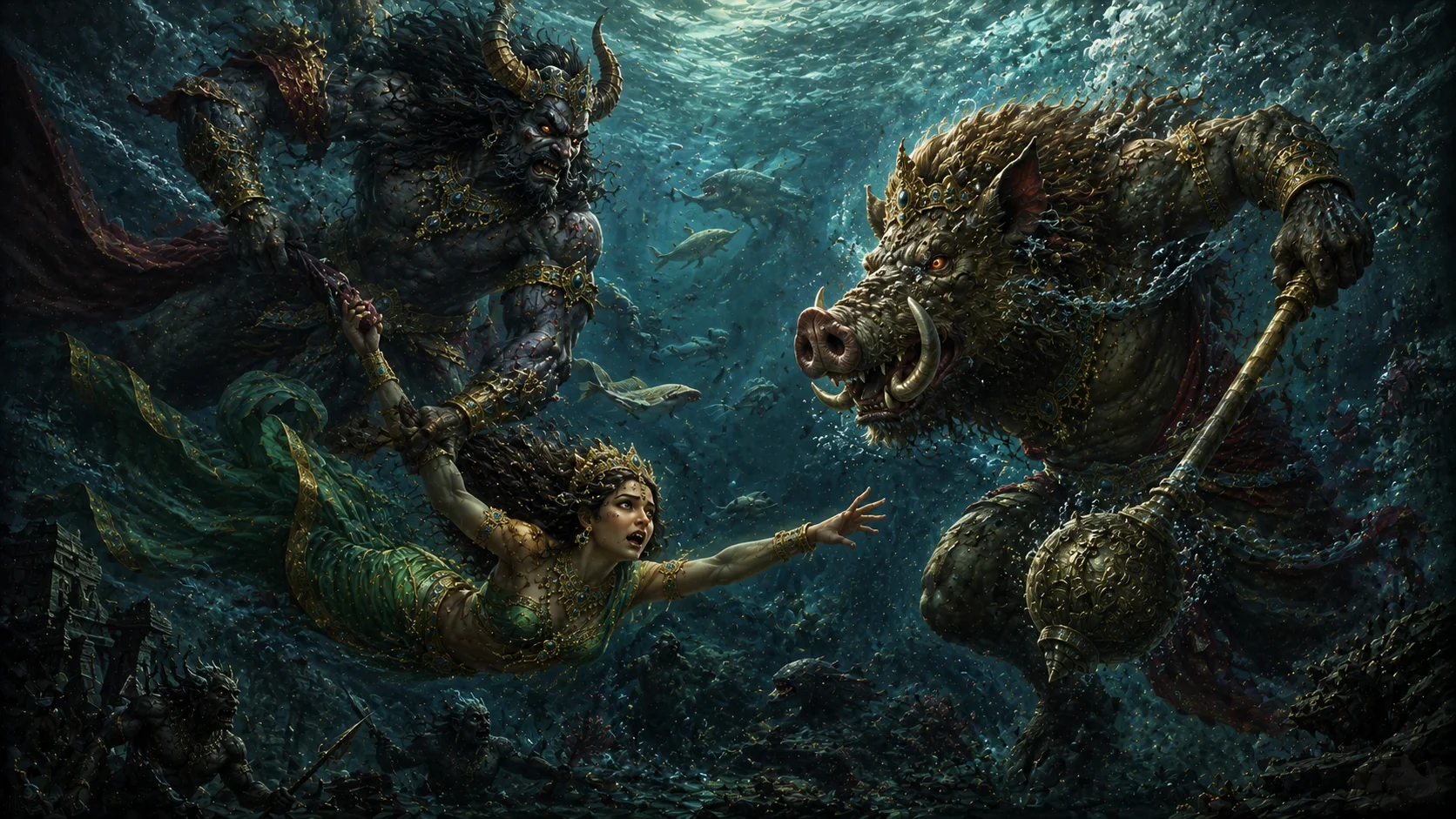
Hiranyaksha is a great demon of Hindu myth — the mighty asura who dragged the earth-goddess down into the cosmic ocean, threatening creation, and was slain by Vishnu's boar avatar Varaha, the brother of Hiranyakashipu. The golden-eyed demon, Hiranyaksha is the asura who seized the earth and was slain by the cosmic boar.
The Golden-Eyed Demon
Hiranyaksha (Sanskrit Hiraṇyākṣa, “golden-eyed”) is a great and powerful asura (demon), the brother of Hiranyakashipu (whom Narasimha would later slay). The two brothers were demons of immense power and hostility to the gods and the cosmic order. Hiranyaksha was a mighty warrior-demon, proud and powerful, an enemy of the gods who terrorised the cosmos.
The Seizing of the Earth
Hiranyaksha's great and terrible deed was to seize the earth itself — the earth-goddess Bhumi (Bhudevi) — and drag her down into the depths of the cosmic ocean, plunging the world into the primordial waters and threatening all of creation with destruction. By taking the earth down into the deep, the demon threatened to undo the ordered world, drowning creation in the cosmic waters. This was a catastrophe that threatened the very existence of the world, and it called forth a divine response.
The Battle with Varaha
To rescue the earth and destroy the demon, the god Vishnu took the form of Varaha — the colossal boar avatar — and dived into the cosmic ocean to recover the drowning earth. There, in the depths, Varaha confronted Hiranyaksha, and the two did battle in a tremendous combat that raged (in the tellings) for a thousand years, the mighty boar against the mighty demon, deep in the cosmic waters. At last, Varaha slew Hiranyaksha, destroying the demon, and then lifted the earth-goddess Bhumi up upon his great tusks, raising the world out of the depths and restoring it to its place in the cosmos. Through the slaying of Hiranyaksha, Vishnu (as Varaha) saved the earth and creation from the demon who had dragged the world into the deep.
The Demon Who Seized the Earth
Hiranyaksha endures as a great demon of Hindu myth — the golden-eyed asura who dragged the earth-goddess into the cosmic ocean and was slain by Vishnu's boar avatar Varaha, the brother of Hiranyakashipu. He embodies the demonic power that threatens to undo creation and drown the world, and his deed called forth one of the great avatars of Vishnu the preserver; and he stands as the demon who seized the earth — the mighty asura whose dragging of the world into the deep was answered by the cosmic boar Varaha, who slew him and lifted the earth back to safety. (With his brother Hiranyakashipu, the two demons are said in some traditions to have been the gatekeepers of Vishnu, cursed to be born as demons and slain by Vishnu's avatars across successive lives.)
The golden-eyed demon who dragged the earth-goddess down into the cosmic ocean, threatening to drown all creation — until Vishnu's boar avatar Varaha dived into the deep, slew him, and raised the world to safety.
Born at the Wrong Hour
Almost every Hindu demon of consequence begins with a moment of carelessness, and Hiranyaksha's is one of the most precise in the whole literature. The Bhāgavata Purāṇa tells it in its third book, where the sage Maitreya recounts the affair to Vidura: Diti, wife of the sage Kaśyapa, was seized by desire and came to her husband at sandhyā — twilight, the seam between day and night, the hour reserved for the evening rite and forbidden to the marriage bed. Kaśyapa told her plainly what she was risking. She would not wait. He yielded, and afterwards spoke the consequence aloud: the sons of that hour would be a scourge upon the worlds.
Diti carried them for a hundred years, and the tradition dwells on the omens — the dimming of the sun, the disorder in the quarters of the sky. When the twins came they were already enormous, already fixed in the temperament that would define them. Their seniority is a small curiosity in itself: Hiranyaksha was delivered first, and yet the tradition counts Hiranyakashipu the elder, on the reasoning that the elder child takes the place behind in the womb and therefore comes out second. Hiranyaksha was simply the one who could not sit still.
Notice what the pair are called. Hiraṇya is gold. One brother is Hiraṇyākṣa, golden-eyed — gold in the very organ of wanting. The other is Hiraṇyakaśipu, golden-cloth or golden-cushion — gold in the bedding, luxury made a name. These are not incidental epithets. The two demons who between them provoked two of Vishnu's incarnations are both named after treasure, and the crime of the golden-eyed one is to take the earth away and hide it where no one can reach it. The myth understood hoarding long before economics did.
The Doorkeepers Who Chose the Shorter Road
The strangest thing about Hiranyaksha is that, in one of the great frame-stories of Vaishnava tradition, he is not really a demon at all. He is a servant of Vishnu serving out a sentence.
Four ancient sages — the Kumāras Sanaka, Sanandana, Sanātana and Sanatkumāra, who by a boon go about in the bodies of small children — came to Vaikuntha to see the lord. At the seventh gate two doorkeepers, Jaya and Vijaya, took them for infants and barred the way. The sages cursed them to fall from that place and be born among embodied beings. Vishnu, when he came out, would not simply cancel the word of a brahmin; he offered the two a choice instead. They could take seven lifetimes as his devotees, or three as his enemies, and either way they would return. They chose the three. Hatred, it turned out, was the faster road home.
The three pairs, in the standard reckoning, are:
- Hiranyaksha and Hiranyakashipu, killed by Varāha and Narasiṁha;
- Rāvaṇa and Kumbhakarṇa, killed by Rāma;
- Śiśupāla and Dantavakra, killed by Kṛṣṇa.
This is a remarkable theological move, and it changes the emotional register of the whole story. Hiranyaksha is not evil incarnate; he is a devotee wearing enmity as a costume, and the boar who kills him is doing him a kindness. In the devotional reading, the only thing the demon truly wants — contact with god — is exactly what he gets, on the only terms his curse allows.
The Demon Who Could Not Find an Enemy
Before the earth was ever touched, Hiranyaksha had a more ordinary problem: nobody would fight him. Spoiling for a fight every day, he took up his mace and went to heaven looking for one, and found that Indra and the gods had hidden themselves rather than meet him. He went through the worlds unopposed, which for a warrior is its own kind of humiliation.
He came at last to Vibhāvarī, the city of Varuṇa in the depths of the sea, and challenged the old god of the waters to single combat. Varuṇa's answer is the finest piece of writing in the episode — not a refusal but a deflection dressed as flattery. He and his had grown peaceable, he said, and he could think of only one opponent fit to satisfy a master of the science of war: the Primeval Person, who takes on bodies precisely in order to put down the wicked. Go and find him, Varuṇa added, and your pride will leave you — you will lie on the warrior's bed with dogs around you. The sage Nārada supplied the address, and the demon went down into the ocean to keep the appointment.
So he dives into the cosmic ocean on purpose. He is not ambushed by an avatar; he goes hunting for one, on directions given by two gods who both knew exactly how it would end.
The Fight Itself
The duel is fought first with maces, and the insults are staged as carefully as the blows. Hiranyaksha calls the boar the meanest of the gods, a thief carrying off property that belongs to the dwellers of the lower world, and a cheat who beats demons by trickery rather than strength. Varāha does not trouble to deny the charge of being low. He agrees that he is a wild beast of the jungle — and adds that he is out hunting dogs like this one.
When force fails, Hiranyaksha turns to māyā — illusion, the demon's characteristic weapon in Sanskrit epic. He raises a wind and a darkness, and out of the sky come showers of stones, blood, pus, filth and bone, and troops of armed rākṣasas. Varāha ends the entire apparatus with one throw of the Sudarśana discus.
And there is a clock running. Brahmā, watching, tells the boar to finish the matter: the auspicious hour called abhijit, which began at midday, has all but run out, and the dark of evening is coming on — the hour when demons grow strong. It is difficult not to notice what that means for this particular demon. He was conceived at twilight. Twilight was very nearly what saved him.
The killing blow is not a weapon at all. Varāha strikes him at the root of the ear with his foreleg — the text reaches for Indra's blow against Vṛtra as the comparison — and the demon goes over like a great tree pulled up by the wind, limbs broken, hair scattered. What the text then lingers on is what did not happen to him: the lustre of his body did not fade, and he gave up his life looking at the face of Vishnu. The gods who gather afterwards say openly how rare a death that is. A cursed doorkeeper could not have asked for better.
The Boar Before the Demon
Here is the detail that reframes everything: in the oldest layers of the tradition, there is no Hiranyaksha at all.
The boar who lifts the earth out of the water is far older than the demon he fights. In the Taittirīya Saṁhitā the lifting is done by Prajāpati, the lord of creatures, who takes a boar's form and raises the earth out of the primeval water; the Śatapatha Brāhmaṇa tells the same act and gives the boar the name Emūṣa. It is a cosmogonic act, not a rescue — the world is not being stolen back from anyone, it is being brought into being, dredged up from the formless deep because that is how solid ground gets made. There is no villain in it, because there is nothing yet for a villain to steal.
Stranger still, Emūṣa belongs to a second and quite different Vedic strand, in which the boar is not the saviour but an asura — a hoarder whose wealth lies behind a mountain that Indra shoots through so it can be carried off. The two boars, the world-raiser and the demon, were eventually harmonised into one. The animal has been on both sides of this story from the beginning.
Even in the Puranic period the two versions sit side by side. The Viṣṇu Purāṇa's Varāha chapter is essentially pure cosmogony: at the opening of the kalpa the boar rises, the water shaken from his brow falls on Sanandana and the sages of the upper spheres, who hymn him, and he lifts the earth on his tusks. No demon troubles the narrative at all. It is the Bhāgavata and the boar-centred Puranas that give the episode an antagonist, a motive, a duel and a deadline.
What that means for Hiranyaksha is unusual and worth stating plainly. He is a later arrival to an older myth — a personification supplied because a creation story eventually needed a reason for the earth to have gone under. Once the boar's dive stopped being simply how the world was made and became a rescue, somebody had to have done the taking. Hiranyaksha is the answer to a question the myth only started asking after it was already ancient.
The Blind Son
The Śaiva Puranas give Hiranyaksha a second life that most retellings drop entirely. In their account he is childless, and undertakes severe austerity to Śiva asking for a son. While he does so, Pārvatī playfully covers Śiva's eyes with her hands; the world goes dark, and from the sweat of that touch a child is formed — dark, misshapen and blind. He is called Andhaka, “the blind one”, and Śiva gives him away to the demon who asked.
Andhaka grows up into one of the great asura antagonists in his own right, and is destroyed by Śiva himself after setting his desire on Pārvatī — the Andhakāsura-vadha, a scene carved on temple walls across India. The genealogy is doing quiet sectarian work, handing the same demonic lineage to Śiva to dispose of. But it also gives Hiranyaksha something the Vaishnava telling denies him: an ordinary want. He wanted a child.
Recognising the Story in Stone
Varāha is one of the easiest figures in Indian art to identify, and Hiranyaksha one of the hardest, because the sculptors almost never bothered with him. Two iconographic forms dominate:
- Nri-Varāha — a human body with a boar's head, one leg planted, the other raised on the coils of the serpent of the deep, with the earth-goddess Bhūdevī small and calm on his tusk or elbow.
- Yajña-Varāha or Bhū-Varāha — the wholly animal boar, whose body is read as the sacrifice itself, each limb equated with an element of the Vedic rite.
The monumental Gupta-period panel at the Udayagiri caves near Vidisha in Madhya Pradesh, cut around 400 CE, is the definitive image of the first type: an enormous striding boar-man with ranks of gods and sages assembled to watch, and the goddess held at his tusk. At Eran, not far away, stands a colossal free-standing stone boar of the second type, its whole body covered in miniature figures of sages, carrying an inscription of the Hūṇa ruler Toramāṇa. The Pallava Varāha maṇḍapa at Mamallapuram and the monolithic boar at Khajuraho take up the same subject centuries later.
Because the earth-lifting is a scene of rescue and restoration, the demon is usually reduced to a small trampled figure beneath the boar's foot — if he appears at all. That vanishing is telling in itself. Kings liked this image: a ruler who lifts the earth and holds it steady is exactly what a dynasty wants carved on a rock face, and the Udayagiri panel has long been read as a statement about imperial power as much as about myth.
Where the Boar Is Still Worshipped
Hiranyaksha has no cult of his own. Varāha, however, is a living object of worship. Temples to Bhū-Varāha Swāmī stand at Srimushnam in Tamil Nadu and at Tirumala in Andhra Pradesh, where temple tradition holds that the boar occupied the hill first and that pilgrims should pay their respects to him before approaching Veṅkaṭeśvara. Varāha Jayantī, marking the avatar's appearance, falls in the bright half of the month of Bhādrapada. And in the Tantric and Śākta traditions the boar has a feminine counterpart, Vārāhī — boar-headed, fierce, counted among the Seven Mothers and worshipped in her own right.
The demon survives only inside those liturgies, as the thing that had to be removed. That is the fate of most asuras: remembered daily, never addressed.
Why the Earth Sinking Is the Fear That Lasts
Strip the theology away and the plot of this myth is startlingly simple. The ground goes under the water, and someone took it.
The image of a diver going down into a limitless sea to bring up a scrap of earth is one of the most widely distributed in world mythology — the earth-diver, who returns from the bottom with mud in his mouth so that there can be a place to stand. India's version gives the diver tusks and a name, and then, later, gives the sea a thief. That addition is the interesting part, because it converts a story about how the world came to be into a story about how the world can be lost.
And what does the loss look like? A being named for gold takes the earth — not to use it, not to rule it, simply to have it, down where nobody else can get at it. Land pulled out of common reach and held by one appetite. Whatever the composers of the Bhāgavata had in view, the shape of the anxiety has not aged: that the solid ground under a community is the kind of thing that can be taken and held under, and that getting it back takes something very large and very old.
It is worth remembering that the boar wins by being an animal. Not a king, not a sage, not a weapon — a tusked, mud-caked forest creature who does the one thing tusks are for. The god who saves the world from the golden-eyed demon rescues it by rooting.
Sources & traditions
- EncyclopediaWikipedia — Hiranyaksha
- TraditionHindu texts, oral tradition and village tellings (South Asia)
Myths change from area to area and from time to time. This chronicle follows the most widely told versions; tellings in other villages, regions and eras may differ.