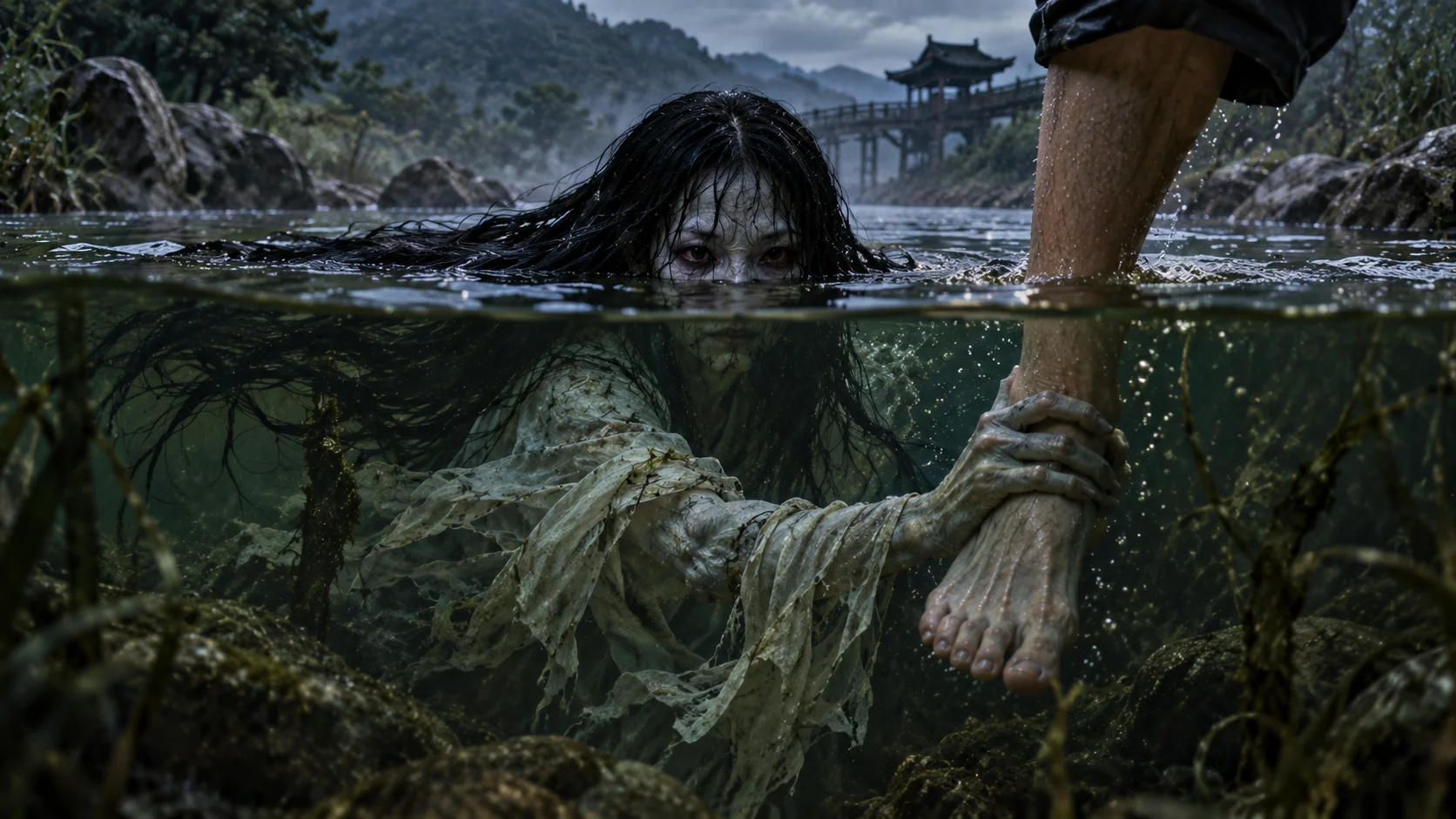
The mul-gwishin (물귀신), the "water ghost" of Korean folklore, is the restless spirit of a person who drowned — bound to the river, lake, or sea that took them, and driven by a single desperate need: to pull a living swimmer down in their place.
A Ghost Born of Drowning
Unlike spirits whose grievance is a wrong done to them by another person, the mul-gwishin's torment is the water itself. Korean belief held that a person who died by drowning could not simply pass into the afterlife the way someone who died on land might. Their spirit remained tethered to the exact currents, whirlpools, or depths that closed over them, unable to move on, unable to rest. The mul-gwishin belongs, alongside beings like the samjok-gu and the broader gwisin, to a wider Korean category of inauspicious spirits and omens — figures used in oral tradition to encode warnings about respecting nature and the dead — though the fact record does not establish a specific taxonomic relationship between mul-gwishin and gwisin beyond that shared category.
Fishermen, villagers living along riverbanks, and coastal communities told these stories not as idle horror but as lived caution, similar in function to Western drowned-spirit legends such as the kelpie: a warning to children and fishermen to stay clear of dangerous currents, whirlpools, and deep water.
Clinging Like a Water Ghost
The defining feature of the mul-gwishin is its need for a substitute. According to the folklore, the drowned spirit cannot cross into the next world alone — it must first drag a living person under the surface to die in the same way, in the same water, so that a replacement takes its place and the original ghost is finally released.
This image was vivid enough to leave a permanent mark on the Korean language itself. The idiom mul-gwishin cheoreom dallabuteunda — "clinging like a water ghost" — describes someone who fastens onto another person or a demand with the same desperate, inescapable grip the ghost supposedly uses on a drowning swimmer: a person who will not let go of a grudge, a debt, an argument, or another person's attention no matter how many times they are shaken off.
A Warning Written in Ghost Stories
Strip away the supernatural framing and the mul-gwishin legend performed a very practical service: it kept children away from unsupervised swimming holes and warned fishermen off waters with known undertows — a story-shaped fence around a community's most dangerous stretch of river or coastline, much as drowned-spirit legends function elsewhere in the world.
Kin Among the Omens
The mul-gwishin belongs to a wider Korean category of inauspicious spirits and omens that also includes the samjok-gu, the three-legged dog whose unnatural anatomy marks its appearance in a household as a warning of coming misfortune or death, and which in some tellings is itself associated with dokkaebi or gwisin taking canine form. Where the samjok-gu's wrongness is visible at a glance, the mul-gwishin's wrongness is invisible until the moment it acts. Both figures encode the same cultural grammar: a being that violates the normal order — whether by defying anatomy or by refusing to let a death be final — is a sign that something requires caution, respect, or ritual attention.
Water, Grain, and the Shape of the Unseen World
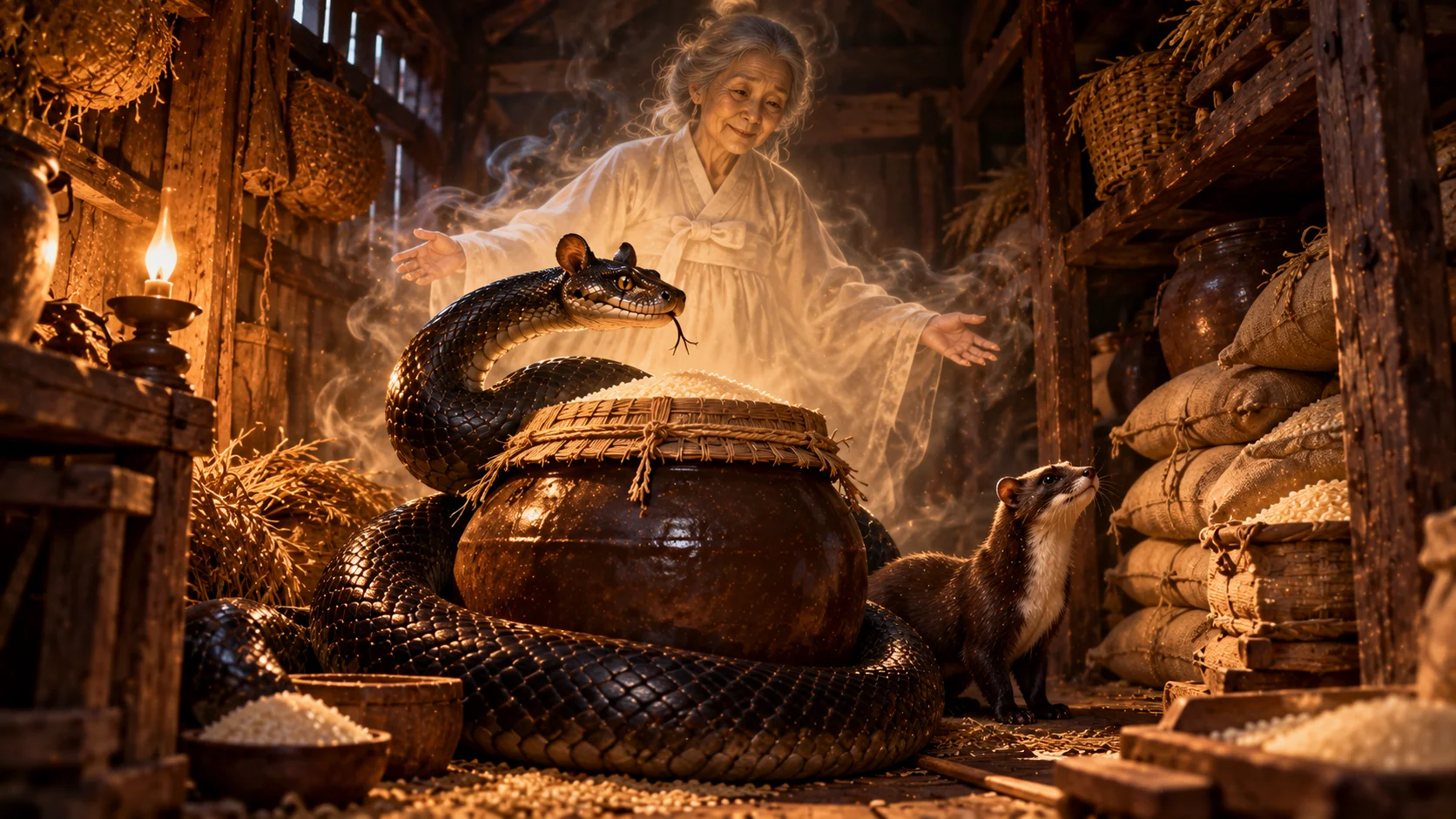
Korean folk religion did not reserve its unseen forces for danger alone. The household deity eopsin, a wealth spirit believed to dwell in the storage jars or beneath the house in the form of a snake, weasel, or toad, mirrors the mul-gwishin's logic in reverse: where the water ghost's presence in a place is a danger to be avoided, the eopsin's presence in a home is a fortune to be protected, and its departure is read as an omen of decline. In some regional traditions, a paramount form of this household guardian was known as eopwang, "king of the eop." This worship was traditionally overseen by the women of the household, reflecting the domestic character of Korean house-worship (gajang-sinang) as distinct from village or state rites.
Metal-Eaters and Winged Horses
Korean legend was equally capable of imagining supernatural forces as overwhelming power. The bulgasari, a bear- or tapir-like beast said to have been formed from balls of rice or thread — in some tellings by Buddhist monks, in others by a grieving family — during the oppressive final years of the Goryeo Dynasty (14th century), grew larger and stronger with every scrap of metal it consumed, eventually devouring the weapons and tools of tyrannical rulers. The legend was popularized in modern media by the 1962 South Korean film Bulgasari and, more infamously, the 1985 North Korean giant-monster film Pulgasari — produced under directives from Kim Jong-il following the abduction of South Korean director Shin Sang-ok. Separately from the monster, "bulgasari" is also the everyday name for starfish and sea cucumbers in some regional Korean dialects, an odd linguistic bridge between the legendary iron-eater and real marine life.
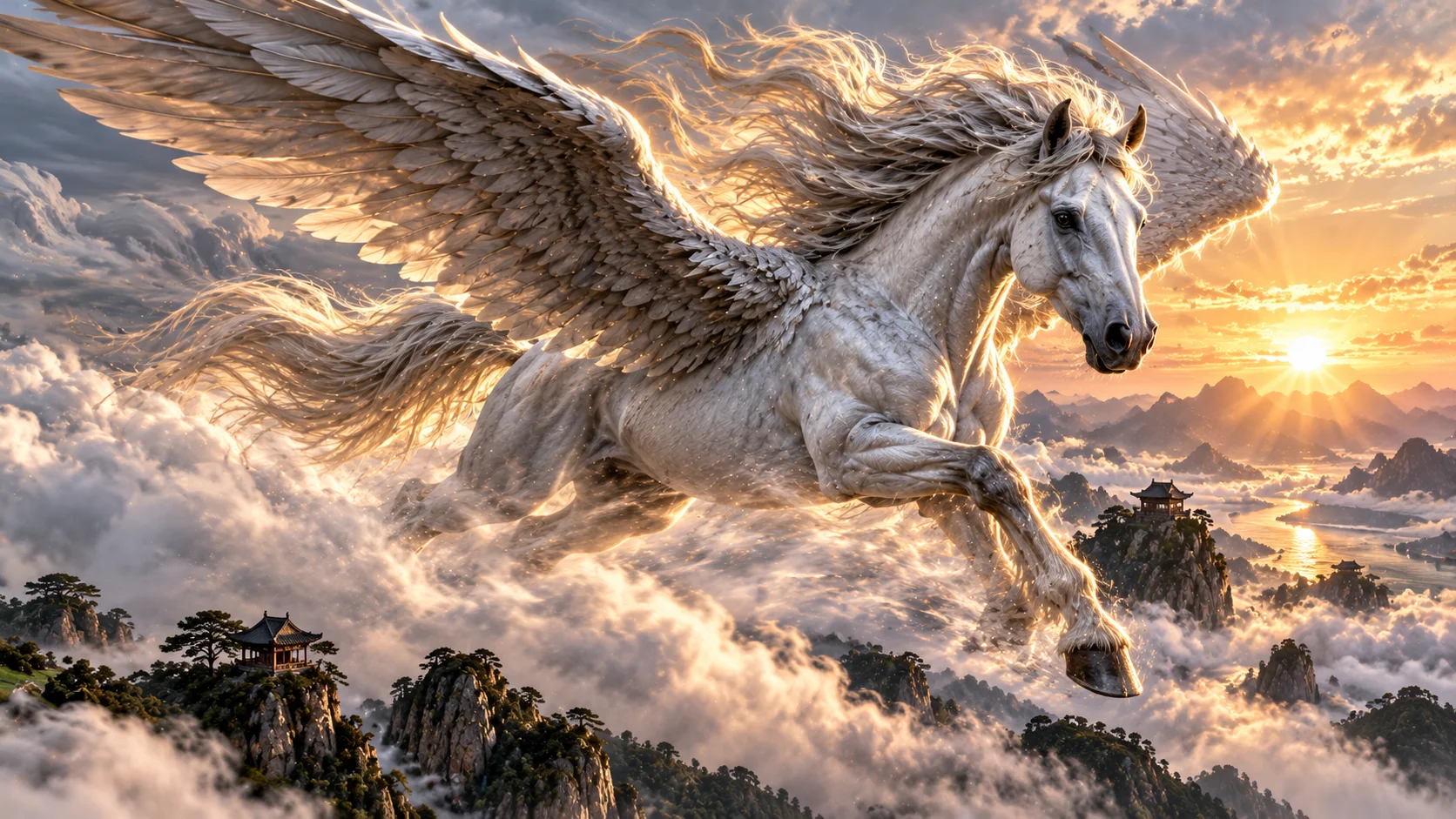
Speed rather than hunger defines the chollima, the legendary "thousand-li horse" said to be capable of covering roughly four hundred kilometers in a single day, a creature so wild and swift that only a truly discerning judge of horses could recognize its worth. The chollima traces back to the ancient Chinese qianlima tradition, but in Korea it took on a specific modern political life: North Korea adopted it as the emblem of its postwar reconstruction drive, the Chollima Movement, launched in 1956–58 under Kim Il-sung as propaganda for rapid industrial and agricultural output, and commemorated it with a bronze Chollima Statue — a winged horse ridden by a worker and a peasant woman — erected in Pyongyang in 1961. The mul-gwishin, by contrast, never left the water it was born in — it remained a private, local fear rather than a national emblem.
A Lord Buddha Waiting, a Goddess Descending
Mireuk, the Korean rendering of Maitreya, is the future Lord Buddha awaited to descend and save all beings once the present age declines, a figure carved into colossal stone statues across the peninsula, including the Gwanchoksa Temple stone Maitreya in Nonsan. Jeju Island's shamanic creation narrative, the Cheonji-wang bonpuri, describes a contest between the benevolent Mireuk and Seokga (Śākyamuni) for rulership of the human world — a contest Mireuk loses through trickery, offered as the reason the present age is one of hardship and falsehood rather than the paradise Mireuk had intended.
Where Mireuk represents a salvation still awaited, the goddess Jacheongbi represents one already delivered. The heroine of the Jeju narrative Segyeong Bonpuri, she disguised herself as a man, fell in love with the scholar Mun Doryeong, and endured trials including death and resurrection — reviving him with the "hwansaenghwa," a flower of resurrection obtained from the Western Heaven, a motif she shares with Princess Bari's quest for the water of life. She ultimately carried the five grains and the knowledge of farming down from Cheonjiwang's heavenly realm to earth, becoming Jeju shamanism's goddess of agriculture, and in some tellings is credited with bringing sericulture and livestock-keeping to humans as well. Figures like Mireuk and Jacheongbi are recited by shamans (simbang) during ritual gut ceremonies as part of Jeju's larger bonpuri myth-cycle.
The Water That Remembers
What ties these figures together — the water ghost waiting below the surface, the omen-dog at the threshold, the wealth-spirit in the storeroom, the metal-eating beast, the winged horse, the future Lord Buddha, the grain goddess — is a worldview in which the visible world is porous, and every place carries the residue of what has happened there. The mul-gwishin and the bulgasari, in particular, share a further thread: both represent overwhelming or transformative supernatural forces — one of patient, drowning power, the other of consuming metal-hunger — and both were later repurposed in twentieth-century political culture, the bulgasari in North Korean cinema, the chollima as a labor-productivity emblem.
That is why the mul-gwishin legend endured long after the specific rituals and beliefs around it faded from daily practice. A parent does not need to believe literally in a vengeful drowned spirit to feel the pull of the warning it carries, and a speaker reaching for mul-gwishin cheoreom dallabuteunda to describe someone who will not release their grip is drawing on centuries of story about a ghost who could never let go either.
Sources & traditions
- TraditionKorean texts, oral tradition and village tellings
Myths change from area to area and from time to time. This chronicle follows the most widely told versions; tellings in other villages, regions and eras may differ.