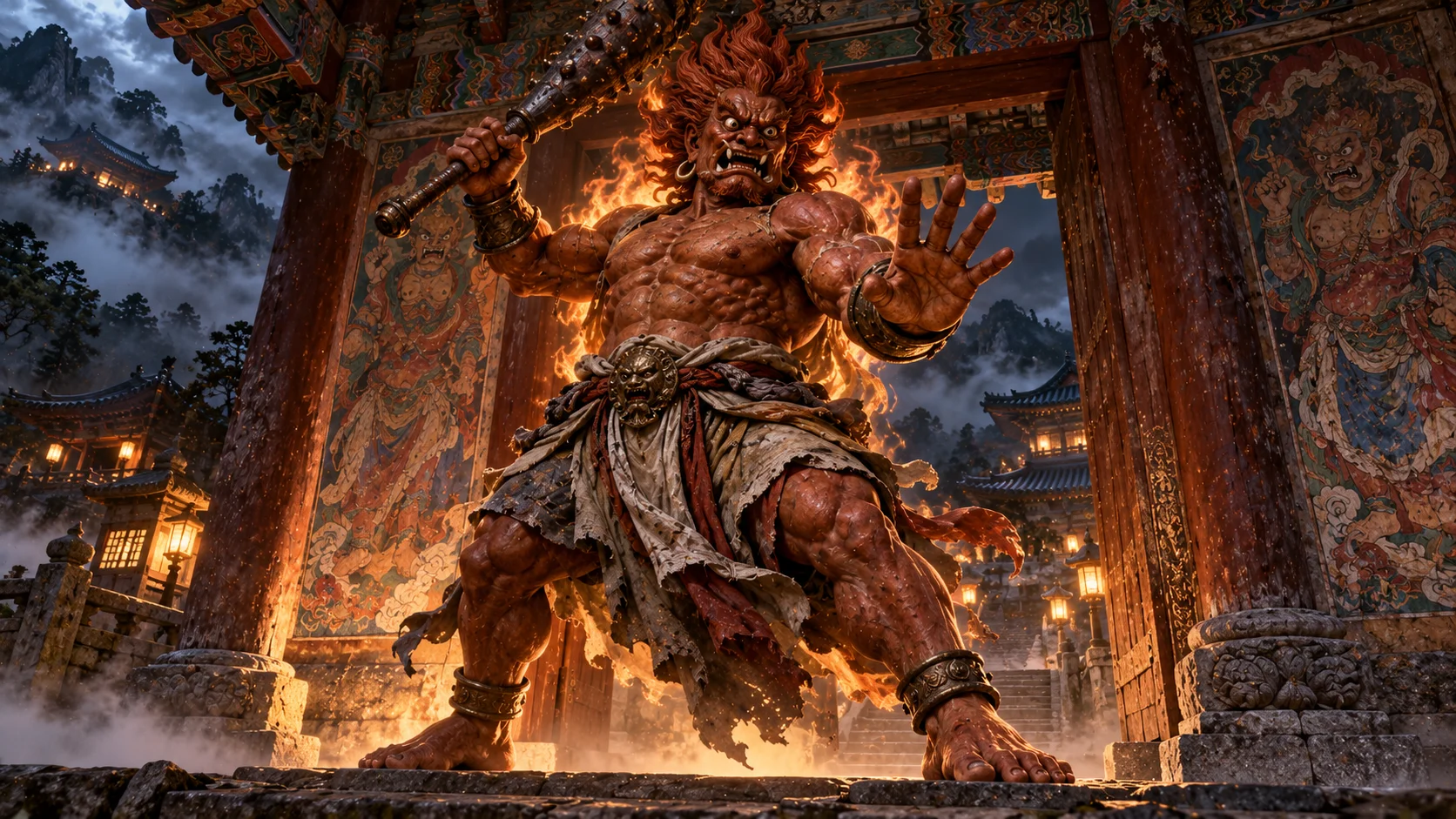
The Bulgasari (불가사리) is one of the strangest and most memorable monsters to emerge from Korean folklore: an iron-devouring beast said to have been born by accident from a lump of leftover rice, and to have grown, meal by metal meal, into a creature nothing could stop. Its very name is popularly explained as a corruption of "bulgasari" (불가살이) — "the thing that cannot be killed" — a folk etymology that captures the entire point of the legend before a single story is even told. This is not a monster born of divine wrath or ancient chaos. It is a monster born of boredom, made of sticky rice, that ate its way into becoming an apocalypse.
A Toy Made of Rice, Never Meant to Wake
The earliest surviving mentions of the bulgasari appear in Joseon-era writings, most notably the Yongjae chonghwa (慵齋叢話), a miscellany compiled by the scholar-official Seong Hyeon. The legend itself is said to reach back further, to the late Goryeo Dynasty, and the myth is associated with the fall of that dynasty — sometimes tied to accounts of the kingdom being unable to arm itself against invaders.
The origin story, in its most common form, is almost tender in its smallness. A group of Buddhist monks — in other tellings, a lonely widow or a nun — found themselves with nothing to do, or perhaps wished to make a talisman, a small protective charm to while away the hours. From leftover grains of rice, sticky enough to hold a shape, they molded a tiny figure: something like a doll, something like an idol, something without a name. And then, in the way of such stories, the little thing moved. It was small, it was harmless-looking, and it was, by every account, an accident. No one summoned the bulgasari. No one bargained with a spirit or broke a taboo to call it into being. It was simply made, the way a child makes a shape out of clay, and it simply lived.
The Shape of an Impossible Animal
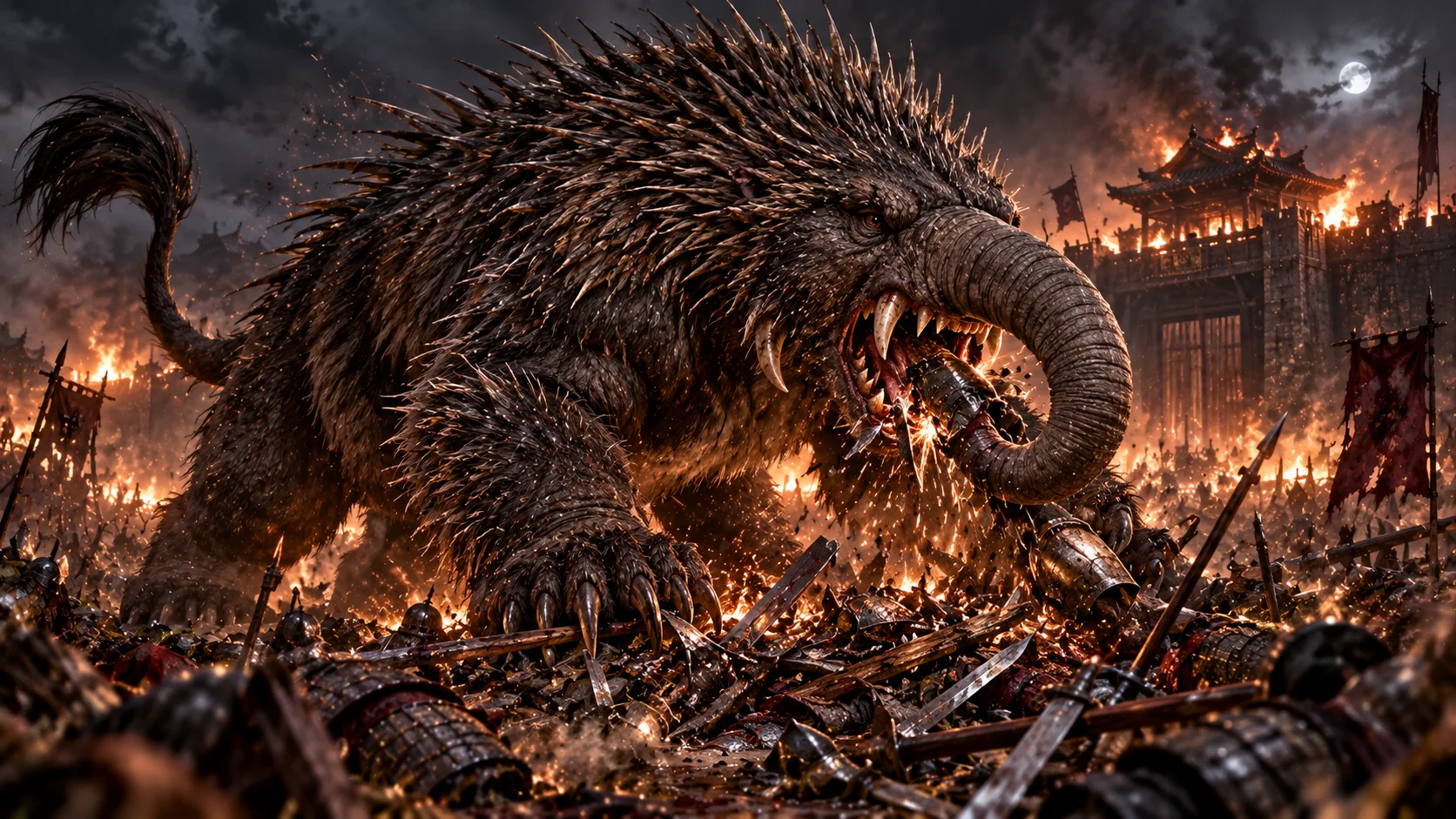
What the bulgasari looked like depends on who is telling the story, but the descriptions agree on one thing: it was assembled, chimera-like, from pieces of other animals, as though its makers — or nature itself — could not decide what kind of creature deserved to carry such an appetite. Most accounts give it a bear-like or tapir-like body, thick and rounded, built for bulk rather than speed. Onto that body is fitted an elephant's trunk or nose, reaching and probing the way a trunk does, useful for a creature that would need to seek out its unusual food source in tight spaces — a drawer, a smithy, a locked chest. Its feet are a tiger's, clawed and heavy, and its tail belongs to an ox, thick and swinging. Some versions add small, almost comically undersized eyes set into that massive head, and give the whole creature a hide as tough as a rhinoceros's — a detail that stops mattering almost immediately, since ordinary hide toughness was never going to be the bulgasari's real defense.
It is worth pausing on this design, because it is not accidental in the way the creature's birth is accidental. A being stitched from bear, elephant, tiger, and ox is a being that refuses to be filed under any single category of monster. It is not a dragon, not a tiger-spirit, not a goblin like the dokkaebi. It stands alone in the Korean bestiary as something genuinely new — invented, quite literally, out of nothing but rice and imagination.
The First Bite: Needles and Small Things
Every legend of the bulgasari's rampage begins the same way: small. The creature did not appear from the rice and immediately begin devouring castles. It began, as the stories tell it, with needles — a household's supply of sewing needles, iron and precious, vanishing one by one into a mouth that should not have had any interest in them at all. Then came other iron tools: knives, sickles, hoes, the ordinary hardware of a working household. Each bite did something remarkable. The creature did not merely feed; it changed. Every scrap of iron it swallowed made it larger, stronger, and harder to kill, as though metal were not food but fuel for its own indestructibility.
This is the detail that separates the bulgasari from almost every other hungry monster in world folklore. A dragon that eats livestock stays a dragon. The bulgasari that eats a needle is measurably, permanently different from the bulgasari before the needle. Its hunger and its power are the same mechanism, which means there is no such thing as feeding it a little.
From Farmhouse to Kingdom: The Growing Menace
Once past household objects, the legend escalates the way a fire escalates — slowly, then all at once. Farm implements disappeared into the creature's growing bulk. Then weapons: swords, spearheads, the iron fittings of carts and doors. Then armor itself, plate and mail stripped from soldiers and storehouses alike. Villages that had once dismissed the creature as a strange but minor nuisance found themselves facing something that could no longer be chased off or reasoned with, a beast now large enough to flatten a house simply by leaning against it, and hungry enough to seek out every scrap of metal a community depended on to farm, to cook, and to defend itself.
The rampage narrative works, in part, because it never loses its logic. The bulgasari was not malicious in the way a demon is malicious. It did not hate the villages it destroyed. It simply wanted more iron, and it kept getting exactly what it wanted.
A Monster Tied to the Fall of a Dynasty
The bulgasari's legend is placed at the end of the Goryeo Dynasty, and the myth is popularly linked to that dynasty's fall — symbolically, through the creature's consumption of all the kingdom's iron weapons. Some tellings tie this to accounts of Goryeo being unable to arm itself against invaders, as though folk memory had reached for a monster large enough to explain a national catastrophe.
Read this way, the bulgasari becomes something closer to a folk allegory than a simple monster tale — a story about a kingdom's own iron and strength being consumed until nothing is left to defend it with. That the creature originated by accident, from something as humble as leftover rice, only sharpens the point.
Fire, Water, and Blade: Why Nothing Could Touch It
The defining trait of the bulgasari, beyond its appetite, is its near-total invulnerability. Folk tradition is consistent on this point across regional variants: ordinary weapons simply do not work. Blades cannot cut it — and even if they could, why would anyone attack an iron-eating monster with a sword it might simply swallow. Fire does not burn it, at least not at first. Water does not drown it. Every conventional method a village might use against a dangerous animal fails, and fails in a way that makes the creature seem less like a beast to be hunted and more like a natural disaster to be endured.
This is, again, where the bulgasari's design does real narrative work. A monster that grows stronger from the very attacks meant to weaken it — since metal weapons only feed it — closes off the most obvious response available to a frightened community. You cannot outfight it. You cannot outrun something that size. The stories leave only stranger options on the table.
Undone by Fire, Undone by Cunning
And yet, in nearly every surviving version of the tale, the bulgasari does not survive. It is destroyed, but never easily and never by force alone. In the more common resolution, the creature is finally undone by fire — not the ordinary fire that failed against it earlier, but fire applied after the bulgasari has eaten so much iron that it finally becomes vulnerable. Having gorged itself past any reasonable limit, the beast becomes, paradoxically, vulnerable in a way it never was as a smaller creature. In other variants, cunning does the work that force could not: a clever ruse, set by someone patient enough to out-think rather than out-fight a monster that could not be reasoned with by strength.
There is a quiet moral logic running underneath both endings. The bulgasari's own greed — its inability to stop consuming — is what eventually delivers it to its enemies. It is not defeated from the outside so much as it defeats itself, growing large enough and gorged enough that the one force it never truly conquered, fire, finally finds purchase.
From Village Legend to Screen Monster
The bulgasari's afterlife did not end with Joseon-era manuscripts. In 1962, South Korea produced a film simply titled Bulgasari, an early attempt to bring the legendary iron-eater to the screen. Far more famous is the 1985 North Korean film Pulgasari, produced under Kim Jong-il's initiative and directed by the South Korean filmmaker Shin Sang-ok. That film reimagined the creature as a towering, kaiju-style monster in the vein of Japan's giant-monster cinema, and it did more than any other single work to carry the bulgasari's name beyond Korea's borders, introducing international audiences to a folk monster most had never heard of. It is a strange piece of the legend's long life: a centuries-old story about a rice figurine that could not stop eating iron, refracted through Cold War-era cinema and monster-movie spectacle, and still recognizably itself underneath.
Guardians in Fur: The Three-Legged Dog
The bulgasari is not the only Korean folk figure whose power comes from an unnatural body. The samjokgu (삼족구), literally the "three-legged dog," occupies a very different role in Korean folk belief — not a rampaging menace but a household guardian, prized precisely because its deformity marks it as spiritually gifted. Folk tradition holds that a three-legged dog can see gwisin, ghosts invisible to ordinary human eyes, and will bark or startle at the passage of spirits that no one else in the house can perceive. In some regional tellings, such a dog is even credited with the power to ward off cholera and plague spirits during historical epidemic outbreaks, a piece of folklore that speaks to how urgently rural communities sought any protection they could find against diseases they could not otherwise explain or treat.
The symbolism of an unusual number of limbs marking supernatural status runs wider through East Asian mythology than the samjokgu alone — it echoes the three-legged crow, associated with the sun across Korean, Chinese, and Japanese tradition. In some Korean folktales, a three-legged dog's birth is itself an omen, said to occur under inauspicious circumstances, such as a mother dog whelping near a grave or during a solar or lunar anomaly, marking the pup from birth as different, sensitive to the world behind this one. The samjokgu motif also surfaces within Korean shamanic practice, muism, where dogs generally serve as liminal animals moving between the human and spirit worlds — and a three-legged dog, doubly marked, was considered especially potent in that role.
The Spirit That Lives in the Grain Jar
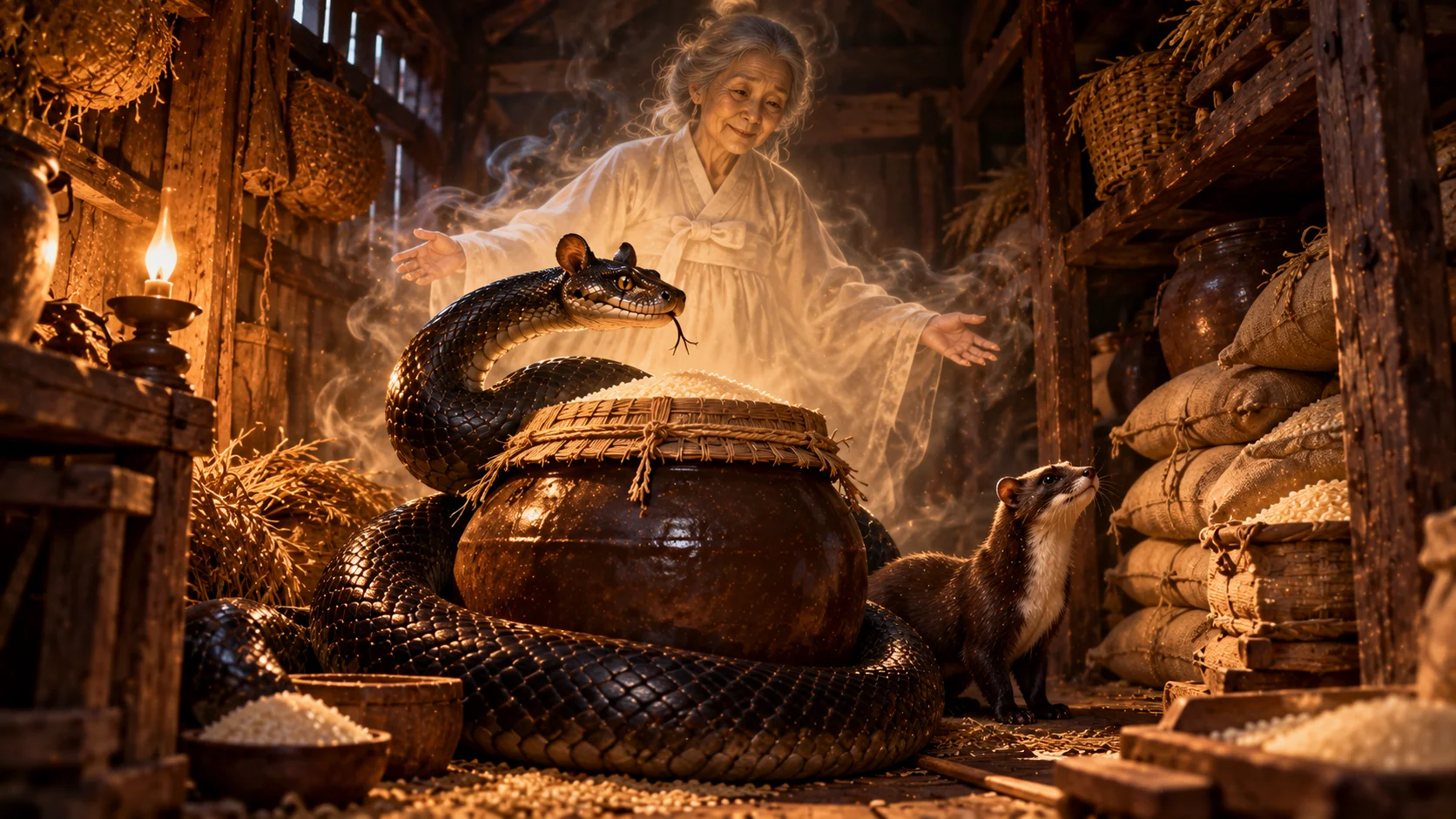
Where the bulgasari devours a household's fortune in iron, another Korean household spirit is responsible for guarding a household's fortune in wealth. The eobshin (업신), sometimes called the "eop spirit," is a tutelary deity of prosperity within Korean shamanism, one of several gasin, or household gods, alongside figures such as the house god and the hearth god. Unlike a spirit worshipped at a shrine or temple, the eobshin is believed to reside directly inside the home, embodied in an animal or object that serves as its physical vessel — commonly a snake known as the eopsa, a toad, a weasel, or simply a jar of stored grain kept in the household.
This belief carried real, practical weight in daily life. To harm, kill, or drive out the eop-animal — especially a household snake found nesting in or near the home — was thought to drive the family's fortune out along with it, a superstition that discouraged the killing of snakes discovered near people's houses across much of rural Korea. Households honored the eobshin with offerings of rice or food left near the grain jar believed to house it, and through gut, shamanic ceremonies performed to placate or honor the spirit, particularly around the New Year or at harvest time, when a family's fortune for the season ahead felt most precarious and most worth protecting.
Regional variation runs deep through this belief. In some areas, the eop-animal was understood to be a large toad living beneath the house's foundation; in others, a weasel nesting in the thatch of the roof; in others still, specifically the eopsa, the house snake proper. The underlying concept — that "eop," a household's fortune or destiny, carries loose echoes of Buddhist karma vocabulary but was thoroughly localized into an animistic house-guardian belief distinct from formal Buddhist doctrine — structurally resembles similar domestic deity traditions found elsewhere in East Asia, such as the Japanese zashiki-warashi or various Chinese hearth and wealth gods, even as the eobshin remains distinctly rooted in Korea's own shamanic muism practice.
Three Creatures, One Cosmology
Set side by side, the bulgasari, the samjokgu, and the eobshin sketch out a shared logic running through Korean folk cosmology, one in which the ordinary and the transformed sit closer together than they might elsewhere. A figure made of rice becomes an unstoppable monster. A dog born with an extra or missing limb becomes a seer of ghosts. A snake or a toad or a jar of grain becomes the seat of a family's entire fortune. In each case, extraordinary power does not descend from some distant divine realm; it rises up out of the household itself, out of the animals and objects and accidents of ordinary domestic life, transformed by circumstance into something that can devastate a kingdom, guard a home from disease, or carry a family's wealth on its back.
The bulgasari, in particular, endures as a singular invention within that cosmology — a monster with no divine origin and no ancient pedigree, whose story is built on a single mechanism: hunger that grows the more it is fed, until it eventually consumes everything within its reach, including, in the end, itself.
Sources & traditions
- TraditionKorean texts, oral tradition and village tellings
Myths change from area to area and from time to time. This chronicle follows the most widely told versions; tellings in other villages, regions and eras may differ.