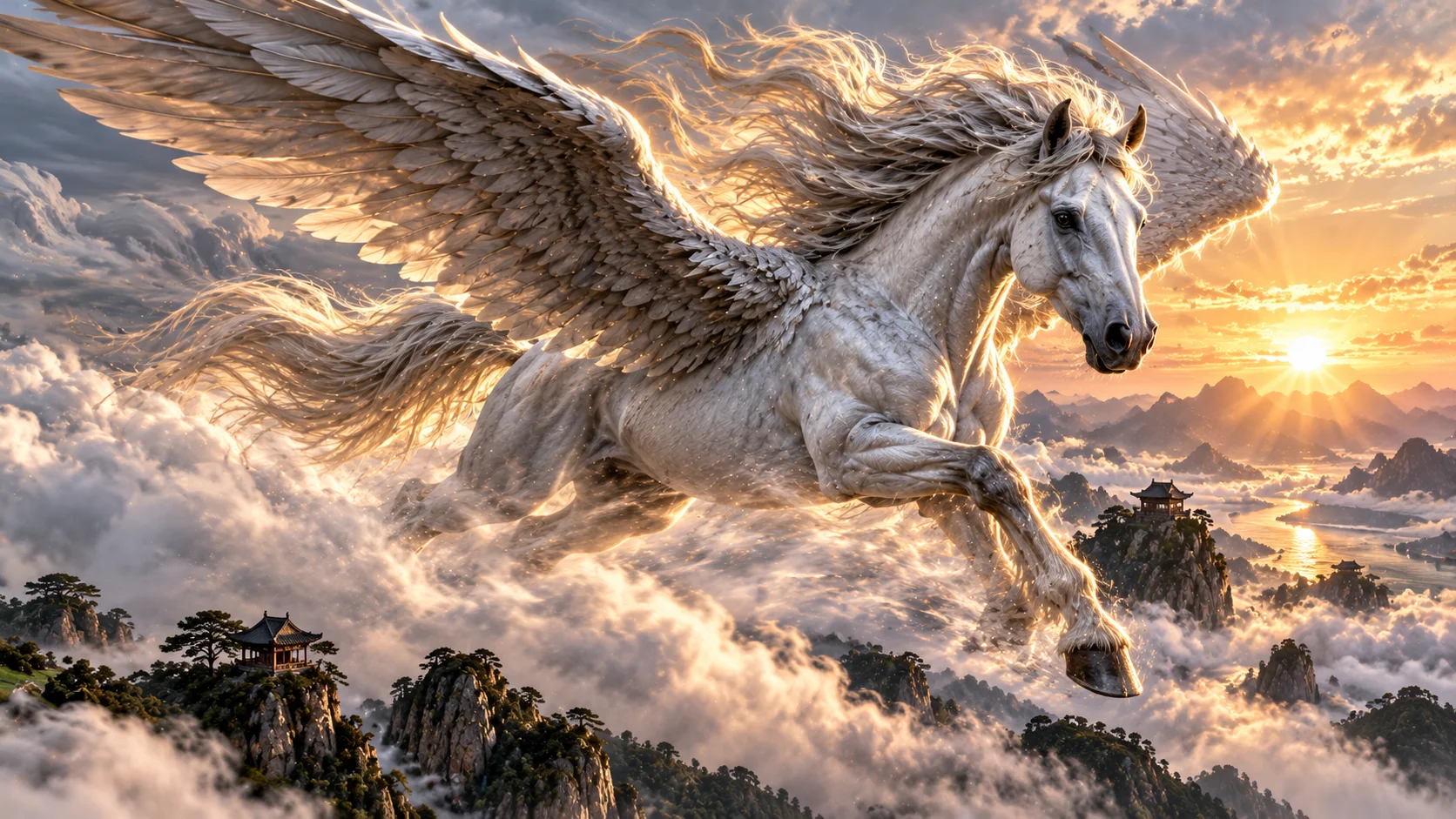
The Chollima, the "thousand-li horse," gallops through Korean legend as a winged steed of impossible speed — a creature said to cover a thousand li, some four hundred kilometers, between one sunrise and the next. It is a horse that belongs less to any single rider than to the idea of speed itself: a promise that greatness exists somewhere, running just out of reach, waiting for the one eye sharp enough to recognize it.
A Horse Too Fast for the World
In the oldest versions of the tale, the chollima is less a beast to be captured than a force to be witnessed. It streaks across plains and over mountain ranges in a single day, its hooves barely touching the ground, wings folding and unfolding faster than the eye can track. No ordinary bridle holds it. No ordinary hand can steady it long enough to climb onto its back. The horse simply outpaces the world it runs through, and that, more than any single feat, is the whole of its legend: speed so total it becomes almost mythic in itself, a benchmark against which everything slower is measured and found wanting.
The Rider Who Never Comes
Central to the chollima story, inherited from the older Chinese tradition of the qianlima, is a quieter and sadder theme: the horse is worthless without someone able to recognize what it is. According to that inherited motif, an ordinary groom looks at the chollima and sees only an unruly, unmanageable animal — dangerous, wasteful of grain, more trouble than a plow horse ten times over. It takes a discerning judge of horses, a specialist trained to see past bad temper and wild eyes, to recognize the once-in-a-generation animal standing in an ordinary stable. Without that judge, the chollima might live and die unridden, its speed never proven, its legend never born. The horse becomes, in this reading, a symbol for hidden greatness of any kind — a scholar overlooked, a craftsman unpromoted, a talent that requires exactly the right patron to be seen at all. Korean folklore absorbed this motif wholesale, using the chollima as shorthand for anyone whose extraordinary ability sits invisible, waiting for a wise enough eye.
A Legend Older Than the Peninsula
The chollima did not originate in Korea. Its lineage runs back through classical Chinese literary tradition, where the qianlima appears again and again as a stock figure in stories about talent, judgment, and waste. Korean storytellers adopted the horse and made it their own, folding it into a broader vocabulary of swift, otherworldly animals that populate the peninsula's oral tradition. What Korea added was not the horse itself but the weight it would eventually carry — a weight no one in the horse's older literary life could have anticipated, and one that would eventually turn a folk metaphor into a piece of twentieth-century statecraft.
Wings Borrowed From a Wider Bestiary
The chollima's wings place it in company with other winged and unnaturally swift animals across East Asian myth, but its specific Korean flavor comes from the sheer literalism of its speed claim — not merely "fast," but a measured, nameable distance, a thousand li, repeated and specific enough to function almost like a unit of legendary measurement. That specificity is part of why the image traveled so well into modern usage: it is not vague poetic exaggeration but a number, a claim precise enough to be quoted, printed, and eventually cast in bronze.
1956: A Horse Recruited for Reconstruction
After the devastation of the Korean War, North Korea's leadership under Kim Il-sung needed an image potent enough to organize an entire population around the labor of rebuilding — factories, farms, and infrastructure reduced to rubble, all to be reconstructed at a pace the country could not otherwise afford. Between 1956 and 1958, the state launched what came to be known as the Chollima Movement, seizing the old legend's core image — a horse too fast for ordinary limits — and repurposing it as the emblem of an economic campaign. The message was direct: workers were to labor as if astride the chollima itself, producing at speeds that would have seemed mythical only years before. Steel output, grain quotas, construction timelines — all were framed through the same borrowed metaphor of flight and unstoppable velocity.
Bronze on a Pyongyang Hilltop
In 1961, the movement's central image was given permanent, monumental form. A large bronze statue — a winged horse in full gallop, ridden by a worker and a peasant woman holding aloft symbols of labor — was erected in Pyongyang to commemorate the Chollima Movement. The Chollima Statue remains one of North Korea's major national monuments today, a permanent civic landmark built not around a historical figure or battle but around a folk tale's horse, transformed into state iconography. Where the horse of legend flew because no one could catch it, the statue's horse flies because the state commanded it to.
Speed as Ideology
What makes the chollima's political afterlife worth dwelling on is how completely it inverted the original folk meaning without abandoning the image. The old story is about recognition — a hidden asset overlooked until a wise judge sees it. The state's version is about output — a visible mandate to be met by everyone, immediately, without the luxury of waiting to be discovered. The horse stopped being a symbol of the rare individual and became a symbol of collective, compulsory acceleration. It is a striking case of a centuries-old motif being lifted almost intact and pointed in a new direction: the wings stayed, the thousand-li distance stayed, but the meaning of running that fast changed entirely.
Kin Among Korea's Repurposed Legends
The chollima was not alone in this journey from folk tale to political tool. The bulgasari, the metal-devouring beast said to have been born from a grieving family's rice or thread during the oppressive final years of the Goryeo Dynasty, underwent a similar transformation in the twentieth century — first popularized through a 1962 South Korean film, then infamously remade under direct political sponsorship in North Korea's 1985 giant-monster production. Both creatures share a common shape of use: a legendary body that already carried a charge of overwhelming, almost uncontrollable power — the bulgasari's insatiable hunger for iron, the chollima's unmatchable speed — became convenient vessels for twentieth-century messages about industrial transformation, one through cinema and one through state economic campaigning. Neither the horse nor the beast asked for this second life; both were simply large enough, and vivid enough, to carry whatever weight was loaded onto them.
The Older Horse Beneath the Monument
It is worth holding both versions of the chollima at once rather than letting the newer one erase the older. Beneath the bronze statue and the productivity slogans is still the folk image of an animal no ordinary hand could tame — a horse that exists, in its oldest tellings, purely as a test of perception, a way of asking whether the people around it are wise enough to see value before it proves itself. That older chollima has nothing to do with quotas or steel tonnage. It belongs to the same imaginative world as Korea's other extraordinary, half-hidden beings — dangerous or wondrous animals that mark out for their communities where the line falls between the visible, ordinary world and something rarer moving just past its edge.
A Legend That Outran Its Own Meaning
Few figures in Korean folklore illustrate as clearly how a single image can be pulled through such different centuries and purposes while remaining, on the surface, exactly the same horse. The animal that once stood for an overlooked genius waiting for a discerning eye became, without changing a single physical feature, the animal standing for an entire nation's demanded pace of labor. Whether encountered in its oldest folkloric form or in the fixed bronze of a Pyongyang monument, the chollima's core claim has never changed: it moves faster than anything meant to keep up with it, and it is the world around the horse — the riders, the judges, the movements built in its name — that must decide what to do with a speed that outstrips them.
Sources & traditions
- EncyclopediaWikipedia — Qianlima
- TraditionKorean texts, oral tradition and village tellings
Myths change from area to area and from time to time. This chronicle follows the most widely told versions; tellings in other villages, regions and eras may differ.