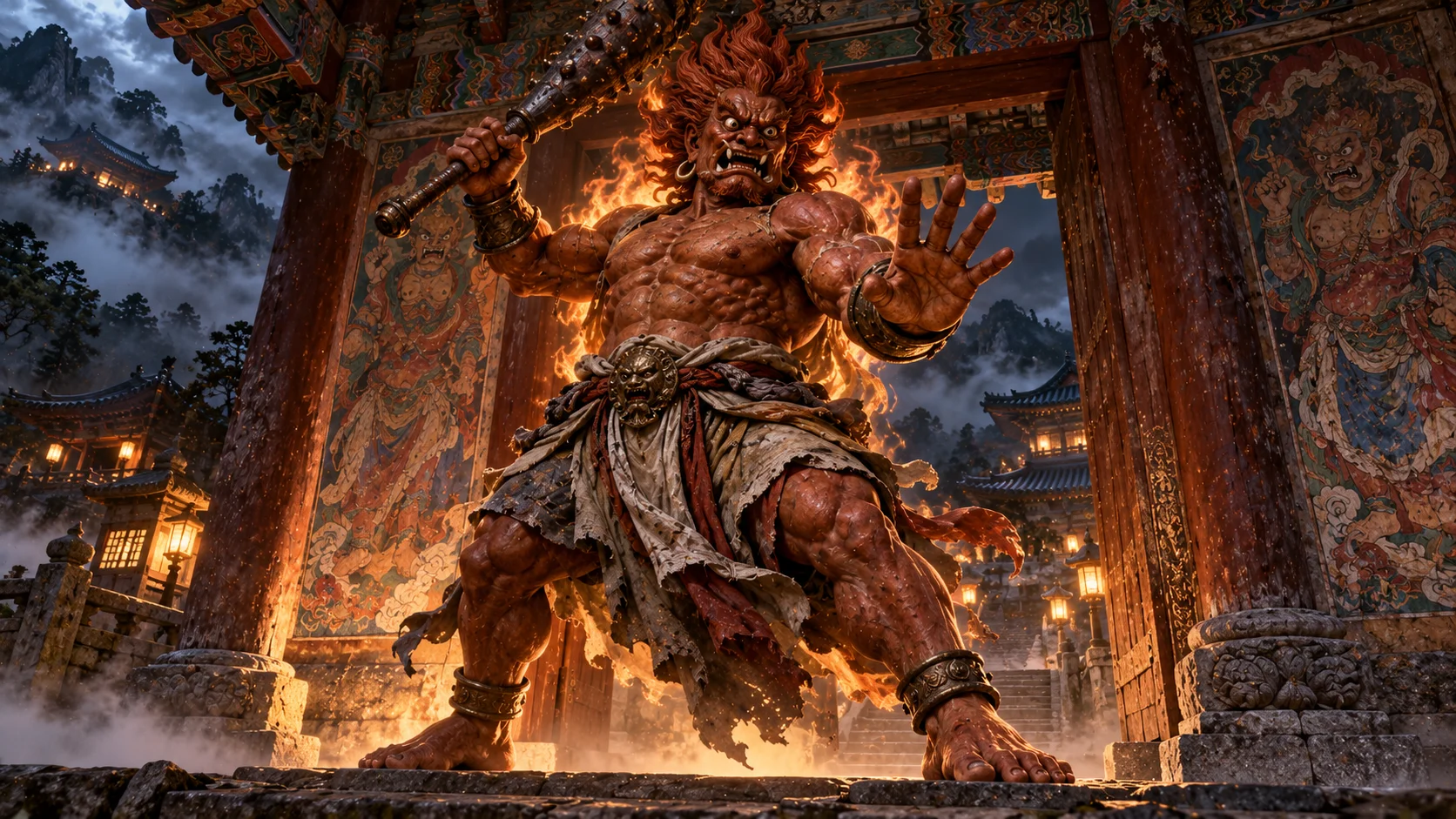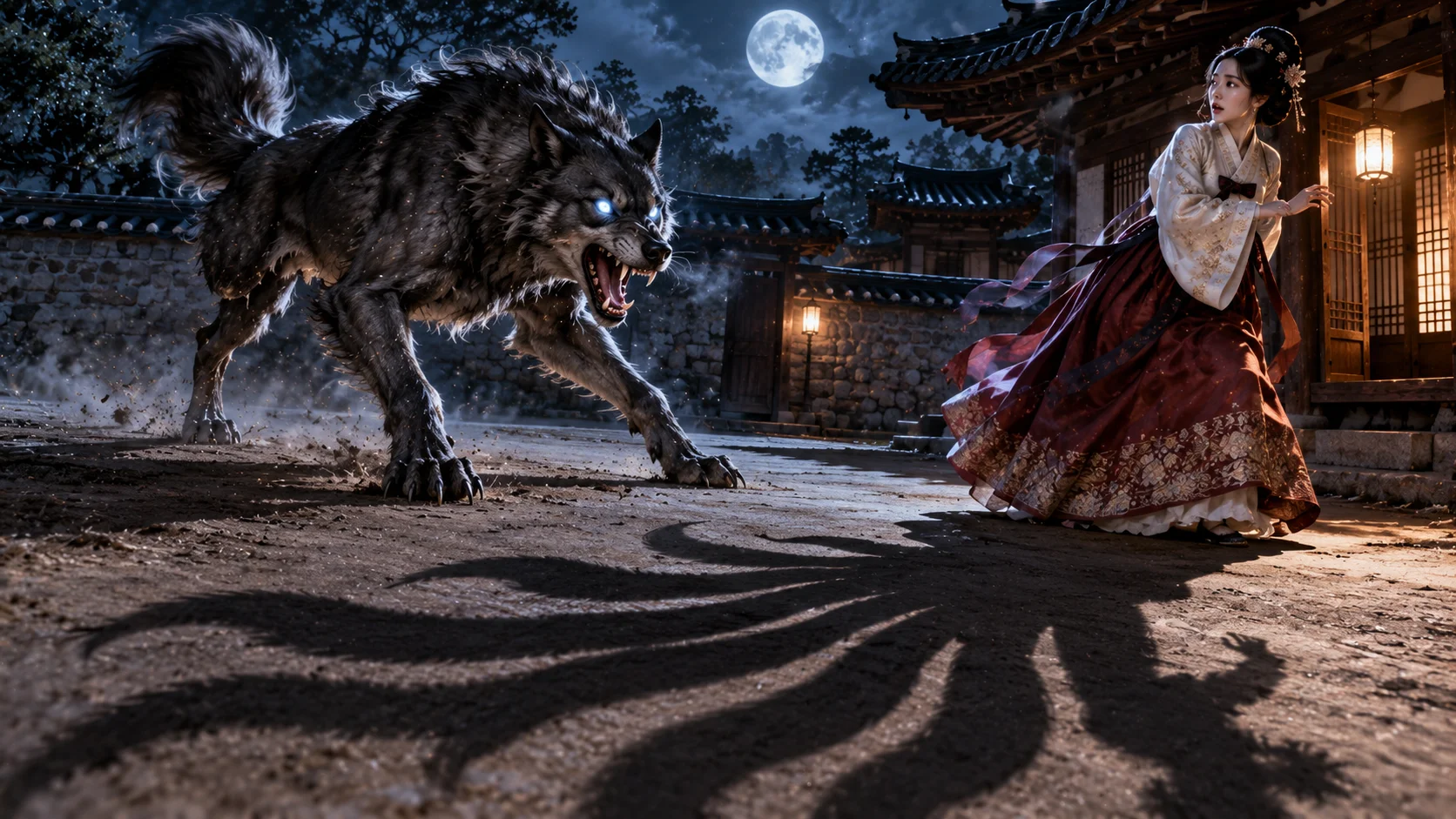
The Samjokgu (삼족구, 三足狗), the "three-legged dog," occupies a singular place in Korean folk belief: a canine marked from birth by an anomaly of form that Korean tradition reads not as deformity but as a sign of otherworldly sight. Where an ordinary dog watches the yard and the road, the samjokgu is said to watch the space just beyond them — the threshold where spirits pass unseen by human eyes.
A Body Marked for the Spirit World
In Korean folk cosmology, unusual number is never accidental. A creature born with three legs instead of four is understood as a creature born incomplete in the ordinary world precisely because it belongs partly to another one. This logic echoes far beyond the samjokgu: the three-legged crow, samjokgo, carries the sun itself across the sky in the shared mythic vocabulary of Korea, China, and Japan. A missing or added limb, in this framework, is not a flaw to be pitied but a signature — proof that the animal's nature has been altered by contact with forces outside the natural order. The three-legged dog inherits this same symbolic grammar on four (or rather three) legs, translated from the celestial register of the sun-bird into the domestic, earthbound register of the household guard animal.
Born Under a Shadowed Sign
Regional Korean folktales differ on how a samjokgu comes into the world, but they agree on the shape of the story: the birth is never ordinary. Some accounts place the mother dog's conception near a grave, binding the puppy to the dead before it draws its first breath. Others tie the birth to a solar or lunar anomaly — an eclipse, an unnatural darkening of the sky — treating the animal as a creature stamped by a cosmic irregularity rather than a biological one. In either telling, the effect is the same: the dog is marked as fated for spiritual sensitivity from the moment of its birth, carrying that inheritance for the whole of its life rather than acquiring it through training or ritual.
The Dog That Sees What Others Cannot
The defining power of the samjokgu is sight — not sharper eyesight, but a different order of vision entirely. Korean folk belief holds that this dog can perceive gwisin, ghosts, that remain wholly invisible to human beings going about their ordinary business. Where a villager might feel only a chill or an inexplicable unease passing through a room, the three-legged dog is said to react visibly: barking, growling, or turning sharply toward a presence that no one else in the house can name. This made the samjokgu something closer to an early-warning instrument than a pet in the households that kept one — a living gauge of the unseen traffic passing through daily life.
Guardian Against the Roaming Dead
Because it could sense what humans could not, the samjokgu was prized specifically as a ward against evil spirits and disease-bringing entities known as yeokgwisin. A household that harbored one was believed to hold a line of defense that no lock, wall, or charm alone could provide, since the threat these entities posed was invisible by nature and required an invisible countermeasure. The dog's bark against an empty room was not dismissed as confusion; it was read as a report from a sense organ humans simply lacked.
A Bulwark Against Plague
Some Korean folk accounts extend the samjokgu's protective role directly into the realm of epidemic disease, describing it as capable of warding off cholera and plague spirits during historical outbreaks. In a worldview where sickness could be understood as the work of a malevolent spirit moving from house to house rather than, or alongside, a purely physical contagion, an animal able to detect and repel such a spirit before it crossed the threshold carried enormous practical weight. A three-legged dog patrolling a farmyard was, in this sense, doing the work later generations would assign to quarantine and sanitation — using a spiritual vocabulary because that was the vocabulary available.
A Place Among the Household Guardians
The samjokgu did not stand alone in the Korean home. Korean shamanism, muism, populated the domestic sphere with a whole household of gasin, tutelary spirits, each with its own domain: Seongjusin, the god of the house structure itself, and Jowangsin, the hearth spirit who watched over the kitchen fire and the family's daily sustenance. Dogs more broadly served as liminal, boundary-crossing animals in this system, bridging the human world and the spirit world by virtue of standing watch at doors, gates, and the edges of the yard — the exact seams through which unwelcome visitors, living or dead, were thought to slip. The three-legged dog was simply the most potent expression of a role dogs already held across Korean village life: not a divine figure to be worshipped in its own right, but a working guardian whose animal nature had been touched by something beyond the ordinary.
The Eop That Dwelt in the Grain Jar
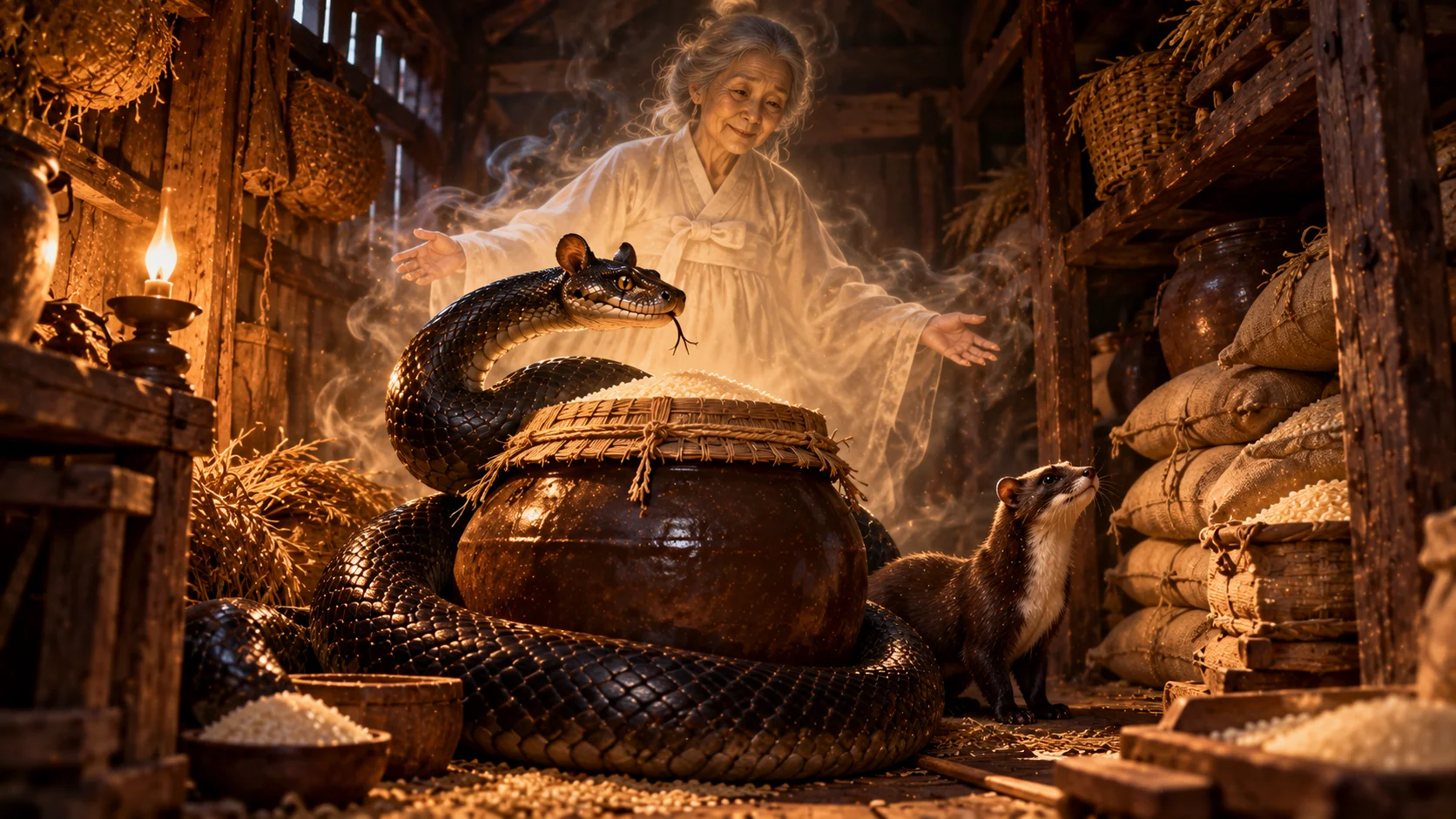
Standing beside the protective, ghost-sensing dog in the wider ecology of Korean household spirits is a very different kind of guardian: the eobshin (업신, 業神), the tutelary deity of wealth and fortune. Where the samjokgu's power lay in what it could perceive, the eobshin's power lay in where it chose to live. Korean folk belief held that this spirit resided in, and was embodied by, a particular animal or object within the home — most commonly a snake known as an eopsa, a toad, a weasel called a jokjebi, or a jar of stored grain — and that its continued presence there was what kept the family prosperous.
Never Harm the Vessel of Fortune
The practical consequence of this belief was a strict and specific taboo: harming, killing, or driving out the eop-animal was thought to drive the family's wealth and fortune out along with it, inviting financial ruin. This superstition had real weight in everyday rural life, historically discouraging people from killing snakes found in or near the home even when fear or disgust might otherwise have prompted it. The snake under the floorboards or the toad beneath the foundation was not vermin to be cleared out but a resident whose welfare was quietly bound up with the household's own.
Regional Faces of the Same Belief
The eop-animal was not fixed across Korea; it took different forms in different regions, each version rooted in the particular creatures a farming household was likely to encounter. In some areas the eobshin was believed to inhabit a large toad living under the house foundation. In others it was a weasel nesting in the thatched roof. In still others it was specifically the eopsa, a snake understood to be the household's own resident deity of fortune, distinct from any ordinary snake that might simply be passing through. Whichever form it took locally, the underlying structure of the belief held steady: an ordinary animal, once identified as the eop, became something families deliberately chose not to disturb.
Offerings at the Grain Jar
Eobshin worship was not passive avoidance alone; it involved active ritual care. Families left offerings of rice or food near the grain storage jar where the spirit was believed to dwell, and performed household gut, shamanic ceremonies, to placate or honor it, particularly around New Year and harvest rites, the two points in the agricultural calendar when a household's fortune for the coming season felt most exposed and most worth securing. The grain jar itself, sitting quietly in a storage room or courtyard, functioned as something closer to a small household shrine than a mere container.
An Inherited Vocabulary, Locally Rooted
The term eop carries an echo of Buddhist-influenced vocabulary around karma and destiny, but in shamanic practice this borrowed language was localized into something distinctly animistic: a house-guardian belief separate from formal Buddhist doctrine, tied instead to a physical creature living under the same roof as the family it protected. The structure this produced — a domestic animal or object standing in for a family's fortune — is not unique to Korea; it parallels other East Asian household deity traditions, including the Japanese zashiki-warashi and various Chinese hearth and wealth gods. What distinguishes the eobshin is how firmly it stays rooted in Korean muism specifically, expressed through the ordinary furniture of a Korean farmhouse: the grain jar, the thatched roof, the space beneath the floor.
Two Guardians, One Household Cosmology
Placed side by side, the samjokgu and the eobshin reveal two complementary halves of how Korean folk belief imagined a home's defenses. The three-legged dog worked by vigilance and sight, patrolling against threats that moved in from outside — wandering ghosts, plague spirits, disease carried on the wind. The eobshin worked by residence and continuity, a quiet presence already inside the home whose undisturbed comfort was the very mechanism of the family's prosperity. One guardian barked at the threshold; the other slept in the grain jar. Together they describe a worldview in which safety and fortune were not abstract conditions but living arrangements, sustained day to day by how a family treated the animals that shared its walls.
A Common Thread in Korean Folk Cosmology
The samjokgu's anomalous birth and the eobshin's animal residence both belong to a broader pattern running through Korean folklore, one in which ordinary creatures become vessels of extraordinary power through some point of transformation. A dog becomes a ghost-seer through an irregular birth. A snake or toad becomes a household god by taking up residence in the right corner of a farmhouse. Elsewhere in Korean legend the same principle appears again in stranger form: the creature known as Bulgasari is said to have begun as nothing more than a figure molded from leftover rice grains, brought to life almost by accident, before it grew, feeding on iron and bronze, into something so indestructible that ordinary blades, water, and fire alike could not touch it — a monstrosity that in most versions of the tale meets its end only when fire, after it has gorged on enough metal to finally weaken it, burns it down. Across all three figures, the pattern holds — transformation does not require a grand or deliberate act of creation. It only requires the right circumstance, the right vessel, and a tradition willing to notice the difference when an ordinary thing stops behaving like one.
Sources & traditions
- TraditionKorean texts, oral tradition and village tellings
Myths change from area to area and from time to time. This chronicle follows the most widely told versions; tellings in other villages, regions and eras may differ.