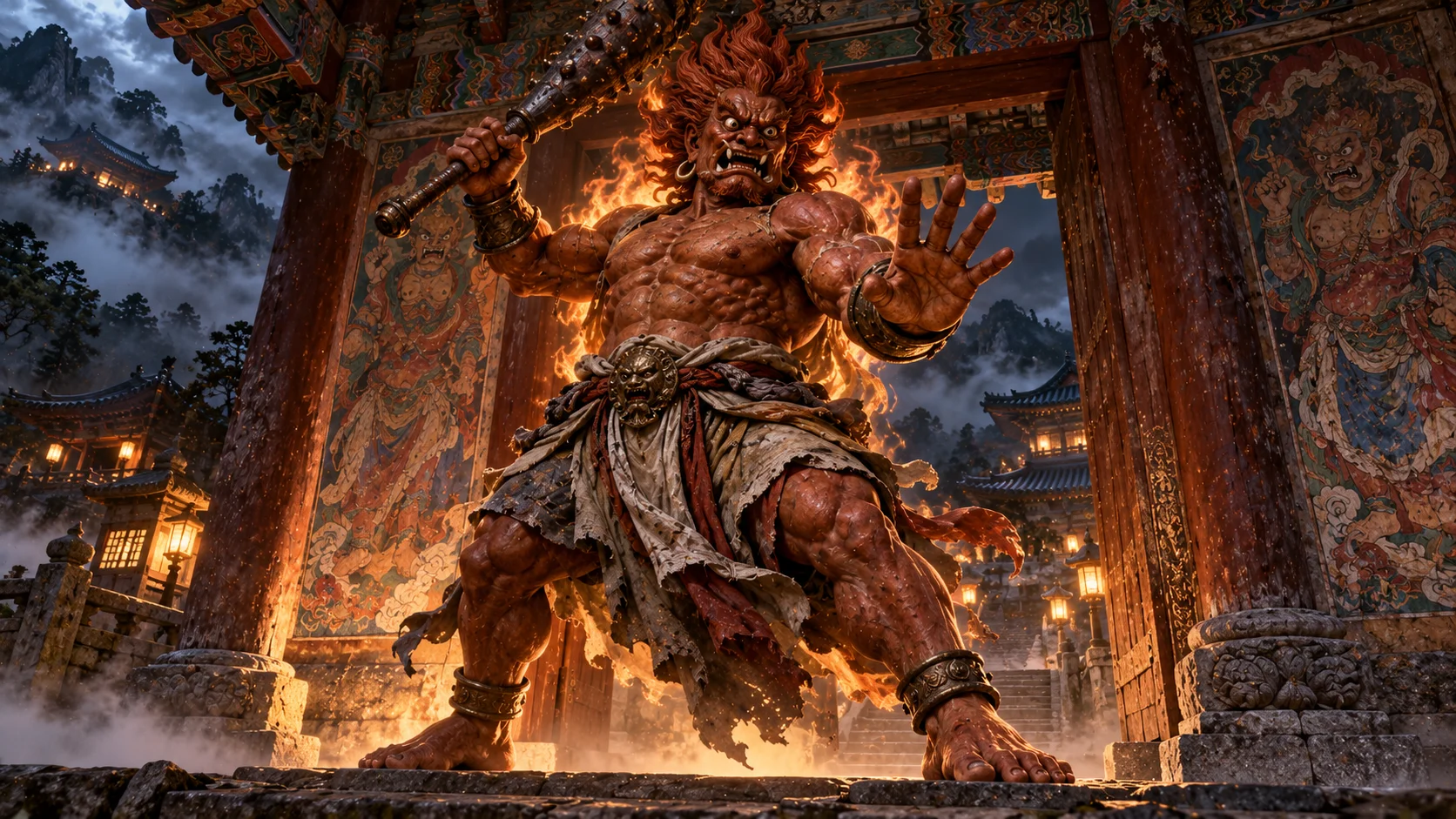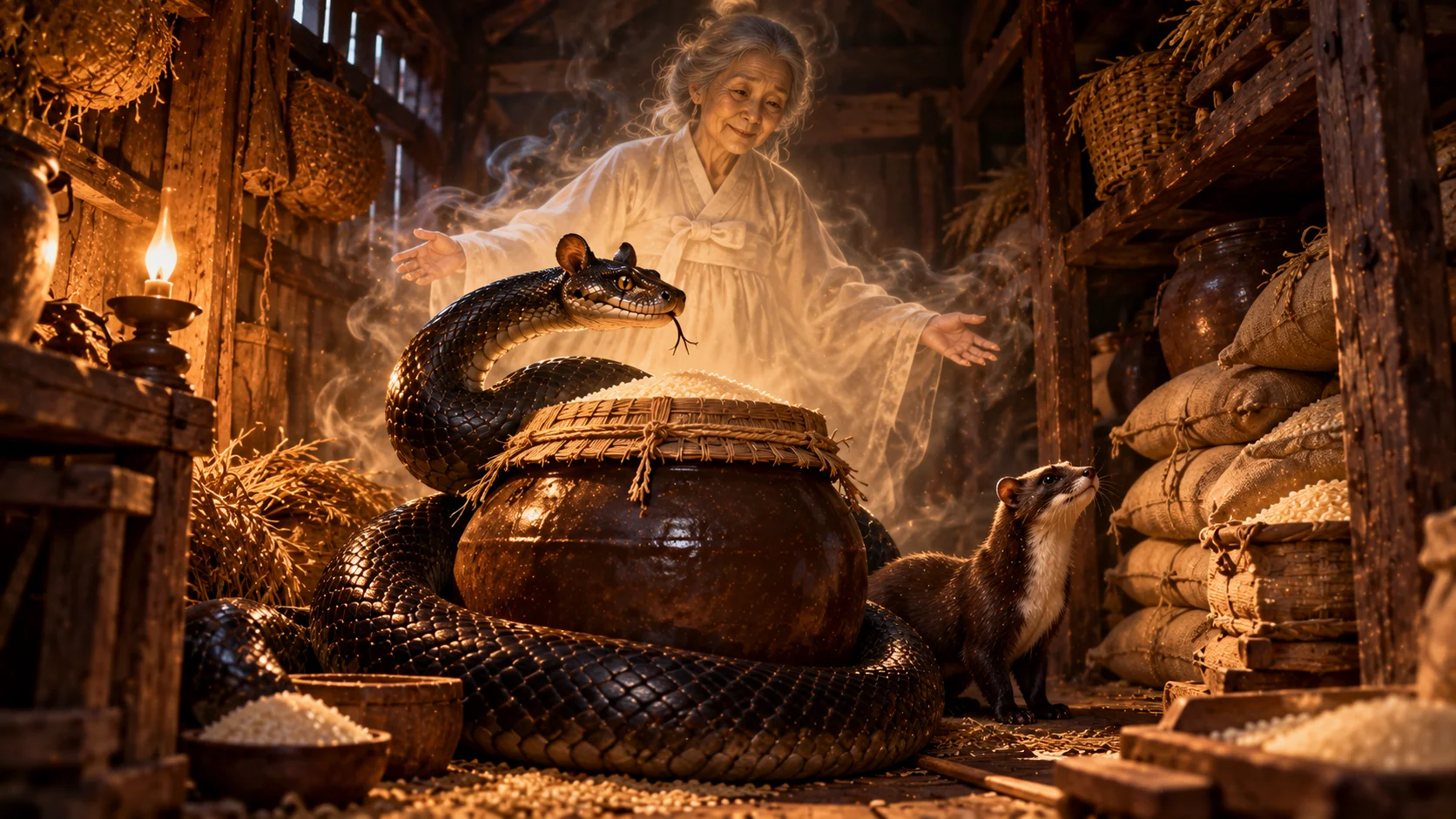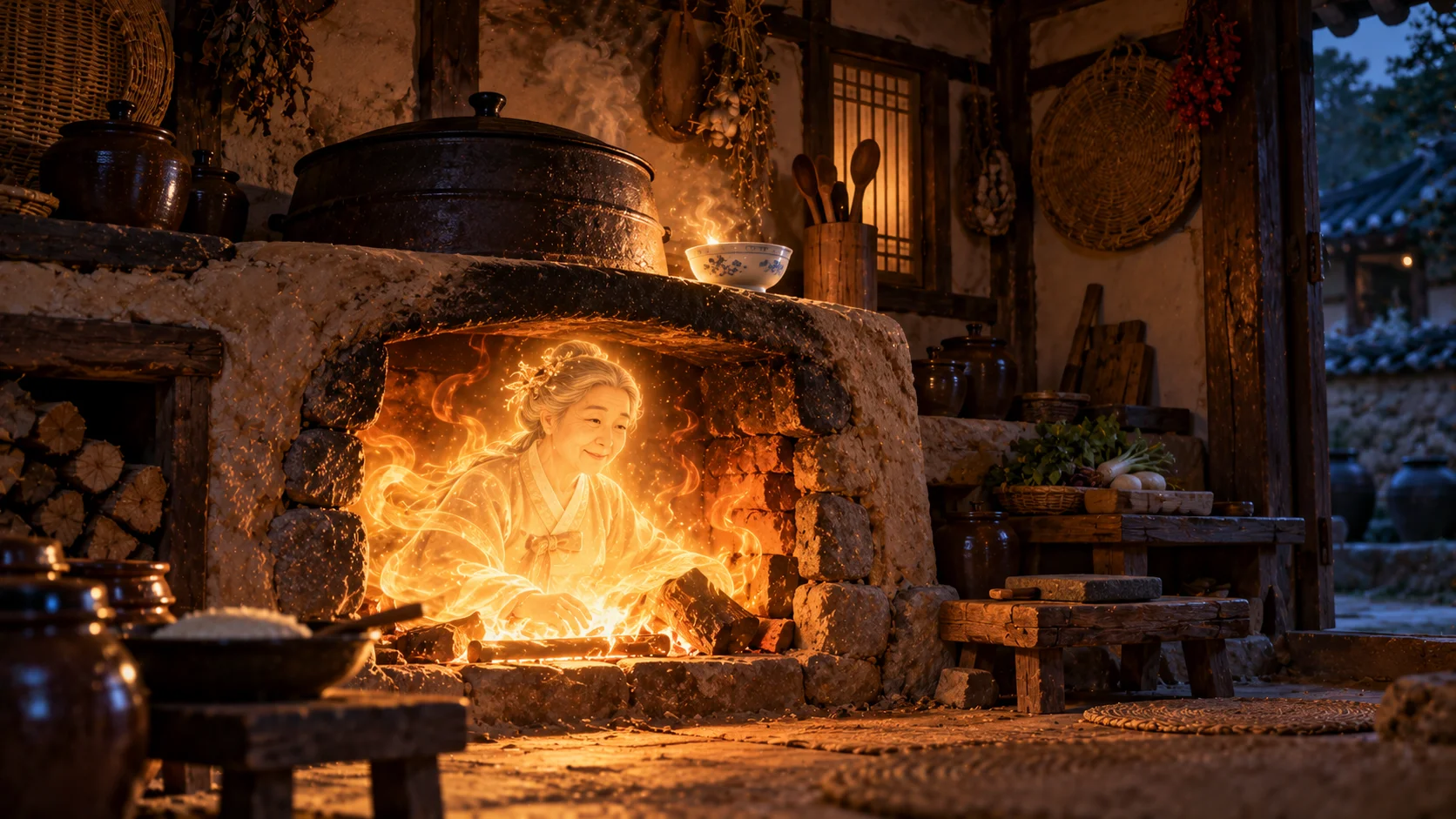
Jowangsin is the Hearth God, the goddess who dwells above the kitchen stove of every traditional Korean home, keeping watch over the family's fortune, harmony, and daily conduct. Of all the household spirits recognized in Korean folk religion — the gods of the gate, the storeroom, the outhouse, the birthing room, and the roof-beam — none was considered closer to the family's daily life than Jowangsin, because the hearth she inhabited was the one fixture in the house that could never go cold without the household itself suffering for it. Fire meant food, warmth, and the boiling of water for medicine and for ritual; a house whose hearth spirit was neglected or offended was, in the folk imagination, a house already halfway to misfortune.
The Goddess Who Lives Above the Flame
Jowangsin is believed to reside in or just above the buttumak, the traditional clay-and-stone cooking hearth that anchored every Korean kitchen for centuries. The buttumak was not a single burner but a built structure, usually holding two or three iron cauldrons of different sizes sunk into the clay above the firebox, with the smoke and heat channeled beneath the floor of the adjoining room to warm it — the ondol system. Because the fire beneath the cauldrons ran continuously through the day, feeding both the cooking and the underfloor heating, the hearth was in a real sense the physical engine of the household, and it made sense to the people who built and used it that a goddess would choose to dwell exactly there, at the point where raw ingredients became food and where warmth radiated out to the rest of the home.
Her presence was not thought of as symbolic or merely ceremonial. She was understood to be literally attentive, present in the kitchen at all times, seeing everything that happened there and, by extension, a great deal of what happened elsewhere in the house, since the kitchen was the room through which the rhythms of a Korean household passed — the first room lit in the morning and often the last one banked down for the night. Because of this constant vigilance, the kitchen was treated as something closer to a shrine than a mere workspace. Loud arguments, cursing, or careless disrespect shown in the kitchen were believed to reach Jowangsin's notice immediately and to sour the luck of the household, so the space demanded a kind of composure that other rooms did not.
The women of the household were her primary caretakers and, in effect, her primary congregation, since the kitchen in traditional Korean domestic life was organized almost entirely around female labor and female authority. The mother-in-law or the senior woman of the house typically held the responsibility of maintaining the relationship with Jowangsin, and this responsibility was treated as a form of quiet authority in its own right — the woman who tended the hearth god was, by tradition, the one whose word carried weight over the kitchen's affairs, even in households where men held authority over most other domains.
A Bowl of Water at Dawn
Each morning the woman of the house would draw fresh water and place it in a bowl on the stove, an acknowledgment that the goddess was present and watching over the household. This water was drawn, wherever possible, before anyone else in the household had touched the well or the spring, so that the offering would be the very first and cleanest water of the day — a small act of precedence that mattered a great deal in a symbolic economy where freshness and purity stood in for sincerity. The bowl itself, called a jeonghwasu or a similar term depending on the region, was often a particular vessel kept for no other purpose, never used for ordinary cooking or drinking, so that it remained set apart as something belonging to the goddess rather than to the family.
Setting out the water was frequently paired with a short, murmured prayer or wish, spoken quietly while facing the stove — a request for the health of children, the safe travel of a husband or son, a good harvest, or simply the general prosperity and peace of the house for the day ahead. Because Jowangsin was believed to listen constantly, these were not formal, scheduled prayers in the way that ancestral rites were, but something closer to a daily check-in, woven into the same motions as building the morning fire and setting the first pot to boil. In this way devotion to Jowangsin was less a special occasion than a running undercurrent to ordinary domestic life, repeated so many mornings across a woman's lifetime that it became indistinguishable from habit.
The bowl of water was also renewed regularly through the day in some households, and allowing it to sit stagnant or to run dry was considered a minor negligence — not a catastrophe, but the kind of small lapse that, repeated often enough, was thought to slowly erode the goodwill a family had built up with its hearth god. Conversely, keeping the water bright, clean, and constantly refreshed was one of the simplest and most universally practiced ways an ordinary household, with no priest and no formal ritual calendar, could stay in Jowangsin's good graces on any given day.
An Emissary to Heaven's Court
Korean folk narratives describe her reporting a family's conduct to the Jade Emperor at the close of the year, mirroring the Chinese Kitchen God tradition of Zao Jun. In this understanding, Jowangsin was not merely a passive presence who blessed or withheld blessing from where she sat above the stove; she was an active witness compiling a record, much like a household inspector whose findings would eventually be read aloud in a celestial court far above the reach of the family she watched. The prospect of that report was what gave the daily conduct expected in the kitchen its real stakes — kindness, honesty, and harmony observed there were not simply good manners, they were testimony being gathered for an audience the family itself could never see or influence directly.
This structure placed Jowangsin within a much larger, shared East Asian cosmology in which the Jade Emperor sat at the head of a vast celestial bureaucracy, receiving reports from countless minor spirits assigned to watch over specific households, mountains, rivers, and trades. The Kitchen God's report, in the parallel Chinese tradition of Zao Jun, was similarly understood to determine the family's fortune for the coming year, and Korean tellings of Jowangsin's journey preserve that same basic architecture even as the details of the goddess's own story and character diverged along their own path. The similarity is not incidental — it reflects centuries of shared religious vocabulary across the region — but Jowangsin's incarnation of the role kept its own distinctly Korean shape, rooted in the buttumak and the domestic customs particular to Korean households rather than simply being a renamed import.
Because the report was understood to be made at the close of the year, the final days leading into the new year carried a heightened awareness of Jowangsin's presence. Families were more careful than usual about disputes, wasted food, and unkind words spoken near the stove during that stretch, as if a kind of annual review period had opened and every small behavior now counted double. Whether or not every household treated this belief with full seriousness, it gave the turning of the year a domestic, moral dimension that sat alongside its more familiar meanings of renewal and fresh starts — the year did not simply end, it was judged.
A Wronged Woman Made Divine
In one telling, Jowangsin was once a mortal woman who suffered at the hands of a cruel husband, and died near the hearth, from which grief she was deified. This origin story places her within a broader and recognizable pattern in Korean and wider East Asian folk religion, in which deities of the domestic sphere are frequently understood to have once been ordinary people — very often women — whose suffering, loyalty, or unjust death within the household became the very thing that elevated them into guardianship over that same household after death. Rather than descending from some remote celestial origin, Jowangsin's divinity in this version of her story grows directly out of a life of hardship lived inside the same four walls she now watches over.
The emotional logic of this narrative gave ordinary women a figure of sympathy embedded in their own kitchens: a goddess who, according to this account, had once stood exactly where they stood, endured what many of them also endured within the constraints of a strict domestic hierarchy, and was transformed by that suffering into a protector rather than simply a casualty of it. Her deification at the hearth, rather than anywhere else in the house, reinforced the sense that the kitchen was not an incidental setting for her death but the true center of her identity both before and after it — the place where her mortal grief occurred was the same place where her divine vigilance would afterward be exercised.
This wronged-woman origin also colors the tone of the household's relationship with her. She is not approached as a distant, abstract cosmic authority in the way some sky gods or mountain gods might be, but as a figure who is thought to understand, from firsthand experience, the strains, injustices, and quiet burdens of domestic life. That familiarity is part of why the daily rituals devoted to her — the fresh bowl of water, the composed conduct near the stove — feel less like appeasement of a stern judge and more like the maintenance of an ongoing, personal relationship with someone who once lived through the very same rooms.
Keeper of Harmony in the Household
Beyond her role as witness and eventual reporter to the Jade Emperor, Jowangsin was widely regarded as an active guardian of harmony within the household in the more immediate, everyday sense. Quarrels between family members, and especially quarrels that spilled into the kitchen itself, were thought to be things she took direct notice of and disapproved of, since discord in the room she inhabited reflected poorly on the household she was meant to be protecting. Families who wished to stay in her good favor were therefore encouraged to resolve conflicts away from the stove and to treat the kitchen, even during ordinary daily labor, as a space that called for a measure of calm.
This expectation dovetailed naturally with the practical reality of a shared hearth: a kitchen with only a few cauldrons and one central fire required cooperation simply to function, since the timing of meals, the sharing of hot water, and the tending of the fire itself could not easily be managed by one person working in isolation or in conflict with others in the same space. In this sense the belief in Jowangsin's watchfulness reinforced behavior that was already necessary for the household to run smoothly, giving a spiritual weight to what was also, quite plainly, good domestic sense.
Her association with the family's fortune extended this idea outward from momentary harmony to the household's standing over time — its prosperity, its health, and its reputation among neighbors were all understood to be bound up, at least in part, with how faithfully the family maintained its relationship with her. A household known for chaos in the kitchen or neglect of the morning water offering might, in the logic of the tradition, find its luck thinning in ways that had nothing directly to do with the kitchen at all, since Jowangsin's judgment was thought to radiate outward into the family's broader affairs rather than remaining confined to matters of cooking and fire.
The Hearth in a Changing Korea
The buttumak that Jowangsin was said to inhabit belonged to a particular architecture of Korean domestic life — one built around ondol floor heating, shared cauldrons, and a kitchen positioned and constructed in a very specific traditional way. As Korean housing shifted over the twentieth century toward apartment living and modern stoves, the literal hearth that had anchored her presence for centuries became far less common, and with it the daily physical ritual of drawing water and setting it on the stove's edge grew rarer as well. The goddess associated so completely with a particular built object faced the same fate as many hearth and household deities elsewhere in the world whose worship was tied to a domestic architecture that modernization gradually replaced.
Even so, the memory of Jowangsin persisted in Korean folklore, in regional customs recorded by folklorists, and in the way older generations spoke about the kitchen as a space still deserving of a certain respect, even after the buttumak itself had largely disappeared from everyday homes. The core elements of her story — the goddess above the flame, the morning bowl of water, the yearly report to the Jade Emperor, and the wronged woman whose grief became guardianship — survived as a coherent body of folk narrative describing a figure who, for as long as Korean households were built around a central hearth, was never far from the center of the home's daily life and its sense of its own fortune.
Sources & traditions
- EncyclopediaWikipedia — Jowangsin
- TraditionKorean texts, oral tradition and village tellings
Myths change from area to area and from time to time. This chronicle follows the most widely told versions; tellings in other villages, regions and eras may differ.