Sansin (산신), the Mountain God, is among the most enduring and beloved deities of Korean folk religion, a spirit of place who rules not the cosmos or the state but a single peak, ridge, or valley, and who is honored precisely because he is local, near, and reachable. Every mountain in Korea is believed to have its own Sansin, a guardian spirit bound to that specific summit, so that to climb a mountain in the old understanding was to enter another being's domain and to ask, quietly, for safe passage. This is a religion of proximity rather than distance: no towering sky-father ruling from far above, but an old man who lives, in a sense, exactly where the worshipper is standing.
The Old Man and the Tiger
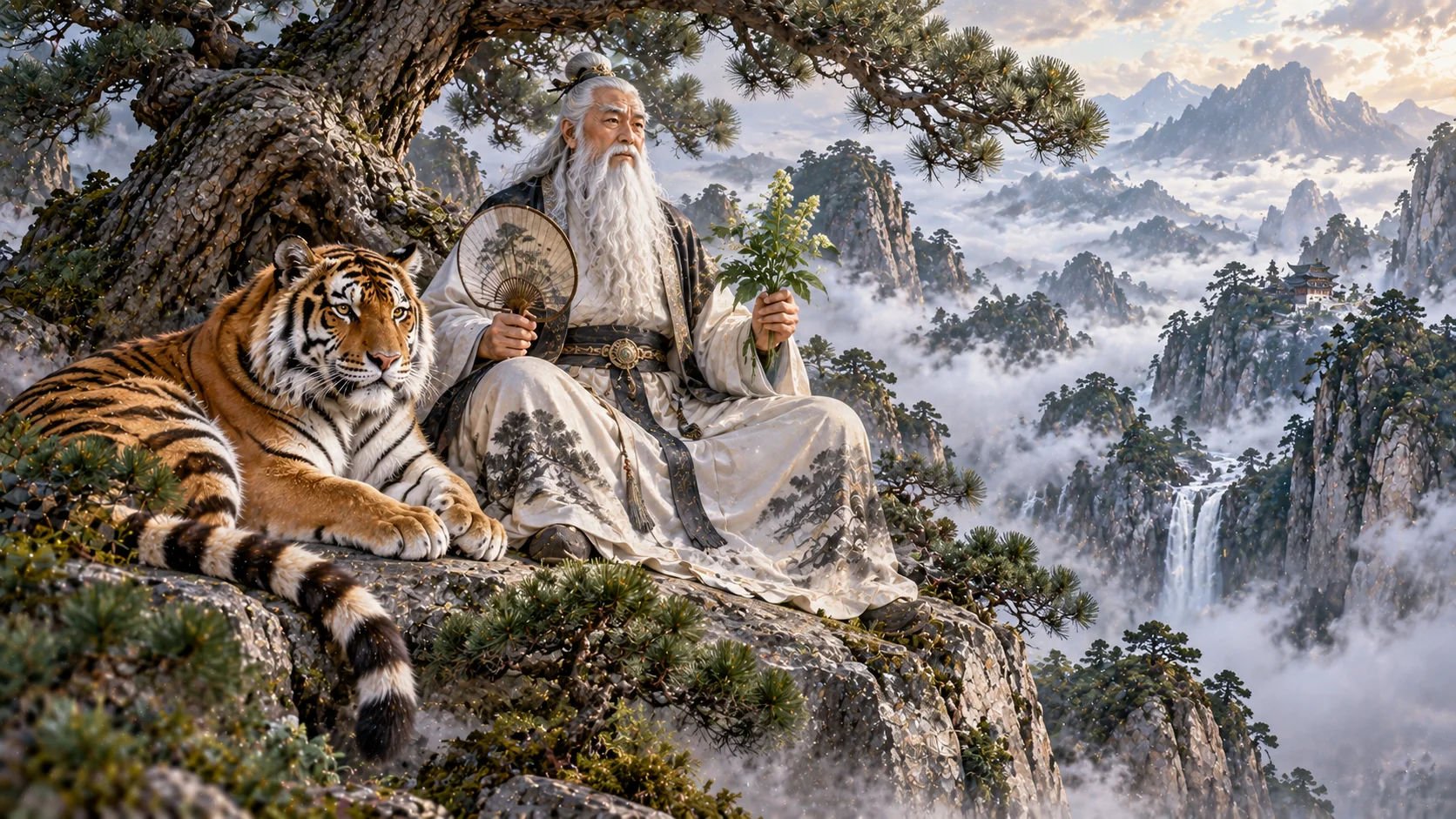
Sansin is almost always pictured the same way: an elderly man with a long white beard, seated in a posture of calm authority, often beneath or beside a gnarled pine tree that signals the mountain setting. At his side, sometimes reclining like a household cat and sometimes standing alert like a guardian, is a tiger. A young attendant boy frequently completes the scene, holding a fan, a scroll, or offerings, underscoring that the mountain court, like a human household, has its structure of elder, servant, and companion animal.
The tiger's exact relationship to Sansin is left productively ambiguous in tradition. In some readings the tiger is simply his mount or his messenger, the way a general might have his horse. In others, the tiger is the god, or at least an alternate form the god may take, so that meeting a tiger on a mountain path was not always understood as meeting an animal at all. This double reading reflects the tiger's larger status in Korean folklore as a semi-divine creature: fearsome, but also moralistic, capable of punishing wrongdoers, testing the virtuous, or rewarding honesty in a hundred village folktales. The tiger who accompanies Sansin is not decorative. It is the visible proof that a mountain's spirit can be both benevolent protector and untamed force, both at once.
Shrines at the Edge of the Temple Grounds
One of the more telling features of Sansin worship is where it physically sits. Most traditional Korean Buddhist temples maintain a small shrine building, called a Sanshingak or Sanshin-gak, somewhere on their grounds — but almost never at the center. It stands apart from the main worship hall, often set higher on the hillside, sometimes tucked behind the principal buildings as if in a supporting role rather than a competing one.
This placement tells a story of religious history that is easy to overlook. When Buddhism arrived in Korea and became the dominant institutional religion, it did not simply erase the older mountain-spirit cult that had preceded it. Instead, Buddhism absorbed Sansin into its own architecture, giving him a room of his own on temple property while leaving the main hall to the Lord Buddha and bodhisattvas. The result is a visible, ongoing compromise: a Buddhist institution making daily space for a deity who predates it, rather than insisting he vanish. Visitors to Korean temples today can still see this arrangement in practice, and it stands as one of the clearest architectural expressions of religious layering anywhere in East Asia.
Dangun and the Mountain Made Sacred
Sansin worship carries a further weight because of its link to Dangun, the legendary founder of the ancient kingdom of Gojoseon and, in the national mythology, the founding ancestor of the Korean people. In some later tellings of his story, Dangun does not simply die or vanish at the end of his reign — he withdraws into the mountains and becomes their spirit, settling as the Sansin of Mt. Guwol or Mt. Taebaek depending on the version. This is a significant move: it ties the entire cult of mountain worship, in all its local and scattered forms, back to a single unifying figure at the root of Korean national identity. Every mountain's individual guardian spirit can be understood, in this reading, as an echo or a descendant idea of the founding king who chose the mountains as his final home rather than any human throne.
It is worth noting how naturally this fits the older, pre-Buddhist material. The tiger, so central to Sansin iconography, also appears independently in Dangun's own founding myth, where a tiger and a bear compete for the chance to become human. That the tiger reappears centuries later as the animal companion of the mountain gods suggests a continuous thread running through Korean myth: the tiger as a liminal creature, forever standing at the threshold between the animal world, the human world, and the sacred authority of the mountains.
Prayers for Rain, Safety, and Return
Long before organized temple worship absorbed him, Sansin was addressed directly in village and household shamanic ritual. In a gut — the general term for a shamanic rite performed to communicate with spirits — prayers to Sansin sought rainfall for crops, fertility for families and livestock, and above all safety: safety for hunters heading into the high forests, safety for travelers crossing mountain passes, safety for anyone whose livelihood or journey required entering territory that belonged, ultimately, to someone else.
This makes sense once mountains are understood the way traditional Korean cosmology understood them: not simply geography, but boundary zones between the human world and the spirit world. A mountain was a threshold. To cross it without acknowledgment was presumptuous at best and dangerous at worst. Offerings — makgeolli, the milky rice wine still associated with countryside life, rice cakes known as tteok, and fresh fruit — were left at mountain shrines by hikers, hunters, and temple visitors alike, a gesture of respect paid to the resident spirit before asking anything of the mountain itself. Remarkably, this is not solely historical description. The same offerings, in much the same spirit, are still left at many Korean mountain shrines today, making Sansin one of the rare mythological figures whose worship has never fully become the property of the past tense.
A Pantheon Sung Rather Than Written
Sansin does not stand alone in Korean religious life; he belongs to a broader household and village pantheon whose stories were preserved not chiefly in written scripture but in oral performance. Korean shamans, or mudang, perform narrative songs called muga during gut rituals — epic recitations that explain where each deity came from, what domain it governs, and how it ought to be approached. Sansin's origin and role, alongside those of household spirits such as Jowangsin, the hearth goddess, would have been transmitted this way: sung into memory across generations rather than fixed once in a text.
This oral, performative character matters for how we should understand Sansin today. He is not primarily a figure out of a storybook, frozen on a page. He is a figure who was, and in many places still is, invoked aloud, addressed directly, and renewed each time a mudang sings his story or a hiker leaves a bowl of rice wine at his shrine.
The Hearth Goddess Who Watches the House
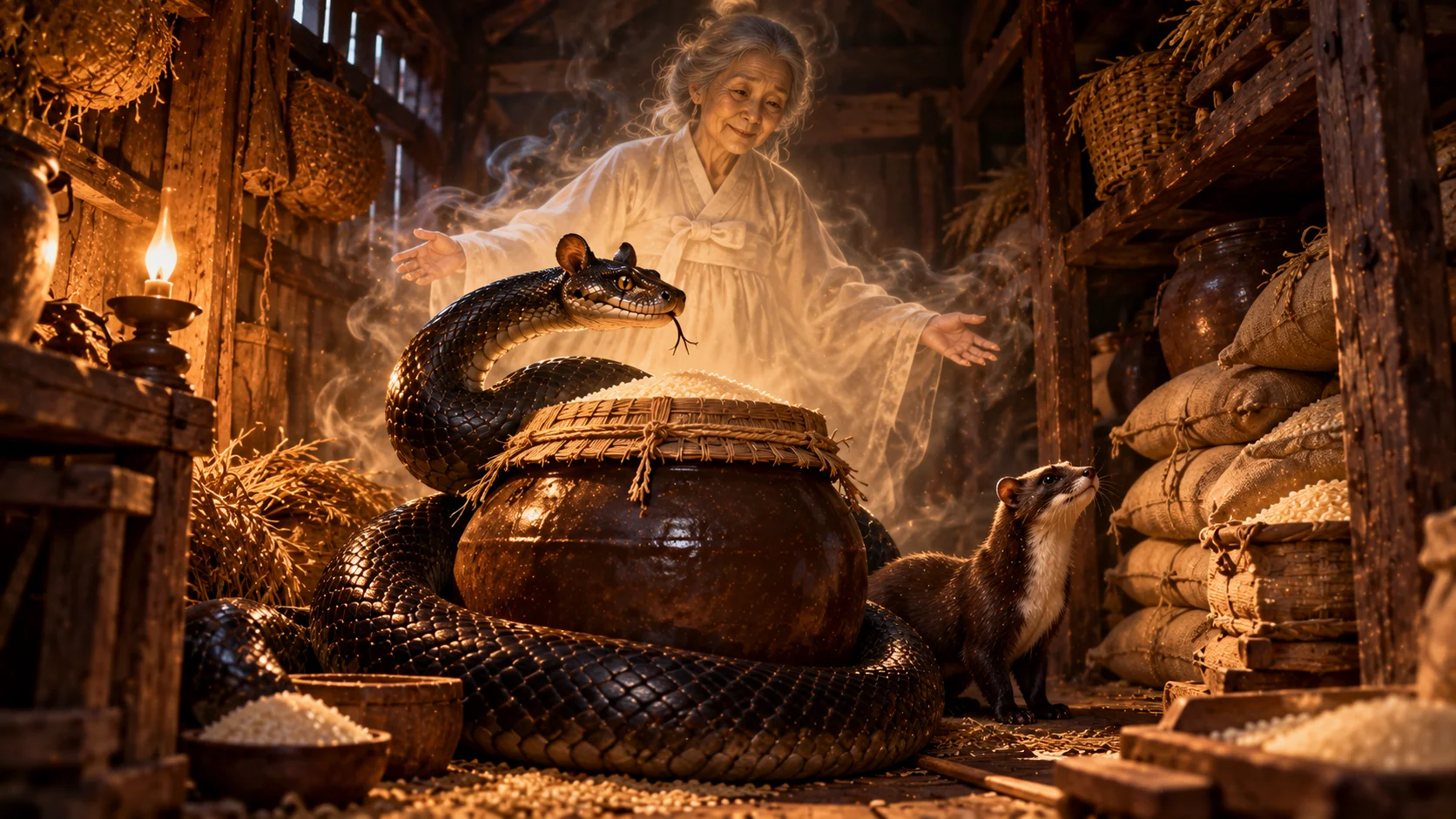
If Sansin governs the wild, outer world of mountains and thresholds, Jowangsin governs the innermost domestic space: the kitchen hearth. Jowangsin is the household goddess of fire and cooking, believed to reside in or above the stove, watching over the family's daily conduct from the very heart of the home. Where Sansin is approached occasionally, at the edge of a journey or in times of particular need, Jowangsin is honored constantly, in the rhythm of ordinary life — traditionally by the woman of the house, who each morning places a bowl of fresh water, called jeongan-su or jowang-mul, on or above the stove as a simple, daily offering.
Within the structure of Korean household religion, known as gasin sinang or "house-god belief," Jowangsin ranks as the most important of the domestic gods after the family's own ancestral spirits, standing alongside Seongju, the guardian god of the house's central ridge beam, and Teoju, the spirit of the building site itself. Together these figures describe a home as a small cosmos of its own, with its ridge, its ground, and its fire each requiring their own quiet, continual acknowledgment.
A Report Carried to Heaven
Jowangsin's role extends beyond simple guardianship into something closer to moral bookkeeping. Folk narrative holds that she reports a family's conduct — its harmony or its quarrels, its honesty or its failings — to the Jade Emperor, or Okhwangsangje, at the close of each year. This structural role mirrors the Chinese Kitchen God, Zao Jun, closely enough that scholars point to it as a clear instance of Daoist cosmology being layered over an older, native Korean hearth cult, rather than replacing it outright. The household's own fire becomes, in effect, an informant standing between domestic life and the judgment of heaven.
Origin myths surrounding Jowangsin often deepen this picture with a note of sorrow. One widely told version casts her as a wronged wife or grieving mother — in some tellings the first, discarded wife of a cruel husband — who dies at or near the hearth and is deified there afterward. This pattern, a suffering woman whose death becomes the seed of her later sacred authority, echoes other prominent threads in Korean myth, most notably the story of Baridegi, and marks Jowangsin as part of a broader tradition in which female suffering is not erased but transformed into enduring spiritual power.
The Restless Dead and the Weight of Han
Beyond the gods of mountain and hearth, Korean tradition holds a vast and carefully distinguished category for the spirits of the dead: gwishin. This is the general term for a ghost or spirit of the dead, distinct from honk, the soul of a living person — a distinction Korean folk belief draws sharply, since a gwishin exists only once the living person it once was has died. Beyond that basic distinction, gwishin themselves are broadly divided into two kinds: ancestral spirits properly cared for through jesa, the family memorial rites, who are honored, welcomed, and folded respectfully into the ongoing life of the family; and wandering, vengeful, or restless spirits, whose presence is unresolved and potentially dangerous. It is this second category, not gwishin as a whole, that folklore and horror fiction alike treat as something to fear.
A wandering or vengeful gwishin, in this framework, is created by a "bad death" — one that leaves behind han, a distinctly Korean concept of accumulated grief, resentment, or unresolved injustice. Dying young, dying unmarried, dying suddenly or violently, or simply dying without the proper funeral and memorial rites being performed, could all produce a spirit trapped between the world of the living and the world it should have passed into. Such a spirit does not rest. It lingers, and its lingering is understood as suffering rather than malice, even when its presence is frightening.
Ssitgim-gut: Washing the Spirit Clean
Korean shamanic practice developed a direct ritual answer to this problem: the ssitgim-gut, or "cleansing gut," especially prominent in the Jindo and broader Jeolla region. The purpose of this ceremony is not to banish the restless spirit but to console it — to resolve its han through ritual performance and offering, and to guide it safely at last into the next world it was denied. It is worth pausing on what this implies about the underlying worldview: a gwishin is treated less as a monster to be exorcised than as a grieving being to be listened to and released. The ritual vocabulary of Korean shamanism is, at its core, more compassionate than combative.
The Virgin Ghost and a Society's Blind Spot
Among the specific categories of gwishin, one has proven especially durable in both folk memory and modern storytelling: the cheonyeo-gwishin, or "virgin ghost," the spirit of a woman who died unmarried. Tradition holds that her han is unusually intense, because she died without fulfilling the roles Joseon-era Confucian society expected of a woman — wife, and in time, mother.
The social mechanics behind this belief were unusually concrete. Under Confucian custom, an unmarried woman's spirit tablet could not be enshrined in the normal line of her own family's ancestral succession. She was, in the most literal ritual sense, spiritually homeless — with no proper place among the ancestors, and therefore, in folk belief, more prone to restlessness and danger than a properly memorialized forebear. The remedy devised for this was itself remarkable: a posthumous wedding ceremony known as yeongon or myeongbuhon, a ghost marriage performed to pair the dead unmarried woman with a spirit husband, sometimes another deceased unmarried person, so that she might symbolically receive in death the married status denied to her in life.
Yin, Silence, and the Shape a Ghost Takes
The visual language now associated with gwishin generally, and cheonyeo-gwishin in particular — a white burial hanbok known as sobok, long black hair worn loose and disheveled — draws on genuine traditional funerary dress, an image later popularized by two landmark films, Whispering Corridors (1998) and A Tale of Two Sisters (2003), which fixed the sobok-and-disheveled-hair look in the modern popular imagination. But the color logic beneath it is older than either film. In Korean cosmology, the dead are classified as pure yin, or eum, standing in direct opposition to the yang of the living. The pallor, the cold, the silence, and the white clothing traditionally tied to ghost sightings are not arbitrary aesthetic choices; they are the visible expression of an entire cosmological category, one shared in broad strokes across East Asian ghost traditions but given its own particular vocabulary in Korea.
One Household, Many Small Gods
Taken together, Sansin, Jowangsin, and the wider circle of gwishin describe a religious landscape built less around a single supreme authority and more around a dense population of local, specific, and intensely relational spirits — a mountain here, a hearth there, a departed relative or a restless stranger somewhere in between. Buddhism arrived and built a shrine for the mountain god at the edge of its own temples rather than displacing him. Daoist cosmology arrived and gave the hearth goddess a heavenly report to file rather than erasing her older, sorrowful origin story. Confucian funerary order arrived and, in leaving no room for an unmarried woman's spirit, generated an entirely new category of the restless dead and a ritual remedy to match.
Scholars often describe this pattern of accumulation rather than replacement as muism, Korean shamanism functioning as a persistent substrate beneath successive waves of imported religious and philosophical systems. What makes Sansin himself so representative of the whole is his sheer visibility: still painted on temple shrine walls, still receiving bowls of rice wine from ordinary hikers, still seated beside his tiger on the mountainside exactly as he has been imagined for centuries, neither displaced by the institutions that arrived after him nor forgotten by the people who continue, quietly, to leave him something at the door of his mountain.
Sources & traditions
- EncyclopediaWikipedia — Mountain God
- TraditionKorean texts, oral tradition and village tellings
Myths change from area to area and from time to time. This chronicle follows the most widely told versions; tellings in other villages, regions and eras may differ.