Seonangsin (서낭신), also known as Seonghwangsin, is the guardian deity of the village and its boundaries in Korean folk religion — a spirit who watches not the hearth or the mountain peak but the seams of the map: the pass where the road climbs out of sight, the crossroads where a traveler must choose, the gate where the settled world ends and the unknown begins. Seonangsin belongs to a wider Korean animistic worldview in which nature, hearths, and boundaries are each governed by resident spirits requiring ongoing propitiation, standing alongside household gods like Jowangsin and mountain guardians like Sansin as part of the same living cosmology of care and offering.
The Shrine at the Village Edge
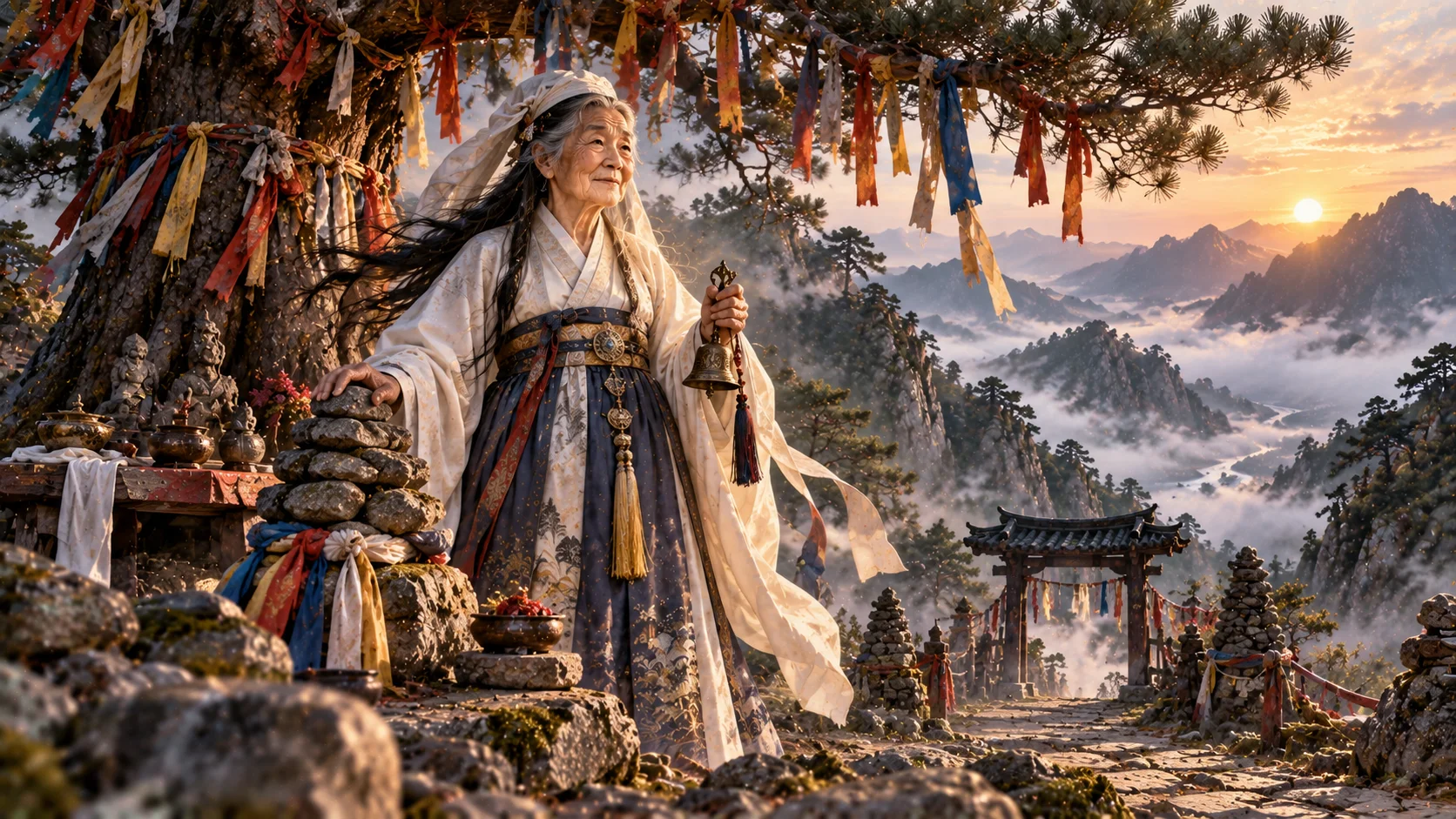
Seonangsin's seat is the seonangdang — a shrine that rarely resembles a temple in any formal sense. More often it is a stone cairn heaped up stone by stone over generations, or a single sacred tree standing alone at a mountain pass, a fork in the road, or the boundary stone marking where one village's land ends and another's begins. These shrines cluster at exactly the points where a community's control over its own space becomes uncertain: the high pass where a traveler could lose the light before reaching the next village, the crossroads where a wrong turn could mean a night lost in the mountains, the gate through which sickness, misfortune, or a hostile spirit might just as easily walk in as a friendly traveler walk out.
There is no single architectural form the seonangdang must take, and that variability is itself part of its meaning. A cairn can be added to by anyone passing, a tree can grow for a century before anyone remembers why it was chosen, and both accumulate their sacredness the way a path is worn smooth — through repetition, not through consecration by any single authority. The shrine belongs to the village and to every traveler who has ever paused there, not to a priesthood.
Stones for Safe Passage
The devotional practice tied to Seonangsin is disarmingly simple and has survived, in some form, for centuries: a traveler passing a seonangdang would add a stone to the cairn, or tie a strip of cloth to the branches of the sacred tree, and offer a brief prayer for safe passage before continuing on. No priest was needed to mediate the exchange, no elaborate ritual calendar governed it — only the traveler's own uncertainty about what lay over the next ridge, and the deity's willingness to be asked directly.
This practice sits within a much larger pattern found across East Asia wherever roads climb through dangerous terrain — the Chinese Chenghuangshen tradition of city and boundary gods shares the same underlying logic, that a threshold needs its own guardian distinct from the gods of hearth or harvest. What distinguishes the Korean form is its portability and its simplicity: any stone will do, any cloth will do, and the shrine grows by accumulation rather than by design, each added stone a small, anonymous record of someone else's fear and someone else's safe arrival on the other side.
Guardian of Threshold and Community
Seonangsin's protection is not limited to individual travelers. The deity is understood as the guardian of the community as a whole against disease, misfortune, and the intrusion of evil spirits — a role that expands the village boundary from a physical line on the ground into something closer to an immune boundary, a membrane the village depends on to keep the outside world's dangers outside.
This is the same logic that governs many of Korea's gasin, or household gods — deities like Jowangsin who governs the kitchen, or the site god Toju-daegam, each assigned a particular zone of vulnerability within the home or the village to watch over. Seonangsin's zone is simply drawn at the largest scale available to ordinary people: not a room, not a house, but the entire settlement and the roads that connect it to its neighbors.
The Dongje: A Village United in Ritual
Once a year, or at intervals set by local custom, a community holds a formal rite for its guardian spirit — the dongje, sometimes called seonghwangje in direct reference to Seonangsin. Unlike the quiet, individual stone-adding of a passing traveler, the dongje is a communal event, drawing in the whole village to renew its relationship with the deity that keeps its borders safe. Offerings are prepared, the shrine is cleaned and refreshed, and prayers are offered not on behalf of one person's journey but on behalf of the collective's protection from disease and misfortune for the year ahead.
Where an individual stone at the cairn asks for one safe crossing, the dongje asks for a whole year of the boundary holding. It answers the same underlying anxiety that runs through all of Seonangsin's worship: that a settlement's safety is never guaranteed and must be actively, repeatedly renewed.
Jangseung: The Village's Carved Sentinels
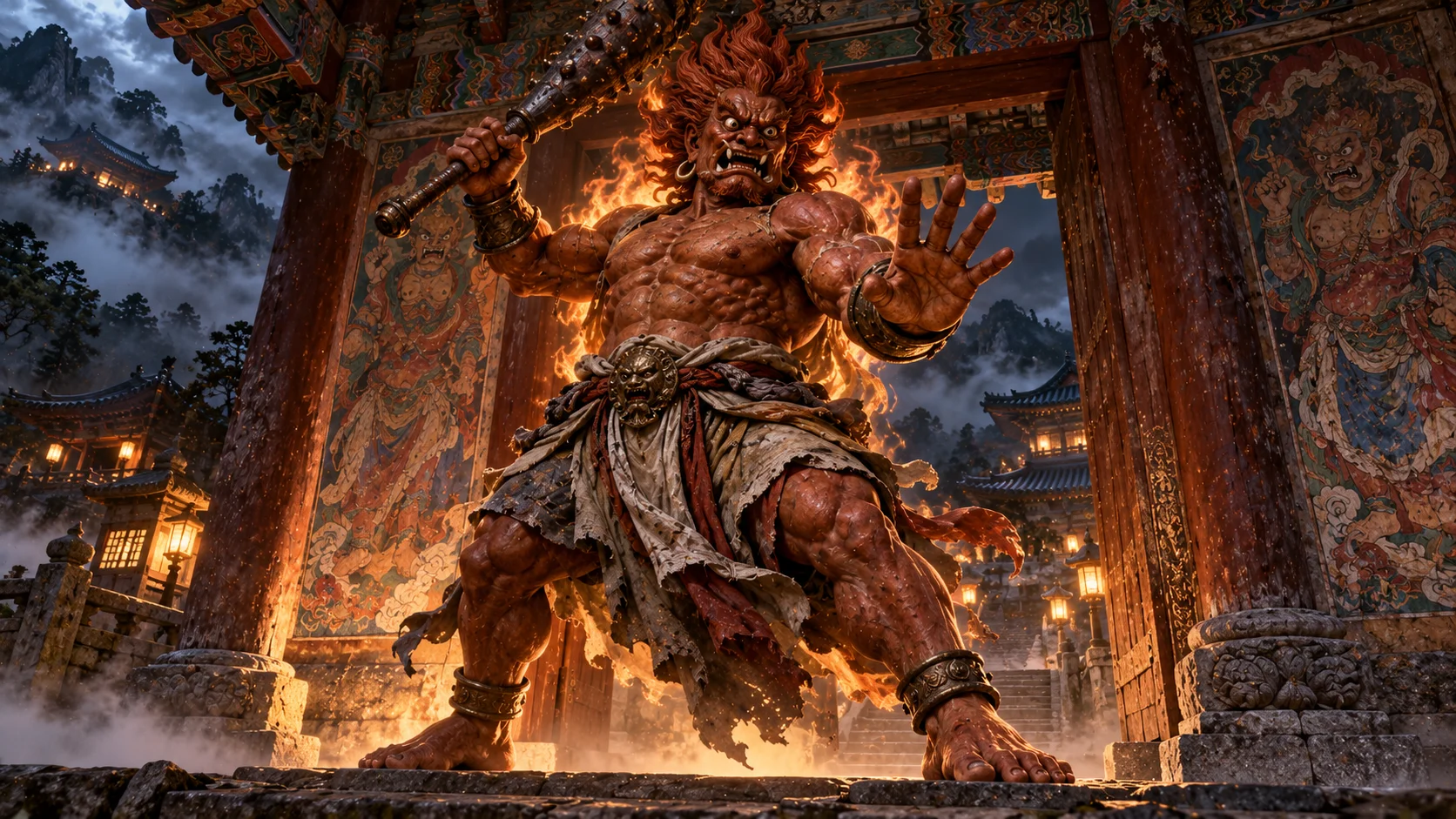
Standing sentry alongside — and sometimes in place of — the seonangdang are the jangseung, Korea's carved totem poles, planted at village entrances and roadsides to ward off evil spirits and mark where one community's territory begins. Traditionally raised in pairs, a male figure called Cheonha Daejanggun, "general beneath heaven," stands opposite a female counterpart, Jiha Yeojanggun, "female general beneath earth" — a paired guardianship that mirrors the way Seonangsin's own protection is understood to cover the village from more than one direction at once.
The jangseung are carved with deliberately exaggerated, bulging eyes and grimacing expressions, a face built specifically to frighten rather than to comfort — the opposite aesthetic of a shrine meant to invite prayer, but serving exactly the same defensive purpose as the seonangdang itself. Beyond their spiritual role the poles doubled as practical mile markers, called era stones or ihyu, carved with the distance to the next town, so that the same object oriented a traveler's body through the landscape while it oriented their spirit against what might be lurking in it.
The renewal of jangseung often coincides with dangsanje, the village shaman rites at which the poles are re-carved or re-erected and fresh offerings made for communal protection and a good harvest — a ceremony that, like the dongje, treats spiritual defense as something requiring regular renewal rather than a one-time installation.
What the Boundary Is Really Guarding Against
To understand what Seonangsin protects against, it helps to understand what Korean folk religion imagined moving through the world uninvited. Chief among these dangers was the gwishin, the general term for a ghost — a spirit unable to pass on from unresolved grievance, or han, and left instead to wander the roads and border-lands precisely where a seonangdang or jangseung would stand watch. A gwishin tied to the mortal world by resentment does not respect property lines or village gates on its own; it is the shrine, the totem, and eventually the intervention of a mudang performing a gut that stands between such a restless spirit and the community it might otherwise trouble.
Among the most iconic of these wandering spirits is the cheonyeo-gwishin, the vengeful ghost of an unmarried woman, traditionally pictured in a white hanbok called a jeoksam, with long, disheveled black hair obscuring her face. Her restlessness traces to a specific injustice recognized under Confucian-era custom: an unmarried woman's spirit could not be honored with the proper ancestral rites, or jesa, leaving her with no ceremonial home to settle into and no route to peace except through someone else's intervention. It is precisely this kind of unresolved, boundary-crossing danger — a spirit with nowhere to belong, moving through the spaces between settled homes — that the seonangdang's quiet stones and the jangseung's carved scowls were built to hold at bay.
A Deity Without a Temple
What sets Seonangsin apart from many other figures in the Korean pantheon is the absence of institutional mediation in its everyday devotion. There is no equivalent of a Buddhist monastery tending the shrine, no dedicated caste of ritual specialists required for the ordinary act of adding a stone. This stands in contrast to figures whose worship depends on trained intermediaries — a mudang is needed to appease a gwishin through a gut, and the great judge of the underworld, Yeomra, presides over a bureaucratic afterlife with scribes recording every soul's deeds — while the simple stone-and-cloth practice at a seonangdang asks only a moment's honesty about one's fear of the road ahead.
This informality does not make Seonangsin a minor figure. It reflects instead a form of devotion built around thresholds: a belief that danger concentrates at edges, and that the response to edge-danger should be as available and repeatable as the edges themselves are numerous. Every pass, every crossroads, every village gate in Korea's mountainous terrain could in principle have its own seonangdang, because the anxiety that produces one recurs at every point where the safety of the known gives way to the uncertainty of the unknown.
Syncretism at the Village Gate
Like much of Korean folk religion, Seonangsin's cult did not develop in isolation from the country's later religious imports. The broader landscape of spirits Seonangsin shares the countryside with — mountain guardians descended from ancient mountain-worship traditions linked to Korea's founding figure Dangun, underworld judges adapted from Buddhist cosmology by way of Chinese translation, kitchen gods who report annually to a heavenly bureaucracy — together sketch a folk religion built in layers, indigenous shamanism absorbing and reshaping Buddhist and Taoist imports without discarding its own older instincts. Seonangsin's shrine at the village edge belongs to that same layered inheritance: like Sansin's mountain worship, it is rooted in indigenous practice that later found its own accommodations with Buddhism and other imported traditions, sharing shrine ground rather than sitting apart from it.
An Enduring, Living Practice
Unlike some folk devotions that have receded into folklore collections and museum placards, the seonangdang tradition persists in living form in parts of Korea's countryside, where cairns are still added to and cloth still tied to branches by people for whom the gesture is not reenactment but genuine practice. This continuity deserves to be treated with the same respect owed to any living indigenous tradition: not as a quaint survival to be catalogued, but as an ongoing relationship between a community and the landscape it depends on, renewed one stone and one prayer at a time. The seonangdang's endurance across centuries of political and religious upheaval in Korea is itself a kind of testimony — to how deeply the anxiety of the threshold, and the comfort of a guardian posted there, remains woven into how people understand the ground beneath their feet.
Sources & traditions
- EncyclopediaWikipedia — Seonangsin
- TraditionKorean texts, oral tradition and village tellings
Myths change from area to area and from time to time. This chronicle follows the most widely told versions; tellings in other villages, regions and eras may differ.