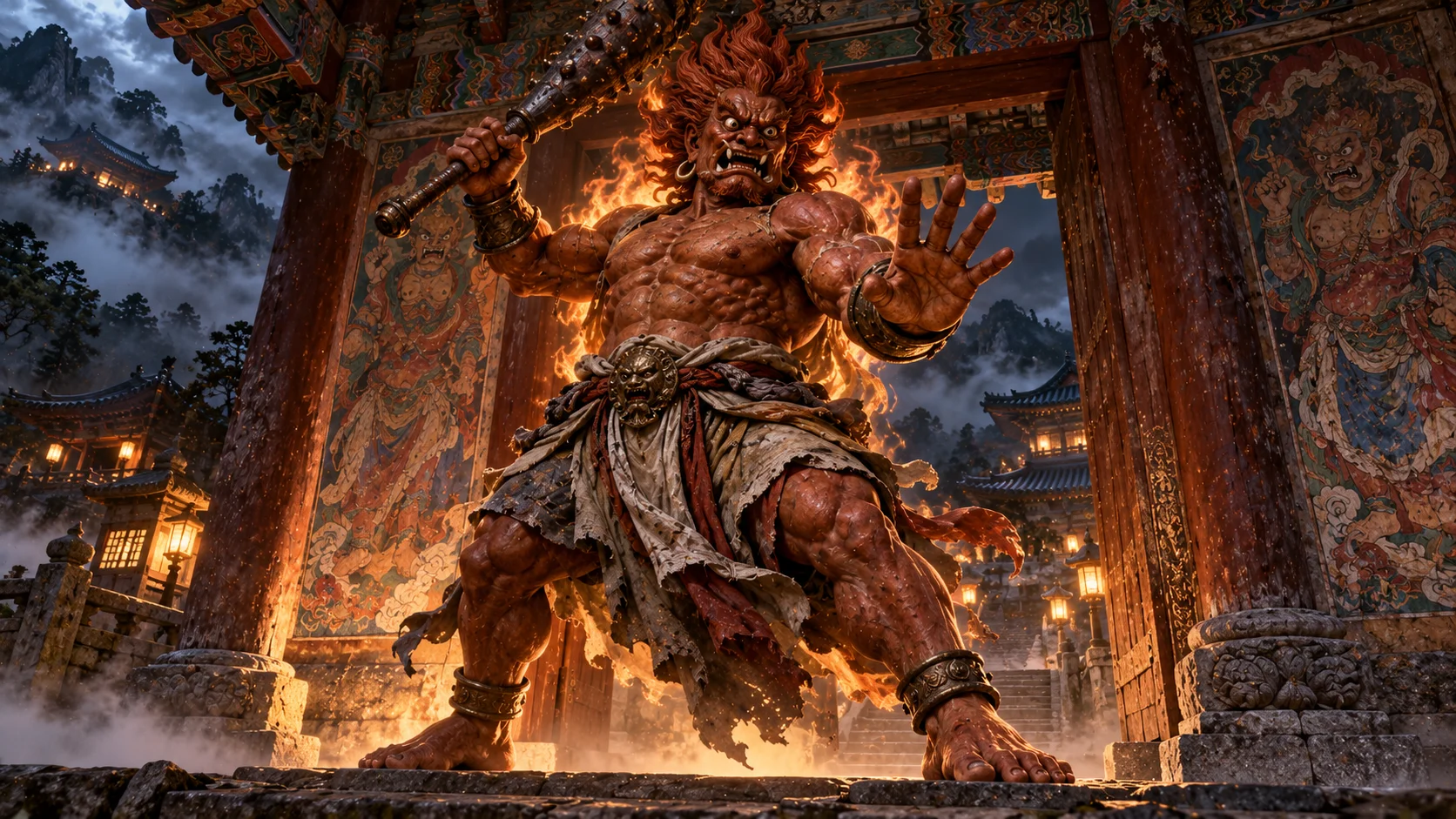
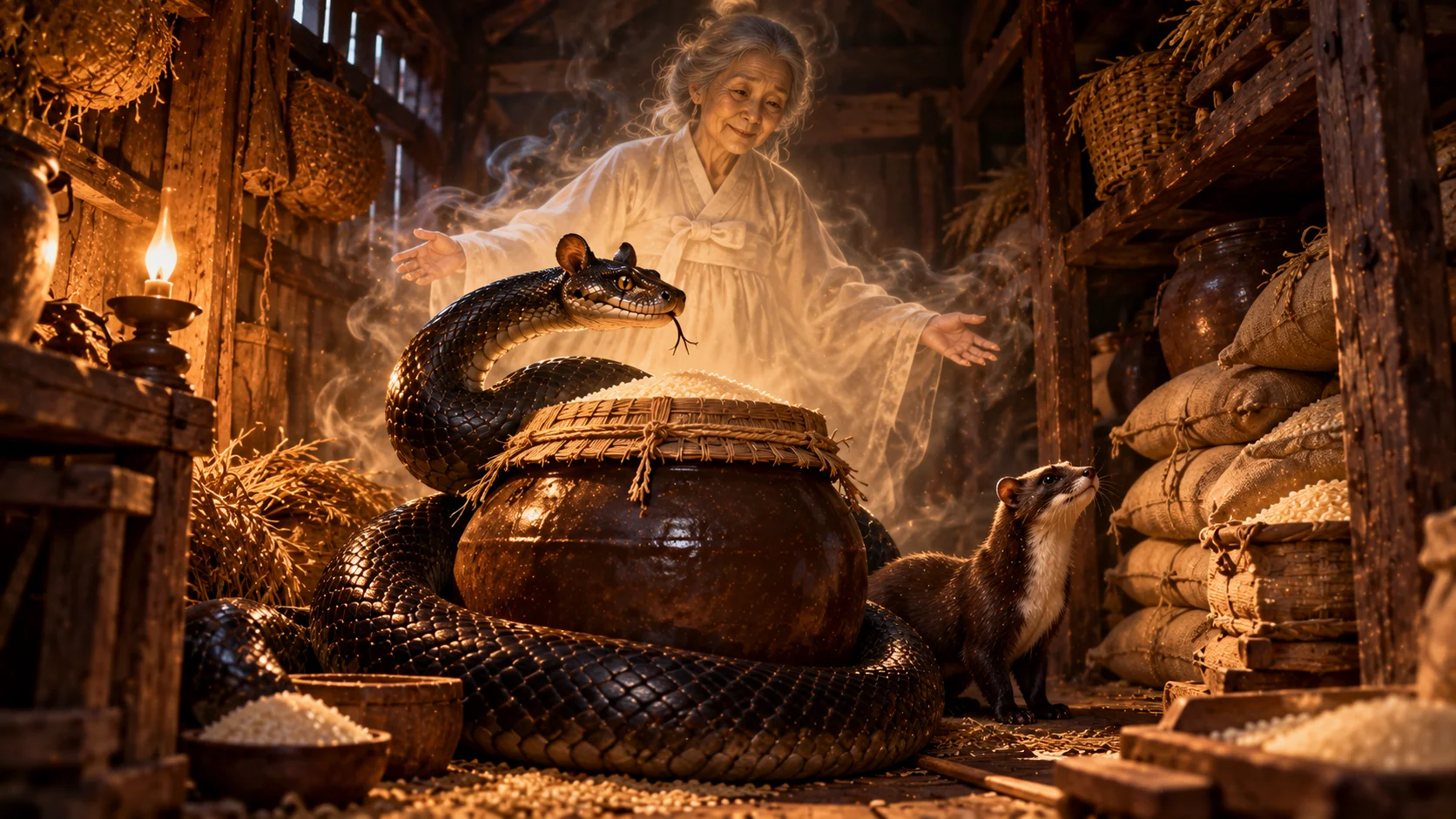
Yeomra (염라대왕, Yeomra Daewang) is the King of the Underworld in Korean mythology, the supreme judge before whom every soul must eventually stand. His office traces back through Chinese Yanluo Wang to the Sanskrit deity Yama, absorbed into the Korean cosmological imagination alongside Buddhist teachings and reshaped into something distinctly local — stern, exacting, and yet, in the folk imagination, not beyond being outwitted by a clever or righteous human. Where Cheonji-wang governs the origin of heaven and earth and Yongwang rules the waters of the world, Yeomra presides over the last and most intimate court any person will ever face: the reckoning of a single lifetime, read back in full.
King of the Dead in Jeoseung
Yeomra presides over Jeoseung, the Korean realm of the dead, from within a great judgment hall where the deeds of the newly deceased are laid bare. Unlike deities of sky or sea, whose domains are vast and largely impersonal, Yeomra's court is intensely individual: each soul that arrives before him is met not with a shared fate but with a private, total accounting. Korean Buddhist temple art renders this scene again and again in the Siwangdo, paintings of the Ten Kings of the underworld, where Yeomra sits enthroned amid smoke and flame, flanked by demon attendants and ink-brushed scribes, his face carved into an expression that is neither cruel nor kind but simply, permanently just.
The Ledger That Forgets Nothing
Central to Yeomra's judgment is the saengsabu, the ledger in which every act of a person's life is recorded — kindnesses extended to strangers, debts left unpaid, promises kept or broken, cruelties committed in private thinking no one would ever know. In Korean folk belief this ledger is not compiled by Yeomra himself but delivered to him complete, the work of the underworld bureaucracy that watches the living long before it ever receives them. The image carries a plain moral force: nothing is truly private, and no kindness or unkindness is ever wasted on silence. It is this ledger, more than any punishment described in temple murals, that gave Yeomra his lasting grip on the Korean moral imagination — the fear was never simply of hell, but of having lived a life whose record one would be ashamed to hear read aloud.
Among the Ten Kings
Yeomra is counted among the Siwang, the Ten Kings of the Underworld, who together judge the dead at intervals following death — traditionally every seven days for the first forty-nine, with further judgments extending beyond. He is the best known of the ten in Korean popular memory, so much so that his name is often used loosely to stand in for the whole tribunal, even though tradition assigns each king his own court along the soul's journey. The Ten Kings system itself is a layered inheritance, blending Buddhist cosmology with older Chinese bureaucratic models of the afterlife — hell imagined not as a single furnace but as a functioning court system, complete with clerks, calendars, and appeals. Korean Buddhist practice still marks the forty-ninth day after death as a significant closing point in this sequence of judgments, when memorial rites are traditionally performed to aid the deceased's passage.
A Face for the Unthinkable
Part of what makes Yeomra endure in the popular imagination, rather than remaining an abstract theological principle, is that Korean folk narrative refuses to leave him untouchably remote. Where other high gods of the Korean pantheon are approached only through elaborate ritual, Yeomra appears in stories as a character who can be met, argued with, and even summoned — which paradoxically makes the terror of the underworld more vivid, not less, because it insists that judgment is not a distant abstraction but a personage with whom one might someday have to reckon face to face.
Gangnim Doryeong and the Summons of the King
The clearest expression of this is the Jeju shamanic myth of Gangnim Doryeong, in which a human messenger is dispatched on an extraordinary errand: to travel to the underworld and bring Yeomra himself back to the mortal world in order to resolve a miscarriage of justice that the living authorities cannot untangle. The tale's premise is startling on its own terms — that the King of the Dead, absolute and terrifying within his own court, can nonetheless be compelled by proper cunning, proper ritual knowledge, or sheer persistence to leave his throne and answer for a wrong committed under his jurisdiction. It is one of Korean folklore's most memorable portraits of Yeomra: not only as judge, but as a figure who can, under the right circumstances, be brought to account himself.
Judgment as Moral Architecture
What separates Yeomra's court from a simple fantasy of punishment is the moral architecture it implies for the living. A ledger kept in secret, read aloud at the end of life, judged by a king who cannot be bribed or deceived by rank or wealth — this is a theology built to level distinctions that mattered enormously in life. A powerful official and a humble farmer arrive before Yeomra as equals, and it is the farmer's quiet decency, not the official's status, that the ledger will vindicate. Korean folk sermons and cautionary tales built around Yeomra's court consistently return to this leveling function: earthly hierarchy dissolves entirely at the threshold of Jeoseung, and only the moral record survives the crossing.
Between the Courts of Heaven, Sea, and Earth
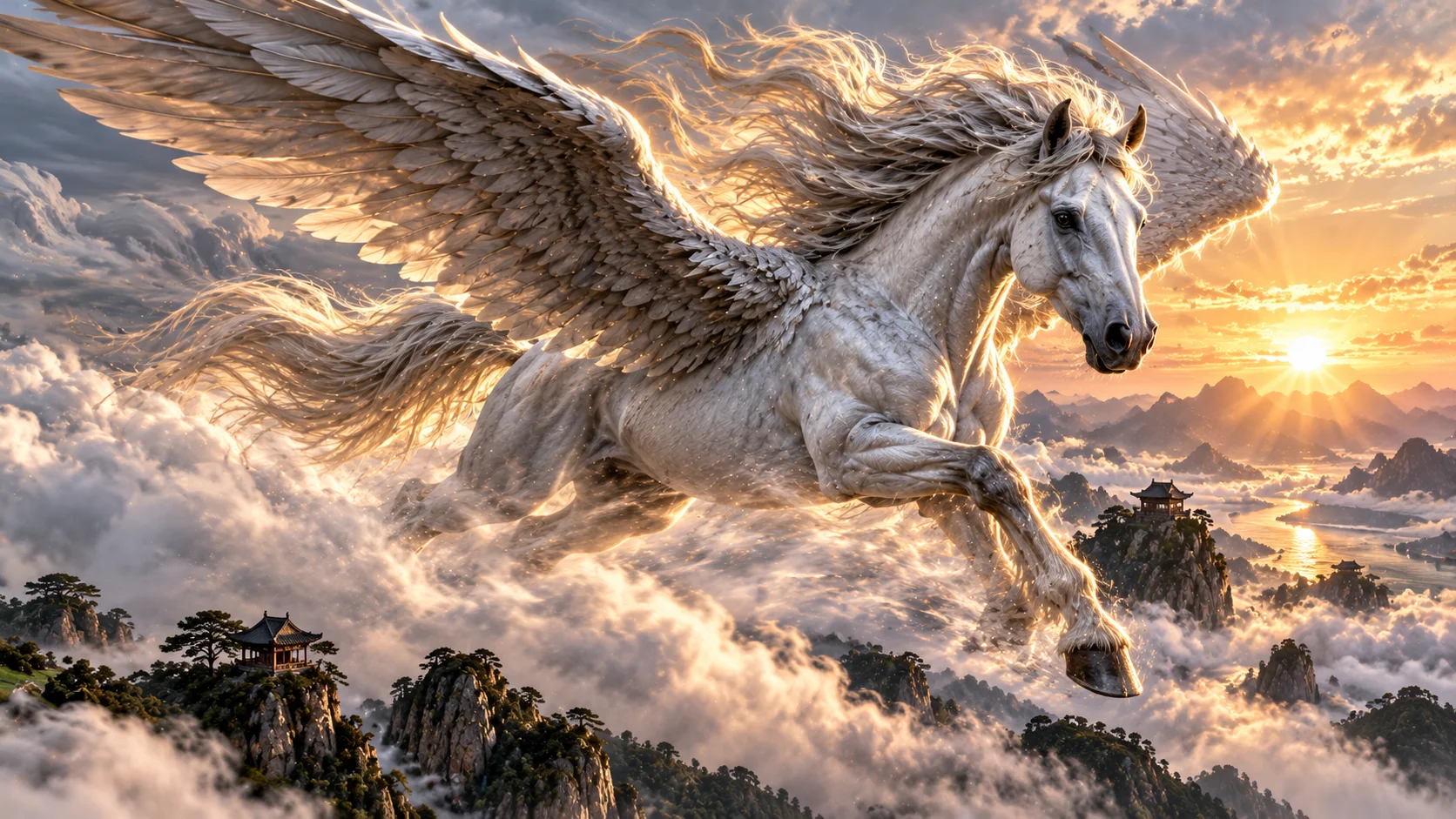
Korean cosmology, as expressed across its major mythic cycles, maps a vertical universe with distinct sovereigns for each register of existence. Cheonji-wang, the Heaven and Earth King of the Jeju creation myth Cheonji-wang Bonpuri, governs the cosmic origin of order itself — the separation of a once-fused heaven and earth, and the placement of sun and moon. Yongwang, the Dragon King and supreme ruler of the sea, governs the seas and all bodies of water from his undersea palace, Yonggung — a Korean localization of the Chinese Dragon Kings of the Four Seas (Longwang), consolidated here into a single sovereign rather than four. He is invoked by coastal communities whenever the harvest of the ocean or the fall of rain hangs in the balance, and is the central figure of the folktale "The Tale of the Rabbit and the Turtle" (Sugungga/Byeoljubu-jeon), in which the ailing Dragon King sends a turtle to the land to lure a rabbit's liver back to cure him. Yeomra governs neither sky nor sea but the final threshold every mortal life must eventually cross, regardless of what waters they fished or what heaven they prayed beneath. Together these figures describe a Korean universe stacked in layers — sky, earth, sea, and underworld — each with its own sovereign, its own protocols, and its own form of justice.
The Liminal Imoogi and the Weight of Waiting
If Yeomra represents an ending rendered with total finality, the Imoogi represents a very different kind of trial: not judgment after the fact, but transformation deferred across an almost unbearable span of time. The Imoogi is a proto-dragon, a giant hornless serpent that must endure in a lake, river, or deep pool — commonly for a thousand years — before it is permitted to become a true yong, a full dragon, and ascend to heaven. Its story is one of patience under an unimaginable clock, and of a transformation that can still be lost at the very last moment through no fault of its endurance, only its luck.
The Jewel and the Fatal Glance
Most tellings of the Imoogi's ascension require a catalyst: the Yeouiju, the wish-fulfilling jewel that dragons are depicted holding in claw or mouth, and which grants its bearer power over water, weather, and fortune. Without obtaining or swallowing this jewel, the creature's centuries of waiting come to nothing. And even success can be undone in an instant by a widespread and haunting motif: if a human witnesses the Imoogi's ascension at its critical moment — most often the moment of sunrise — the transformation fails outright, and the Imoogi falls back to earth or is destroyed rather than completing its rise. A being who has waited a thousand years can lose everything to a single set of eyes in the wrong place at the wrong hour, a detail that gives Korean dragon lore a tragic undertone rare in dragon mythologies elsewhere, where dragons are more often simply born, not painstakingly earned.
Kinship With the Jiaolong and the Shape of Korean Dragon Lore
The Imoogi's pattern of gradual transformation echoes the Chinese jiaolong, a hornless flood-dragon that likewise must pass through age and trial before becoming a full dragon — a clear sign of how thoroughly Korea absorbed and localized Sinitic dragon cosmology while still making it its own. Some regional Korean legends push the Imoogi further from sympathy, casting it as inherently malevolent, a hoarder of treasure or a terror haunting a village's water source until a hero arrives to end its reign — a darker counterpoint to the more common image of a creature simply waiting, blamelessly, for its transformation. This tension matters because the fully realized yong, the dragon the Imoogi hopes to become, is traditionally gentle: a wise water deity bound up with kingship and the coming of rain, closer in spirit to a guardian than a monster. That the road to becoming such a benevolent being runs through a millennium of vulnerability, and can end in tragedy rather than triumph, is part of what makes Imoogi tales resonate as stories of striving rather than simple monster legends.
Where Judgment and Transformation Meet
Set beside one another, Yeomra and the Imoogi describe two very different relationships between time and fate in Korean myth. Yeomra's ledger accumulates across an entire human life and is read out in a single uncompromising sitting; the Imoogi's fate accumulates across a thousand years and can be undone in a single glance. Both figures insist, in their own registers, that outcomes are earned across long spans of unseen effort and judged in moments that cannot be repeated — a shared moral grammar running beneath a mythology that otherwise spans creation gods, sea kings, transforming serpents, and the terrifyingly patient bureaucracy of the dead.
Ritual Memory and the Living Tradition
None of these figures survive today purely as literary curiosities. The forty-nine-day mourning rites tied to Yeomra's courts are still observed in Korean Buddhist practice, the Cheonji-wang Bonpuri is still recited by Jeju shamans as part of the General Bonpuri cycle at the Cheongung-maji ritual, and Yongwang-gut ceremonies still send offerings of rice cakes and rice wine into the sea at dawn along Korea's fishing coasts, especially around Jeju Island — alongside giu-je, the rain-prayer rites once performed by farmers and officials to Yongwang during times of drought. Yeomra's court, in particular, remains a living presence in Korean funerary custom, less a distant myth than a horizon every family ritual is implicitly oriented toward — a reminder that the ledger, in the tradition's own telling, is still being kept.
Sources & traditions
- EncyclopediaWikipedia — Yama (Buddhism)
- TraditionKorean texts, oral tradition and village tellings
Myths change from area to area and from time to time. This chronicle follows the most widely told versions; tellings in other villages, regions and eras may differ.