Dangun Wanggeom is remembered as the founding sovereign of Gojoseon, the first kingdom of Korea, and as the heir of a lineage that begins in the sky and passes through the wild, tree-covered slopes of Taebaek-san before ever touching a throne. His story survives largely because Iryeon recorded it in the Samguk Yusa (1281), citing an older, now-lost Wei Shu and a text called the Gogi, or Old Record. Later chroniclers reshaped pieces of the tale — the Jewang Ungi of 1287 makes Dangun a grandson of Hwanin rather than simply a son of Hwanung — but the core architecture of the myth has held for more than seven centuries: heaven descends, nature transforms, and from their union a founding king is born.
A Kingdom in Heaven Looks Downward
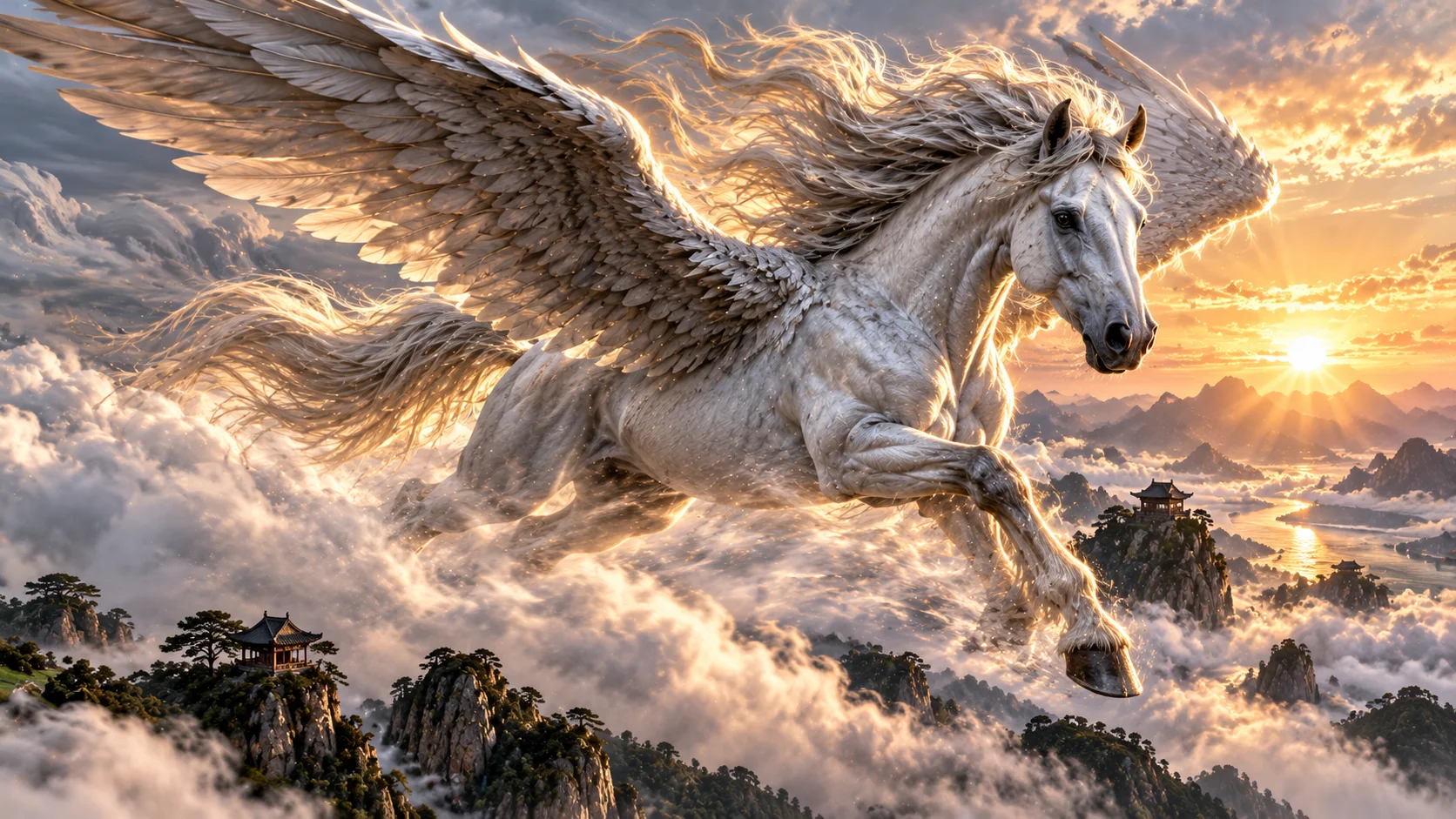
Long before there was a Gojoseon to found, the myth begins in a heaven already governed, ordered, and full. Hwanin, the Lord of Heaven, ruled a celestial court, and it was his son, Hwanung, who asked permission to descend to the human world below. Hwanin, weighing the request, is said to have surveyed three high peaks before granting Hwanung Taebaek-san, traditionally identified with Baekdu Mountain, as the place his son might govern.
The Descent to Taebaek-san
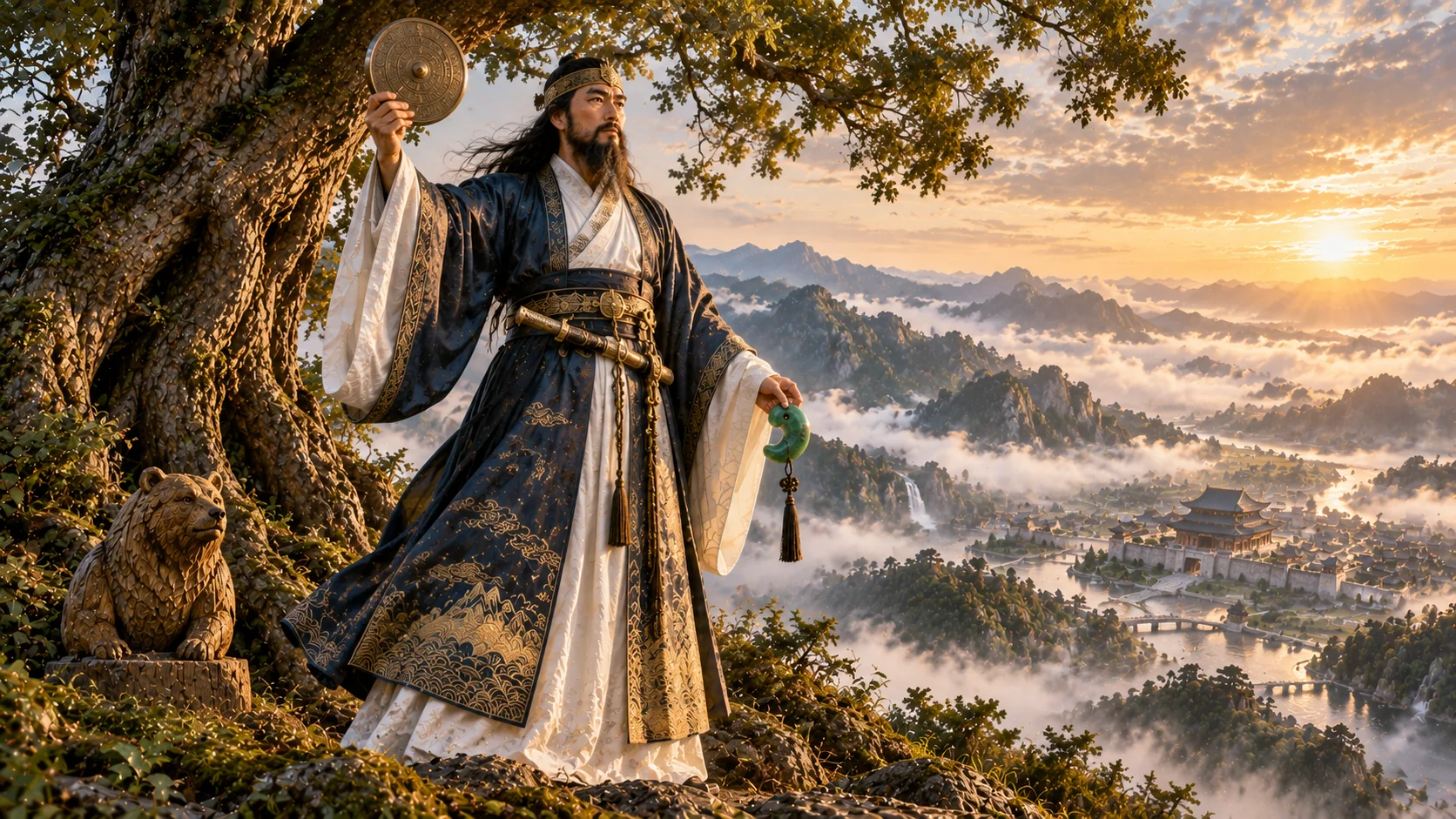
Hwanung did not come down alone. Tradition holds that he descended with three thousand followers, arriving beneath a sacred sandalwood tree known as Sindansu, and there he founded a settlement called Sinsi, the "City of God." The image is deliberately agricultural and civic rather than martial: a god does not conquer the mountain, he settles it, plants his court beneath a tree, and begins the work of ordering human life from the ground up. Sinsi becomes, in effect, the first capital of a mythic Korea — not a palace of stone but a grove made sacred by the presence that has chosen to dwell in it.
Wind, Rain, and Cloud in Council
To govern his new domain, Hwanung brought three ministers whose names describe the very elements a farming people lived and died by: Pungbaek, the Earl of Wind; Usa, the Master of Rain; and Unsa, the Master of Clouds. Their presence at Hwanung's side reflects an agricultural cosmology built around wind, rain, and clouds. The Samguk Yusa records that Hwanung took charge of some 360 areas of human affairs — "agriculture, life, illness, punishment, and good and evil" — ruling not from a remove but embedded directly in the texture of mortal need. A sky god who commands wind and rain is, in an agrarian cosmology, a god who commands the harvest itself, and by extension, survival.
A Bear and a Tiger Ask for a Human Life
Into this ordered heavenly settlement come two animals with an unusual request. A bear and a tiger, dwelling near Hwanung's court, pray to become human. Some readers of the myth have described this as a reversal of the more familiar mythic direction — beasts aspiring upward rather than mortals aspiring to divinity — though the text itself offers no commentary on what that reversal is meant to say about the relative standing of animal and human life; it simply records the request. Hwanung hears them and sets a trial rather than granting the wish outright: he gives the pair a bundle of mugwort, or ssuk, and twenty cloves of garlic, and commands that they eat nothing else and avoid sunlight for one hundred days.
The Discipline of Darkness
The trial itself is worth lingering on, because its terms are so spare and so exacting. No spectacle, no combat, no riddle — only endurance, darkness, and a bitter diet sustained against the passage of time. The tiger, restless and unable to bear the confinement, abandons the trial before it is finished, and vanishes from the story as swiftly as it entered it. The bear remains. According to the Samguk Yusa, it is not the full hundred days but twenty-one that the bear endures before the transformation completes, and she emerges as a woman, called from that moment onward Ungnyeo — the bear-woman.
Ungnyeo Beneath the Sandalwood Tree
Ungnyeo's transformation does not end her story. Made human, she comes to the sandalwood tree at Sinsi and prays there for a child. Hwanung, moved by her prayer, changes himself temporarily and takes her as his wife, and Dangun is born of that union. Scholars have long read Ungnyeo's arc as evidence of an ancient bear cult, linking it to shared Siberian and Tungusic bear-veneration traditions found across the circumpolar region. The myth does not ask its audience to forget that Dangun's mother was once a bear; that fact remains part of how his dual nature, half of heaven and half of the transformed earth, is explained.
The Birth of Dangun Wanggeom
From the union of the sky-descended Hwanung and the bear-transformed Ungnyeo comes Dangun Wanggeom. By lineage he is neither fully divine nor fully human but drawn from both, a bridge figure between heaven and earth in Korean cosmology: heaven above him through his father, the transformed natural world behind him through his mother, and the human world his own to inherit.
The Founding of Gojoseon
Tradition dates the founding of Gojoseon, the first kingdom of Korea, to 2333 BCE, a date preserved in both the Samguk Yusa and the later Dongguk Tonggam of 1485. The Dangun narrative, taken as a whole, functions as a foundation myth linking heaven (Hwanin and Hwanung), earth and nature (the bear Ungnyeo), and humanity (Dangun) into a single genealogical chain — a structure scholars have identified as central to the formation of Korean national identity, particularly during the twentieth century.
A Fifteen-Hundred-Year Reign
The Samguk Yusa credits Dangun with an extraordinarily long rule — some fifteen hundred years over Gojoseon. Long reigns of this kind are common in foundation myths generally, often serving to compress a slow, uneven, centuries-long process of political consolidation into the lifetime of a single ancestral figure.
Retirement to the Mountain
Dangun's story does not end in an ordinary death. According to the same account, he eventually retired from rule and became a mountain god, a sanshin, at Mount Asadal. The ending returns Dangun to the mountains from which his father first descended, closing a circuit between sky, mountain, and kingdom rather than ending the myth with a funeral.
A Myth Pressed Into Service Against Empire
The Dangun narrative's cultural weight has never been static. During the Japanese colonial period from 1910 to 1945, veneration of Dangun was promoted as a form of anti-colonial nationalism, asserting a Korean origin story independent of any external claim on the peninsula's history. Out of that same era grew Daejongism, also called Dangungyo, formally organized in 1909 as a religion venerating Dangun as a divine ancestor.
Gaecheonjeol and the Living Memory of a Founding
The myth is not confined to old texts. South Korea marks National Foundation Day, Gaecheonjeol, every October 3rd, commemorating the founding of Gojoseon under Dangun — a modern civic holiday resting on a Bronze Age legend, still observed, still tying present-day Korean identity back to a bear who endured darkness for twenty-one days and a god who came down from the sky to a sandalwood tree on a mountain called Taebaek.
A Different Kind of Spirit: The Dokkaebi
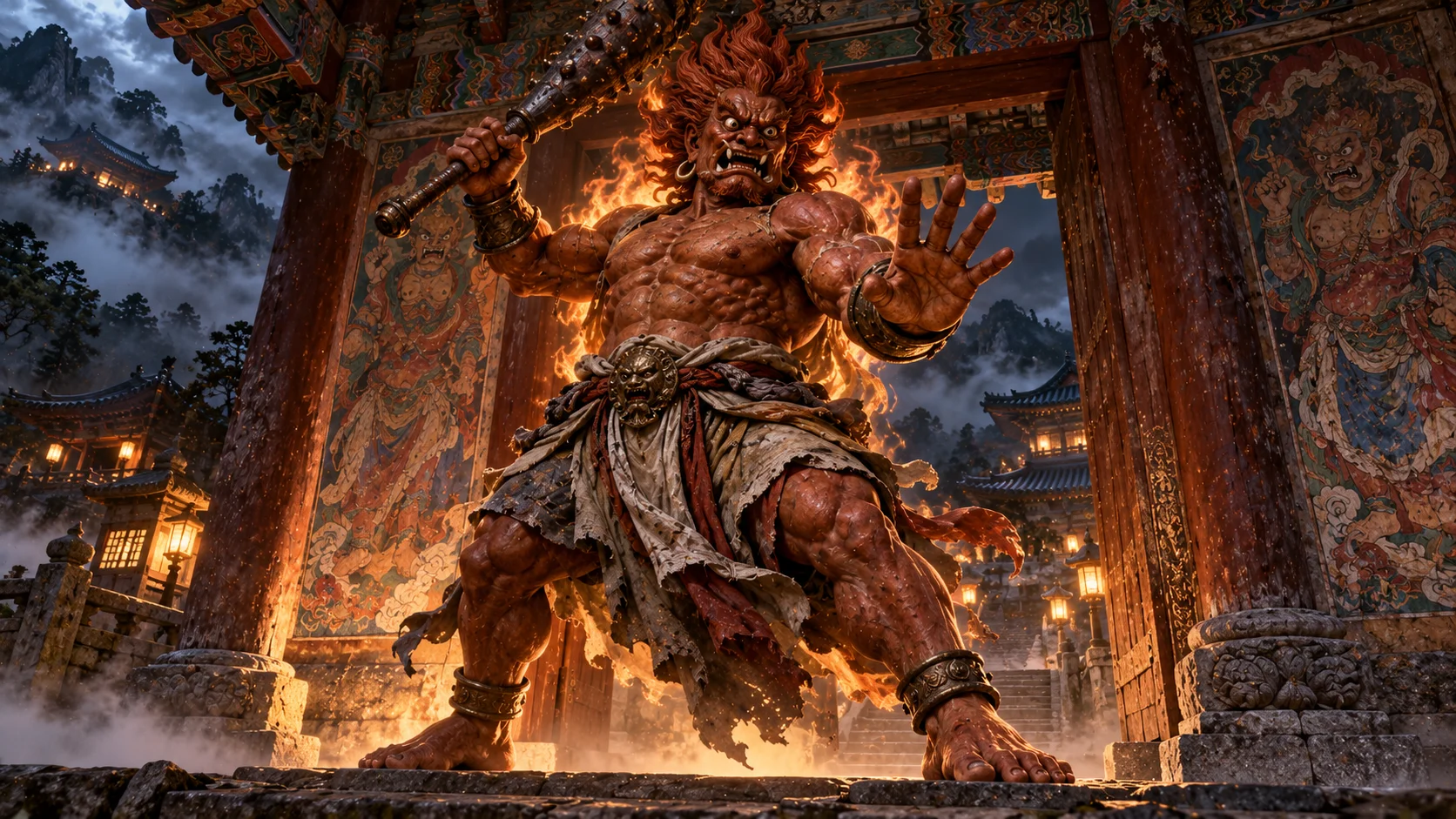
Not every figure in Korean folklore descends from heaven the way Dangun's father does. The dokkaebi is a class of Korean folk goblin or spirit, distinct from the Japanese oni, traditionally depicted as mischievous rather than purely malevolent — as likely to help the poor as to punish the greedy and cruel. Where Dangun's line begins in a celestial court, dokkaebi folklore holds that these spirits are born from ordinary, inanimate objects: old, blood-soiled or long-used household items such as brooms, blood-stained sticks, or worn-out tools, said to become imbued with spirit over time, a concept tied to broader Korean folk animism.
Dokkaebi are traditionally associated with a magical cudgel or bat, the dokkaebi bangmangi, capable of summoning riches or objects on command — a recurring motif in Korean folk tales such as "The Dokkaebi's Club." They are also commonly depicted challenging travelers to wrestling matches, ssireum, at night, and folklore claims their weak point is always one leg, so that a persistent opponent can defeat them by targeting it. Villagers are said to have left out makgeolli, rice wine, and memil-muk, buckwheat noodles, to appease or befriend them. Modern popular depictions, such as the 2016–17 Korean television drama "Goblin" (titled "Dokkaebi" in Korean), draw on and adapt this older folklore, which originally had no single fixed visual form — unlike the horned, ogre-like image often shown today.
Set beside Dangun's myth, the dokkaebi tradition is a reminder that Korean folk belief holds more than one register at once: a solemn founding genealogy running from Hwanin through Hwanung and Ungnyeo to Dangun on one hand, and, on the other, a household-level animism in which spirit can rise out of a worn broom or a bloodied stick, ready to wrestle a traveler for sport.
Sources & traditions
- EncyclopediaWikipedia — Tan'gun
- TraditionKorean texts, oral tradition and village tellings
Myths change from area to area and from time to time. This chronicle follows the most widely told versions; tellings in other villages, regions and eras may differ.