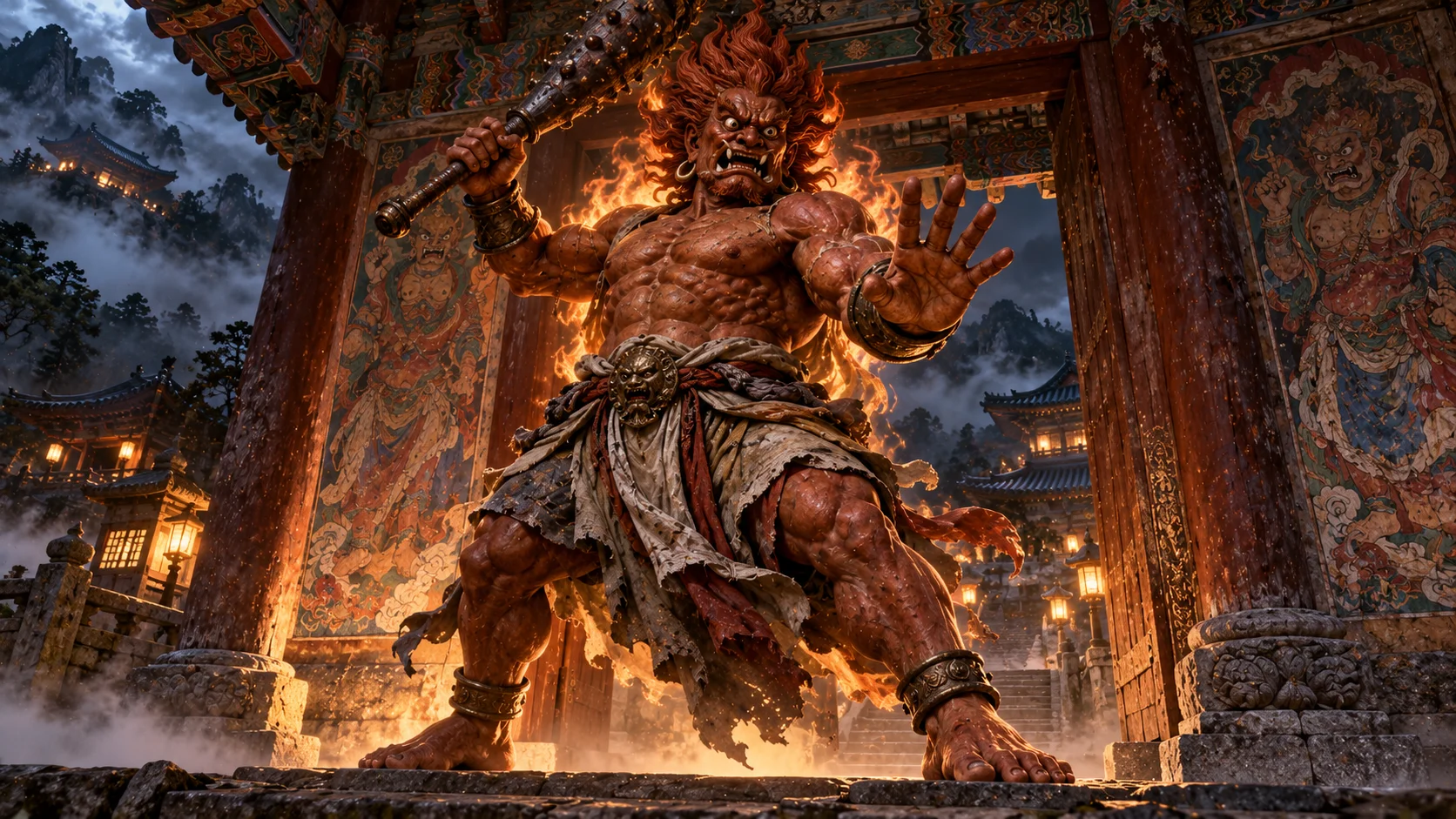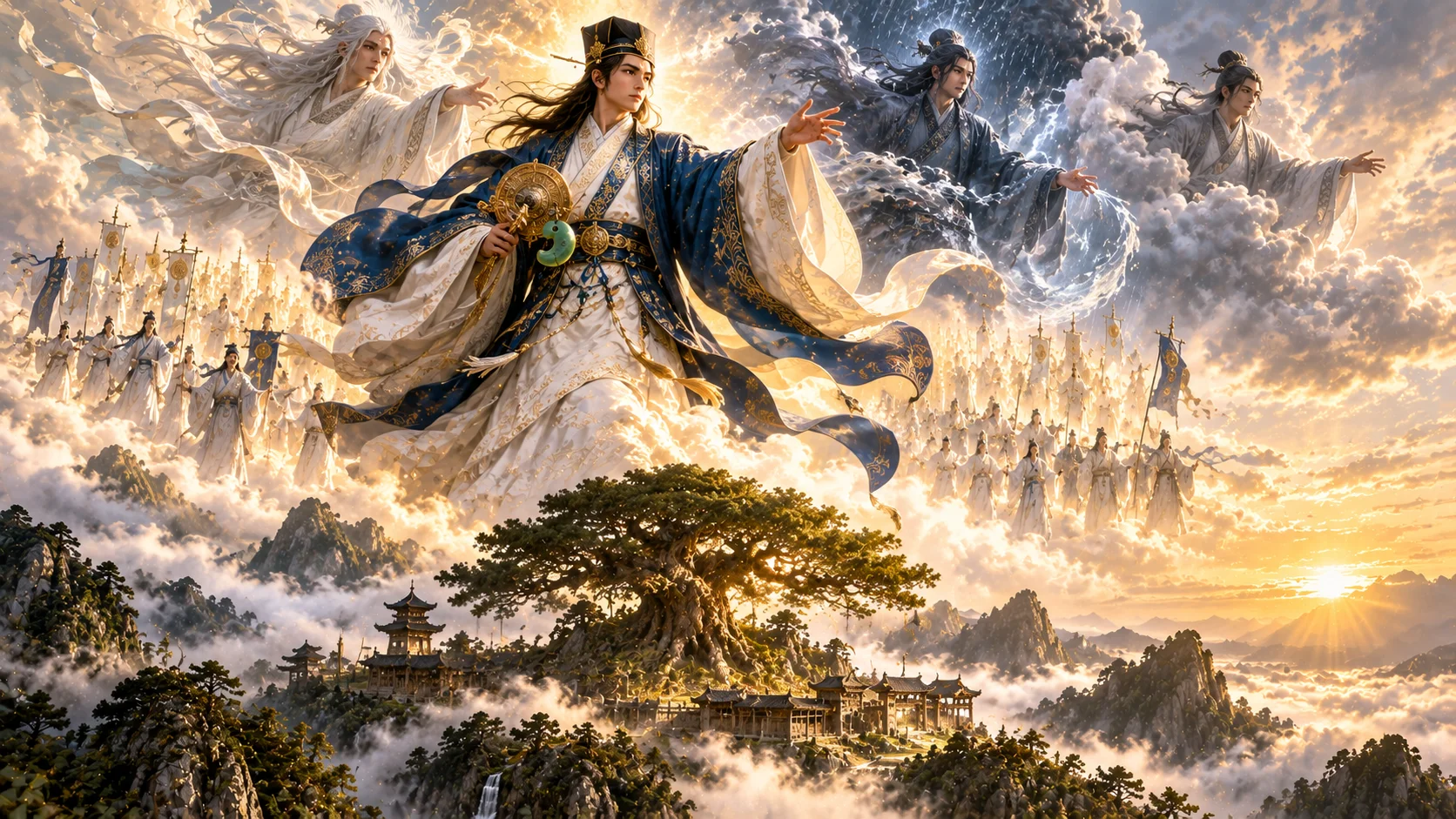
Hwanung — "Ung, Son of Heaven" — is the celestial prince of Korean mythology who left the courts of the sky to walk the earth as its first true ruler, and whose union with a transformed bear-woman gave Korea the founder-king it still honors every autumn. He belongs to that narrow class of mythic figures who are neither wholly god nor wholly ancestor, but the hinge between the two: the point where heaven's authority is deliberately, permanently handed down to the human world.
A Prince Who Kept Looking Downward
Long before there was a Korea to found, there was only Hwanin — the Lord of Heaven, ruler of the sky realm, a figure the Samguk Yusa quietly likens to the Buddhist sky-king Indra. The text tells us only that Hwanung, Hwanin's son, wished to descend and govern the human world; it says nothing of siblings, and no source in the record singles him out among other sons. What it does preserve is the wish itself, and the fact that it was voiced openly: Hwanung asked his father outright for permission to descend and govern humankind. Nothing in the myth suggests Hwanung was sent away or cast out. He petitioned. Heaven granted. It is a founding story built on consent between generations rather than rupture — a lineage that begins with a father listening to a son's desire to serve, not escape.
Three Mountains, One Chosen
Hwanin did not simply wave his son toward the earth. According to the account, he surveyed three high mountains before making his decision, weighing the whole peninsula's high places as a father might weigh three suitors before granting a blessing. The mountain he settled on was Taebaek-san — traditionally identified with Baekdu Mountain, the peak that still anchors Korean geography and imagination at the northern edge of the peninsula. (The myth does not characterize the mountain's geology; its significance here is symbolic and territorial, not volcanological.)
The choice matters because it is specific. This is not a myth that hand-waves its geography into "somewhere in the mountains." It names a real, towering, still-visible landmark and welds it permanently to the origin of a nation. To this day, Baekdu Mountain carries a symbolic charge in Korean identity — north and south alike — that traces directly back to this one sentence of celestial real-estate selection: Hwanin looked, and chose, and gave his son a mountain.
Under the Sandalwood Tree
Hwanung came down to Taebaek-san accompanied by three thousand followers — not a lone deity descending in isolation, but something closer to a court, a whole retinue of heaven relocating to earth. Beneath the mountain's crown he settled by a sacred sandalwood tree, the Sindansu, and there he founded a city he called Sinsi: the City of God, or the Divine City.
The sandalwood tree deserves its own moment of attention. In the myth it is not scenery. It is the fixed point of the entire narrative — the place where Hwanung governs from, the place where a bear-turned-woman will one day come to pray for a child, the axis where sky and soil are literally rooted together. Sacred-tree cosmology of this kind echoes across many of the world's oldest myths, but here it is doing something very local and specific: marking the exact spot where a heavenly bloodline first touched Korean ground.
Wind, Rain, and Cloud in His Court
Hwanung did not rule Sinsi alone. He governed with the aid of three named ministers — Pungbaek, the Earl of Wind; Usa, the Master of Rain; and Unsa, the Master of Clouds. Their presence in the myth is not decorative; it reflects a plainly agricultural cosmology, built by and for a people whose entire survival turned on when the wind shifted, when the rain fell, and when the clouds gathered or broke.
A heavenly government organized around wind, rain, and cloud is a government organized around the harvest. It tells us plainly what the earliest tellers of this story believed a ruler was actually for: not conquest, not spectacle, but the stewardship of the forces that decide whether a field feeds a village or fails it.
Three Hundred and Sixty Burdens
The Samguk Yusa is unusually precise about the scope of Hwanung's rule, describing him as being in charge of some three hundred and sixty areas of responsibility — among them agriculture, life itself, illness, punishment, and the perennial human struggle between good and evil. This is not a god who reigns from a distance issuing occasional judgments. This is a ruler who has taken direct, granular responsibility for the daily texture of human existence: what grows, who lives, who sickens, who is punished, who is forgiven.
The myth records the number itself — 360 — without explaining its intent, and no source here glosses it as ritual or symbolic shorthand rather than a literal count; any reading of what "360" was meant to convey would be interpretation, not established fact, so it is left unglossed. What the number does establish, plainly, is scope: Hwanung is a monarch whose stated authority reaches into every corner of mortal life.
Two Petitioners at the Cave Mouth
Into this thriving Sinsi come two animals with an identical, extraordinary wish: a bear and a tiger, both longing to become human, both bringing that longing directly to Hwanung. That the myth pairs them sets up a trial that reads as a study in temperament — endurance against impatience — and it is Hwanung himself who designs the test that will decide the outcome.
He gives the pair a bundle of mugwort and twenty cloves of garlic, and a single instruction: eat only this, and avoid the sunlight, for one hundred days. It is a spare, almost ascetic commandment — no spells, no heavenly fire, just discipline sustained in darkness. The tiger abandons the trial partway through; the bear does not. According to the received text, she achieves her transformation after twenty-one days of the ordeal, emerging not as a bear who resembles a woman but as a woman outright — thereafter known as Ungnyeo, the bear-woman. (The myth itself does not editorialize on the tiger's temperament; that the tiger "gives up" while the bear "perseveres" is the plain content of the story, not an embellishment, though any further characterization of the tiger's nature beyond that would be reading into the text.)
Scholars have long pointed to this episode as a surviving trace of an ancient bear cult, one that Korea's early peoples likely shared with wider Siberian and Tungusic circumpolar traditions in which the bear holds a singular, half-sacred status. Hwanung's role in the episode is worth naming plainly: he is not a passive witness to the bear's ordeal. He is the one who sets its terms and who alone has the power to honor its completion.
A Prayer Beneath the Same Tree
Ungnyeo's transformation did not end her story; it opened a new want. She returned to pray beneath the same sacred sandalwood tree where Hwanung had first made his home, and what she prayed for was startlingly human: a child.
The myth says Hwanung was moved by her wish. He temporarily transformed himself and took her as his wife, and their union produced a son whose name would eventually eclipse his father's in the memory of a nation: Dangun Wanggeom. It is worth pausing on the symmetry here — the tree that anchored Hwanung's arrival from heaven is the same tree that receives Ungnyeo's prayer from earth, and it is at that single point that the divine and the human genuinely, physically meet.
The Genealogy a Nation Built Itself On
What emerges from Hwanung's story, once Dangun is born, is a complete chain: heaven in Hwanin, nature and earth in the bear-woman Ungnyeo, and humanity itself in their son. Scholars studying Korean identity formation have described this three-link structure as close to load-bearing for the culture's sense of itself — a founding myth in which no single realm claims sole credit for the nation's birth.
That structure took on new political weight during the Japanese colonial period from 1910 to 1945, when veneration of Dangun — and by extension the whole lineage running back through Hwanung to Hwanin — was consciously promoted as a form of anti-colonial nationalism. Dangun himself is said to have ruled the resulting kingdom, Gojoseon, for 1,500 years before retiring to become a mountain god, or sanshin, at Mount Asadal — a coda to the founding line that closes the story Hwanung's descent had opened.
One Line Splits in Two Directions
Not every early text agrees on exactly how Hwanung fits into the family tree that follows him. The Samguk Yusa presents him simply as Hwanin's son and Dangun's father — a clean, single-generation bridge. But the later Jewang Ungi, compiled in 1287 by Yi Seung-hyu, offers a variant genealogy in which Dangun is instead described as Hwanin's grandson, subtly repositioning Hwanung's place in the chain.
Rather than a contradiction to be resolved, this divergence is itself a piece of history: it shows that Korea's foundation myth was never a single frozen text handed down unchanged, but a living tradition retold and reframed by different compilers across different centuries.
The Records That Carried Him Forward
Hwanung survives at all only because Iryeon, a Goryeo-era Buddhist monk, chose to preserve the story in his Samguk Yusa of 1281, and he did so by explicitly quoting still older sources — the now-lost Wei Shu and a text called the Gogi, the Old Record — rather than inventing the tale himself. Later, the Dongguk Tonggam of 1485 would fix the traditional founding date of Gojoseon at 2333 BCE, cementing Hwanung's grandson's reign as the formal starting point of Korean historical memory.
This layered transmission — lost originals, quoted fragments, monastic compilation, later dynastic chronicling — is itself part of the myth's meaning. Hwanung's story reached the present only because successive generations judged it worth the effort of copying forward.
A Reverence That Never Really Stopped
The line Hwanung set in motion did not remain confined to old manuscripts. Dangun worship persists today through Daejongism, a religion formally organized in 1909 that venerates Dangun — and through him, the whole heavenly lineage beginning with Hwanin and Hwanung — as a divine ancestor of the Korean people. And every third of October, South Korea observes National Foundation Day, Gaecheonjeol, a national holiday commemorating the founding of Gojoseon.
It is a rare thing for a mythic figure from a text this old to still have a date on the modern calendar named in his family's honor. Hwanung is not a story Korea outgrew; he is a story Korea still marks time by.
The Shape of a Founding
Strip away the specific names and Hwanung's arc is unusually legible: a son who asks rather than seizes, a father who deliberates before granting, a government built around the literal weather that feeds a people, a trial offered to whichever petitioner has the patience to complete it, and a marriage that turns divine longing into a mortal child. Nothing in the myth insists on conquest or violence to explain how a nation began. It presents instead consent, endurance, and a willingness — on heaven's part — to be moved by an earthbound prayer.
That may be the most durable thing Hwanung left behind, more durable even than Baekdu Mountain or the sandalwood tree at Sinsi: the idea, still carried into a modern national holiday, that Korea's first authority to govern itself was not taken. It was asked for, granted, and earned.
Sources & traditions
- EncyclopediaWikipedia — Hwanung
- TraditionKorean texts, oral tradition and village tellings
Myths change from area to area and from time to time. This chronicle follows the most widely told versions; tellings in other villages, regions and eras may differ.