Long before the carved guardians took their places at Korean temple gates, the wilderness already had its watchers — spirits neither wholly benevolent nor wholly cruel, dwelling in old trees, lonely passes, and the dark beneath eaves. The Yacha (야차) is the Korean rendering of the Sanskrit yaksha, a class of nature-spirit and demigod absorbed into the Buddhist cosmology that crossed into the Korean peninsula alongside sutras and stupas. To call a yacha simply a "demon" or simply a "guardian" is to miss what makes it interesting: it is both, depending on which side of it faces you, and depending on how old the story being told about it actually is.
A Spirit Older Than the Temple That Housed It
Before Buddhism gave the yacha a uniform and a post at the temple gate, the yaksha tradition it descended from belonged to wilder, older ground — tree-spirits and mountain-haunters whose loyalties were their own. Korean Buddhism did not erase this origin so much as recruit it. The yacha entered the peninsula's religious imagination already carrying two natures sewn together: the raw, unpredictable spirit of the wild, and the disciplined guardian bound by dharma to a fixed post. Korean temple art keeps both readings alive. In the oldest layers of belief, an un-converted yacha could still behave as its yaksha ancestors always had — frightening, and sometimes devouring, travelers who wandered into its territory without leave. In the converted, institutional form that later dominated temple iconography, that same aggression was re-pointed outward, at the enemies of the dharma rather than at ordinary people.
Muscle at the Northern Gate
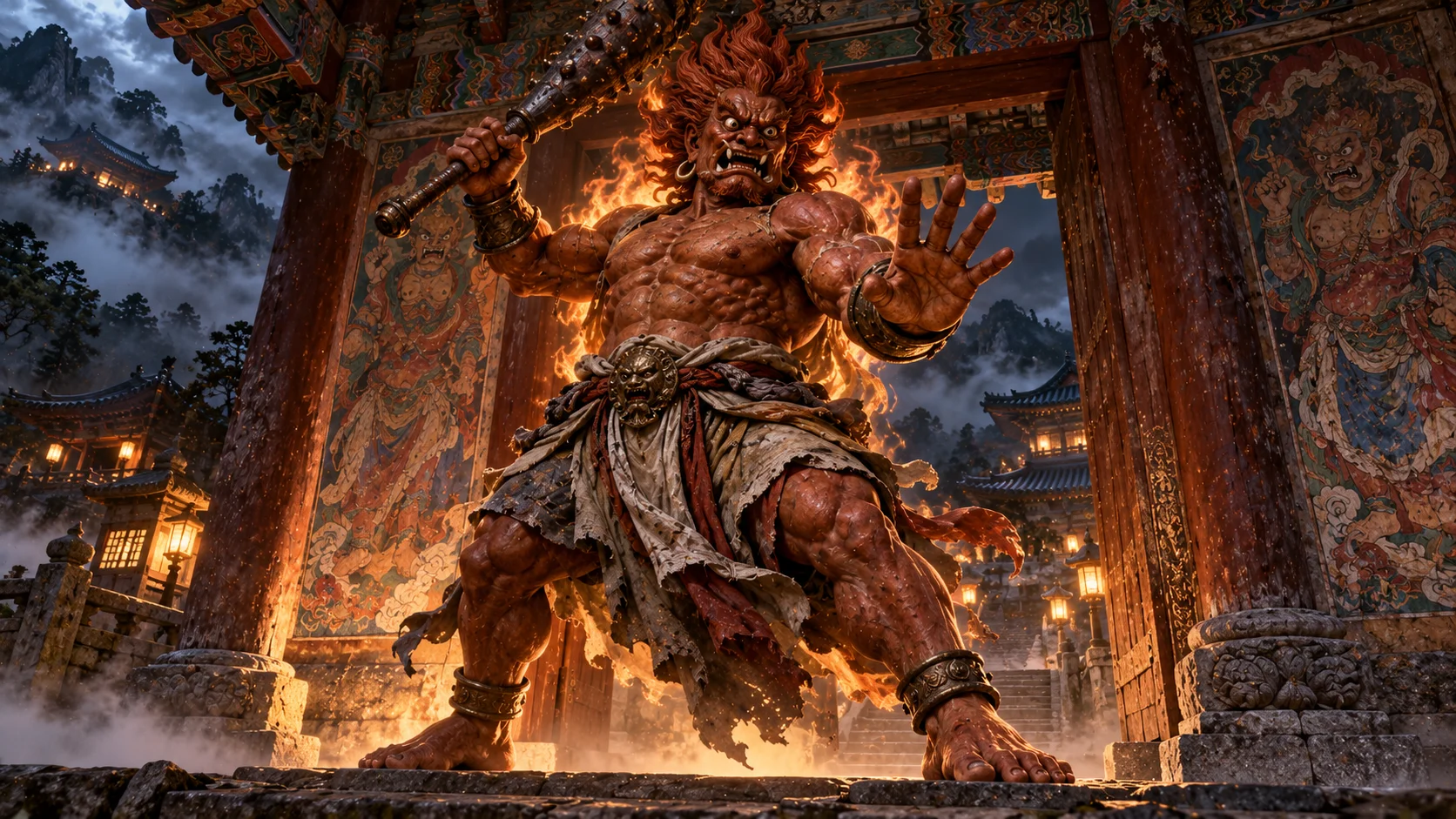
Walk into almost any working Korean Buddhist temple and the yacha's descendants are already watching you from the gate. They serve among the retinues of the palbujung, the eight classes of protective deities charged with guarding Buddhist law, and within that arrangement yacha are most often placed under the command of Damun Cheonwang — Vaisravana, guardian of the north, one of the Four Heavenly Kings (Sacheonwang) who stand sentinel over the cardinal directions. Sculptors and painters gave the yacha bodies to match the job: thick-muscled, wild-haired, faces locked in a snarl meant to be the last thing a hostile spirit ever sees. This is not decoration. In a tradition where the temple compound is treated as sacred ground requiring active defense, the yacha's fearsomeness is the point — a demon's face put to a guardian's purpose.
The Ambivalence Buddhism Never Fully Tamed
What keeps the yacha compelling, rather than simply decorative, is that Korean tradition never pretended the conversion was total. Even within a cosmology that formally enlists yacha as dharma-protectors, the older, untamed character shows through in how people spoke of them — nature spirits whose good behavior was a matter of correct ritual standing, not settled temperament. A yacha under the discipline of the Heavenly Kings was safe to live near a temple with. A yacha still answering to its pre-Buddhist instincts was not something you wanted to meet on a dark mountain road. This ambivalence is not a contradiction the tradition failed to resolve — it is the tradition's actual shape, the same way many nature-spirit classes across Buddhist Asia carry both a protective institutional role and an older, wilder reputation underneath it.
Guardians Who Keep Company
The yacha did not stand watch alone in the Korean supernatural imagination. Korean folk religion is dense with figures whose entire purpose is protection against exactly the kind of restless, invisible threat a converted yacha is meant to repel — a household, a village, a traveler, all needed watching over, and each got its own guardian suited to the job. Among the household gods, or gasin, that structure Korean domestic belief, this specialization runs deep: Seongju presides over the roof beam, Jowangshin over the hearth, Samshin over birth, and a wealth-spirit answers for the storeroom. It is a whole architecture of protection, domain by domain, not unlike the way the yacha's own watch was assigned to a single direction under a single Heavenly King.
The Dog With the Extra Leg
If the yacha's protective instinct found a four-legged cousin in Korean village belief, it would be the Samjokgu, the three-legged dog kept in shamanic and village-guardian tales precisely because its unnatural extra deformity was believed to grant it supernatural sight. An ordinary dog sees an ordinary road. A samjokgu, according to these tales, sees the ghosts (gwisin) and tokkaebi walking that same road invisibly — and being able to see them was understood as the first step toward driving them off. Households and shamans who kept such a dog were said to value it for exactly this reason: its very deformity was its qualification, a mark of otherness turned into a gift for detecting the kind of restless spirit that a converted yacha, in its own more formal capacity, was likewise charged with keeping at bay.
A Contest That Ended the Golden Age
Korean shamanic myth offers its own account of how the world came to need guardians against suffering and wrongdoing at all, and it does not begin with demons — it begins with a broken promise between two creator gods. In the Cheonji-wang bonpuri tradition, recited above all in the Jeju Island Changsega cycle, the world's first ruler was Mireuk, the Korean name for Maitreya, the future Lord Buddha of Buddhist eschatology who is prophesied to descend to earth long after Lord Gautama Buddha's teachings have faded, to save all beings. Under Mireuk's original rule, the myth insists, humanity did not need to labor: food was eaten raw and eaten happily, and the human world knew no death, no theft, and no adultery. It was, in the fullest sense the tradition allows, a golden age.
That age ended in a contest. Mireuk's rival, Seokga — Shakyamuni, the historical Lord Buddha recast here as a twin and competitor rather than a successor — challenged him for rule of the newly made human world, and won not through virtue but through trickery, in a flower-growing contest remembered in some tellings as a test performed while both gods slept. Mireuk's departure and defeat are held responsible, in the myth's own logic, for everything that followed: suffering entered the world, along with crime and moral corruption, in the very same moment authority passed from the god who had ruled without needing to compete to the god who had won by cheating. It is worth sitting with the fact that a mythology capable of imagining guardian spirits as fierce as the yacha also imagines its own creator gods as fallible, competitive, and capable of losing something irreplaceable through a rigged contest.
Trials, Not Combat
The Mireuk-Seokga contest belongs to a wider pattern in Jeju's bon-puri epic tradition, in which divine authority over a domain of human life is not simply inherited but won through a trial — and the tradition's other great trial myth replaces a rigged contest with a set of trials borne, rather than gamed. Jacheongbi, heroine of the Segyeong Bonpuri cycle, disguises herself as a man to study at a Confucian school beside Mun Doryeong, the son of a heavenly family, and falls in love with him there. What follows her is not a single contest but a sequence of trials — servitude, deception, even death, from which she is restored using flowers of resurrection — undertaken to prove a worth that the myth never simply grants her. Where Mireuk loses his world through someone else's trick, Jacheongbi earns hers through trials she survives herself, and the heavens reward her for it: she receives the seeds of the five grains and descends to earth on the fifteenth day of the seventh lunar month, Baekjung, to become the goddess who oversees agriculture and grain cultivation. Hereditary shamans, the simbang of Jeju Island, still recite her myth-cycle during gut rituals tied to farming — a living tradition, not an archived one, and one deserving exactly the same respect owed to the yacha's own place in temple practice.
The Guardian Beneath the House
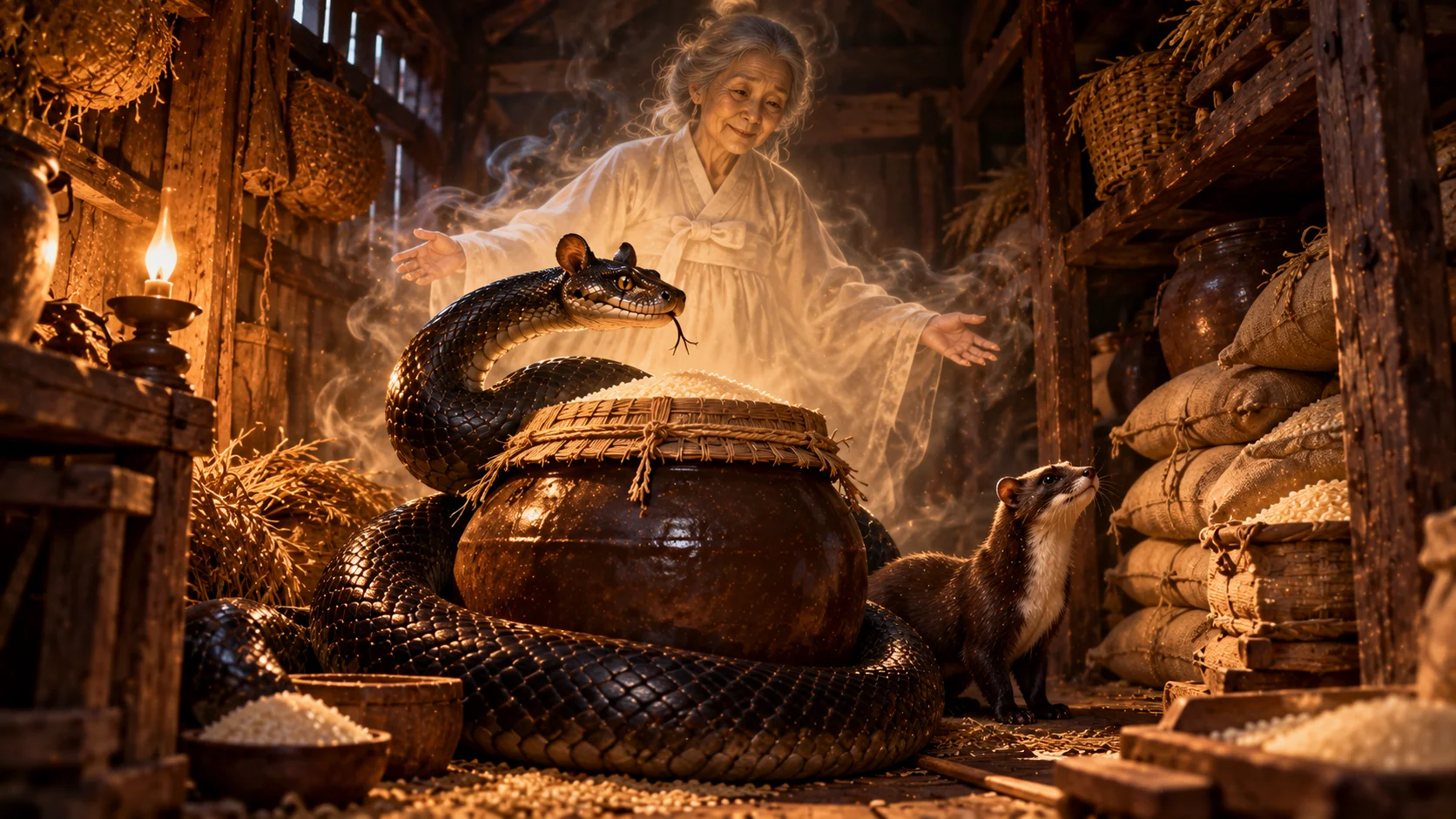
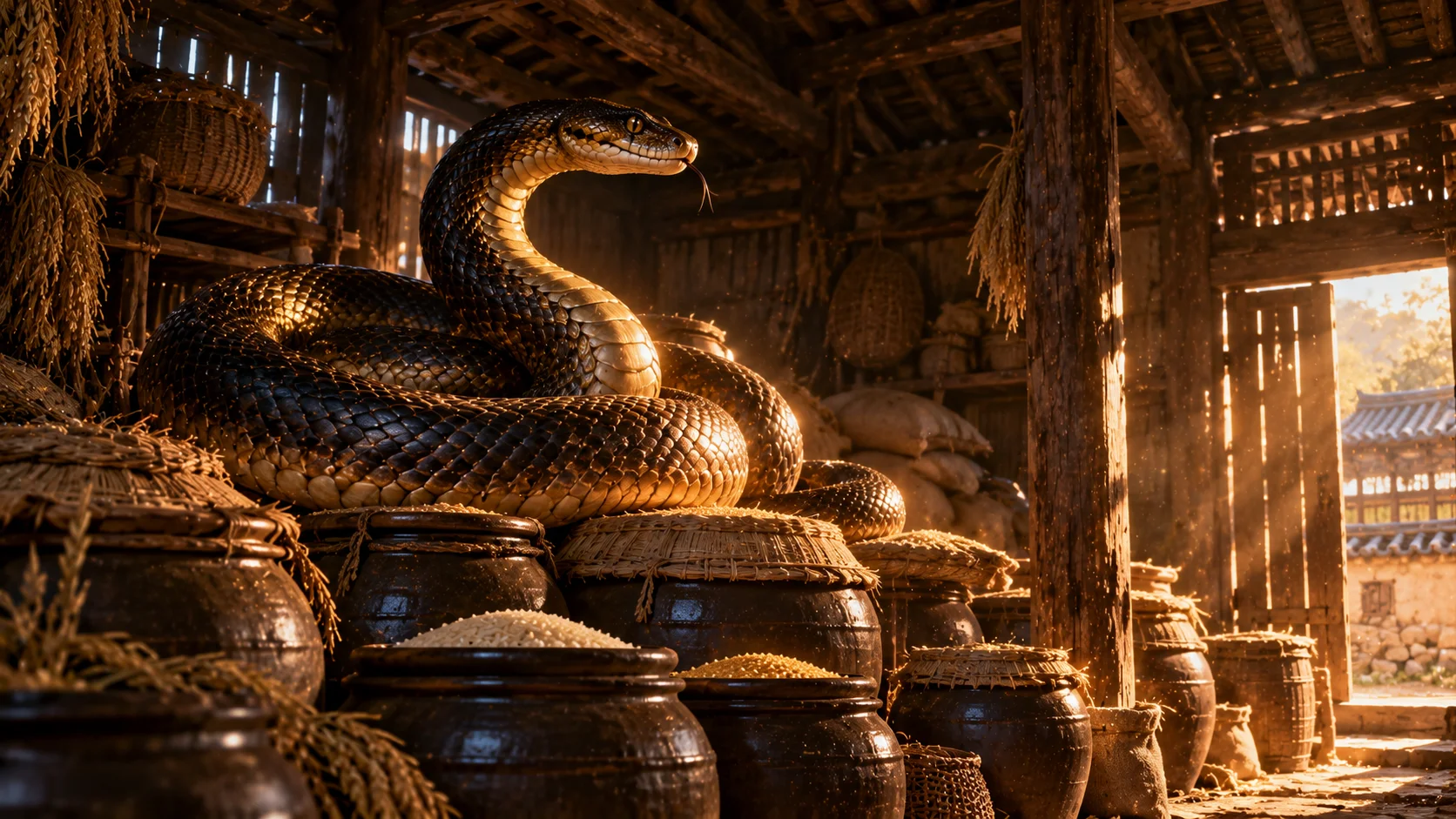
Where the yacha's watch is public — carved at a gate, facing outward against intruding spirits — Korean household belief keeps a guardian whose watch is private and largely unseen. Eobshin, sometimes honored under the title Eopwang, is believed to reside in a home as the spirit responsible for bringing and maintaining its wealth. Within the structured pantheon of gasin household gods, Eobshin's domain is the storeroom, the gwangju, and folk belief often gives it a physical form — a snake, a weasel, a toad — living quietly beneath the house or among the stores. Nothing about Eobshin is fearsome the way a yacha carved at a temple gate is fearsome; its power runs the other direction, toward the domestic and the provisional, and its departure from a home was said to be the surest sign that ruin was coming. It stands as a reminder that not every guardian spirit in Korean tradition wears a warrior's face — some keep watch by simply staying, and are feared to leave.
A Horse No One Was Fit to Ride
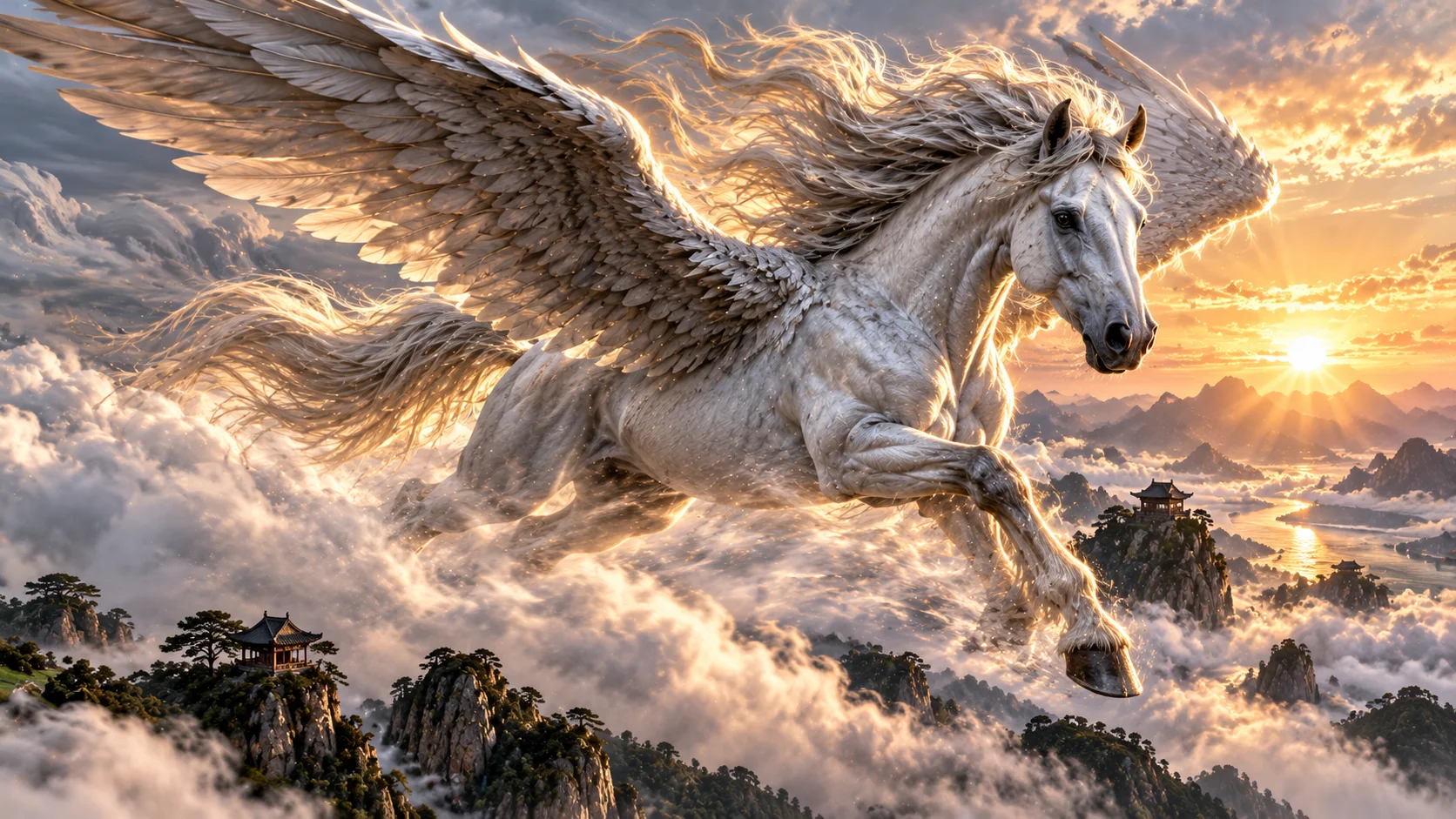
Korean legend keeps at least one guardian-adjacent figure whose power lay not in ferocity but in sheer unattainability. The Chollima, the "thousand-li horse," was a mythical winged steed of East Asian legend — adopted from Chinese tradition into Korean lore — said to be swift enough to cover a thousand li, roughly four hundred kilometers, in a single day. Korean tradition held that no ordinary rider was worthy or capable of mounting and controlling such a horse; it was less a mount than a standard, an ideal that measured how far short ordinary ambition fell. In the twentieth century the image was put to entirely new work: North Korea's Chollima Movement, launched in the late 1950s, seized on the winged horse as a propaganda symbol for rapid economic development, and in 1961 a statue of a worker and farmer riding the Chollima was raised in Pyongyang. It is a striking afterlife for a creature that began, like the yacha, as something the ordinary world was never quite equipped to master.
What the Yacha's Snarl Actually Protects
Return, in the end, to the temple gate. The yacha carved there — muscled, snarling, standing in the retinue of Damun Cheonwang against the northern approach — is not merely frightening for its own sake. It is doing the same work the samjokgu does with its extra leg, the same work Eobshin does by simply staying put beneath a house: holding a boundary against something that would otherwise cross it unseen. What distinguishes the yacha is the memory it still carries of standing on the other side of that boundary — a wilderness spirit whose ferocity Buddhism did not invent but redirected, the way Mireuk's golden age was not erased from the myth but preserved as the very thing lost. Korean religious imagination rarely asks its guardians to be gentle. It asks them to be exactly as fierce as what they are meant to keep out, and to remember, if only faintly, what it once meant to be on the other side.
Sources & traditions
- TraditionKorean texts, oral tradition and village tellings
Myths change from area to area and from time to time. This chronicle follows the most widely told versions; tellings in other villages, regions and eras may differ.