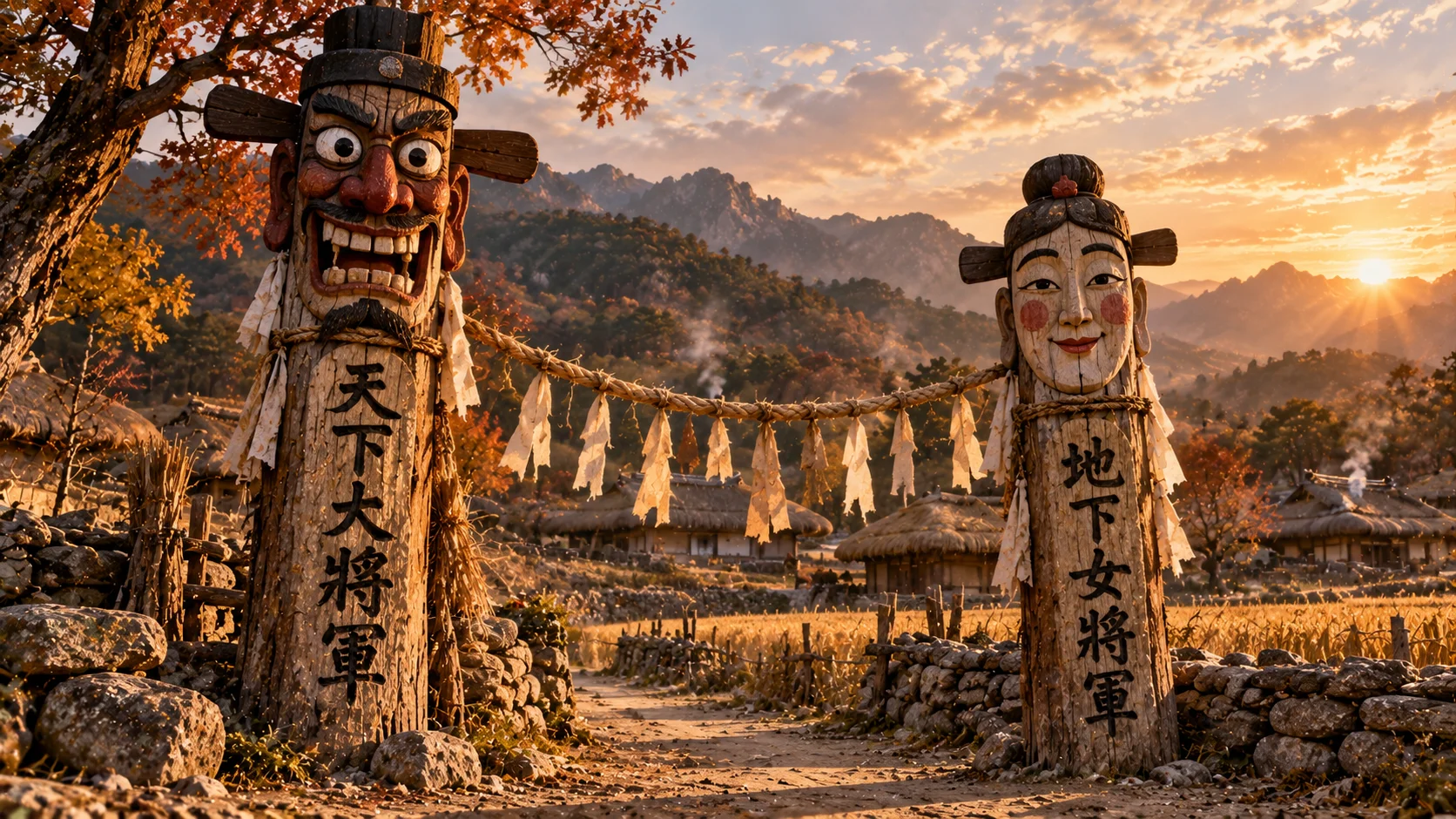
The Jangseung are the totem-poles of Korea: tall wooden or stone guardian posts, carved with fierce and often comically exaggerated faces, planted at the entrances to villages, along mountain roads, and at temple gates across the peninsula. They belong to that layer of Korean folk religion where a boundary is never just a line on the ground — it is a threshold that something must be posted to defend.
Faces Carved to Frighten
A jangseung's power lives entirely in its face. The carvers who made them reached for exaggeration rather than realism: eyes bulge out of the wood in great round protrusions, eyebrows arch upward in permanent alarm, and mouths split open in wide, tooth-baring grins that read as much like a snarl as a smile. Ears sometimes flare outward like wings. Noses jut forward, blunt and oversized. None of this was meant to be beautiful in a refined sense — it was meant to work, the way a scarecrow works, by being more unsettling to the thing it repels than to the people it protects.
That thing was disease, misfortune, and the wandering malevolent spirits collectively feared in the countryside — the same restless, ungoverned presences that show up elsewhere in Korean belief as gwishin, spirits of the dead who linger because their grievances were never resolved. A jangseung's grimace was a standing warning sign aimed at exactly that population: turn back, this ground is guarded.
A General Above, a General Below
Jangseung traditionally stand in pairs, and the pairing is gendered and titled like a small bureaucracy of protection. The male figure is inscribed as Cheonha Daejanggun, "Great General Beneath Heaven," and the female figure as Jiha Yeojanggun, "Female General Beneath the Earth." Villagers historically knew which post was which by its inscription and title even where paint had worn away and carved lettering had blurred — the two posts named and jurisdictioned, one over heaven's portion of the boundary, one over earth's.
The pairing matters. This is not a lone sentinel but a jurisdiction split between heaven and earth, matching a broader instinct in Korean folk cosmology to divide protective authority into complementary halves rather than concentrate it in one figure. It is the same instinct that gives a household its own division of labor among guardian spirits, or gives a mountain both a face and a beast to embody it.
Kin to the Household and Mountain Guardians
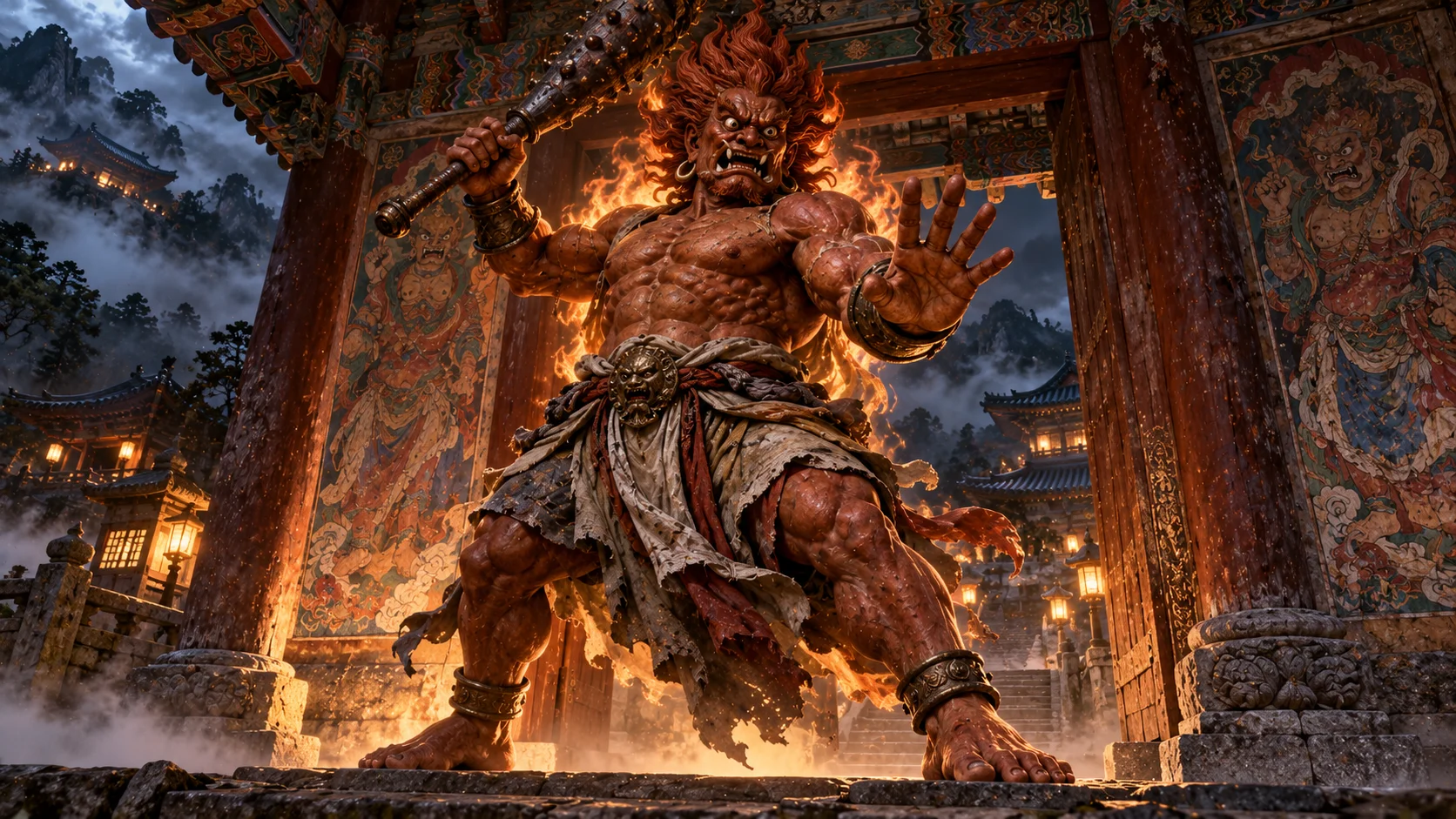
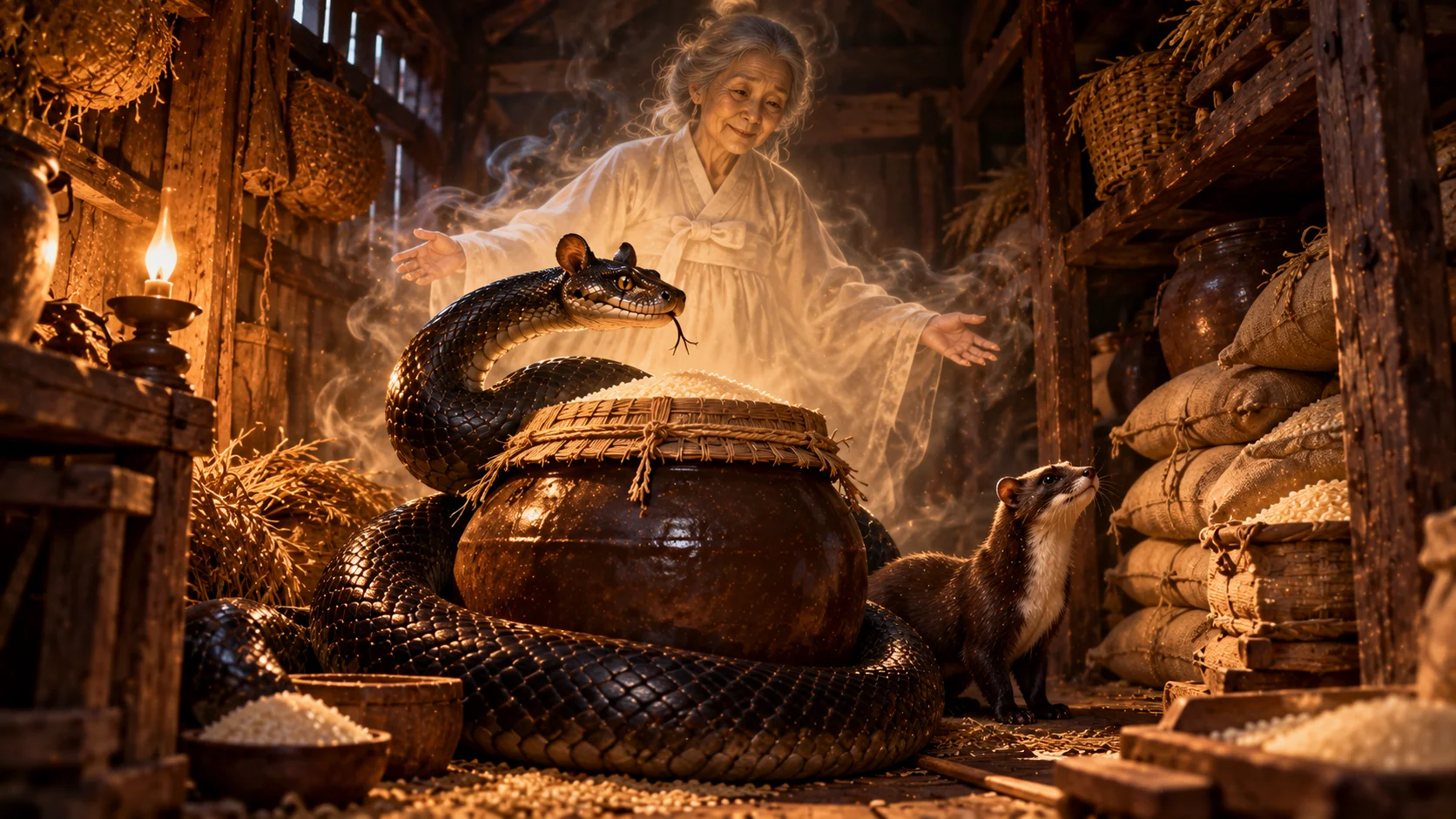
The jangseung did not stand alone in the world of Korean folk protection. Inside the home, Jowangsin kept watch over the hearth from a bowl of clean water, jeongan-su, renewed daily on the kitchen stove as an offering and act of prayer — and once a year reported the family's conduct and household affairs to the Heavenly Jade Emperor, Okhwangsangje, a yearly accounting that shapes the family's fortune for the year ahead and parallels the Chinese Kitchen God Zao Jun tradition. On the mountainside, Sansin, the bearded mountain spirit usually shown beside a tiger, held dominion over the wilderness beyond the fields; Sansin worship traces back to ancient Korean mountain-worship traditions and is linked to the founding myth of Dangun, Korea's legendary progenitor, who is sometimes said to have become a mountain spirit himself after his reign ended. At the village edge itself, Seonangsin presided over stone cairns and sacred trees where travelers left a stone or a strip of cloth in exchange for safe passage.
The jangseung occupies a place adjacent to all of these — not inside the house, not deep in the mountains, but exactly at the seam where a settlement declares itself to the outside world. Korean folk religion parceled out protective duty by location with remarkable consistency: hearth, mountain, crossroads, and village gate each got their own resident authority, and none of them were interchangeable. A traveler passing a Seonangdang shrine and a village's paired jangseung within the same afternoon was moving through two different protective jurisdictions, not one continuous ward.
Markers of Distance as Well as Danger
Jangseung carried a second, more practical duty that had nothing to do with spirits at all. Many posts, known in this function as era stones or ihyu, were inscribed with the distance to the next town or the name of the settlement ahead, making them de facto milestones along Korea's road network. A traveler reading the carved characters at the base of a jangseung learned two things in one glance: how far to walk, and that the ground beneath their feet was watched.
This dual identity — supernatural sentinel and civil signpost — is not a contradiction so much as a habit of premodern life, where the sacred and the administrative were rarely filed into separate categories. A boundary worth marking for pedestrians was, by the same logic, worth marking for spirits.
Raised Anew at the Village Rite
Jangseung were not carved once and forgotten. Wood rots, paint fades, and a guardian with a crumbling face was widely felt to have weakened along with its wood. Villages renewed or replaced their posts periodically, and the act of raising a new jangseung was folded into dangsanje, the village's communal shaman rite, rather than treated as ordinary carpentry.
At these rites, offerings were made as the new post went into the ground, asking the renewed guardian to take up its post for the community's protection and for a good harvest in the season ahead. The ritual timing bound the object to the community's yearly rhythm: a jangseung was never simply infrastructure, it was a periodically re-consecrated member of the village's defenses, its raising tied to the same communal calendar that governed the village's other shaman rites.
Grievance the Posts Could Not Reach
For all its ferocity, a jangseung's protection was general and preventive — a gate against what might come, not a remedy for harm already done. Korean tradition kept a separate mechanism for spirits already caught in unresolved suffering, most vividly embodied in the figure of the cheonyeo-gwishin, the vengeful spirit of an unmarried woman, traditionally pictured in a white hanbok with long black hair loose across her face. Confucian-era custom held that an unmarried woman could not be honored with proper ancestral rites, leaving such a spirit with nowhere to be received and no ritual channel for her grievance, or han, to be laid to rest.
Where a jangseung stood as a fixed deterrent at the boundary, a spirit already bound by grievance needed something more targeted: a gut, the ritual ceremony performed by a mudang, a shaman who could address the root of the resentment directly and help the spirit move on. The posts guarded the gate; they could not perform the individualized work of releasing a soul already caught. The two forms of protection — the standing ward and the responsive rite — operated on different registers of the same fear, one general and architectural, the other personal and diagnostic.
Judgment Waiting at the Furthest Boundary
If the jangseung marked the nearest boundary a Korean villager might cross, the furthest one belonged to Yeomra, the Korean adaptation of the Buddhist king of hell, who presides as the most powerful of the Ten Kings, or Siwang, over the judgment of the dead. Where a jangseung's authority was preventive and communal, Yeomra's was final and individual: every soul that passed his throne, flanked by scribes recording deeds in the Ledger of Life and Death, faced a reckoning no carved post could intervene in.
Korean tradition also gave this furthest boundary its own folk narrative of a human crossing it and returning, in the tale of Gangnim's Journey to the Underworld, the Chaesa Bonpuri myth preserved on Jeju Island. Gangnim, a clever mortal magistrate, is sent to summon Yeomra to the world of the living and ultimately becomes a death messenger, a jeoseung saja, himself — a human absorbed permanently into the machinery of the boundary he once merely crossed. Between the jangseung at the village gate and Yeomra's throne in the underworld lies the full span of Korean folk cosmology's concern with thresholds: the near one guarded against wandering harm, the far one adjudicated the soul's final account.
Order Since the World's First Division
Korean myth traces the very existence of boundary and disorder back further still, to the Jeju creation narrative Cheonji-wang Bonpuri, recited by shamans, or simbang, during the island's Keun-gut, the Big Shaman Ritual. In it, Cheonji-wang, the Heavenly King of Heaven and Earth, separates the two realms and fathers twin sons, Daebyeol-wang and Sobyeol-wang, who compete in a flower-growing contest to decide who will govern the living and who the dead. The elder twin, Daebyeol-wang, wins by cheating — and Korean tradition explains the persistent injustice and disorder of the human world as the lasting consequence of that single act of deception at the beginning of things.
A jangseung standing at a village gate is a small, local answer to that much older cosmic problem. If the world's basic order was compromised from its very founding, then every boundary a community can actually watch — a gate, a threshold, a road's edge — becomes worth fortifying by hand, since the larger order was never guaranteed to hold on its own.
Syncretism Written on the Roadside
The jangseung's world is unmistakably a shamanic one, rooted in the same animistic worldview, muism, that gives resident spirits to hearths, mountains, and crossroads alike. But it developed alongside Buddhism rather than in isolation from it — the same way Sansin acquired his own shrine, a Sanshingak, inside the grounds of Buddhist temples, and the same way the Indian god Yama traveled into Korea as Yeomra through Chinese Buddhist translation, arriving fully dressed in the bureaucratic robes of the Ten Kings. A grimacing wooden post at a country crossroads and a solemn judge presiding over a ledger of souls look like they belong to different religious worlds. In Korea's folk pantheon they belong to the same continuous one, in which foreign doctrine and indigenous spirit-guardianship were never required to cancel each other out.
What the Wood Still Carries
Jangseung are not solely artifacts of the past. Renewed poles still stand at the entrances to some Korean villages and temple approaches, carrying forward a tradition of communal protection that predates any single religious framework layered on top of it. To read a jangseung only as folk art — a striking carved face and nothing more — is to miss what it was built to do: stand at the exact point where a community ends and the unguarded world begins, and hold that line with nothing but an expression fierce enough to mean it.
Sources & traditions
- EncyclopediaWikipedia — Jangseung
- TraditionKorean texts, oral tradition and village tellings
Myths change from area to area and from time to time. This chronicle follows the most widely told versions; tellings in other villages, regions and eras may differ.