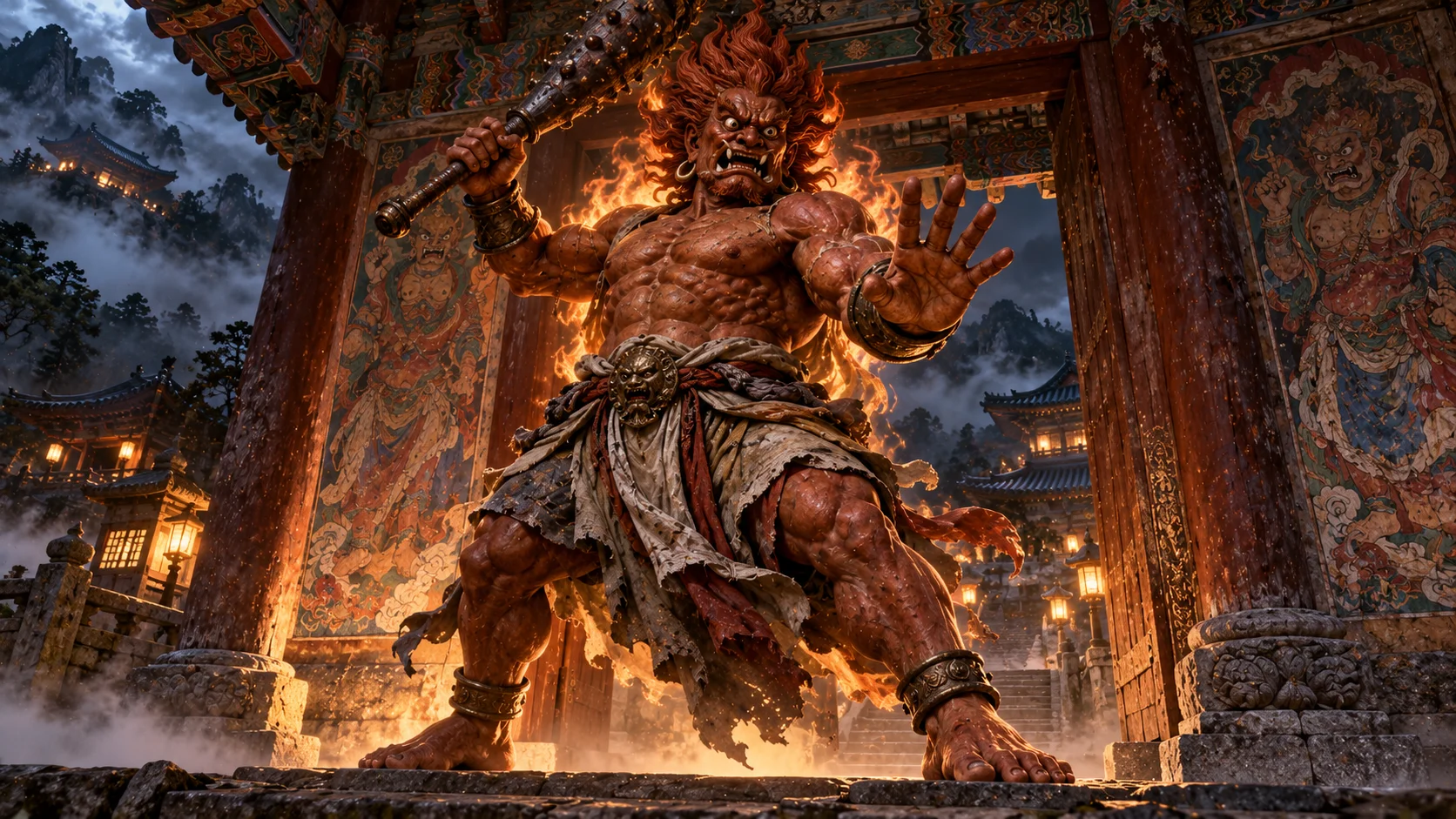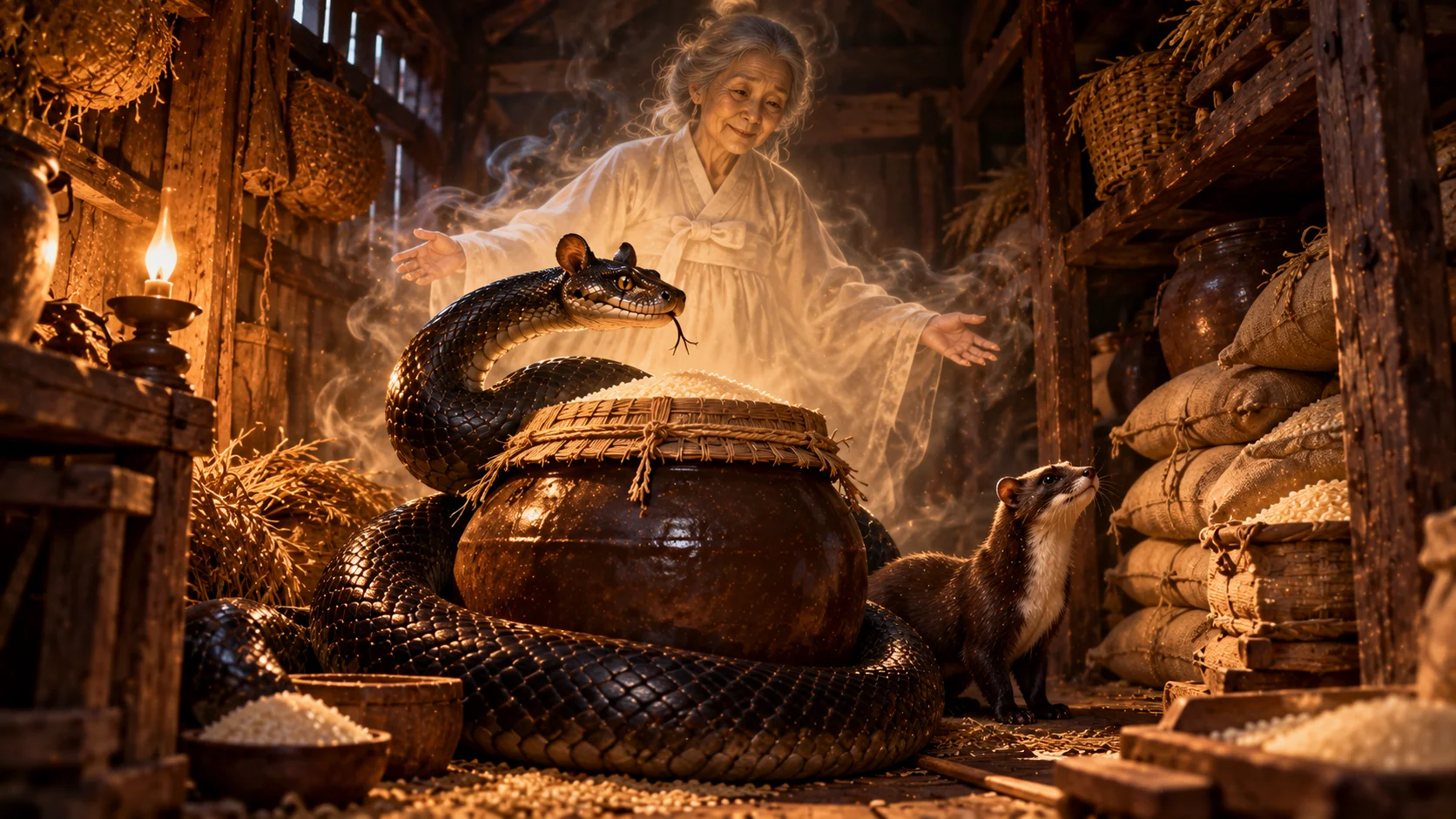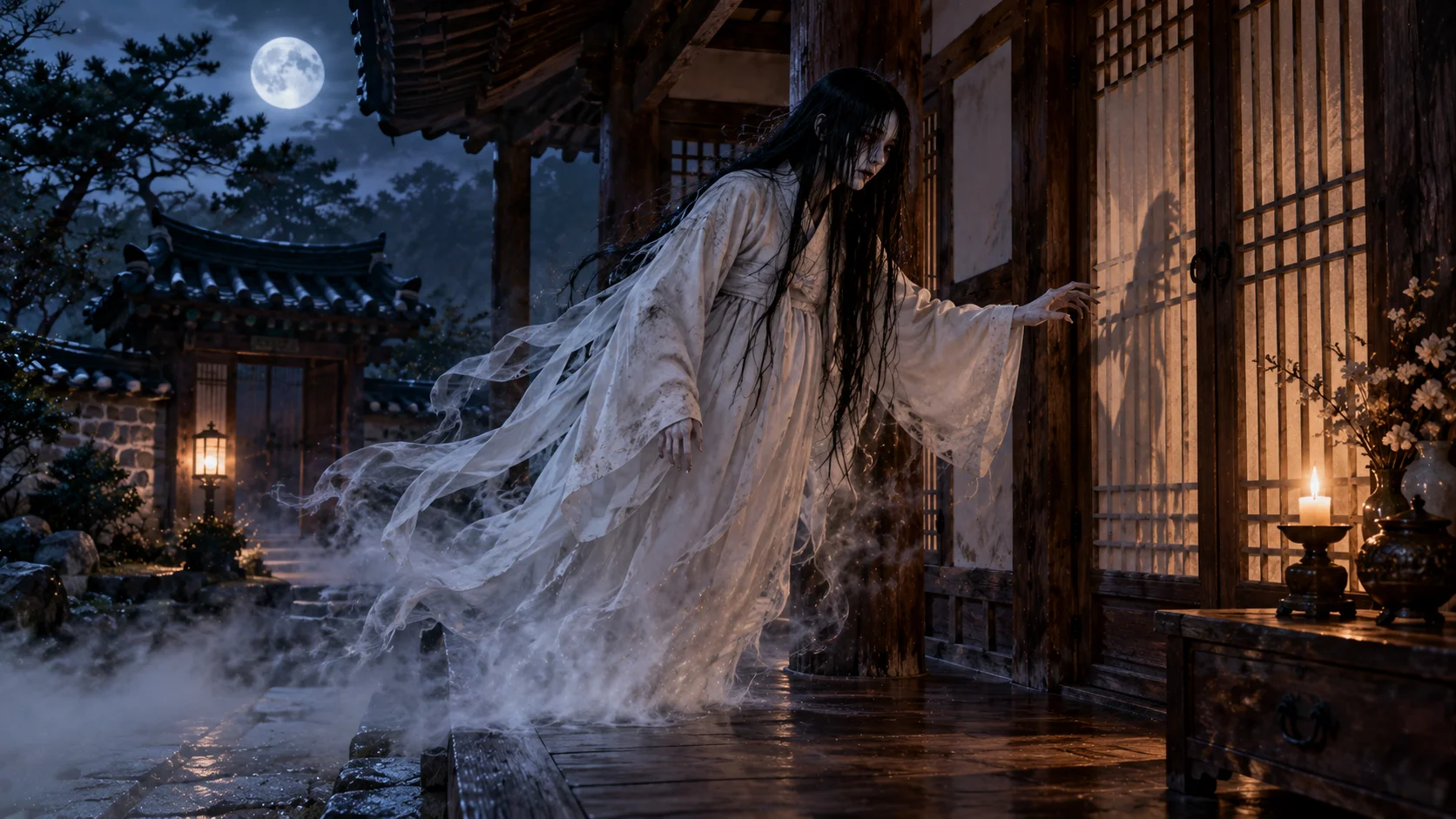
The Gwishin (귀신) is the ghost of Korean tradition — not a single monster but a whole category of the restless dead, spirits of people who left the world of the living without the peace that a proper death and proper mourning are supposed to secure. Where an ancestor honored with jesa memorial rites settles into the household's spiritual order and becomes a source of blessing, a gwishin is what happens when that order breaks: a soul stranded between the human world and whatever lies beyond it, unable to move on because something was left unfinished.
The Living Soul and the Wandering Dead
Korean folk cosmology draws a careful line between the soul of a living person, called honk, and a gwishin, which only comes into being after death. Not every death produces a gwishin. A person who dies old, married, surrounded by family, and sent off with the correct funerary and memorial rites becomes an ancestor — cared for, fed at the household altar, consulted in memory, folded into the family's ongoing life. A gwishin is what remains when that transition fails: the spirit of someone who died badly, and who therefore cannot complete the passage that a good death allows. Korean tradition broadly divides the dead into these two camps — ancestral spirits properly cared for through jesa, and wandering, vengeful, or restless spirits who are not.
Han: The Grief That Will Not Dissolve
At the center of the gwishin belief is the Korean concept of han — a deep, compounded grief and sense of injustice that can outlast the body itself. A death is considered "bad" when it leaves han unresolved: dying young, dying unmarried, dying with a wrong unavenged, dying without the family present to perform the necessary rites. The han does not simply disappear when the heart stops. In traditional belief it binds the spirit to the place, the memory, or the person connected to its grievance, holding the gwishin in the world of the living long after its body has gone, trapped between the world of the living and the afterlife until that grievance is addressed.
A Spirit Between Two Worlds
Because a gwishin has not been released, it exists in a liminal condition — neither properly dead nor in any sense alive. Folk narrative describes such spirits as lingering near the site of their death, haunting a family member, or simply wandering, unable to find rest so long as the han that binds them remains unresolved. This liminality is why gwishin are treated as fundamentally different from other spirits in the Korean pantheon, such as the mountain guardian Sansin or the hearth goddess Jowangsin, both of whom occupy settled, honored places in the cosmic order. Sansin, worshipped as the guardian spirit of individual mountains and linked in later legend to the founding king Dangun, has a permanent home in shrines that sit on the grounds of most traditional Buddhist temples. Jowangsin, the hearth goddess, is honored daily with a bowl of fresh water placed above the stove and is ranked among the most important of the household gods, alongside Seongju and Teoju. Both deities are fixed points in the domestic and natural order — settled, named, and cared for. The gwishin, by contrast, occupies no place at all — that absence of a proper home is precisely its condition and its danger.
The White Hanbok and the Yin of the Dead
Korean cosmology classifies the dead as pure eum (yin), the opposite pole from the yang of the living, and the imagery long attached to gwishin follows that classification: cold air, silence, pale or absent color, and the white burial hanbok known as sobok, the traditional dress in which the dead were laid out. Long, disheveled black hair obscuring the face is another persistent element, rooted in older funerary custom before it became a visual shorthand. This is the image later crystallized by modern horror cinema — most famously in the 1998 film "Whispering Corridors" and 2003's "A Tale of Two Sisters" — but the aesthetic itself long predates those films, drawn directly from the traditional clothing and cosmological logic of death itself rather than invented for the screen.
Cheonyeo-Gwishin: The Virgin Ghost
Among the many forms a gwishin can take, one is named and feared with particular specificity: the cheonyeo-gwishin (처녀귀신), the spirit of a woman who died unmarried. In Joseon-era Confucian society, marriage and motherhood were not simply life events but the roles that gave a woman her recognized place within the family and the ancestral order. A woman who died before fulfilling them was believed to carry an especially intense han — grief tied specifically to never having taken up the socially expected roles of wife and mother.
Spiritually Homeless
The consequences of dying unmarried extended beyond the emotional. Under Confucian ritual convention, an unmarried woman's spirit tablet could not be placed in the normal line of succession on her own family's ancestral altar — the very mechanism by which the dead were transformed into cared-for ancestors was closed to her. Popular belief accordingly held that a cheonyeo-gwishin was spiritually homeless, without the ritual anchor that settled other spirits, and therefore more likely to remain restless and more likely to be dangerous to the living she encountered than a properly memorialized ancestor.
The Ghost Marriage
Korean folk practice developed a direct remedy for exactly this problem: the posthumous or "ghost" marriage, known as yeongon or myeongbuhon. In this ceremony, performed after death, the unmarried woman's spirit was symbolically wed — sometimes to another deceased unmarried person — so that she could take on, even in death, the married status denied to her in life. The logic is precise rather than sentimental: if the grievance was the absence of a completed social role, the ritual answer was to complete it, allowing her spirit the standing that would let it finally settle.
Ssitgim-gut: Washing the Spirit Clean
Beyond marriage ritual, Korean shamans — mudang — developed an entire ceremonial form devoted to consoling the restless dead: the ssitgim-gut, or "cleansing gut," especially prominent in the Jindo and wider Jeolla region. The name itself means to wash or cleanse, and that is the ritual's purpose: to console the gwishin, resolve the han binding it to the world, and guide it safely across into the next world. Where a wronged spirit cannot resolve its own grief, the ssitgim-gut performs that resolution on its behalf, giving it what a bad death withheld.
The Shaman as Intermediary
The mudang's role in these rites reflects a broader structure in Korean shamanism: the shaman performs the gut ritual and, alongside it, sings muga — the oral narrative songs performed during gut that explain the origin and function of a deity or spirit. These are the same narrative songs used to recount the origins of Sansin and Jowangsin within the wider household and village pantheon. Ritual in Korean shamanism therefore works on two tracks at once: the gut itself, which acts directly to console and guide the spirit, and the muga sung alongside it, which narrates the spirit's story so the community understands what is being resolved and why.
A Pattern Repeated Across Korean Myth
The shape of the cheonyeo-gwishin's story — a woman suffering, dying with grievance unresolved, and only finding peace through a ritual act performed by others — echoes a recurring pattern in Korean mythology, most famously in the Baridegi narrative, where a wronged or abandoned figure's suffering is eventually redeemed through ritual passage. Jowangsin's own origin myth follows a similar emotional logic: one telling casts her as a wronged or grieving mother or wife — in some versions the discarded first wife of a cruel husband — who dies by the hearth and is deified there. In both cases, female suffering is not simply erased but is transformed, through myth and rite, into something that can be honored or resolved rather than left to fester.
A Wider Pattern of Syncretism
Gwishin belief does not exist in isolation; it sits inside the same layered religious landscape that produced Sansin and Jowangsin. Scholars describe Korean religion as a pattern of localized, domesticated nature and household spirits coexisting with imported Buddhist and Daoist cosmology, rather than one displacing the other — a syncretism termed muism, or Korean shamanism layered under Buddhism. Sansin's shrines sit on temple grounds rather than replacing them; Jowangsin's year-end report to the Jade Emperor borrows directly from the Chinese Kitchen God tradition; and the gwishin's passage into the next world is handled through gut ritual regardless of whether the household otherwise identifies as Buddhist. The gwishin is a native concept of the restless dead operating inside this same layered, absorptive system, addressed by the same shamans who tend the mountain god and the hearth goddess.
Order Restored, Not Abolished
What the gwishin tradition ultimately describes is not a world haunted at random but a world governed by an exacting moral bookkeeping: every death is supposed to resolve into its proper place, whether as a cared-for ancestor or, in the case of grievance, through a specific ritual answer matched to a specific wrong. A gwishin is what appears when that bookkeeping fails — and the ssitgim-gut, the ghost marriage, and the whole apparatus of Korean shamanic ritual exist to correct the failure, one restless spirit at a time, rather than to banish the dead outright. The dead are not enemies to be defeated in this tradition; they are relations whose accounts have not yet been settled.
Sources & traditions
- EncyclopediaWikipedia — Gwisin
- TraditionKorean texts, oral tradition and village tellings
Myths change from area to area and from time to time. This chronicle follows the most widely told versions; tellings in other villages, regions and eras may differ.