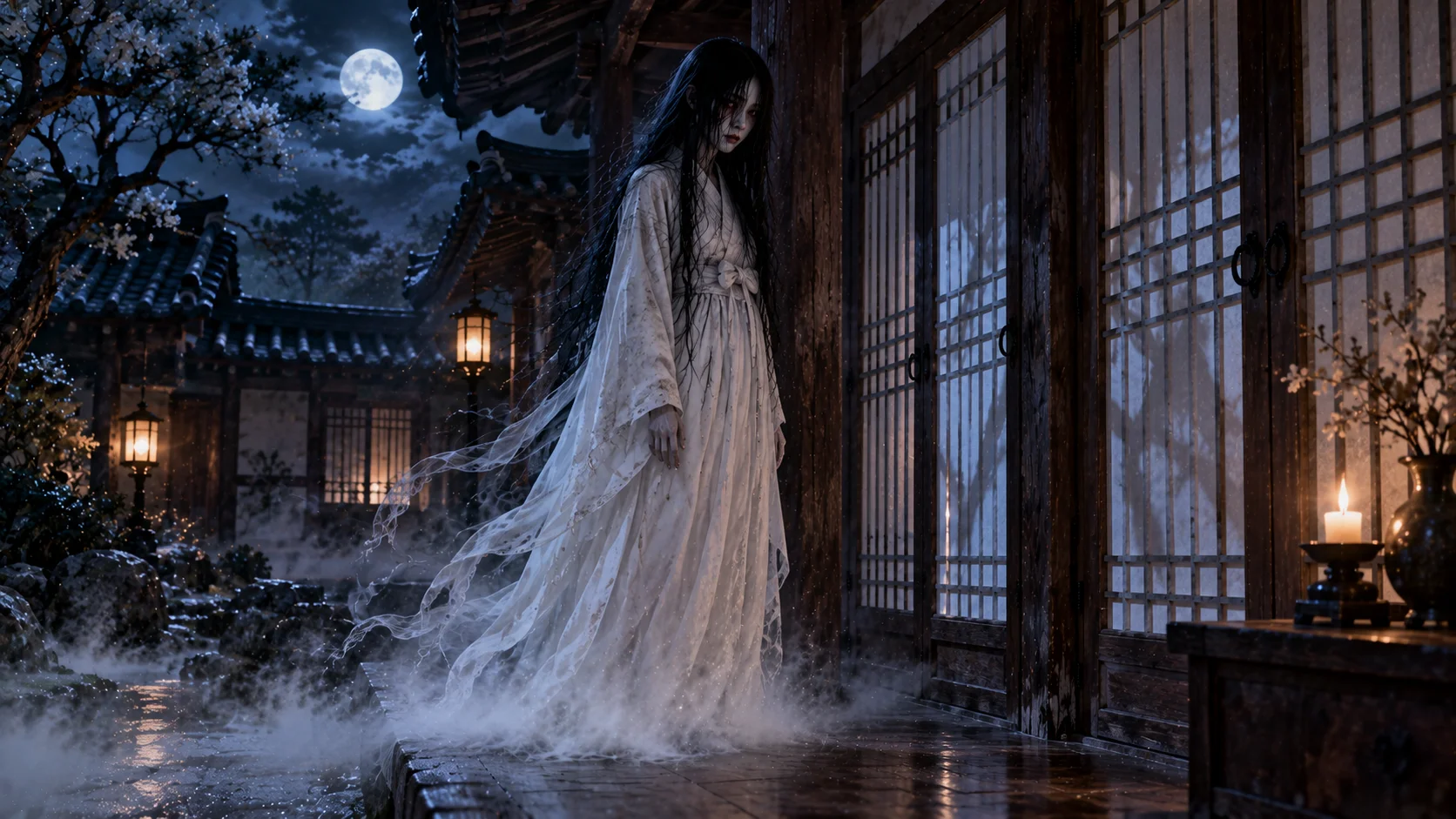
The Cheonyeo-gwishin (처녀귀신), the "virgin ghost," is the most recognizable spirit in Korean folklore: a young woman who died before marriage, returning in white burial hanbok with black hair unbound, carrying a grief so total that the ordinary rites for the dead cannot hold it.
The Maiden Who Died Unwed
In the broad taxonomy of Korean ghost belief, a gwishin is any spirit of the dead who has not passed cleanly into the next world — distinct from the disciplined, well-fed ancestral spirits honored at jesa, the family memorial rites. Most gwishin are said to result from a "bad death": dying suddenly, dying with a grievance unresolved, or dying without the social completion a life was supposed to reach. The cheonyeo-gwishin is the purest expression of that last category. She died before becoming a wife and mother, the two roles that, in traditional Korean society, defined a woman's completed life. Her death is not simply early; it is unfinished in a structural sense, and that unfinishedness is what folklore says binds her to the world of the living.
A Spirit With No Place on the Tablet
The severity of her condition in the old cosmology was not just emotional but bureaucratic. In Joseon-era Confucian practice, ancestral tablets and the succession of memorial rites followed lines of marriage and lineage. An unmarried daughter had no proper place in that system — she belonged neither fully to her birth family's ritual line, since she was expected to marry out of it, nor to a husband's family, since she never joined one. Popular belief described her, as a result, as spiritually homeless. Without a fixed home in the world of the dead, she was thought to linger closer to the world of the living than an ancestor properly enshrined and fed at each memorial — and to linger more dangerously.
Han: The Grief That Will Not Dissolve
Central to understanding the cheonyeo-gwishin is the Korean concept of han — a knot of grief, resentment, and unresolved injustice that can outlast the body. Han is not simply sadness; it is a kind of pressure that accumulates when a life is cut short of what it was owed. A young woman who dies unmarried is, by the logic of the folk tradition, almost guaranteed to carry han, because she has been denied not a small pleasure but an entire expected shape of adult life: household, husband, children, standing. The ghost stories built around her are, structurally, stories about that pressure finding an outlet — sometimes as vengeance against a specific wrongdoer, sometimes as a more diffuse haunting that simply will not stop until someone notices her.
Sorrow Before Malice
It is worth separating the cheonyeo-gwishin from a simple monster. In the older oral tradition, and in many of the stories that were later reshaped by print and screen, she is rarely evil for its own sake. She is far more often depicted as an aggrieved party seeking acknowledgment: a wrong committed against her that no one addressed while she lived, now demanded of the living after her death. The haunting is a form of testimony. Where she causes harm, it is frequently framed as retribution against a specific offender — a cruel household, an unfaithful intended, a family that failed her — rather than indiscriminate cruelty. The fear she inspires is real, but the folklore consistently gives her a reason.
The Color of Death: Sobok and the Logic of Yin
Her visual signature — white burial hanbok (sobok), unbound black hair falling over the face, cold air marking her presence — is not an invention of modern horror cinema, though films like the late-1990s and early-2000s wave of Korean horror popularized and sharpened the image for a global audience. It draws on traditional Korean funerary dress and a cosmological logic in which the living are aligned with yang and the dead with yin: pure, cold, silent, and colorless. White, worn for burial and for mourning alike, marks her as fully crossed over into that yin state even as she has failed to leave the world behind. The dishevelment of her hair signals the same thing from another angle — hair properly bound was part of an adult woman's completed, ordered appearance; hair let loose is a mark of a life, and a death, left undone.
The Wandering Dead and the Properly Fed Ancestor
Korean spiritual practice draws a firm line between two categories of the dead. On one side are ancestral spirits who died at a reasonable age, married, with descendants to perform jesa for them — spirits who are, in effect, cared for indefinitely, folded into the ongoing life of the family through regular ritual attention. On the other side are the wandering dead: those who died young, violently, unmarried, or without anyone left to remember them properly. The cheonyeo-gwishin belongs unambiguously to the second group. She is not malicious by nature so much as unclaimed — a spirit for whom the ordinary machinery of memory and rite was never built, and who is left to seek attention by other means.
Ssitgim-gut: Washing the Grief Away
Korean shamans, or mudang, developed a specific ritual response to exactly this problem: the ssitgim-gut, or "cleansing gut," most closely associated with the Jindo and wider Jeolla region. The name means roughly "washing away," and the ritual is built around that image — cleansing the deceased spirit of the accumulated han that keeps it tethered to the living world. Through chant, dance, and symbolic washing performed by the shaman, the rite is meant to loosen the grip of grievance on the spirit and allow it, finally, to move on to the afterlife rather than remaining caught at the threshold. For a spirit as thoroughly stuck as a cheonyeo-gwishin is imagined to be, such a rite was often considered the only real remedy — ordinary memorial practice was not built for her case.
Ghost Marriage: Completing an Unfinished Life
A second, more specific folk remedy addressed the root of her unrest directly rather than washing it away after the fact: the posthumous or "spirit" marriage, known as yeongon or myeongbuhon. In this rite, the dead unmarried woman was symbolically wed — sometimes to another deceased unmarried person, joining two incomplete fates into one completed pairing. The logic is precise: if her torment stems from having been denied the married status that would have anchored her properly within the family and ritual system, then granting her that status after death, even symbolically, should resolve the underlying grievance. The ceremony did not pretend she was alive; it acknowledged her death while repairing the specific social incompleteness the folklore blamed for her restlessness.
Muga: The Songs That Explain the Spirit World
Figures like the cheonyeo-gwishin do not exist in isolation from the rest of Korean shamanic belief — they sit within a much larger, orally transmitted pantheon explained through muga, the narrative songs performed by mudang during gut rituals. These epics account for the origins and functions of a wide range of spirits and household gods, from mountain deities to hearth goddesses, giving each a story that justifies its power and its needs. The cheonyeo-gwishin's condition — young, unmarried, aggrieved, unhoused in the ritual order — fits a recognizable pattern within that larger tradition of narratives explaining why certain deaths produce certain kinds of restless spirits, and what the living owe them in response.
A Female Grief With Deep Narrative Roots
The theme of a wronged or suffering woman whose death demands recognition recurs elsewhere in Korean myth, most famously in the Baridegi narrative pattern, and it surfaces again in household belief in the figure of Jowangsin, the hearth goddess, whose own origin story in some tellings casts her as a grieving, discarded wife deified at the site of her suffering. The cheonyeo-gwishin belongs to this same current of storytelling: female death and injustice rendered not as an endpoint but as the beginning of a spiritual claim on the living, one that ritual, memory, or narrative must eventually answer.
Between the Human World and the World Beyond
Just as Korean cosmology placed mountains as liminal ground between human settlements and the domain of spirits like Sansin, the cheonyeo-gwishin occupies a liminal position of her own — caught between the ordered world of the properly married and remembered dead, and full departure from the world of the living. She is neither settled ancestor nor total stranger to the family and community she left; she is a reminder that a life interrupted does not simply end quietly, and that the tradition took seriously the idea that some griefs require deliberate ritual work, not just time, to be laid to rest.
A Story Still Being Told
The cheonyeo-gwishin's persistence — from shamanic ritual through oral muga into modern Korean cinema and beyond — speaks to how durable this particular grief has proven as a cultural image. She is at once a specific folk category with specific remedies attached to her, and a broader symbol of injustice demanding to be witnessed. Whether approached through the ssitgim-gut's washing away of sorrow, the ghost marriage's completion of an interrupted life, or simply the story told and retold, the tradition surrounding her insists on the same underlying point: a death that leaves something undone leaves something behind, and it falls to the living to see that it is finally addressed.
Sources & traditions
- TraditionKorean texts, oral tradition and village tellings
Myths change from area to area and from time to time. This chronicle follows the most widely told versions; tellings in other villages, regions and eras may differ.