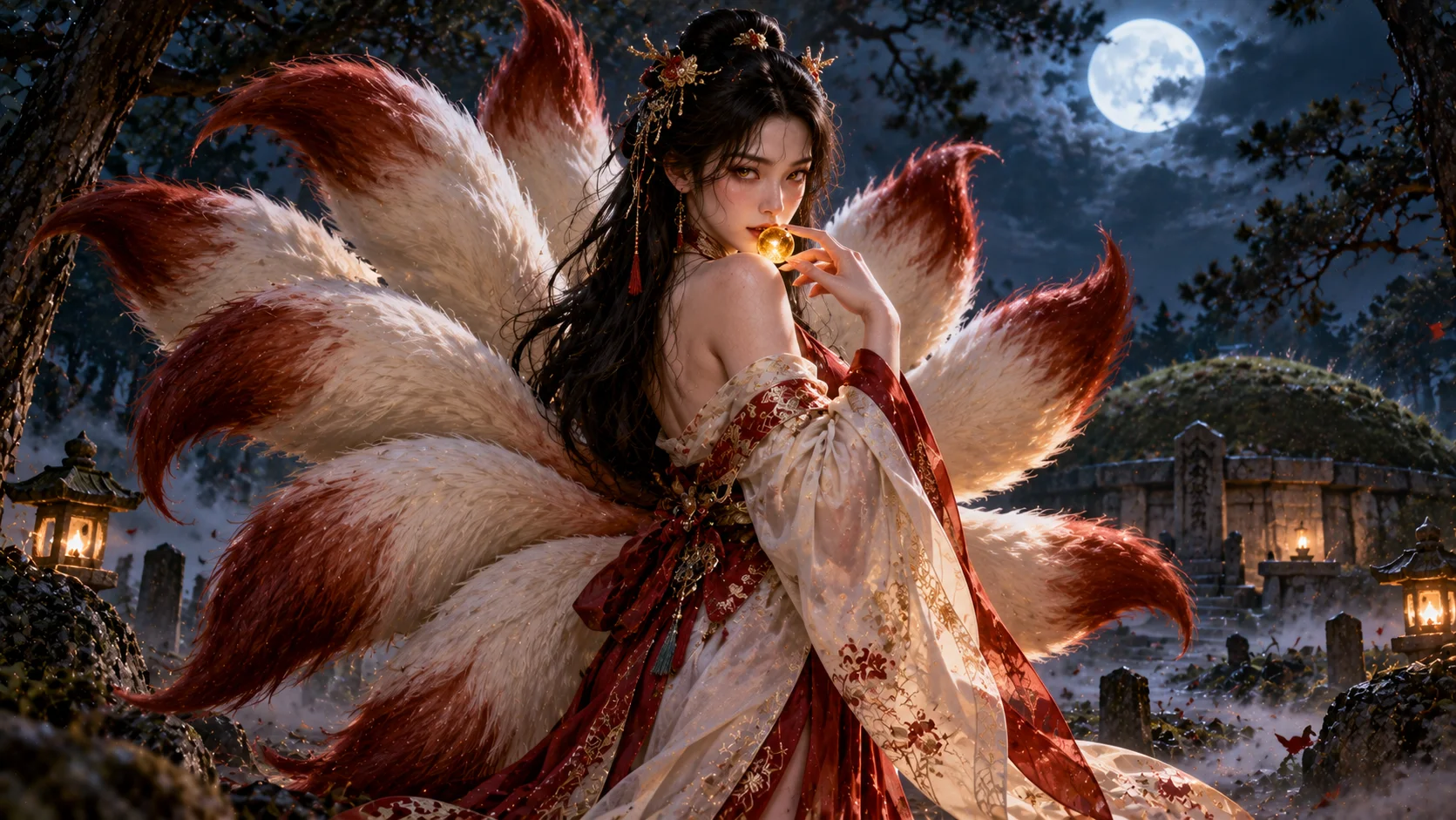
In the misted hill-country of old Korea, where fox-fires flicker along forest paths at dusk, no creature commands more dread and pity at once than the Gumiho — the nine-tailed fox. She appears at a crossroads as a woman of impossible beauty, her hair black as wet ink, her voice pitched to unravel the resolve of any man who hears it. But beneath the silk of her hanbok, coiled and trembling, wait nine tails, and behind her lovely face waits an appetite that has outlived centuries.
A Spirit Born of Ten Thousand Years
Korean village storytellers rarely agreed on gumiho's exact origin, but they agreed on this: no ordinary fox becomes a gumiho by accident. It takes centuries of quiet cunning, of surviving hunters and hard winters, before a fox's spirit thickens into something that can bend the shape of its own body. The ninth tail is the mark of completion — proof that the fox has absorbed enough life, enough time, enough hunger, to stand upright and walk among people. Where the bear-woman Ungnyeo endured a trial of stillness and self-denial before becoming human, as told in the Dangun cycle recorded by the monk Iryeon, the fox's path runs in the opposite direction: it is fed, not starved, by consumption, and the gap between beast and human is bridged only by taking human vitality itself.
Kin Across the Mountains and Straits
Gumiho does not stand alone in East Asia's imagination. She shares deep roots with China's huli jing and Japan's kitsune, all three drawing from an ancient nine-tailed fox motif that reaches as far back as the Shan Hai Jing, the "Classic of Mountains and Seas," where a nine-tailed fox is already recorded as an omen creature roaming distant wilds. As the motif traveled and settled into each culture, it took on a distinct local temperament — the huli jing often cast as a trickster or even a benevolent immortal, the kitsune capable of loyal devotion as well as mischief. Korea's telling is, by most accounts, the sharpest and most predatory of the three: gumiho's beauty is rarely a gift, and almost always a lure.
The Bride Who Was Never a Bride
The most enduring gumiho tales are stories of marriage gone wrong. A young man on a lonely road meets a woman of startling grace, is led home by her, and marries her within days. She is the perfect wife by every visible measure — devoted, composed, untouched by scandal. And then, night after night, something in the household begins to fail: livestock vanish, a strange silence falls over the kitchen, or a brother-in-law grows suspicious of a wife who eats alone, facing away from the table, and never lets anyone see her plate.
In the classic shape of the tale, discovery comes at the worst possible moment — a husband peering through a crack in the wall to see his bride crouched over a corpse, or worse, a living animal, drawing out its liver with her bare hands. The liver and heart are gumiho's true food: organs believed to hold the essence of life itself, which she must devour again and again to keep her borrowed humanity from dissolving.
The Discipline of Becoming Human
Not every gumiho is content to prey forever. Woven through the folklore is a recurring, almost tragic ambition: the fox who wants, truly, to become human — not merely to wear a human shape, but to be released from the fox nature entirely. The path to that release is discipline of a punishing kind. In many versions she must pass one thousand days without killing a single person, holding her hunger in check while every instinct in her screams against it. Other tellings compress the ordeal to one hundred days of abstaining from human liver alone, a trial nearly impossible to complete, since one slip — one moment of desperation — resets the count to nothing.
This is what separates gumiho from a simple monster. She is written, again and again, as a creature capable of longing for exactly the thing she is doomed to destroy. Villagers who told these stories by lamplight understood the cruelty in that shape: a soul which most wants humanity is the one built by its own nature to prey upon it.
The Bead That Betrays the Truth
Discovery is the hinge on which every gumiho story turns, and Korean folklore hands its listeners a set of specific, almost forensic tools for it. A husband or a watchful brother might use a treasured comb or bead — the yeouiju, a wish-fulfilling jewel that recurs across Korean myth in contexts far beyond the fox tale — to force a hidden nature into view: held up at the right moment, it reveals the fox tail hidden beneath silk and composure, exposing what the bride truly is. Other versions rely on nothing more mystical than patience: watch closely enough, long enough, and a tail will slip loose from beneath a hem, or a shadow on the wall will fall wrong, nine-pointed instead of one.
Dokkaebi's Distant Cousin, Never Quite the Same
It is worth setting gumiho beside the mischievous dokkaebi, if only to see how differently Korean folklore treats its two most famous supernatural tricksters. Dokkaebi are said to be born from old, discarded household objects — a worn broom, a bloodstained shovel — never from the dead and never, in older telling, from a living creature at all. They are morally double-edged, capable of rewarding an honest woodcutter as readily as they punish a greedy one, and their menace comes wrapped in comedy: a night-time wrestling match, a cudgel that conjures gold with a tap. Gumiho carries none of that levity. Where dokkaebi's danger is a game with rules a clever human can win, gumiho's danger is appetite, plain and patient, and the stakes of losing to her are never played for laughs.
A Kingdom of Watchful Spirits
Gumiho belongs to a much larger constellation of Korean beings who exist to test human character, and who reward or ruin people according to how they behave when watched — or when they believe themselves unwatched. The stone guardian haetae, carved at the gates of Gyeongbokgung Palace, was trusted for a very different kind of judgment: an incorruptible sense of right and wrong, potent enough that its image was stitched onto the robes of Joseon censors who policed corruption among officials. Where haetae's justice is public and institutional, gumiho's is intimate and domestic — she tests a household, a marriage, a single unsuspecting man, rather than a court. Both figures reflect the same cultural instinct: that unseen eyes, whether stone lion-dragon or fox-woman, are always somewhere in the room.
Water, Serpents, and the Long Road to a Different Kind of Transformation
Gumiho's thousand-year discipline of restraint has an echo in Korean dragon lore, in the figure of the imoogi — a giant serpent or hornless proto-dragon condemned to a trial of its own, commonly said to last a full thousand years, before it may finally ascend to heaven as a true dragon. Some tellings hold that the imoogi must also find and hold a yeouiju to complete the change, the same wish-granting jewel that surfaces in gumiho stories as a marker of the fox's hidden nature. Both creatures are, in their own way, stories about waiting: about power that can only be earned by endurance, and about how easily a single mistake, a single moment of being seen, can undo a transformation centuries in the making.
The Dragon King's Court and the Order of Things
Where gumiho haunts back roads and lonely households, Yongwang, the Dragon King who rules the seas and rivers, presides over an entirely different register of Korean belief — the great shamanic and, later, Buddhist-syncretized order of the waters, honored in coastal Yongwang-je rituals for safe voyages and full nets, and enshrined in his own small hall in Buddhist temples across the peninsula. The gumiho tales and the Yongwang tales rarely cross paths directly, but together they mark the two poles of the same worldview: an agrarian, coastal society that saw the wild as inhabited on every scale, from the fox waiting at the edge of the village to the king ruling the deep water beyond the shore, each demanding its own form of respect and caution.
Why the Fox Endures
Centuries on, gumiho has hardly loosened her grip on the Korean imagination. She survives in television dramas, in horror films, in the wary half-joke older relatives still make about a suspiciously charming stranger. Some of that endurance is simply good storytelling — a monster with a face, a motive, and a tragedy built into her own hunger is more compelling than one with none of those things. But some of it, surely, is the shape of the warning itself, which has not gone out of date: that the most dangerous thing in a story is rarely the creature snarling in the dark tree line. It is the one already seated at your table, smiling, and never once explaining why she will not eat.
A Reflection Older Than the Fox Herself
Strip away the tails and the liver and the moonlit crossroads, and gumiho's oldest function becomes visible: she is a mirror Korean communities held up to their own anxieties about trust, appearance, and the stranger who arrives with no history to check. A beautiful newcomer, a marriage arranged too quickly, a household member who keeps to unexplained habits — these were real social frictions long before they were fox-spirit plots. Gumiho gave them a shape sharp enough to tell around a fire, and frightening enough that a listener might, afterward, look twice at the next stranger on the road home.
Sources & traditions
- EncyclopediaWikipedia — Gumiho
- TraditionKorean texts, oral tradition and village tellings
Myths change from area to area and from time to time. This chronicle follows the most widely told versions; tellings in other villages, regions and eras may differ.