The Imoogi (이무기) is Korean myth's dragon-in-becoming: a colossal, hornless serpent that must endure an age of waiting — a millennium, in the tellings that count the years exactly — coiled in the darkness of a lake, a river bend, or a cave pool, before it may cast off its serpent's skin and rise into the sky as a true Yong. It is a creature caught mid-transformation, belonging fully to neither the water-world of crawling things nor the heaven-world of dragons, and that in-betweenness is the whole of its story.
A Serpent Waiting for the Sky
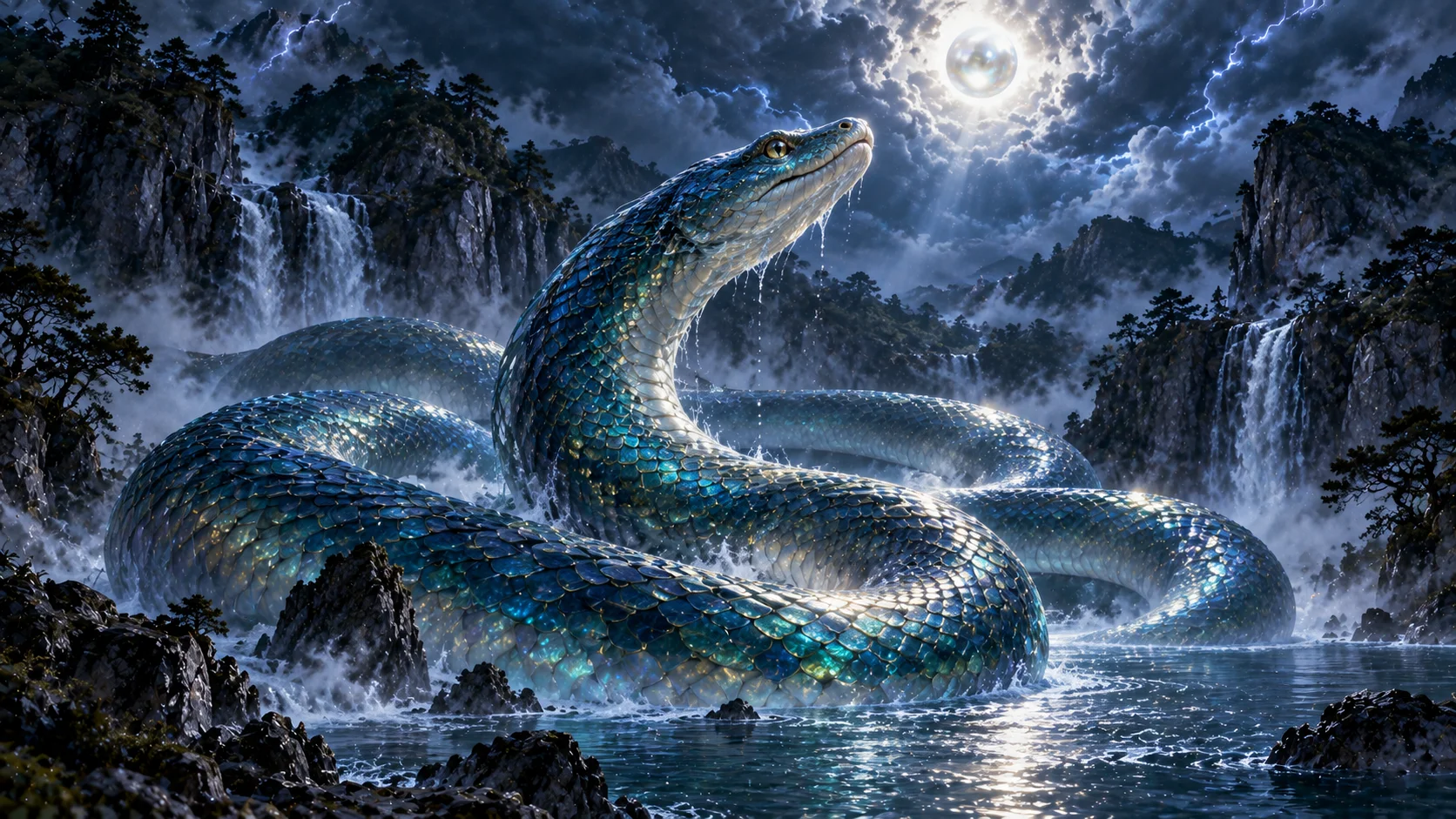
Where a fully realized Yong is depicted with horns, claws, and the unmistakable bearing of a water deity, the Imoogi is described as a great snake — immense, ancient, sometimes scaled in dull colors that mirror the mud and weed of the pool it has claimed as its prison and its cradle. The lore does not dwell on how any particular Imoogi first came to be; what unites nearly every account instead is the number that recurs like a drumbeat through Imoogi lore — one thousand years. A thousand years of waiting, of hiding, of hunger and patience, submerged in one body of water, watching the seasons turn without once being seen.
This is not a comfortable dormancy. The Imoogi is often written as restless, coiled tight around its own accumulating power, aware that after all that time a single mistake — a single unlucky moment — can undo the entire wait. That fragility, after so vast an investment of time, is what gives the Imoogi its peculiar poignancy among Korea's mythic beasts. Nothing else in the tradition asks for quite so much patience in exchange for quite so uncertain a reward.
The Yeouiju: A Jewel Worth a Thousand Years
In most versions of the tale, waiting alone is not enough. The Imoogi must swallow or otherwise obtain the Yeouiju, the wish-fulfilling jewel that dragons are shown clutching in their claws or holding beneath their chins in temple carvings and folk paintings across Korea. The Yeouiju is not decoration; it is the concentrated essence of a dragon's authority — over weather, over water, over fortune itself — and without it an Imoogi's transformation cannot complete no matter how many years have passed.
The same jewel appears throughout Korean dragon iconography associated with Yongwang and the other true dragons of the tradition, which is precisely the point of the symbol: the Yeouiju marks the boundary between an almost-dragon and a real one. An Imoogi with the jewel in its mouth, straining toward the sky, is the single most recognizable image the folklore offers of the moment just before everything changes — or just before everything is lost.
The Fatal Glance at Sunrise
No motif recurs more insistently in Imoogi storytelling than the taboo of being seen. Village after village tells some version of the same climax: after its long vigil, after securing the jewel, the Imoogi rises from its pool at the appointed hour — very often at sunrise, the threshold between night and day — and begins its ascent, its long body twisting up out of the water toward the clouds like smoke given shape. And in that single, unrepeatable instant, everything depends on nobody watching.
If a human being sees the Imoogi at the moment of transformation, the ascension fails. The dragon-to-be falls back into the water, or is said to be destroyed outright, its centuries of patience undone by one careless witness — a farmer rising early, a fisherman checking his nets, a curious child at a window. Some tellings frame this less as bad luck than as a kind of cosmic law: the passage from the mundane world to the divine one cannot survive mundane eyes upon it. Other tellings turn the taboo into tragedy proper, dwelling on the cruelty of a witness who never meant harm, who simply happened to look out at the wrong dawn, and who must live afterward knowing they cost a thousand years of waiting with a single glance.
Kin of the Jiaolong
The Imoogi does not stand alone in East Asian dragon-lore; it has a close relative in the Chinese jiaolong (蛟龍), a hornless flood-dragon that likewise must pass through age and ordeal before achieving full dragon-form. The resemblance is not coincidence but inheritance: Korea's dragon cosmology absorbed a great deal of Sinitic tradition over the centuries, and the Imoogi's whole narrative shape — serpent first, trial in the middle, true dragon at the end — echoes the jiaolong's arc closely enough that the two are often discussed as regional cousins of a shared idea. What Korean storytelling did with that inherited frame was distinctly its own: the specific weight given to the number one thousand, the centrality of the Yeouiju, and above all the taboo of the human witness are elaborations that gave the Imoogi its own identity within a wider East Asian family of dragon-becoming myths.
When the Waiting Curdles into Menace
Not every Imoogi is a sympathetic figure patiently biding its time. In a substantial thread of regional legend, particularly the kind of story told to explain why a certain pool is avoided or why a certain village suffered a run of misfortune, the Imoogi is something closer to a monster outright — a cursed or malevolent serpent that has claimed a river, spring, or well as its own, hoarding treasure in its depths or terrorizing the people who depend on that water to live. These Imoogi do not evoke the same pity as the failed ascendants of the sunrise tales; they are obstacles, guardians of ill-gotten hoards, or outright terrors until a hero intervenes.
Such stories almost always call for a hero — sometimes an ordinary villager pushed past endurance, sometimes a wandering warrior, sometimes a figure with ritual or supernatural help — to confront the creature and free the water it has claimed. The contrast this draws is deliberate and sharpens the meaning of the whole Imoogi tradition: a Yong, once achieved, is gentle and wise, a benefactor of rain and kingship, but an Imoogi that never completes its transformation, or that turns its long wait toward greed and cruelty instead of patience, can curdle into exactly the kind of threat a true dragon would never be. The failure to ascend is not merely sad in these tellings — it is dangerous, a reminder that power without its proper completion can rot into something worth fighting.
The Court the Imoogi Longs to Join
Everything an Imoogi endures its long wait for is, in the end, admission to the world ruled by Yongwang, the Dragon King who governs every sea, river, and lake in Korean cosmology from his undersea palace, Yonggung. Yongwang is the Imoogi's aspirational endpoint made explicit: benevolent, authoritative, and permanently settled in the very kind of dominion an Imoogi only borrows for a thousand years before it must either transform or fail. Where the Imoogi is transitional and unstable, forever balanced on the edge of becoming something else, Yongwang simply is — the finished article, ruler of waters rather than a captive of one particular pool.
Yongwang's most famous appearance in Korean storytelling, the tale of the ailing Dragon King who sends a turtle to the land to fetch a rabbit's liver as a cure, shows a very different register of dragon-story than the Imoogi tales — courtly, clever, almost comic — but it belongs to the same layered cosmology. The Imoogi's water is a rung on a ladder that Yongwang stands at the top of.
Rites at the Water's Edge
Yongwang is not confined to old narrative; he remains an active presence in Korean shamanism, invoked in gut ceremonies and especially in Yongwang-gut, rites performed by coastal and fishing communities to ask for safe voyages and a plentiful catch. Along Korea's coasts, and notably around Jeju Island, offerings of rice cakes and rice wine are still carried to the sea at dawn as part of this living veneration — a practice that deserves to be understood on its own terms, as a continuing tradition rather than a folkloric relic. Where Chinese tradition divides comparable authority among four separate Dragon Kings of the Four Seas, Korean belief localized that power into a single supreme aquatic deity, and it is this same singular Yongwang that Korean farmers and officials once petitioned during drought through rain-prayer rites, or giu-je, asking the ruler of the waters to loosen the sky over dry fields.
The Imoogi's whole ordeal, seen against this backdrop, is an attempt to cross from being merely water-bound into becoming an agent of that same rain-granting, harvest-sustaining power — which is exactly why its failures land so heavily in the storytelling. To fall short is not just personal loss; it is to remain forever apart from the order that sustains the living world above the water.
Judgment Waiting at the Other End of Life
Korean cosmology does not stop at the water's edge. Where Yongwang governs the seas and the Imoogi struggles toward joining him, an entirely different domain awaits the dead, presided over by Yeomra (염라대왕), King of the Underworld, a figure drawn from the Sanskrit Yama by way of the Chinese Yanluo Wang. Yeomra judges the newly dead against the record of their earthly conduct, reading from the saengsabu, a ledger said to hold every deed a soul committed in life, and he is counted among the Siwang, the Ten Kings who each take their turn judging the dead at set intervals after death — every seven days out to forty-nine, and onward through further stages beyond that.
Korean Buddhist temple art renders this judgment repeatedly in the Siwangdo, paintings of the Ten Kings enthroned amid demon attendants and diligent scribes, each king weighing a different soul's balance of sin and virtue. Yet Yeomra is not painted as untouchable or purely mechanical in Korean storytelling — the Jeju shamanic myth of Gangnim Doryeong tells of a human messenger sent to fetch Yeomra himself into the mortal world to settle a case of injustice, a story that treats even the King of the Underworld as a character who can be summoned, reasoned with, and in his own way outwitted.
Before Sea and Underworld: The King of Heaven and Earth
Above both Yongwang's waters and Yeomra's court of judgment sits a still earlier layer of Korean cosmology, preserved above all in the Jeju shamanic creation narrative Cheonji-wang Bonpuri. Its central figure, Cheonji-wang, the Heaven and Earth King, is the supreme creator deity of this mythology, and the story tells of his descent to the human world, where he fathers twin sons — Daebyeol-wang and Sobyeol-wang — with a human woman remembered as Baekju, or Chongmyeong-buin. The myth accounts for the very separation of heaven and earth, once fused or chaotic, and for the ordering of sun, moon, and cosmic time that followed.
The twin sons' rivalry gives the myth its most human moment: a flower-growing contest decides which brother will rule the world of the living and which the world of the dead, and Sobyeol-wang wins only through trickery — a victory that Jeju's shaman-storytellers, the simbang, cite as the very origin of injustice and disorder among the living. This narrative is transmitted as part of the General Bonpuri cycle, recited during the Cheongung-maji ritual, one of the central ceremonies of Jeju's shamanic tradition — a living practice, not a closed text, carried forward by the communities who still perform it.
A Vertical Universe, and the Creature Caught Between Its Layers
Set side by side, these four figures map a Korean mythic universe with real vertical structure: Cheonji-wang above, governing the cosmic origin of heaven and earth; Yongwang in the waters, ruling seas, rivers, and rainfall; Yeomra below, presiding over the dead and their judgment; and the Imoogi occupying the strange, unstable space between all of it — a water-creature reaching upward, neither fully of the depths nor yet of the sky. Every other figure in this cosmology already occupies a settled office. The Imoogi alone is still becoming, which is exactly why its story resonates the way it does: it is the one mythic being in this whole structure whose fate is not yet decided.
Why the Wait Matters More Than the Wings
It would be easy to tell the Imoogi's story as a simple monster tale — a giant snake wanting horns — but Korean tradition treats the wait itself as the meaningful part, not merely an obstacle before a reward. A thousand years is not a number chosen for its size alone; it stands in for an almost unimaginable discipline, a patience longer than any human life, spent entirely on the hope of becoming something gentler and more powerful than what one started as. That the reward, the Yong, is imagined in Korean tradition as wise and benevolent — a bringer of rain, an emblem of kingship, nothing like the menacing dragons of other traditions — is what makes the Imoogi's failure feel like tragedy rather than mere misfortune. To fail is not to be defeated by a monster-slayer; it is to lose, in one unlucky instant, the chance to become something good.
Traces of the Imoogi in the Landscape
Because the Imoogi's vigil is always tied to a specific body of water, the myth naturally attaches itself to real places — a particular deep pool in a mountain river, a certain lake said to hide unfathomable depths, a well that local memory insists should not be looked into too closely at dawn. These attachments give the Imoogi a kind of local, almost intimate presence that grander sky-and-sea deities like Yongwang or Cheonji-wang do not usually have; a village might have no shrine to the Dragon King at all, and still tell, generation after generation, about the thing that is said to be waiting in the pool past the old mill, and about the year someone almost saw it rise.
That intimacy is, in the end, the Imoogi's particular gift to Korean mythology: it takes the vast cosmological machinery of dragons, kings, and judgment and roots one small, patient, endangered piece of it in a place a person could actually walk to, and wait beside, and — if they are not careful, at the wrong sunrise — accidentally undo.
Sources & traditions
- TraditionKorean texts, oral tradition and village tellings
Myths change from area to area and from time to time. This chronicle follows the most widely told versions; tellings in other villages, regions and eras may differ.