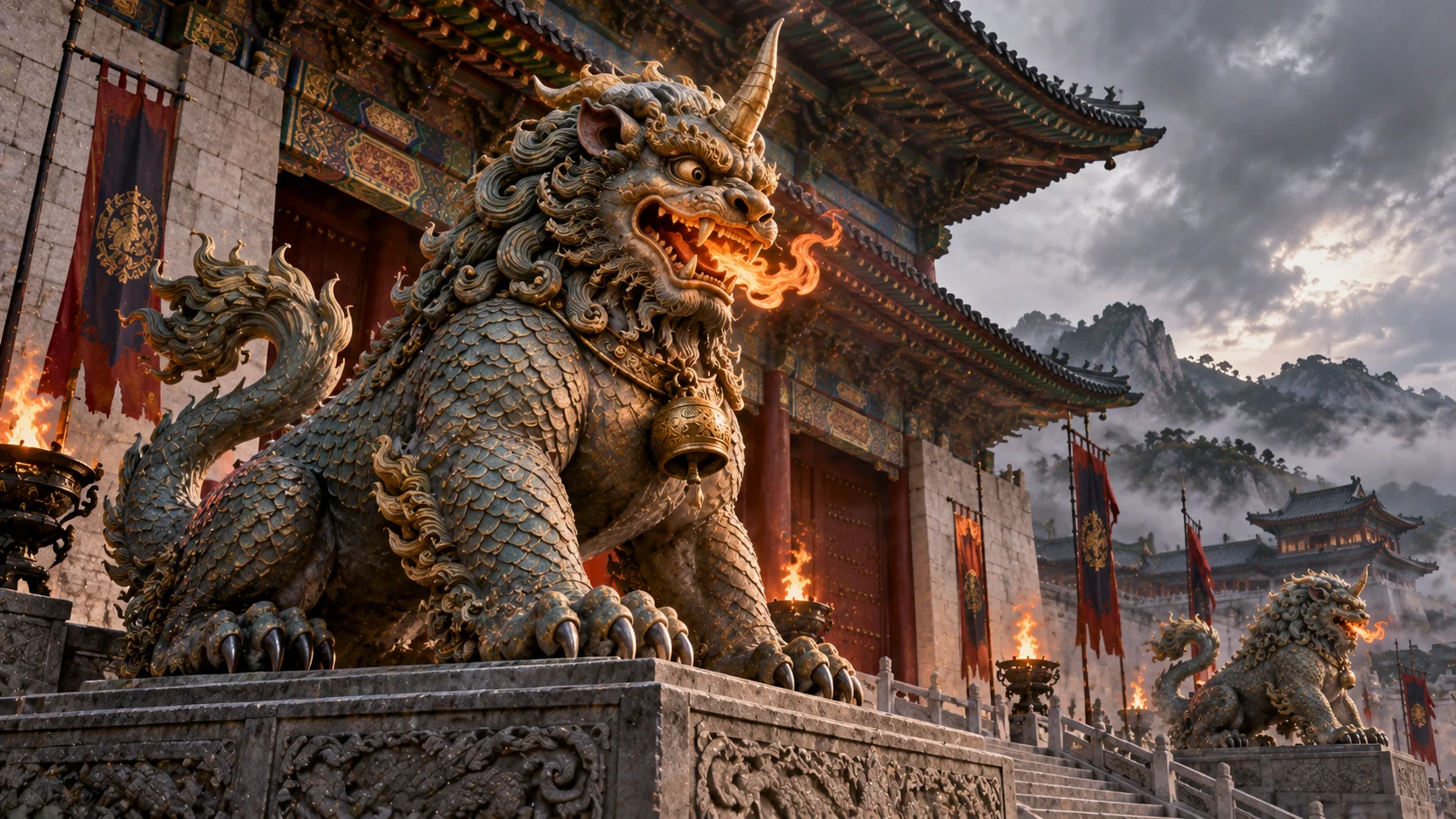
Long before Seoul's palace gates wore stone lions in the European sense, they wore something stranger: the Haetae (also written haechi), Korea's mythical lion-dragon hybrid, a guardian said to eat fire and to know right from wrong on sight. Unlike most guardian beasts, carved simply to look fierce, the haetae's whole reputation rests on a faculty no chisel can render directly: judgment. It does not merely defend a threshold. It is said to know what crosses it.
A Creature Built From Two Elements
Korean myth rarely lets a single element carry a protector alone, and the haetae is no exception. It is described as a lion-dragon-like creature — leonine in its base form, but bound up with the dragon lineages that dominate the peninsula's water and sky myths. It is neither fully lion nor fully dragon, and that ambiguity suits its role: a creature meant to stand at boundaries, belonging to no single order of being, given a moral portfolio broader than mere ferocity — not just a guardian, but a judge.
The Sense That Cannot Be Fooled
What separates the haetae from ordinary temple guardians is a single reputed faculty: it is said to detect right from wrong. Presented with two disputing parties, a haetae does not need testimony — it simply knows. Over centuries of retelling this made it less a beast to be feared and more a beast to be trusted: the sort of arbiter that cannot be bribed, flattered, or intimidated, because whatever its method, it does not operate by human persuasion at all.
Fire's Natural Enemy
The haetae's second defining trait is more elemental than moral: it is said to eat fire, or at least to hold power over it, making it a natural ward against blazes. This was not treated as poetic flourish by the people who built Korea's wooden capitals. Palaces, courts, and archives built almost entirely from timber and paper faced an ever-present, catastrophic risk, and a guardian whose signature power was fire-suppression was not decorative — it was functional, in the same way a lightning rod is functional. To place a haetae at a gate was to make a targeted request of the cosmos: keep the flames out of this specific building.
Gwanaksan's Shadow Over the Palace
Nowhere is that request more visible than at Gyeongbokgung Palace in Seoul, where haetae statues have flanked the main approach for centuries. Their placement is not incidental. To the south of the palace rises Gwanaksan, a mountain believed under the principles of pungsu (the Korean cousin of feng shui) to radiate hwagi — fire energy — toward the royal seat. A mountain associated with fire, facing a palace built of wood, was not a risk anyone building in Joseon-era Seoul could afford to ignore. The haetae were installed partly as a countermeasure: stone sentinels meant to help protect the wooden palace from that threat.
A Robe Embroidered With Judgment
The haetae's reputation for discernment did not stay confined to statuary. In the Confucian bureaucracy of the Joseon court, censorial officials — the daesagan, tasked with monitoring corruption among other officials — wore insignia bearing the haetae's image. This was a pointed choice of emblem. To dress an anti-corruption official in the symbol of an incorruptible beast was to make a claim about the office itself: that its holder was meant to see through deception the way the haetae reputedly could, unmoved by rank, bribery, or persuasive argument. Whether any individual inspector lived up to that standard was, of course, a separate matter — but the aspiration was stitched directly into the fabric of the office.
From Palace Gate to City Emblem
The haetae's long association with justice, safety, and incorruptibility made it a natural choice when the city of Seoul went looking for a symbol of its own modern identity. In 2008, the municipal government formally adopted haechi as Seoul's official mascot, reframing the ancient fire-eating judge of old palace gates as a civic emblem representing safety, trustworthiness, and fairness in a contemporary metropolis of ten million people. It is a striking continuity: a creature first placed to protect a single wooden palace now stands, in mascot form, on manhole covers, safety campaign posters, and tourism materials across the entire city, its ancient duties translated almost without alteration into modern civic virtues.
Guardians in a Crowded Mythic Landscape
The haetae did not stand alone in Korea's guardian bestiary, and its particular flavor of protection becomes clearer set beside its neighbors. Where the haetae judges and repels fire from a fixed post, the dokkaebi wander — mischievous spirits transformed not from the dead but from old discarded household objects, morally ambiguous tricksters who punish greed and reward honesty on their own unpredictable terms rather than through fixed judgment. Where the haetae is incorruptible by design, the gumiho is a creature of concealment — a fox spirit that transforms into a beautiful woman to seduce and consume the livers or hearts of young men, and in many tellings must pass as human, undetected, through a set trial period (sometimes counted as a thousand days) to become fully human itself. The haetae's whole narrative function is almost a rebuke to a figure like this: in a mythic ecology that includes shapeshifters skilled at passing undetected, here is one thing that cannot be tricked.
Water, Sky, and the Beasts Between
Korea's mythic imagination is saturated with serpentine and draconic beings tied to water, weather, and the agrarian cycles an entire civilization depended on. The imoogi, a proto-dragon condemned to a trial commonly cited as a thousand years before it may finally ascend to heaven as a full dragon, embodies transformation endlessly deferred — patience as cosmic prerequisite. Above it in the hierarchy sits Yongwang, the Dragon King who rules the seas and rivers outright, invoked by coastal and fishing communities through ritual and gut ceremonies for safe voyages and abundant catches, and later folded into Buddhist temple life with shrine halls of his own. The haetae belongs to a different register than either of these water-sovereigns — it is a beast of the built world, of gates and courts and cities, rather than of tides and rain — but all three share a root assumption: that the natural world is populated by intelligences with moral weight, capable of reward, punishment, and judgment on their own terms.
A Nation's Older Foundations
The haetae's role as a righteous, discerning guardian of civic order sits comfortably within a much older Korean narrative preoccupation: the idea that legitimate rule and correct judgment are not simply human inventions but are sanctioned from beyond the human sphere. The founding myth of Dangun Wanggeom, preserved in the thirteenth-century Samguk Yusa, tells of Hwanung descending to Taebaeksan with ministers who governed wind, rain, and clouds, establishing 360 departments of human affairs under the guiding principle of hongik ingan — to widely benefit humanity. That founding vision of governance answerable to something larger than personal ambition echoes, centuries later, in a stone beast placed at a palace gate specifically because it could not be bribed. Even the transformation myth of Ungnyeo, the bear who endured a hundred days in darkness to become human and bear Dangun, speaks to a broader Korean mythic pattern in which discipline and endurance — not force alone — earn transformation and legitimacy.
Stone That Still Watches
What makes the haetae unusual among mythical guardians worldwide is how little distance separates its ancient function from its present one. It was never retired into pure folklore the way some guardian spirits eventually are, spoken of only in old stories. Its statues still flank a functioning historic palace visited by millions of tourists a year; its mascot likeness still appears on the city's official signage; its old bureaucratic association with incorruptible judgment still gets invoked, half-seriously, whenever Seoul wants to gesture at institutional integrity. Few mythological beings make so clean a jump from Joseon-era cosmology to twenty-first-century municipal branding while keeping their core meaning almost entirely intact.
Why the Judge Still Matters
Strip away the fire-eating and the reputation for unerring judgment, and the haetae endures because it answers a need that never goes away: the wish for an arbiter untouched by the pressures that bend human judgment — money, fear, favor, fatigue. Korea placed that wish at the doors of power, in the form of a beast said to see the truth without being told it. That the same figure now appears as a friendly city mascot rather than only standing watch at a palace gate does not dilute the idea. If anything, it has let the haetae's oldest promise — that justice can be recognized on sight, and fire kept from the door — travel further than any single dynasty could have carried it alone.
Sources & traditions
- EncyclopediaWikipedia — Xiezhi
- TraditionKorean texts, oral tradition and village tellings
Myths change from area to area and from time to time. This chronicle follows the most widely told versions; tellings in other villages, regions and eras may differ.