Ungnyeo, whose name means simply "bear woman," occupies a strange and tender place in Korean mythology: she is neither goddess nor mortal, neither fully animal nor fully human, but the hinge on which an entire national origin story turns. Without her patient transformation beneath a sandalwood tree on Mount Taebaek, there is no Dangun, no Gojoseon, and no 2333 BCE founding date etched into the Korean calendar. She is the earth and animal world's contribution to a genealogy that otherwise runs entirely through heaven — and her endurance, not her divinity, is what makes the myth work.
A Bear and a Tiger Before the Cave
The story as preserved in Iryeon's thirteenth-century Samguk Yusa — itself drawing on an earlier, now-lost Wei Shu and a text called the Gogi, or Old Record — opens not with Ungnyeo as a woman at all, but as one of two animals living in the shadow of a divine settlement. A bear and a tiger, so the record goes, shared a den and shared a longing: both wished to become human. The text does not explain why; it simply reports that they went together to Hwanung and asked.
This detail — that the tiger is present at all, and that its failure is recorded alongside the bear's success — is easy to read past, but it does real work in the myth. It transforms Ungnyeo's eventual transformation from an automatic reward into an achievement measured against a rival who did not make it. The tiger is not punished or villainized; it simply leaves. Korean folk tradition would go on to make the tiger one of its most vivid recurring figures, by turns a mountain guardian and a trickster in later folktales, but in this founding story it is defined by the one thing it could not do: wait.
The Gift of Mugwort and Garlic
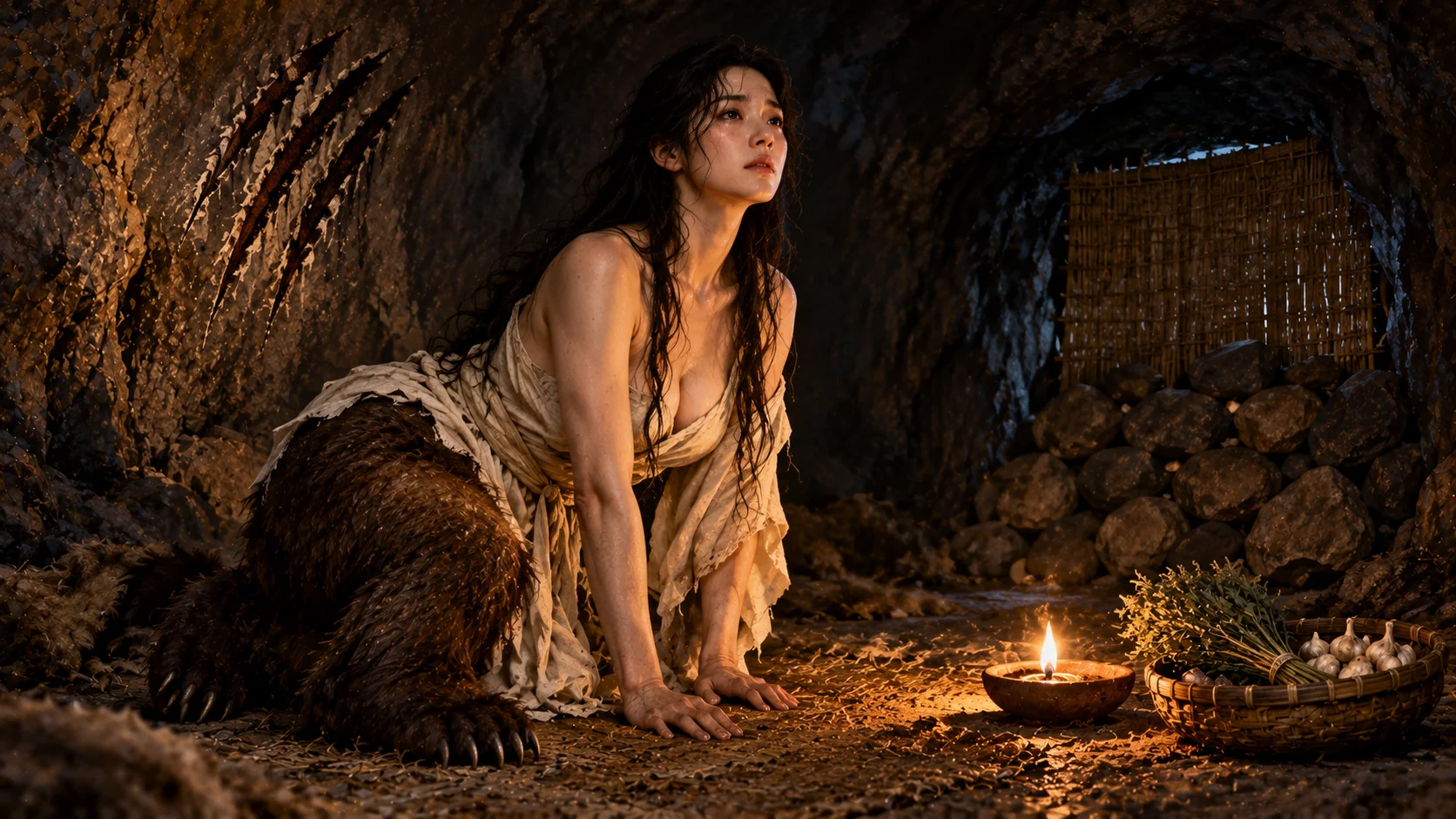
Hwanung's response to the two petitioners was neither refusal nor blessing, but a test disguised as a gift. He gave them a bundle of mugwort, or ssuk, and twenty cloves of garlic, and set two conditions: eat nothing else, and see no sunlight, for one hundred days. It is worth pausing on how ordinary these ingredients are. Mugwort and garlic are not exotic substances or magical elixirs; they are foods still burned, brewed, and eaten across Korea today — mugwort in rice cakes and in the smoke of moxibustion, garlic as the backbone of Korean cuisine. The myth roots its most supernatural event, a literal change of species, in the plainest domestic materials available to an early agricultural society. Transformation, the story suggests, does not require anything rare. It requires only that the ordinary be endured completely.
The hundred-day figure set by Hwanung is itself a striking number for the trial, whatever its resonance or lack of it with later custom — the text gives no gloss on why one hundred was chosen, only that it was the term the bear ultimately did not need in full.
Twenty-One Days in Darkness
Here the two animals part ways. The tiger, according to the Samguk Yusa, could not bear the confinement and abandoned the trial before it was finished, returning to the forest and to its old shape. The bear stayed. And crucially, the text does not claim the bear endured the entire hundred days before changing — it specifies twenty-one days, considerably short of the full term Hwanung had set. Whether this means the trial's difficulty was measured in resolve rather than a strict calendar, or whether it reflects the layering of variant oral traditions into a single written account, readers have debated for centuries. What the text preserves without ambiguity is the outcome: the bear that endured the dark and the bitterness became, at the end of that stretch of days, a woman. From this point the record calls her Ungnyeo.
Scholars examining this episode alongside similar bear narratives from Siberian and Tungusic peoples, and more broadly across the circumpolar cultures that venerated bears as kin, ancestor, or intermediary with the spirit world, have long argued that Ungnyeo's story is not an isolated invention but a Korean expression of an ancient, widely shared bear cult. In that broader context, a bear capable of becoming human — or a human descended from a bear — is not a fantastical embellishment but a solemn claim about kinship between the human community and the animal world it depended on for survival. Ungnyeo's transformation carries that older reverence forward into a specifically Korean act of nation-founding.
A Prayer Beneath the Sacred Tree
Becoming human did not complete Ungnyeo's story; it only changed the shape of her longing. The Samguk Yusa records that she went to the sandalwood tree the Korean tradition calls Sindansu — the very tree beneath which Hwanung had descended with three thousand followers to found Sinsi — and there she prayed, openly and repeatedly, for a child. This is a striking image: a woman who was, a matter of days or weeks earlier, an animal in a cave, now standing beneath the most sacred tree of the new divine settlement, asking heaven directly for what she wants. There is no intermediary, no ritual specialist standing between her and Hwanung. Her transformation has earned her that access.
Moved by her devotion, Hwanung is said to have taken temporary human form himself in order to marry her. The union is described with a certain narrative economy — the text does not linger on courtship — but its consequence is the entire point of the myth: from this marriage between a heavenly being and a woman who had been a bear, a son was born. That son was Dangun Wanggeom, who would go on to found Gojoseon, the first kingdom of the Korean peninsula, in a year later tradition would fix as 2333 BCE.
The Genealogy That Binds Heaven to Earth
It is worth setting Ungnyeo's role against the fuller structure of the founding myth to see exactly what she supplies to it. At the top of the lineage stands Hwanin, the Lord of Heaven, sometimes identified in the text with the Buddhist sky-king Indra, or Śakra. Hwanin's son Hwanung asked to descend to the human world, and Hwanin, after surveying three high mountains from above, granted him Taebaek-san — traditionally identified with Baekdu Mountain — as his domain. Hwanung descended with three thousand followers, three named ministers responsible for wind, rain, and clouds, and administrative authority, the text says, over some three hundred and sixty separate areas of human life, from agriculture and illness to punishment and moral judgment.
That is an impressively complete cosmology of heaven and governance. What it lacks, on its own, is the earth. Ungnyeo supplies exactly that missing term. She is not descended from Hwanin's heavenly line; she rises instead from the animal world, from the mountain, from the cave — from everything Hwanung's court governs but does not itself embody. Dangun's birth from their union therefore does something more precise than simply producing a hero: it welds heaven, earth, and the animal world into a single unbroken genealogical chain, with humanity — represented eventually by the Korean people themselves — as its living continuation. Later texts complicate this lineage further; the thirteenth-century Jewang Ungi by Yi Seung-hyu, for instance, makes Dangun the grandson of Hwanin rather than simply Hwanung's son, a variant that tightens the tie to heaven even further while leaving Ungnyeo's contribution of earth and endurance untouched.
Why a National Myth Needed an Animal Mother
It is tempting, reading this story from a distance, to treat Ungnyeo as a supporting character in Dangun's story. Korean tradition itself resists that reading. A myth that wanted only to legitimize a heavenly founder could have given Dangun two divine parents and been done with it — plenty of comparable founding myths elsewhere do exactly that. Instead, the story insists on an origin that must pass through struggle, through the body, through an animal's patient submission to darkness and bitterness. The kingdom's founder is only half a sky-being; the other half of him is a mother who had to earn her humanity through hardship rather than possess it from birth.
This detail took on renewed weight during the twentieth century. Under Japanese colonial rule between 1910 and 1945, the Dangun narrative — and by extension Ungnyeo's place within it — was actively promoted by Korean nationalists as a counter-claim to colonial erasure: a genealogy reaching back to 2333 BCE that no occupying power could rewrite. Reverence for Dangun persists today through Daejongism, a religious tradition formally organized in 1909 that venerates him as a divine ancestor, and through South Korea's National Foundation Day, Gaecheonjeol, observed each October 3rd. Ungnyeo's endurance beneath the sandalwood tree is the quiet, less-celebrated foundation underneath all of it.
The Mountain as Witness and Destination
The Samguk Yusa account does not end with Dangun's birth. It follows him through a reign said to have lasted fifteen hundred years before he retired from kingship to become a mountain god, a sanshin, at Mount Asadal. There is a quiet symmetry in this ending that returns the myth to where Ungnyeo's transformation began. She rose out of a mountain cave to become human and to bear a king; her son, at the end of an impossibly long reign, returns to the mountain to become a spirit that watches over it. The mountain in Korean myth is never simply scenery — it is cave, threshold, throne, and finally destination, and Ungnyeo is the figure who first proved that a mountain's creatures could cross into the human world at all.
Kinship With Korea's Restless Spirits
Ungnyeo's story belongs to the solemn register of Korean myth — origin, sacrifice, and the founding of a kingdom. It sits at some distance from the more mischievous folk spirits who populate later Korean storytelling, such as the dokkaebi, goblin-like beings said to spring not from mountains or divine descent but from ordinary objects — old brooms, worn tools, blood-stained sticks — that have absorbed enough use and spirit to awaken. Where Ungnyeo's transformation is earned through a hundred days of discipline and darkness, a dokkaebi's animation seems to arrive almost by accident, out of long service and neglect. Where Ungnyeo prays beneath a tree for a serious and singular purpose, dokkaebi are remembered for wrestling travelers on lonely roads at night, always vulnerable in the same leg, and for accepting bowls of makgeolli and buckwheat noodles as tribute. The two traditions rarely intersect directly, but placed side by side they sketch the wide range of what Korean folk imagination allowed the non-human world to become: on one end, a bear whose patience births a nation; on the other, a broom whose long years of service births a prankster.
Reading Ungnyeo on Her Own Terms
It is easy, in a myth this tightly bound to a national founding, to read Ungnyeo only as a means to Dangun's existence — a necessary step between Hwanung's descent and Gojoseon's founding. The text itself resists that flattening if it is read closely. She is given her own trial, her own hundred-day condition, her own failure witnessed in the tiger's departure, and her own prayer spoken in her own voice beneath the sacred tree. Nothing in the account suggests she was chosen or destined before she endured; the myth is explicit that the tiger had exactly the same opportunity and chose otherwise. Ungnyeo's story is, in that sense, one of the oldest surviving Korean statements about what patient endurance under hardship can produce — not merely a change of form, but a mother, a kingdom, and a lineage stretching from a heavenly father through a bear who chose to stay in the dark until she was ready to walk into the light.
Sources & traditions
- EncyclopediaWikipedia — Ungnyeo
- TraditionKorean texts, oral tradition and village tellings
Myths change from area to area and from time to time. This chronicle follows the most widely told versions; tellings in other villages, regions and eras may differ.