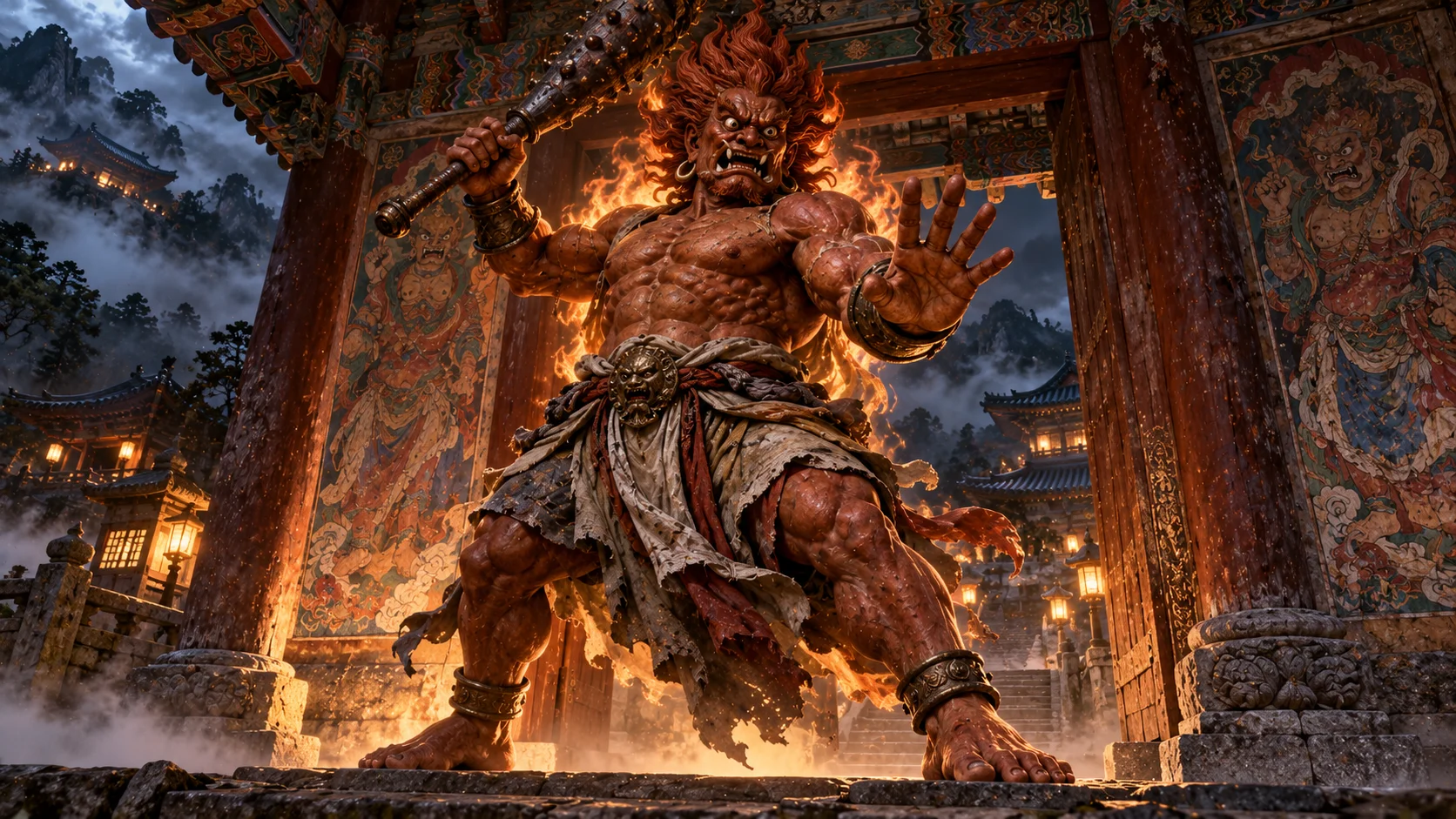
Eopwang (업왕), literally "king of the eop/fortune," is a term used in some regional traditions of Korean shamanism (muism) for a paramount or ruling household guardian deity of wealth. It functions as an honorific or superior term for the more widely known Eopsin figure, or, in certain shamanic rites (gut), as the presiding deity among a household's eop-spirits. To understand Eopwang is to step into the quiet, intimate architecture of Korean home-worship — a religious life lived not in temples or shrines but in storage jars, granary corners, and the space beneath the floorboards.
A King Without a Throne Room
Eopwang holds no grand shrine, commands no procession, and appears in no widely painted iconography. Its domain, as with Eopsin generally, is the house itself — the storage jars, the granary, the space under the home where the eop-spirit was believed to reside. This belongs to the broader current of gajang-sinang, household-god (gasin) worship, a devotional layer of Korean religious life distinct from village-level or state Confucian rites and traditionally overseen not by the male head of household but by women — the jusingu, the female head of house. This gendered division reflects the domestic, matrilineal-adjacent character of Korean house-worship as a whole.
Eopwang's cult, understood through this lens, sat at the intersection of economic anxiety and daily ritual: small, repeated acts of respect performed not for the salvation of a soul but for the ordinary, pressing question of a family's material continuity.
The Living Vessel of Fortune
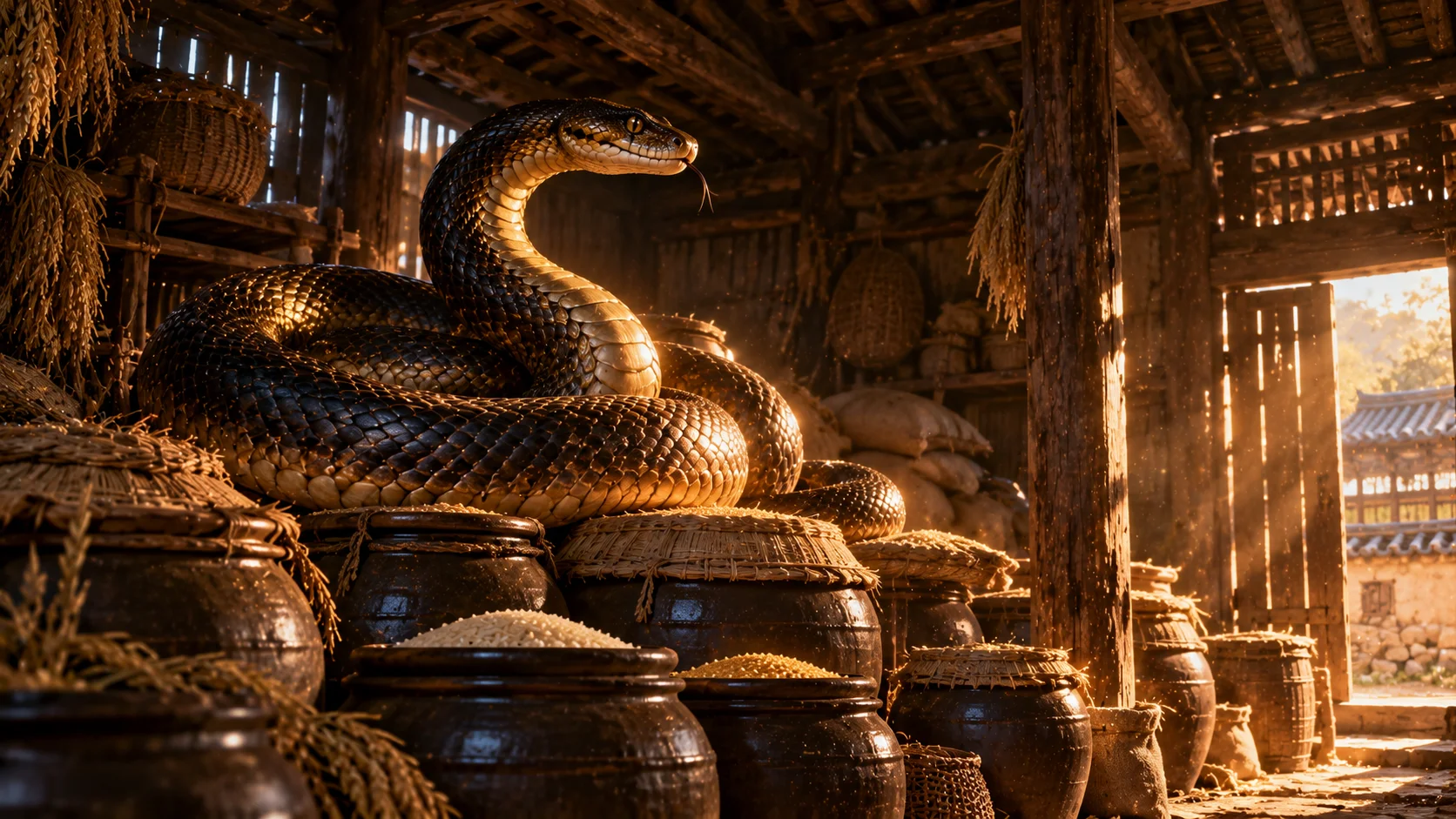
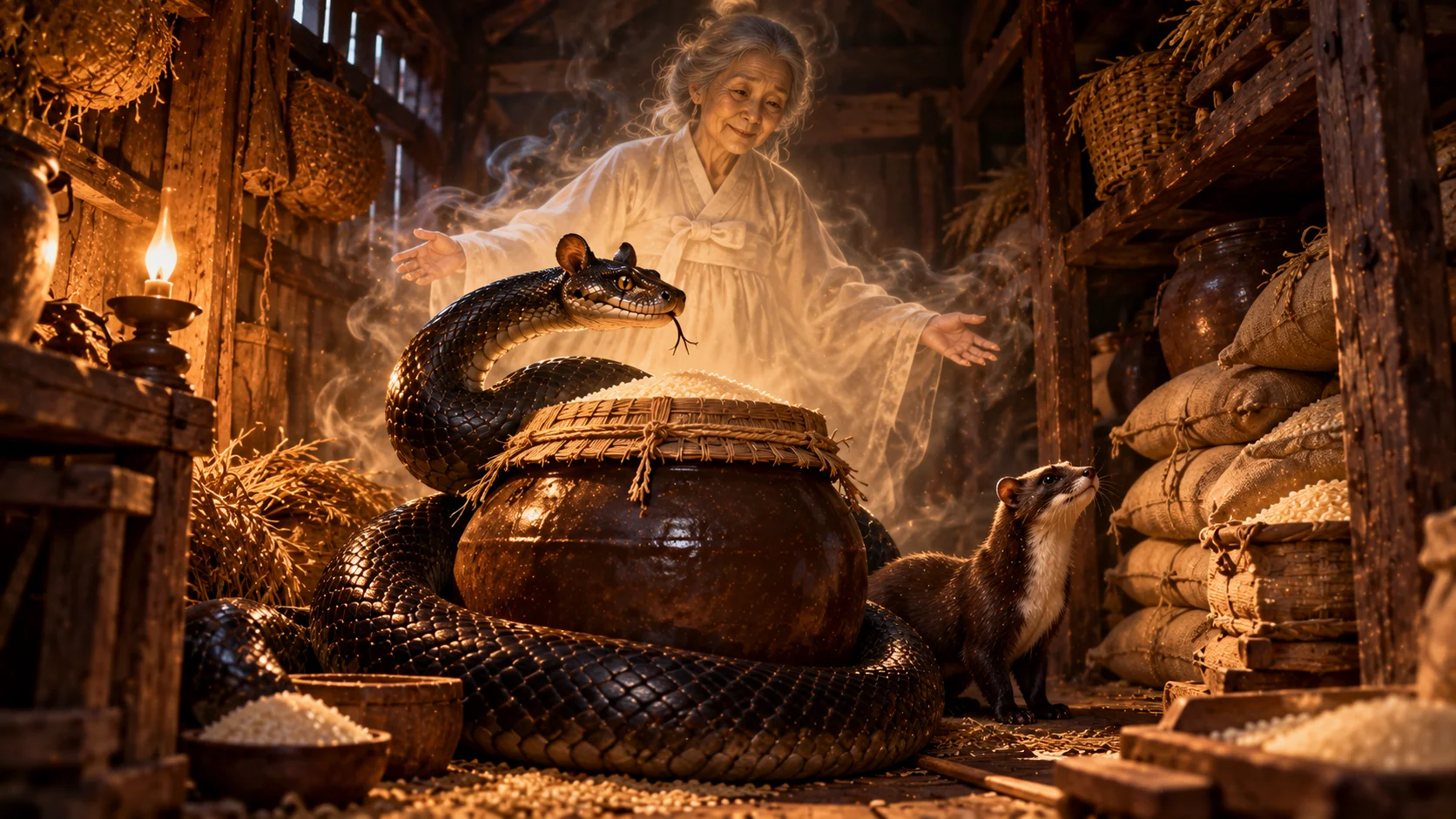
Korean tradition held that the eop-spirit did not remain wholly abstract. It was commonly believed to take residence in a living form — a snake, a weasel, or a toad — typically making its home among the storage jars, in the granary, or beneath the house. This belief is documented for Eopsin as the general household wealth spirit, and it is reasonable to read Eopwang, where the term names an elevated or presiding version of the same figure, as sharing this same associated imagery, though the fact record does not describe a distinct named vessel or shrine object specific to Eopwang itself.
The relationship between a family and this resident creature was read as a running commentary on its fortunes. The eopsin/eopwang's continued presence in the household was believed to preserve prosperity; its departure — a resident snake or weasel leaving the house — was traditionally read as an omen that the family's fortune would decline. In an agrarian society where a single bad harvest could mean genuine hardship, this domestic sign carried real emotional weight, whatever concrete form it happened to take in a given household's practice.
Eopsin and Eopwang: One Spirit, Two Registers
The relationship between Eopwang and the more commonly cited Eopsin is best understood as a matter of register rather than rivalry. Eopsin is the broad, general name for the household wealth spirit — the jaemulsin, or wealth deity — found across ordinary household observance. Eopwang, by contrast, surfaces in certain regional traditions as an honorific or superior term: sometimes applied to the same figure in an elevated sense, sometimes understood as the presiding deity among a cluster of household eop-spirits invoked during a shamanic gut.
This layering is characteristic of Korean folk religion generally: a single functional role — here, guardian of a family's material fortune — can accrue different names, different emphases, and different levels of formality depending on region, on the officiating shaman, and on the specific ritual occasion. Because the underlying record on Eopwang is thin and regionally variable, it is worth being explicit about what is and is not established: that the term exists and denotes a superior or presiding eop-figure is documented; the specific ritual furniture, iconography, or enumerated companion deities that might surround such a figure in any one village's practice are not part of the settled record here, and should not be presented as if they were.
The Silent Economy of the Storeroom
What distinguishes Eopwang and household eop-worship generally from more dramatic strands of Korean myth is the total absence of spectacle. There is no epic quest, no cosmic contest, no descent to the underworld. The devotion, as far as the record shows, was transactional in the most literal, domestic sense: maintain the household, do not disturb the creature believed to live among the stores, and prosperity was thought to continue its quiet accumulation. It is a theology of housekeeping, in which the sacred and the practical occupy the same act.
This intimacy also helps explain why Eopwang and its household kin left a comparatively thin trail in the literary and iconographic record compared to figures who animate Korea's grand myth-cycles — deities recited by name in shamanic epic, or given monumental physical form. Eopwang belongs to a different register of the sacred: not narrated in verse before a gathered village, but tended, by the account we have, quietly and privately, generation by generation, inside a single home.
Fortune Among the Household Gods
Eopwang did not operate in isolation from Korean household religion's wider structure. Eopsin/Eopwang belongs to the category of gasin — household deities — worshipped alongside other domestic spirits as part of gajang-sinang practice. The fact record does not enumerate which other named gasin figures a given household recognized or how their jurisdictions were divided; what is established is the general pattern — a family's home understood as inhabited by more than one guardian presence, with the eop-spirit's portfolio specifically concerned with accumulated wealth and stored grain. That focus placed it among the more emotionally immediate of these figures, since wealth, unlike some other domestic concerns, was visibly present or absent from one season to the next.
It is worth briefly setting this domestic wealth-cult beside the grander agricultural mythology Korean shamanism also preserved, where the Jeju narrative of Jacheongbi credits a goddess with bringing the ogok, the five sacred grains, and farming knowledge to earth at the scale of humanity as a whole. Eopwang operates at the opposite end of the same broad concern: not the origin of agricultural abundance in general, but the narrower, recurring question of whether one particular household's stores would see it through to the next season. The two are not doctrinally connected, but the contrast is a useful one — one mythic and expansive, the other private and immediate.
Reading the Signs of Fortune
The idea that a household spirit's presence or absence communicates something about the family's fate sits within a wider Korean habit of watching the household's own domestic and animal life for meaning. The samjokgu, the three-legged dog of Korean folklore, shows the protective side of the same habit: it was believed to sense ghosts and harmful spirits that people could not see, and to bark them away from the household. Where the eop-spirit guarded the family's fortune by staying, the samjokgu guarded the family by keeping watch — different mechanisms, but part of the same broader folk grammar. The comparison is offered here only as context for that shared interpretive habit, not as a claim that the two figures are otherwise connected.
The Household as a Modest Frontier of the Sacred
Set against Korea's more monumental religious and folkloric figures — deities with statues, epics, and even modern political afterlives — Eopwang can look modest indeed: a spirit, or an honorific for a spirit, with no fixed shrine and no narrative cycle of its own. But that modesty is largely the point. Korean religious life did not confine the sacred to temples or to stories recited before a gathered crowd; it extended, through Eopsin and, in certain regional traditions, the more exalted Eopwang, into the ordinary architecture of the home itself. What the fact record supports is comparatively spare — a name, a function, a register above the everyday Eopsin, and a general household-worship context tended by women — and that spareness is itself informative about how this particular deity was regarded: not through grand telling, but through steady, largely undocumented household practice.
Where this account has been more specific than that — about a particular jar, a particular enumerated pantheon of named household gods, or a particular vivid scene of the creature glimpsed at dusk — it would be reaching past what is actually known about Eopwang and presenting invention as established folklore. The honest shape of the figure is a modest one: a superior or presiding name for a household wealth spirit, tied to the same storage-jar and granary imagery as Eopsin, tended in the domestic register of gajang-sinang, and, beyond that, a name about which the specific regional practices remain genuinely underdocumented rather than settled.
Sources & traditions
- TraditionKorean texts, oral tradition and village tellings
Myths change from area to area and from time to time. This chronicle follows the most widely told versions; tellings in other villages, regions and eras may differ.