Jacheongbi (자청비) is the goddess of agriculture and grain in Korean shamanic myth, the heroine of the Jeju Island narrative known as the Segyeong Bonpuri. Chanted by shamans, or simbang, during ritual gut ceremonies, her story is one of the great bonpuri cycles of Jeju — an origin myth that explains not the birth of the world but the birth of farming itself, and why a woman, of all beings, is remembered as the one who carried the five grains down from heaven to earth.
A Sibling Myth: The Age Before Farming
Jacheongbi's story belongs to the same Jeju shamanic tradition as an older creation narrative, the Cheonji-wang bonpuri. In that separate bonpuri, the benevolent deity Mireuk ruled over an original age of abundance, only to lose a rigged contest of dominion to the trickster Seokga — the deity identified with the historical Lord Buddha — a defeat that the tradition holds is why the present world knows hunger, falsehood, and hard labor. The two narratives are not presented in the source tradition as one continuous plot, one answering the other; they are separate bonpuri recited within the same body of Jeju shaman myth, each explaining a different piece of how the human world came to be as it is. Read alongside each other, though, they sketch a world that needs feeding and a goddess whose task is to feed it.
It is in that broader cosmology — an earth that must now work for its bread — that a headstrong, cross-dressing, endlessly resourceful young woman sets out to bring heaven's abundance down to earth.
The Girl Who Disguised Herself as a Scholar
Jacheongbi's story begins not with grain but with love, and with a disguise. Drawn to the world of learning that was closed to women of her station, she disguised herself as a man and presented herself as a fellow student to the scholar Mun Doryeong. The two studied side by side for years. The sources for this bonpuri do not detail exactly how she maintained the disguise day to day, or precisely how it eventually gave way — those specifics vary by teller and telling, and are not fixed points of the myth the way her heavenly errand is.
The disguise itself, though, is not incidental color; it is the engine of the whole myth. Jacheongbi succeeds at everything the story asks of her — as a scholar, as a suitor, as a warrior, as an emissary to heaven — precisely by refusing to be confined to the role assigned to her sex. Korean shaman narrative repeatedly rewards this kind of transgression in its heroines, and Jacheongbi is among its boldest: she does not simply endure hardship, she out-thinks and out-maneuvers the obstacles placed in front of her, male or female.
Love Revealed, and a Reluctant Parting
The truth of her sex could not stay hidden forever. When it finally surfaced, Mun Doryeong's affection for his "brother" transformed at once into a suitor's longing. But the two were separated before their bond could be sealed, and Jacheongbi was left to make her way back to her own life alone, carrying a love that the story is only beginning to test.
Trials, Death, and the Flower That Undoes It
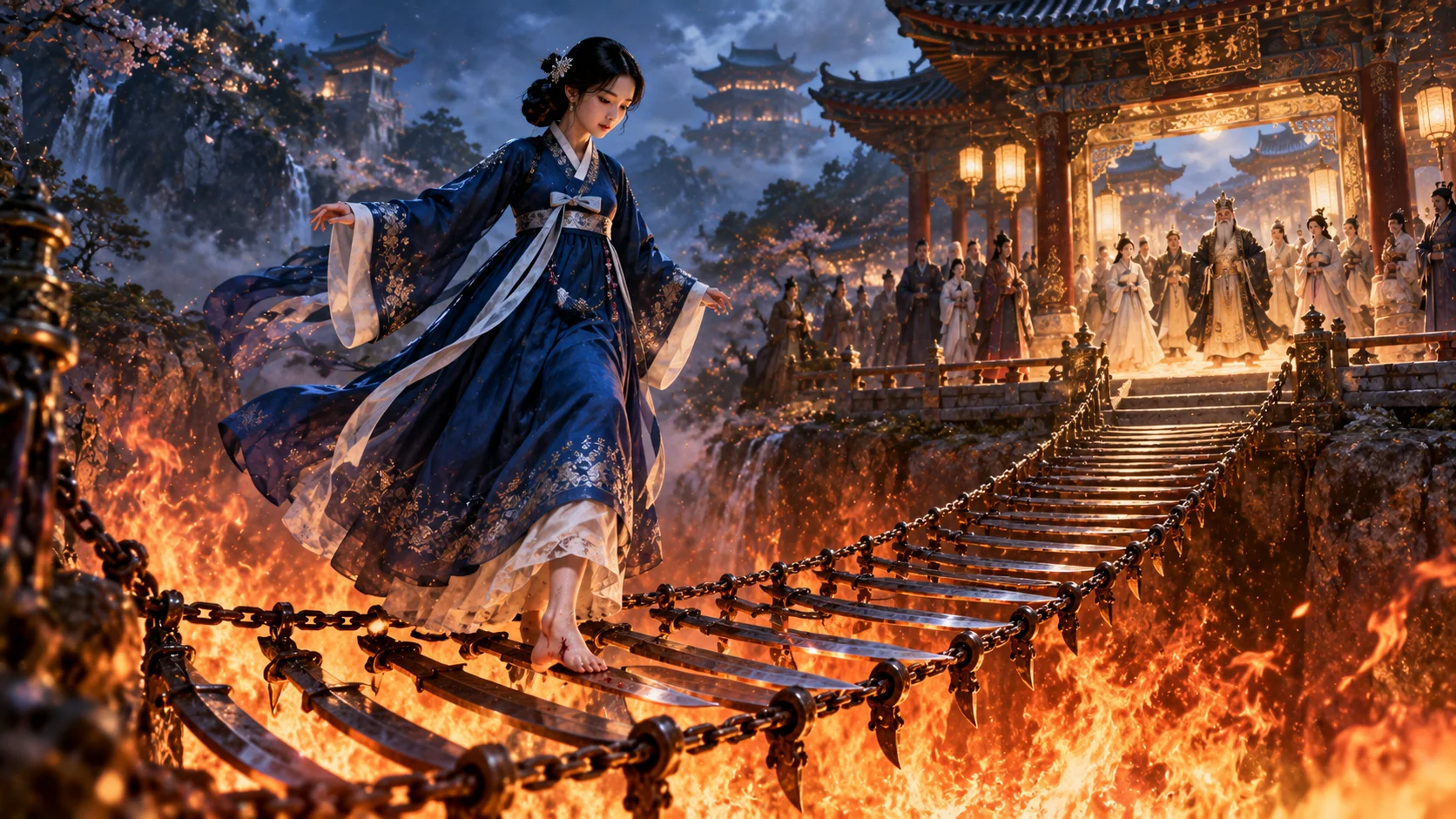
What follows is one of the bleaker turns in Jacheongbi's story: at its cruelest point, Mun Doryeong dies. Rather than accept the loss, Jacheongbi travels to the Western Heaven in search of the hwansaenghwa, the flower of resurrection, and uses it to bring him back to life.
This is not an isolated flourish of imagination. Korean shaman narrative returns to the same image elsewhere — most famously in the myth of Princess Bari, who undertakes her own perilous quest for the flower or water of life to save a parent who cast her aside. Jacheongbi's resurrection of her lover belongs to that same family of stories: a shamanic conviction that death is not always final, that a determined enough hero can travel to where life is kept and bring some of it back, and that the ones who make that journey are very often women the world had underestimated.
The Descent of the Five Grains
Reunited with Mun Doryeong and having proven herself in heaven as thoroughly as she once proved herself in a scholar's classroom, Jacheongbi is granted the ogok, the five grains, from the celestial realm of Cheonjiwang. She carries them down to the human world herself, along with the accumulated knowledge of how to plant, tend, and harvest them: the difference between a seed scattered by chance and a seed sown with purpose.
This descent is the reason the myth gives for Jacheongbi's worship as a farming goddess: she does not simply become one by decree, but by physically bridging heaven and earth and carrying down, in her own hands, the thing that turns hunger into harvest. Jeju shamanism venerates her accordingly, invoking her in rites tied to the planting and growing seasons, when a community's fortunes for the year still hang on whether the crop takes.
Mistress of More Than Grain
Later strands of the Jeju tradition extend Jacheongbi's domain well past the grain field. Some tellings credit her with introducing sericulture — the raising of silkworms — and with bringing knowledge of livestock husbandry to earth alongside the crops, making her patroness not just of the harvest but of the broader pastoral economy that surrounded it: the animals that plowed the fields, the herds that fed a household, the silk that clothed it. In this expanded reading she is less a single-purpose grain deity than a comprehensive goddess of agrarian survival, watching over every thread — literally, in the case of silk — that ties a farming community's life together.
A Household's Fortune, Measured in Smaller Gods
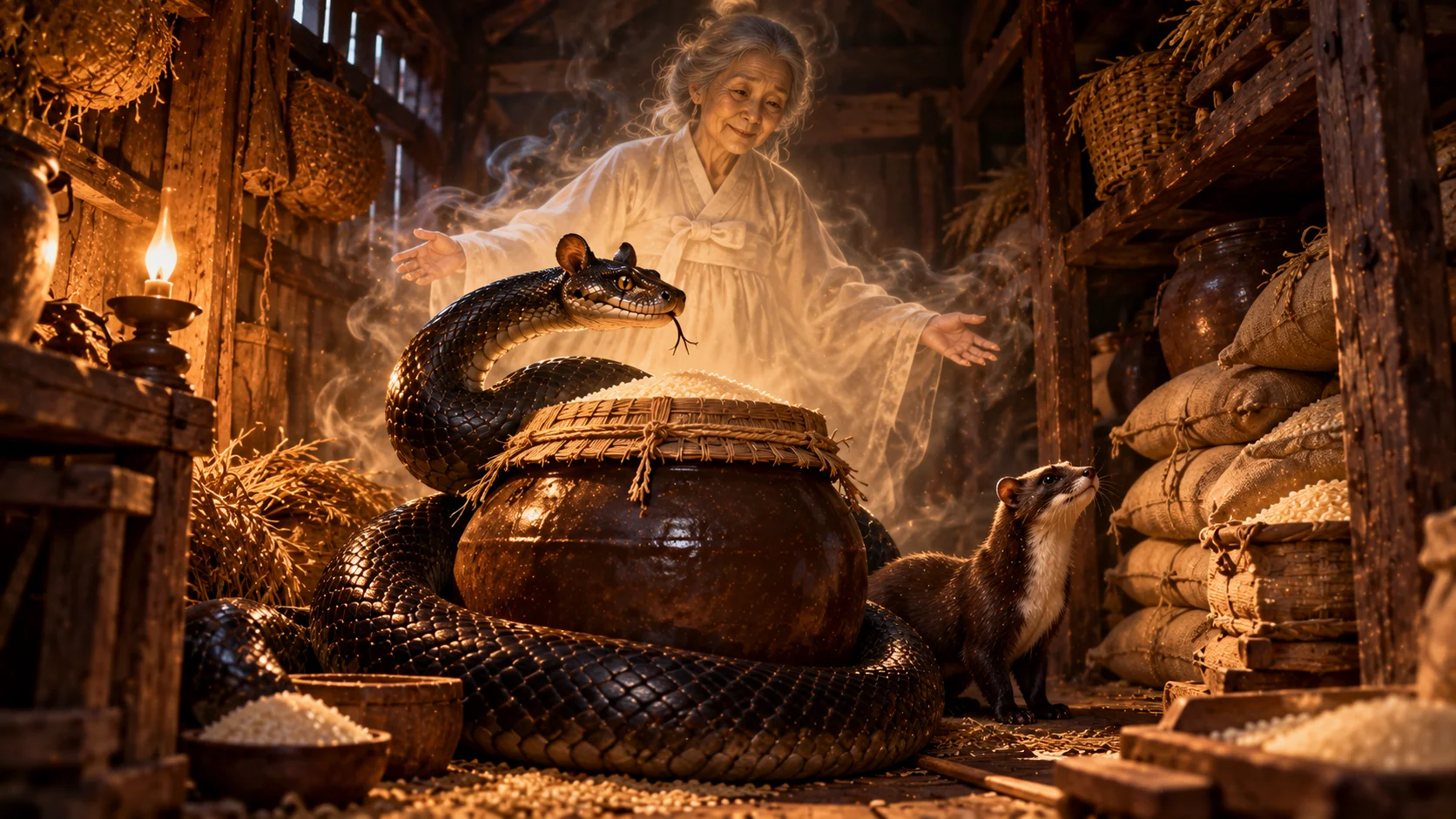
Jacheongbi's myth operates at the scale of the whole human world — she is the reason, in this tradition, that anyone anywhere can grow rice at all. But Korean household religion also kept a much smaller, more intimate register of fortune, tended not by shamans reciting an epic but by the woman of the house watching a corner of the granary. This is the domain of the eopsin, a household guardian of wealth believed to dwell in the storage jars or beneath the house, often taking the form of a snake, a weasel, or a toad. Some regional traditions elevate a paramount version of this figure as eopwang, literally "king of fortune," presiding over a household's prosperity much as Jacheongbi presides over the nation's harvest.
The logic of the eopsin is deceptively simple and quietly severe: its presence preserves a family's wealth, and if the creature that embodies it is ever seen leaving the house — a snake slipping out the door and not returning — that departure is read as an omen that fortune itself is packing up to leave. It was traditionally the female head of the household, the jusingu, who tended this belief, watching over the granary in a domestic register that echoes, on a much smaller scale, Jacheongbi's stewardship of the whole earth's supply of grain.
What the Water Remembers
If Jacheongbi's myth encodes a community's hope — that the harvest can be secured, that death itself can sometimes be reversed by someone determined enough — other figures in the same folk tradition encode its fears. Chief among them is the mul-gwishin, the "water ghost," believed to be the restless spirit of someone who drowned, lurking in rivers, lakes, and the sea to pull a living swimmer under. The lore holds that a mul-gwishin needs a substitute victim to drown in its place before it can finally be released to the afterlife — the origin of the still-used idiom "clinging like a water ghost" for someone who simply will not let go.
Stripped of its supernatural framing, the mul-gwishin functioned much as Western drowned-spirit legends did: a story sturdy enough to keep children and fishermen away from dangerous currents and whirlpools without needing to explain hydrology. Where Jacheongbi's myth teaches a community how to secure its food, the mul-gwishin teaches it how not to lose a life to the water that helped grow that food.
A Dog That Sees Ghosts
Korean folk tradition set protectors beside its water ghosts as well as warnings, and one of the best known is the samjokgu, the three-legged dog. Its unusual body marks it as touched by something beyond the ordinary, and it was credited with seeing the ghosts and harmful spirits that people could not, and with barking them away from the household it guarded. Set beside the mul-gwishin, it belongs to the same broad world of unseen spirits through which Korean oral tradition explained the dangers, and the protections, of everyday life.
An Iron-Eating Beast Born of Grief
Not every creature in this folklore is a warning against nature's dangers — some were imagined as answers to human cruelty. The bulgasari, a bear- or tapir-like beast with an insatiable appetite for metal, is said in one of its oldest forms to have been created during the oppressive final years of the Goryeo Dynasty, molded by Buddhist monks or a grieving family out of balls of rice or thread, or carved as a cursed sculpture, only to come to life and begin devouring the weapons and tools of the rulers who had caused that grief. The more metal it consumed, the larger and stronger it grew.
The bulgasari's afterlife outside folklore is its own small history: it gave its name, in some regional dialects, to the ordinary starfish and sea cucumber, and it was resurrected on screen twice in the twentieth century, first in a 1962 South Korean film and then, far more strangely, in the 1985 North Korean production made under directives from Kim Jong-il following the abduction of its director — a monster imagined as an answer to tyranny becoming, briefly, the property of one.
A Horse Too Fast for Any Ordinary Rider
Where the bulgasari represents overwhelming strength, the chollima represents overwhelming speed: a mythical winged horse said to cover a thousand li — roughly four hundred kilometers — in a single day, too wild and swift for any ordinary rider to tame. The legend descends from an old Chinese literary tradition about an exceptional horse recognizable only to a truly discerning judge, adapted into Korean folklore as a symbol of hidden greatness that needs a wise patron to see it for what it is.
Like the bulgasari, the chollima found a second life in twentieth-century politics, becoming the namesake and emblem of North Korea's postwar Chollima Movement, commemorated in Pyongyang by a bronze statue of the winged horse carrying a worker and a peasant woman — folklore's image of unbridled swiftness pressed into service as a promise of unbridled industrial output.
Why a Woman's Journey Still Anchors the Harvest
Set against these omens, monsters, and propaganda horses, Jacheongbi's myth reads as something rarer in this company: a story of a woman who disguised herself, studied, loved, lost, traveled to the land of the dead and back, and finally carried down the grain an agricultural society needed most. Jeju's shamans have kept her story alive in the same broader ritual tradition that recites the fall from Mireuk's original paradise, the household vigilance over the eopsin's granary, and the older warnings about water and omens — different bonpuri within one shamanic cosmology, in which a single goddess's persistence is still, every planting season, what a community calls on to keep the field from going empty.
Sources & traditions
- TraditionKorean texts, oral tradition and village tellings
Myths change from area to area and from time to time. This chronicle follows the most widely told versions; tellings in other villages, regions and eras may differ.