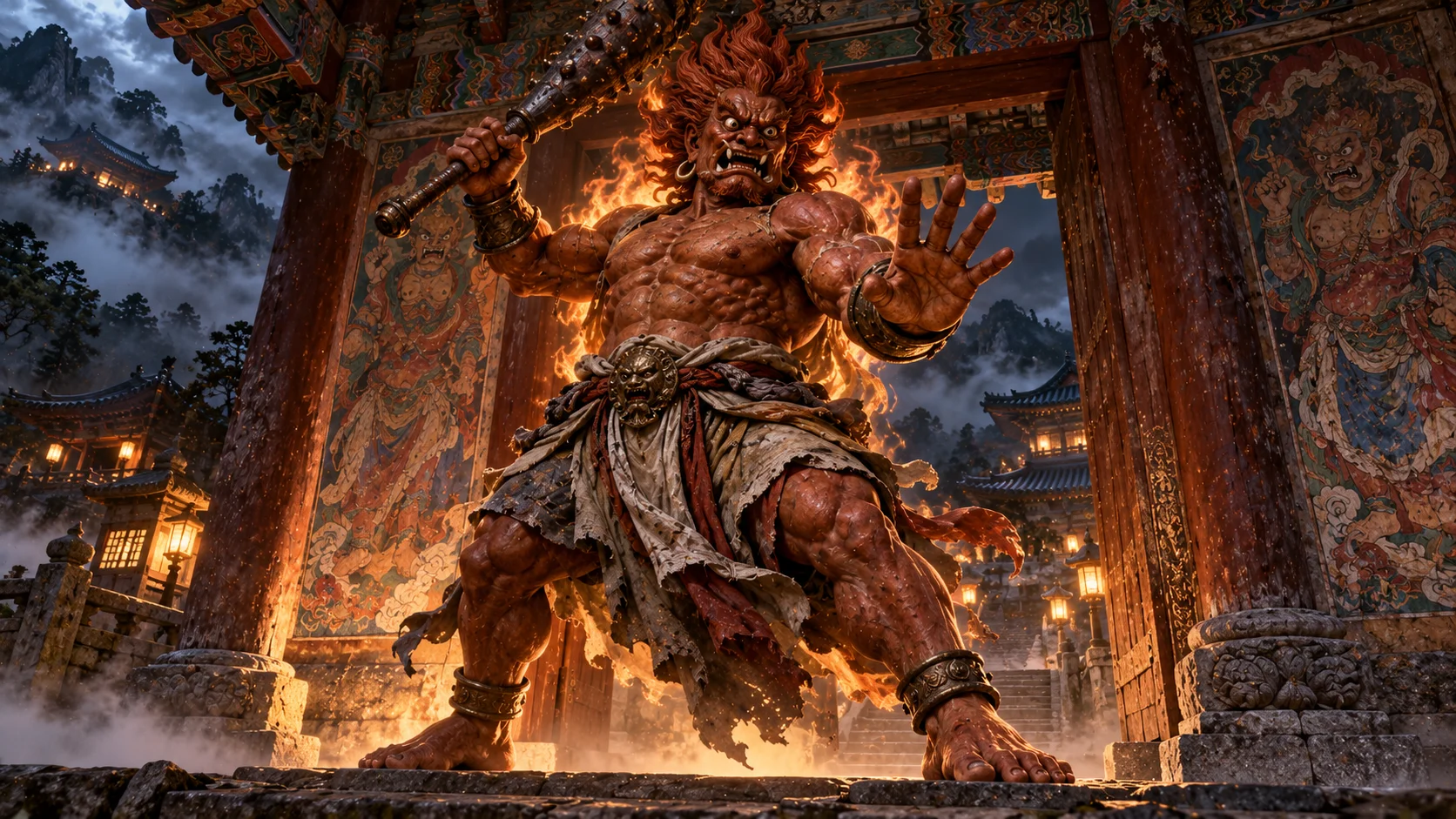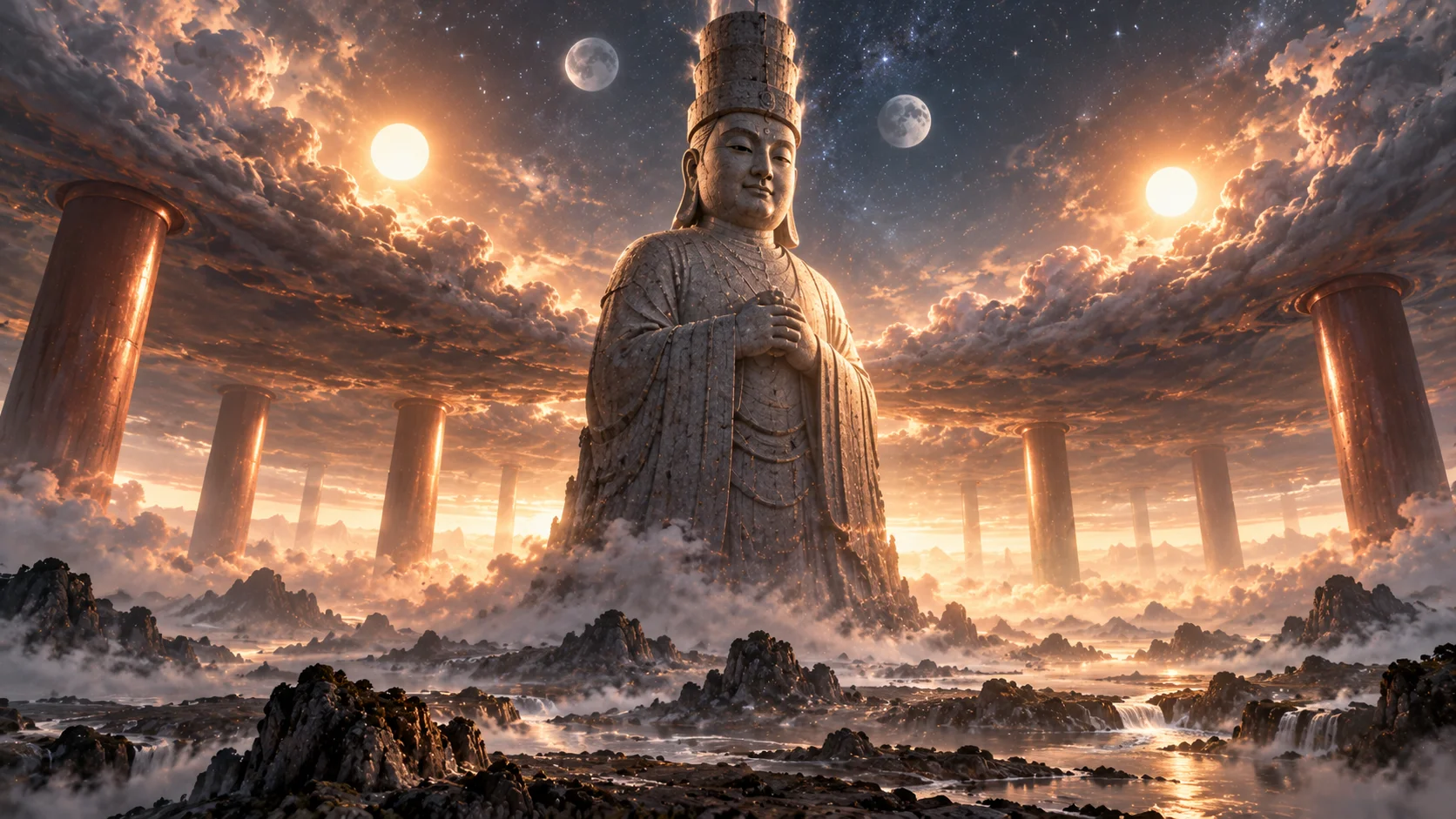
Mireuk (미륵) is the Korean rendering of Maitreya — in orthodox Buddhist teaching, the future Lord Buddha destined to descend to this world after the present Buddhist age has run its course, when the teachings of the historical Lord Buddha have faded from memory and the world stands in need of renewal. But in Korea, Mireuk has never lived only inside temple doctrine. Long before Buddhism arrived as an organized religion, and long after it settled into village life, Mireuk was absorbed into an older, indigenous layer of belief — the shamanic cosmology of muism — where he appears not as a distant figure awaiting a future age, but as a creator-god who once ruled the world directly, in a golden time now lost.
A Future Lord Buddha with a Past
The paradox at the center of Mireuk's identity is that a figure defined by futurity — the Lord Buddha who has not yet come — is remembered in Korean folk religion chiefly for a reign that has already ended. This is the layering that makes Mireuk worship in Korea so distinct from Maitreya devotion elsewhere in the Buddhist world. Formal Buddhist teaching keeps Mireuk oriented forward, toward a coming era of peace and plenty that he alone will usher in. Village and household religion, by contrast, folded him into a native creation narrative where he stood at the very beginning of things, not the end.
Both versions of Mireuk survived side by side for centuries, neither one erasing the other. Devotion to the roadside stone Mireuk-bul and formal chanting anticipating Maitreya's eventual descent coexisted across Korean religious life. The two Mireuks are, in the end, the same name carrying two different relationships to time.
The Cheonji-wang Bonpuri and the Separation of Heaven and Earth
The clearest surviving account of Mireuk as creator comes from Jeju Island, in the shamanic narrative tradition known as bonpuri — origin myths recited by ritual specialists called simbang during gut ceremonies. Chief among these Jeju narratives is the Cheonji-wang bonpuri, the "origin story of the Heaven-and-Earth King," which describes a time before heaven and earth had separated. Mireuk is the deity credited with dividing them — the bonpuri does not specify the mechanism by which this separation occurred, only that it is attributed to him.
This act places Mireuk not merely among Korea's supernatural figures but at the structural foundation of the cosmos itself, in the same register as the world-parting deities found across many of the world's oldest creation traditions. Having separated the two realms, Mireuk is said to have governed the resulting world during an age remembered as a golden age.
The Golden Age of Mireuk's Reign
Mireuk's original reign is remembered in the bonpuri tradition as a golden age — the world under his direct rule is described as prosperous and untroubled by comparison with what followed. The narrative treats this age as fragile rather than permanent, and its ending is not framed as decline or entropy but as the direct consequence of a contest between Mireuk and a rival deity over who would rule the human world.
Seokga's Challenge for the World
Into Mireuk's reign comes Seokga — the Korean name for Śākyamuni, the historical Lord Buddha, recast here as Mireuk's cosmic rival rather than his successor in the ordinary Buddhist sense. The bonpuri recounts a contest between the two deities over who would rule the human world — a contest Seokga wins through trickery, which is the reason the present age is understood as one of suffering and falsehood rather than Mireuk's original paradise. The bonpuri tradition does not specify the exact terms of the contest or the precise form the trickery took; those particulars are not preserved in the surviving accounts referenced here, and any specific description of a flower contest, its symbolism, or the mechanics of Seokga's deception would be embellishment beyond what the tradition, as recorded, establishes.
The Fall of the Golden Age
What the bonpuri does make explicit is the consequence: because Seokga's rule began through deceit rather than fair means, the present age — the one that followed Mireuk's golden reign — is one of suffering and falsehood rather than the ease and abundance that characterized Mireuk's original world. Korean shamanic cosmology, in other words, offers an etiology for why the present world is imperfect — not a punishment handed down from above, but the lingering consequence of how the current era began.
Mireuk's Departure and the World Seokga Inherited
With the contest lost, Mireuk withdraws from direct rule of the human world, and Seokga's flawed, present age begins. The bonpuri, in the broad shape preserved here, leaves room for the belief that would come to define later Mireuk worship: that a god who once ruled the world and lost that rule through another's trickery might yet be looked to for restoration.
This is the seam where the shamanic creator-god and the Buddhist future-Buddha rejoin. The two traditions, developed independently, converge on the same broad expectation — a coming era of peace and abundance — even though they arrive at it by entirely different roads: one through cosmic myth and a lost contest, the other through Buddhist doctrine and the natural decline of a teaching over vast spans of time.
Reciting the Myth in Ritual Practice
The Cheonji-wang bonpuri is not a story preserved only in written form or told casually as folklore; it is recited within the structure of Jeju shamanic ritual itself, performed by simbang during gut ceremonies alongside other origin narratives, including the myth cycle of Jacheongbi and the beginnings of agricultural order. In this context, the story of Mireuk and Seokga functions as living religious knowledge rather than antiquarian legend — an explanation, reactivated in ritual speech, for why the world behaves the way it does.
That the myth is performed rather than merely remembered matters. Each recitation renews the narrative's claim on the present, situating Mireuk's lost age not as a closed chapter but as a standing point of reference, carried forward every time the bonpuri is spoken aloud.
Stone Mireuk Across the Korean Landscape
Alongside this shamanic memory, a parallel tradition of Buddhist folk devotion produced one of Korea's most visible forms of religious art: colossal stone statues of Mireuk, known as Mireuk-bul, carved and erected across the peninsula over many centuries. These are not modest devotional objects tucked inside temple halls but towering figures meant to be seen from a distance, standing over villages, crossroads, and temple grounds.
The stone Maitreya at Gwanchoksa Temple in Nonsan is among the most celebrated of these figures — an immense standing image associated with the belief that Mireuk's eventual arrival will bring peace and abundance. Statues of this kind are understood as being believed to usher in that coming era; the specific devotional practices associated with any individual statue, including Gwanchoksa's, are not detailed in the sources drawn on here, and this piece does not claim to describe them.
Two Forms of Longing, One Name
What unites the doctrinal Maitreya of temple Buddhism and the wronged creator-god of Jeju shamanism is not theology but longing — a shared structure of expectation built around a figure who is not currently present but whose return is anticipated. For Buddhist practice, that expectation rests on cosmic time and the far-future decline of the current teaching. For shamanic practice, it rests on the memory of a contest lost to trickery. Both draw on two different vocabularies to express something remarkably similar: a conviction that the present arrangement of the world is not the way things were meant to be, and that Mireuk's return, or restoration, would set it right.
This dual character — future Lord Buddha and deposed creator, doctrine and myth held together without needing to be reconciled — is what has kept Mireuk so persistently present in Korean religious life outside as well as inside the temple gate, carried in stone, in ritual speech, and in the enduring shape of a story about a contest, a defeat by trickery, and a golden age that ended as a result.
Sources & traditions
- TraditionKorean texts, oral tradition and village tellings
Myths change from area to area and from time to time. This chronicle follows the most widely told versions; tellings in other villages, regions and eras may differ.