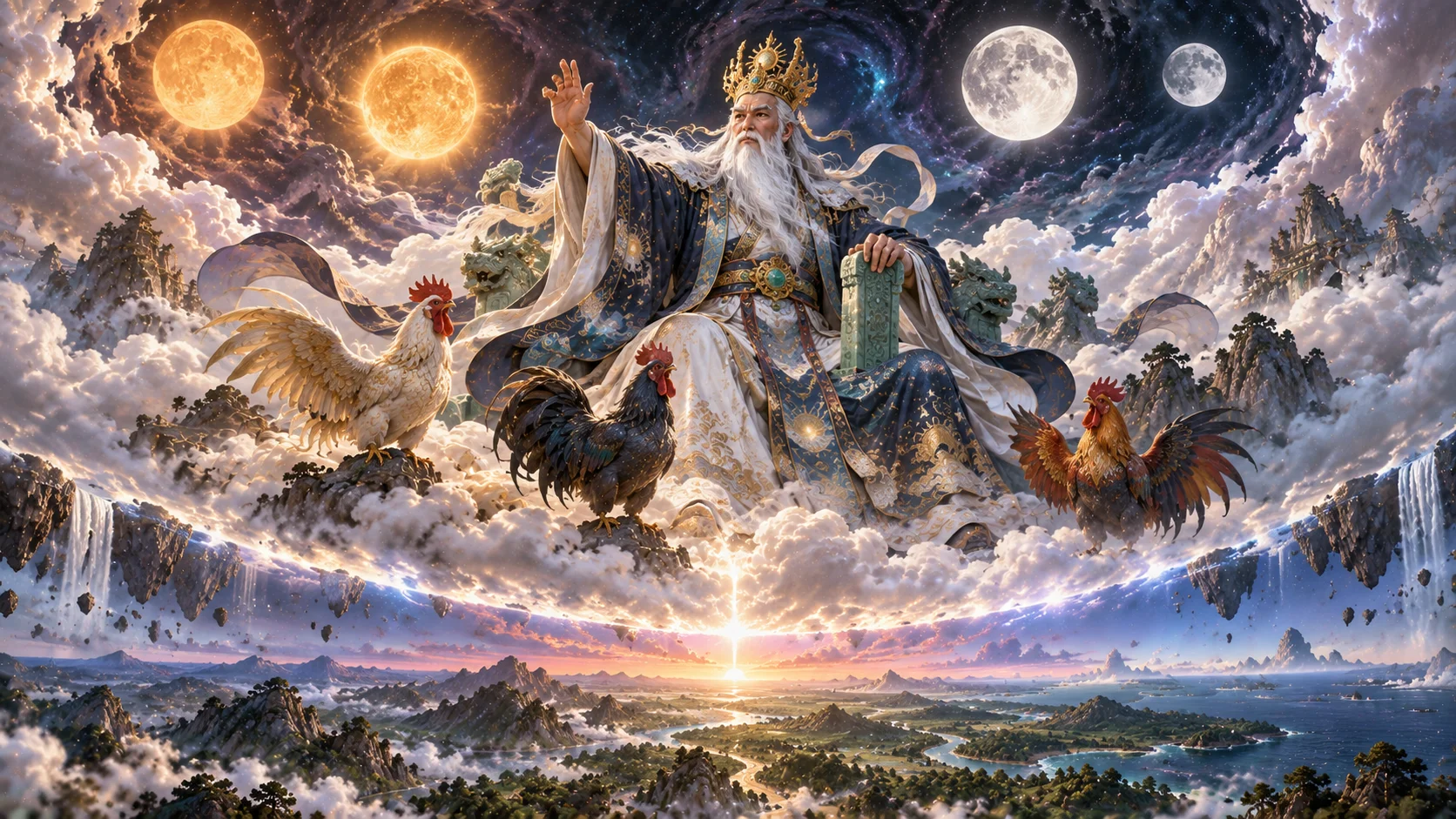
Cheonji-wang, the King of Heaven and Earth, stands as the supreme creator deity of the Korean shamanic cosmos — a figure remembered not in a royal court chronicle but in the sung and chanted verses of Jeju Island's shamans, who have carried his story across generations of coastal ritual. He is the central presence of the Cheonji-wang Bonpuri, one of Korea's foundational cosmogonic narratives, and through it he explains nothing less than how the sky came to separate from the earth, how the sun and moon took their places, and how order — however imperfect — came to govern the human world.
Before the Sky and Earth Were Torn Apart
The Cheonji-wang Bonpuri opens not with a world already made, but with a world still fused — heaven and earth pressed together in a single undifferentiated mass, without light, without season, without the vertical order that later mythic geography would take for granted. It is only through Cheonji-wang's presence and action that this primal fusion begins to loosen, sky lifting from ground, the first dews and vapors mingling to bring forth the earliest forms of things. This is a classic creation narrative in shape — a cosmogony — but it is told with a distinctly Jeju sensibility: intimate, domestic, and populated by characters who behave like people even as they reorder the universe. The myth credits this same founding moment with establishing the sun, moon, and cosmic order that later generations would take for granted.
A King Who Descends Rather Than Rules From Afar
Unlike sky deities in many traditions who remain remote, observing the world from a fixed and untouchable height, Cheonji-wang's myth is defined by his descent. He comes down to the human world, and it is this descent — not a distant decree issued from the clouds — that sets the rest of the narrative in motion. The myth's emotional center is not cosmic architecture for its own sake but the consequences of a heavenly king choosing to enter human affairs directly, forming a bond with a mortal woman and fathering children who will inherit the unfinished business of his descent.
Baekju, the Woman Who Bore Heaven's Sons
The human woman at the center of this union is named Baekju, also known in some tellings as Chongmyeong-buin. She is not a passive vessel in the narrative but the parent through whom Cheonji-wang's heavenly nature becomes rooted in the human world. Her sons, born of a sky king and an earthly mother, embody the myth's central tension: two domains, heaven and earth, brought together in a single bloodline, destined to be pulled apart again into separate spheres of authority — one over the living, one over the dead.
The Birth of Daebyeol-wang and Sobyeol-wang
Baekju bears twin sons, Daebyeol-wang and Sobyeol-wang, whose names mark them from birth as a pair of opposites — greater and lesser, elder and younger — set on a collision course with each other's destiny. In the logic of the Bonpuri, twins are never simply two of the same thing; they are two halves of a single cosmic settlement waiting to be decided. Their story picks up where their father's descent leaves off, carrying the myth from the register of cosmic origin into the register of succession, rivalry, and the founding of moral order.
The Flower-Growing Contest
The defining episode of the twins' story is not a battle or a divine tribunal but a contest of quiet, almost agricultural stakes — a flower-growing competition between Daebyeol-wang and Sobyeol-wang, staged to decide which brother will govern the world of the living and which will govern the world of the dead. Whichever brother succeeds in growing the more vigorous, more flourishing flower will be granted rule over the human world of the living, the richer and more desirable domain, while the loser is consigned to govern the world of the dead.
Sobyeol-wang's Trick and the Origin of Injustice
Daebyeol-wang, the elder, grows the stronger flower fairly — his blossom flourishes while his younger brother's withers. But Sobyeol-wang, unwilling to accept the underworld as his portion, wins through trickery: he swaps the flowers while Daebyeol-wang sleeps, presenting the healthier bloom as his own and claiming rulership over the living world by deceit. This single act of trickery is one of the most quietly radical moments in Korean mythology: myth-tellers cite it as the origin of injustice and disorder in human affairs. The world of the living is not ruled by the brother who earned it, and Jeju shamans reciting this myth are explicit that this is precisely why the human world remains imperfect — its very first ruler took his throne by cheating, and every unfairness since has been, in a sense, inherited from that founding lie.
Daebyeol-wang's Consolation and the Governance of the Dead
Cheated of the living world, Daebyeol-wang withdraws to govern the realm of the dead instead — a domain that, in the layered vertical cosmology the Bonpuri sets out, sits alongside the undersea kingdom of Yongwang and the judgment halls of Yeomra as one of the great parallel jurisdictions beneath and beyond the world of ordinary life. Where Sobyeol-wang inherits a world he did not fairly win, Daebyeol-wang inherits a world that, in its own way, is charged with correcting the imbalances the living world cannot resolve on its own — a narrative echo of Yeomra's later role reading the ledger of each soul's deeds and assigning its fate accordingly.
The Cheongung-maji and the Living Memory of the Myth
The Cheonji-wang Bonpuri is not a fossil text preserved only in old manuscripts; it survives because it is performed. It belongs to the General Bonpuri cycle recited by Jeju's simbang, the island's hereditary and initiated shamans, most prominently during the Cheongung-maji, a major ritual devoted to recounting the origin of the world. In this setting the myth is not simply narrated for entertainment or instruction but sung as an act of ritual necessity — a recitation believed to renew the order it describes, performed with the rhythms, instruments, and communal participation that mark Jeju shamanic practice as a living tradition rather than a historical curiosity. Reciting Cheonji-wang's descent and his sons' contest is, in this context, itself a small ritual re-enactment of the world's original ordering.
A Cosmos With Cheonji-wang at Its Summit
Korean shamanic cosmology, as preserved on Jeju, is best understood as a vertically layered universe, and Cheonji-wang occupies its highest tier. Below the heavens he tore open lies the world of the living his sons contested; beneath the land and sea stretches the domain of Yongwang, sovereign of every river, lake, and ocean; and beneath the world of the living entirely lies the underworld where the dead are judged, a realm whose ruler Daebyeol-wang came to inherit and which resonates with the judgment presided over by Yeomra. Even the transitional, in-between creatures of Korean folklore — the Imoogi, a serpent-like proto-dragon suspended between the mundane waters and the divine sky it aspires to ascend into — find their place in this same layered map, occupying the liminal space between Yongwang's watery kingdom below and the heavenly order Cheonji-wang first set in motion above.
Why the Myth Insists on an Unresolved Ending
What distinguishes the Cheonji-wang Bonpuri from many creation myths that end in tidy cosmic harmony is its refusal to resolve cleanly. The world of the living is left, quite deliberately, in the hands of the brother who won it by cheating. Jeju's shamanic tradition treats this not as a narrative flaw to be smoothed over but as the explanatory heart of the whole myth: it is offered as the reason imperfection, injustice, and disorder persist in human life at all. A creation myth that ended with everything set perfectly right would have nothing left to say about the world as it is actually experienced — flawed, uneven, and shadowed by the memory of an original unfairness. By ending instead on Sobyeol-wang's trick, the Bonpuri gives the living world an origin story that matches its lived texture.
Cheonji-wang's Place Among Korea's Ruling Deities
Set beside Yongwang's dominion over the seas and the rain that sustains agriculture, and beside Yeomra's solemn accounting of each soul's moral record, Cheonji-wang's authority is distinguished by its originating character: he does not administer an already-existing domain but brings the very framework of heaven, earth, sun, and moon into being in the first place. His sons administer what he created — one imperfectly ruling the living, one ruling the dead — but the initial act of separating a fused, undifferentiated cosmos into a livable world belongs to Cheonji-wang alone. It is this originating role, transmitted for generations through the sung verses of Jeju's simbang rather than through any centralized religious institution, that marks him as the summit of a distinctly Korean shamanic cosmology — one told, still, at the Cheongung-maji, by ritual specialists who understand themselves to be recounting the very reason the world holds the shape it does.
Sources & traditions
- TraditionKorean texts, oral tradition and village tellings
Myths change from area to area and from time to time. This chronicle follows the most widely told versions; tellings in other villages, regions and eras may differ.