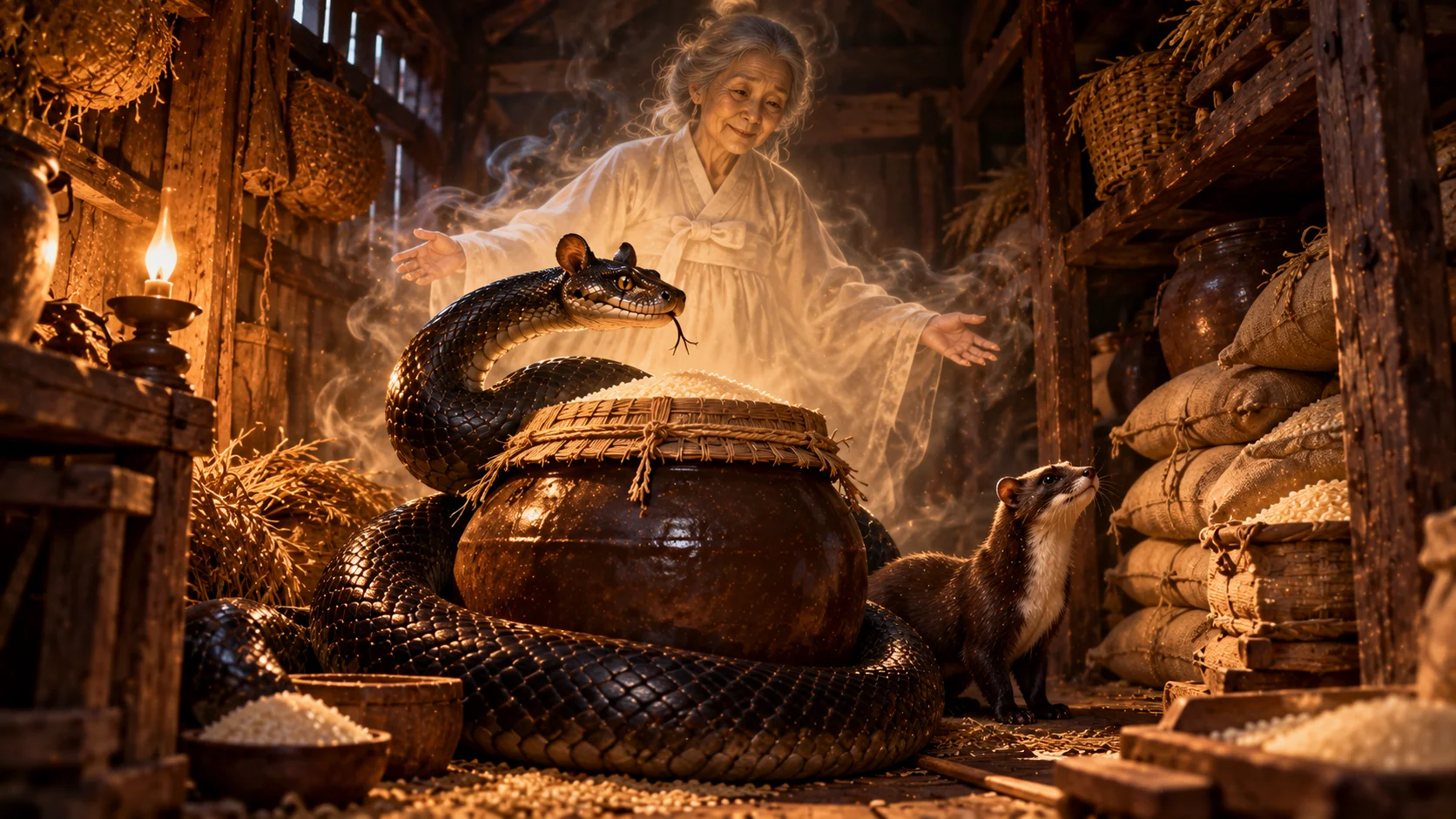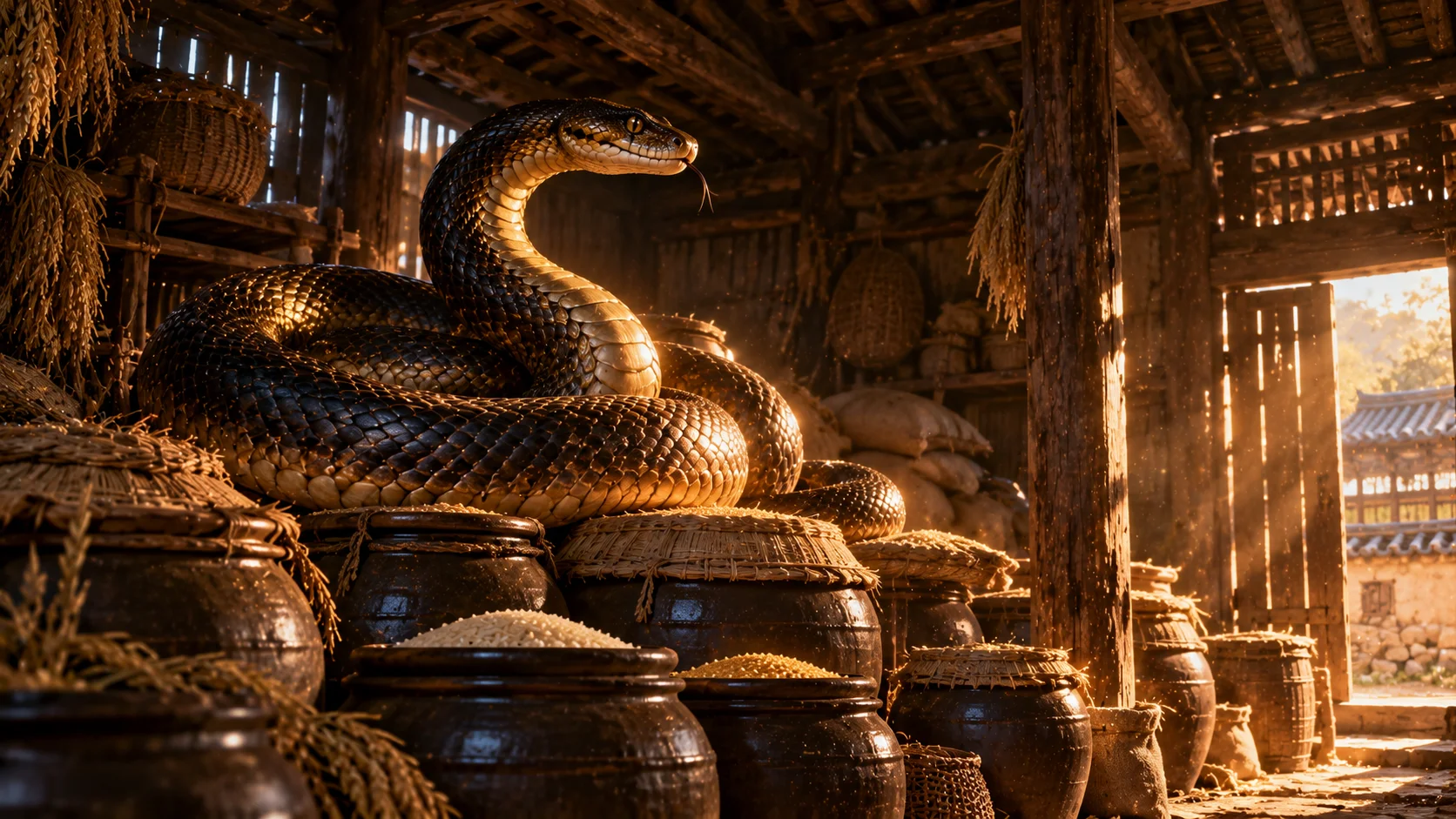
Eobshin (업신, sometimes rendered eopsin) is one of the quiet powers of the Korean home — a household deity of wealth, granary abundance, and family fortune, worshipped not in a shrine or temple but in the dark corner of a storehouse, beneath a floorboard, or coiled in the thatch of a roof. Eobshin belongs to the wider family of gasin (家神), the "house gods" of indigenous Korean shamanism, or muism, standing alongside figures such as Seongjusin (the house god) and the hearth deity Jowangsin. Eobshin's own domain, distinct from these fellow gasin, was the accumulated grain, coin, and cloth that separated a prosperous household from a hungry one. Eobshin belonged to ordinary families, in the most unremarkable spaces of the Korean home.
A Spirit Without a Fixed Face
Unlike deities who are given a settled appearance in painted scrolls or carved images, Eobshin has no single iconography. The spirit does not appear as a robed figure or a seated statue. Instead, Eobshin is believed to inhabit — to actually reside within — a living creature or a humble object kept somewhere in or beneath the house. This vessel is often called an eop (업), and the animal or item chosen to house it varied from region to region and household to household. In some accounts the eop was a snake, in others a toad, in others a weasel, and in still others simply the family's central jar of stored rice. What united all these forms was the belief that fortune itself had taken up residence in something ordinary, something a family might otherwise overlook, ignore, or even fear.
The House-Snake as Eop
The most widely recorded form of the eop-animal is the household snake, sometimes called an eopsa (업사). A snake discovered living quietly within the walls, under the eaves, or near the grain store was not something to be killed or driven away in the old Korean countryside — it was regarded as the eop itself, the living body through which Eobshin's blessing flowed into the family. To harm this snake, or to force it from the house, was believed to sever the household's connection to its own prosperity. Families who found such a snake were expected to leave it undisturbed, and in many communities the sight of a snake in the home was met not with the instinctive fear it might provoke elsewhere, but with a kind of cautious reverence — the sense that the family's fortune had, quite literally, moved in.
The Toad Beneath the Foundation
In other regions of Korea, the eop-animal took the form of a large toad said to live beneath the foundation stones of the house itself. This variant placed the spirit's vessel not in the walls or roof but in the earth the house was built upon, as though prosperity rose up through the ground into the family living above it. As with the house-snake, the toad was left alone, its presence treated as confirmation that the household's wealth rested on solid, spirit-favored ground. A family that dug up its foundations carelessly, or disturbed the creature living beneath them, risked more than structural damage — they risked disturbing the very thing that kept them fed.
The Weasel in the Thatch
A third regional variant identified the eop-animal as a weasel, known in some Korean dialects as a jokjebi, making its home in the thatched roof above the family. Where the snake and toad belief tied fortune to the walls and ground of the house, the weasel-eop placed it overhead, watching the household from the roofline. Across all three variants — snake, toad, and weasel — the underlying logic remained constant: an ordinary creature, one a family might otherwise trap, kill, or evict without a second thought, was instead understood as sacred by virtue of where it had chosen to live. The animal itself was not divine. Its residence was what mattered.
The Jar of Grain as a Bloodless Vessel
Not every household located its eop in a living creature. In many homes, the vessel of Eobshin was simply the jar or container that held the family's rice or grain reserves. This form of the belief needed no snake, toad, or weasel to sustain it — the grain jar itself, so long as it remained full and undisturbed, was treated as the physical seat of the household's fortune. Rice, after all, was wealth in the most direct and literal sense in an agrarian society: a full jar meant survival through winter, seed for spring planting, and a buffer against famine. Housing the eop-spirit inside the very substance that measured a family's material security made the belief almost self-evidently practical, even as it carried the full weight of the supernatural.
Karma's Word, Turned Toward the Hearth
The term "eop" itself carries an intriguing linguistic history. It is related to the Buddhist-derived vocabulary of karma — the concept of accumulated destiny arising from past action. Yet in the shamanic practice that produced Eobshin, this borrowed word was reshaped into something distinctly animistic and local. Eobshin's "eop" is not the doctrinal karma of Buddhist scripture, concerned with rebirth and moral cause across lifetimes. It became, instead, a household's accumulated fortune bound up in a physical, present, and tendable thing — a spirit you could feed, honor, and keep close, rather than a cosmic ledger stretching across incarnations. The word survived the journey from temple to farmhouse; its meaning was quietly rewritten along the way.
Offerings at the Grain Jar
Eobshin was not a deity who required elaborate temple ritual. Devotion took the modest, recurring form of household offerings — bowls of rice or prepared food set near the grain storage jar where the spirit was believed to dwell. These offerings were part of the ordinary rhythm of domestic religious life. The offerings asked for nothing dramatic: only that the fortune already present in the house be allowed to remain, to be pleased, and to stay.
Gut Rites at New Year and Harvest
Beyond these offerings, households also performed household gut — shamanic ceremonies — to placate and honor the eop-spirit more formally, especially during New Year or harvest rites. These rites clustered around two points in the agricultural calendar that carried the greatest anxiety and the greatest gratitude: the turning of the New Year, when a family looked ahead to the fortunes of the coming twelve months, and the harvest, when the grain jar was filled again and the household's survival through winter was, for the moment, secured. A gut performed for Eobshin was an act of both thanksgiving and insurance — gratitude for what had been provided, and a plea that it continue.
What Happens When the Eop Departs
The darker half of the Eobshin belief was as important as its blessings. If the eop-animal was killed, or driven from the house, the family's fortune was believed to leave with it. This was not framed as bad luck in some vague sense — it was understood as a direct, almost mechanical consequence: prosperity had a physical address in the home, and destroying that address evicted the prosperity along with it. This belief carried real practical weight in rural Korean life. It functioned as a powerful, superstition-backed reason not to kill snakes found in or near a home — an animal many people would otherwise reflexively fear or destroy was instead protected by the conviction that its life and the family's wealth were bound together.
A Pattern Shared Across East Asian Homes
Eobshin is not a uniquely Korean impulse so much as a distinctly Korean expression of a much broader East Asian pattern: the household as a space inhabited by its own protective and provisioning spirits, often tied to unassuming domestic animals or objects. Japanese folk tradition holds the zashiki-warashi, a child-spirit whose presence in a house is likewise linked to its fortune, and whose departure likewise foretells decline. Chinese household religion maintains its own hearth and wealth deities, tended with comparable seasonal offerings. Eobshin sits within this family of beliefs while remaining rooted specifically in Korean muism — its snake, toad, weasel, and grain-jar forms, and its particular vocabulary of "eop," belong to Korea's own shamanic vocabulary rather than to any imported Buddhist or Chinese framework, even where borrowed words like "eop" trace back to Buddhist-influenced concepts of karma.
Ordinary Creatures, Extraordinary Trust
What makes Eobshin distinctive within Korean folk cosmology is the sheer ordinariness of its vessels. This is not a spirit demanding a carved idol or a consecrated statue; it is a spirit that might already be living in your roof, your foundation, or your rice jar without your having noticed. That ordinariness is the point. Korean household religion repeatedly finds the sacred hiding inside the unremarkable — the same imaginative move that gives Korean folklore other creatures born from the transformation of common things into vessels of extraordinary power. Eobshin asked nothing of a family beyond attentiveness: leave the snake alone, keep the jar full, offer a little rice, and the fortune already sheltering in your home would have no reason to leave.
A Household God Rooted in Practice
Eobshin's story survives in the accumulated, regionally varied practice of ordinary households — in the snake left undisturbed in the wall, the toad beneath the floor, the weasel in the roof, the jar kept full, and the small offerings laid beside it at New Year and harvest. This is a deity defined by domestic practice rather than dramatic legend, and that is precisely what makes Eobshin one of the most human-scaled figures in Korean shamanic belief: a god small enough to live in a jar of rice, and important enough that no family wanted to risk letting it go.
Sources & traditions
- EncyclopediaWikipedia — Eopsin
- TraditionKorean texts, oral tradition and village tellings
Myths change from area to area and from time to time. This chronicle follows the most widely told versions; tellings in other villages, regions and eras may differ.