When a household falls silent and the last breath has gone out of a body laid on the floor of the main room, Korean tradition says a second visitor is already on the road. Not the soul's family, not the mourners gathering outside — but a stranger in black, moving with the unhurried certainty of someone who has done this before, and will do it again tonight, and tomorrow, and for as long as people continue to die. This is the Jeoseung Saja, Korea's psychopomp, the messenger sent to fetch the dead and walk them to the world beyond, called jeoseung.
A Black Coat on the Threshold
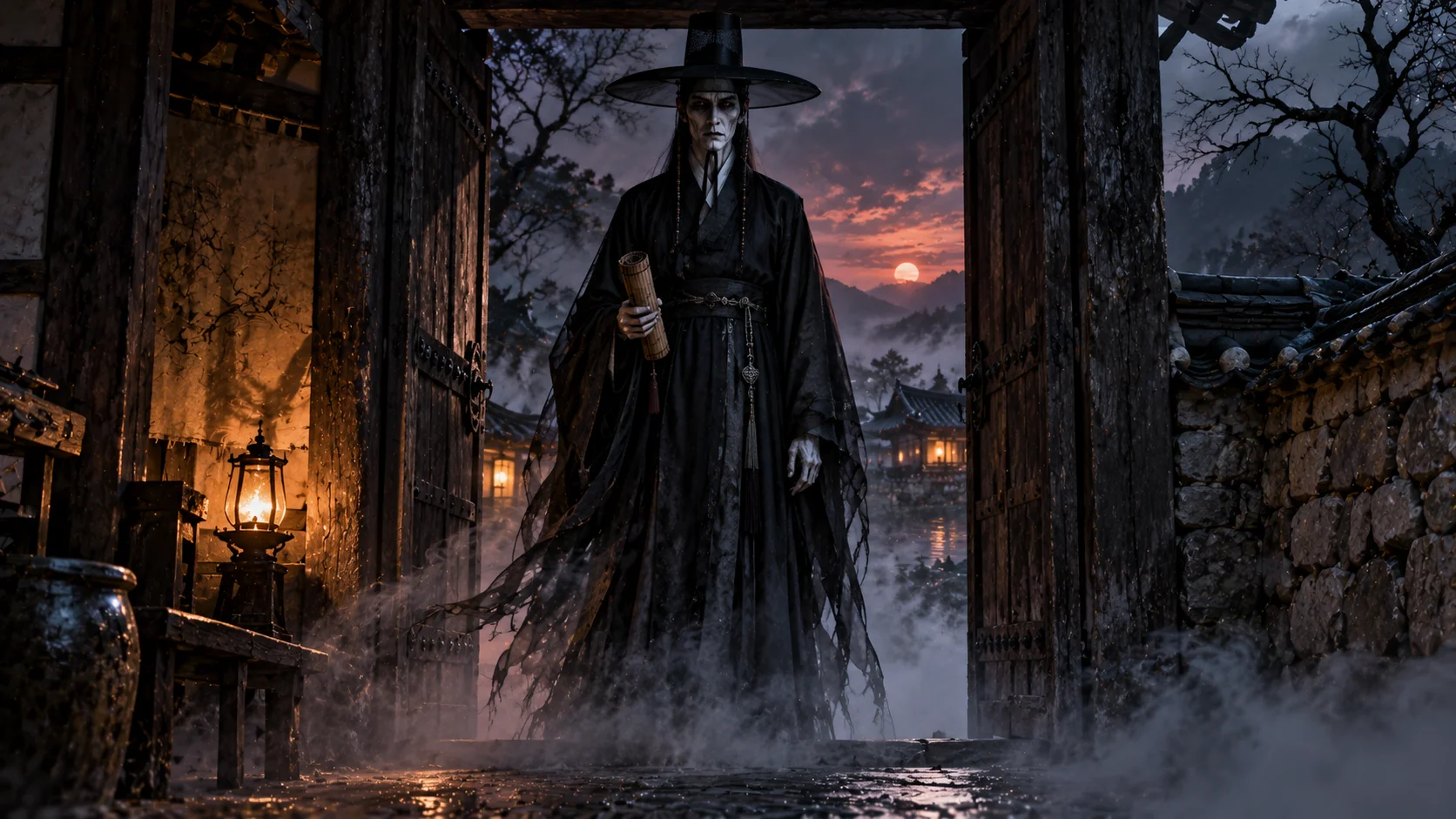
The image is fixed and immediately recognizable across Korean folk art, film, and shamanic ritual painting: a tall figure in the black official robes of a Joseon-dynasty government clerk, with a black gat — the traditional horsehair hat — set low over the brow. The bureaucratic costume is not incidental. Jeoseung Saja is imagined as a civil servant of the afterlife, a functionary executing a summons rather than a hunter stalking prey. There is no malice in the traditional conception, only procedure. A name has been entered into a ledger somewhere beyond the visible world, an appointed hour has arrived, and the messenger has been dispatched to see that the transfer is completed without delay or error.
That bureaucratic framing separates Jeoseung Saja from monstrous death-figures elsewhere in world folklore. He is not a reaper who causes death with a scythe; he arrives after the decision has already been made higher up the chain, to escort what remains of a life to its next destination. The horror he carries is administrative — the horror of paperwork nobody can appeal, not the horror of a blade.
The Long Walk to Jeoseung
The word jeoseung names the far shore, the realm on the other side of the boundary that separates the living world, iseung, from everything that comes after. Korean cosmology treats death not as an ending but as a journey with a fixed itinerary, and the newly deceased are thought to be disoriented, frightened, and in need of a guide who knows the route. That is the core function of Jeoseung Saja: less an agent of death than a chaperone through unfamiliar country, someone who has crossed the threshold thousands of times before and will not lose his way even if the soul in his charge does.
The path is long, and Korean folk belief holds that a single soul is not always left to walk it with only one companion. Tradition allows for multiple Jeoseung Saja to be dispatched together to escort a single soul — a detail folk sources record without spelling out exactly why, leaving room for a family to imagine it as one more form of care taken over the dead.
Rice, Coins, and Straw Shoes
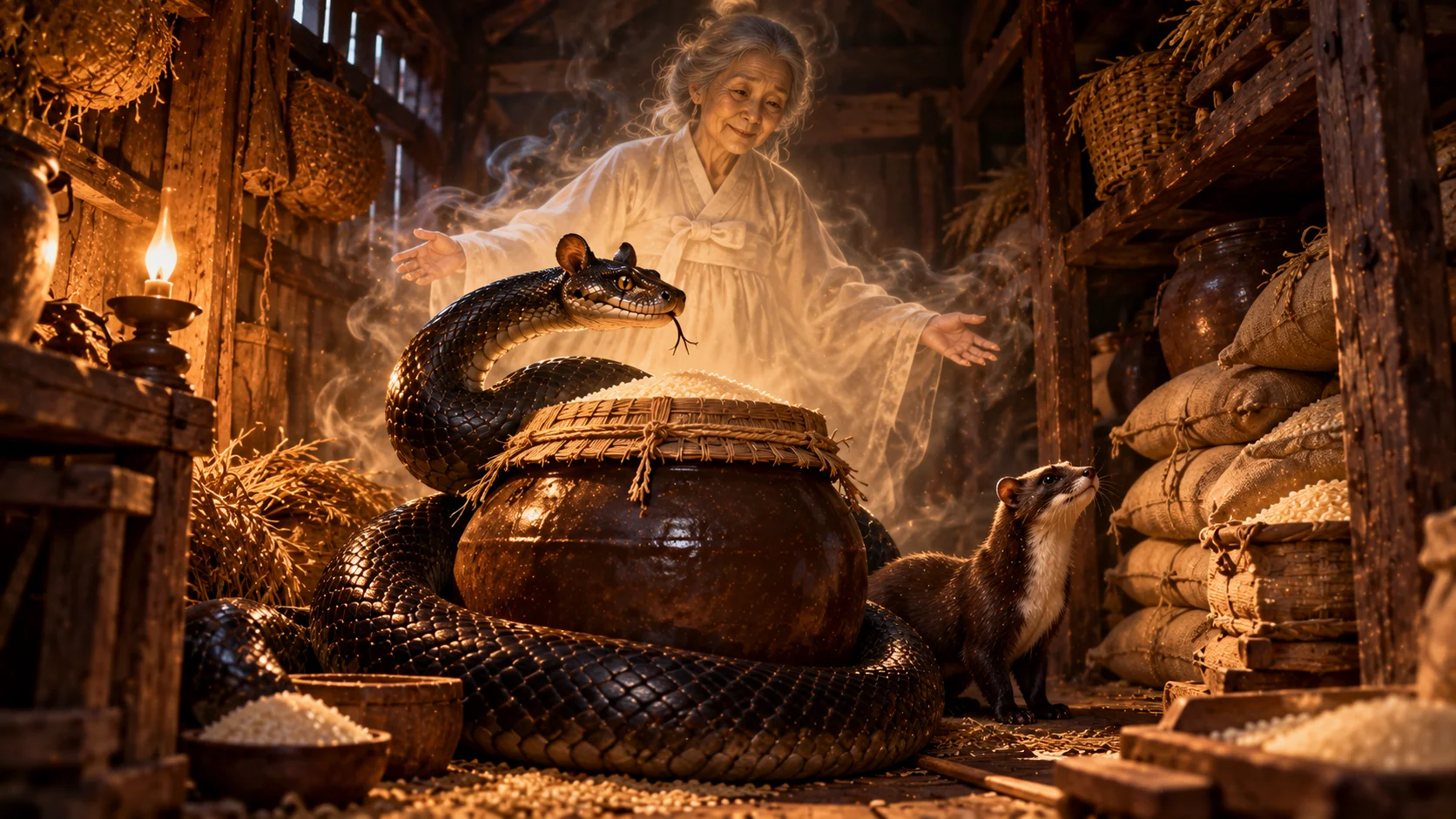
Because the messenger must be dealt with rather than simply feared, Korean funerary custom developed a practical response: appeasement through hospitality. Families traditionally set out jeon-sa-bap, a ritual meal of rice and coins, along with small offerings of money and even straw shoes, positioned near the deceased or at the household's threshold. The straw shoes speak to the length of the road ahead — a messenger who has to walk a dead soul all the way to the other side will wear out his footwear, and a family that provides a fresh pair is buying a measure of goodwill.
The logic behind the offering is neither transactional in the sense of a bribe to reverse fate, nor purely symbolic. It sits somewhere between: an acknowledgment that the passage itself can be made gentler or harsher depending on how the escort is inclined to treat his charge, and that a grieving family retains at least this one small form of agency in a situation otherwise stripped of any. Feed the messenger well, the custom implies, and the soul in his keeping travels more easily. Ignore him, and the road may prove needlessly hard.
Beyond a Single Judge
Jeoseung Saja does not operate in isolation, and Korean vernacular belief did not invent him from nothing. He is bound tightly to a much larger cosmological apparatus absorbed into the peninsula's folk religion from Chinese Buddhist and Daoist sources: the Siwang, the Ten Kings of the underworld. In this system, the deceased soul does not arrive at a single verdict but passes through as many as ten successive courts, each presided over by its own king, each concerned with a different reckoning of the life just ended. Sin, virtue, intention, and consequence are weighed and re-weighed across these tribunals before a soul's ultimate disposition is finally settled.
Jeoseung Saja's role within this machinery is that of the essential first link: without an escort to physically deliver the soul from the world of the living to the first court, the entire judicial process downstream has nothing to judge. He is not one of the ten judges and holds no authority to rule on anyone's fate. He is transport and custody, the officer who makes the arrest, so to speak, so that trial can begin. It is a modest role in the grand architecture of the afterlife, and that modesty is precisely what makes him so present in the popular imagination — everyone eventually meets the messenger, whether or not they ever stand before a king.
An Underworld Borrowed and Made Local
The Ten Kings cosmology did not originate in Korea. It traveled from Chinese Buddhist and Daoist afterlife traditions, entering Korean folk Buddhism over centuries and fusing with older shamanic understandings of death that were already deeply rooted on the peninsula. Jeoseung Saja himself sits at exactly this fusion point — a figure whose black official's robes evoke the very real world of Joseon-dynasty bureaucracy and law, applied metaphorically to a cosmic administration that borrows its structure from imported Buddhist doctrine while being staffed, in the popular imagination, by a distinctly Korean civil servant.
This is a recurring pattern across Korean mythology: a framework arrives from a continental neighbor and is reclothed in local costume and local logic until it no longer reads as foreign at all. The Ten Kings remain recognizably Buddhist in their function. The messenger who delivers souls to them wears the clothes of a Korean magistrate, and the family standing over the deathbed leaves out food and shoes according to customs with no direct equivalent in the source tradition. The result is not a copy of an imported system but a distinct Korean elaboration of it.
A Cousin, Not a Twin, of the Ghost
Korean folklore is careful to distinguish Jeoseung Saja from the restless dead he sometimes escorts. A gwisin, an ordinary ghost, belongs to the category of spirits born of death rather than of objects — the fundamental line folk tradition draws between a ghost and a trickster spirit like the dokkaebi. The messenger's own purpose sits alongside that distinction: he is the figure charged with getting a soul across to the other side at all, and a soul under his escort is, by definition, one that is making the crossing rather than remaining behind among the living.
He is equally distinct from spirits born of objects rather than of death, such as the mischievous dokkaebi, who traditionally arise from old household tools and blood-stained items rather than from any human soul at all. Where dokkaebi folklore is full of playful contests — dokkaebi are said to love wrestling matches with humans (always supposedly weaker on their left leg) and to trick greedy people while rewarding honest ones — Jeoseung Saja has no interest in games, contests, or moral testing. His visits are not negotiable and his errand does not change based on cleverness or virtue, a contrast that says as much about how differently Korean folklore treats death and mischief as it does about the figures themselves.
Neither Devil Nor Angel
It is worth resisting the impulse to translate Jeoseung Saja too neatly into "grim reaper" and stop there, because the Western reaper carries theological freight — sin, damnation, an adversarial cosmic order — that does not map cleanly onto the Korean figure. He is not evil. He is not judging anyone; that work belongs to the Ten Kings waiting further down the road. He does not choose who dies, nor does he take any apparent pleasure in the task. He is closer, in spirit, to an official executing a writ that was drawn up somewhere entirely beyond his authority, arriving because the hour listed on it has come due.
That neutrality is part of what has kept the figure so durable in Korean storytelling across centuries: solemn, correct, occasionally even sympathetic to the humans he must collect, bound by rules he did not write and cannot bend, even when a family's grief or a soul's terror might move an ordinary person to relent.
Waiting at Every Threshold
What makes the Jeoseung Saja tradition durable is not spectacle but universality. Dragons guard treasure and heroes slay tigers, but every single household, eventually, receives this particular visitor — there is no family in the tradition's imaginative world exempt from a knock at the door from the black-robed messenger. That inevitability is precisely what the funerary offerings were built to soften: not to cancel an appointment nobody can cancel, but to make sure that when the appointment comes, it is met with rice, with coins, with a fresh pair of shoes, and with whatever small measure of grace a frightened family can still offer to the stranger who has come, as he always does, right on time.
Sources & traditions
- EncyclopediaWikipedia — Jeoseung Saja
- TraditionKorean texts, oral tradition and village tellings
Myths change from area to area and from time to time. This chronicle follows the most widely told versions; tellings in other villages, regions and eras may differ.