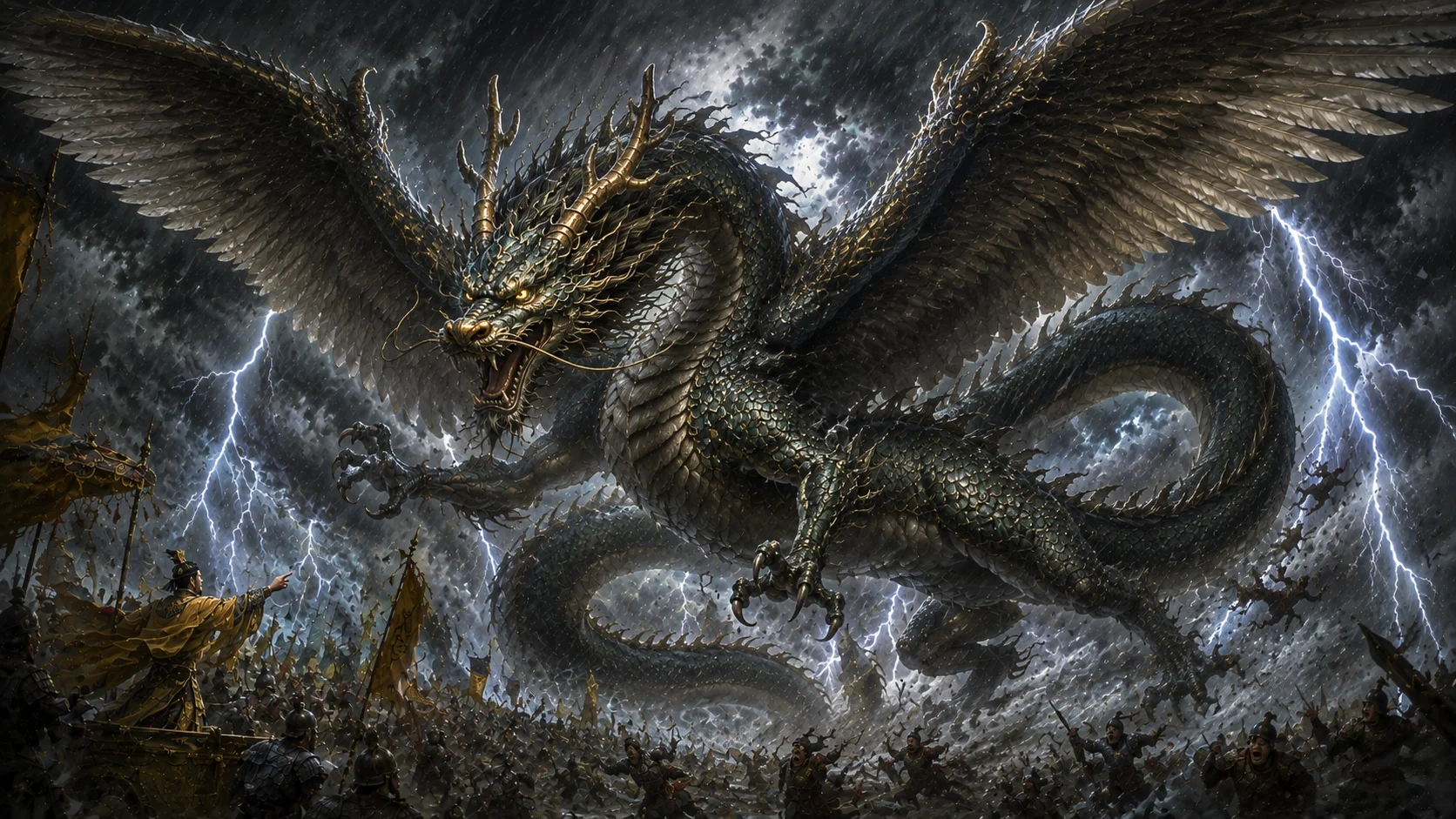
Among the dragons of the old texts, most are wingless — the serpentine jiaolong coiled in river pools, the horned qiulong basking on stone. Yinglong, the Responding Dragon, is not one of these. He carries wings, and in a mythology where flight is rare and dearly earned, that alone marks him as something older, stronger, and closer to the sages than any river-spirit could claim to be.
A Name That Answers
The character 應 (ying) means "to respond" or "to answer a summons," and later tradition reads Yinglong's name accordingly: he is the dragon who comes when a sage-king truly needs him, not a spirit who must be coaxed or bribed with offerings. This distinguishes him sharply from the regional rain-dragons invoked in later folk ritual. Yinglong does not wait in a shrine for incense. He answers a call from the very summit of heaven's order, and then withdraws.
The Earliest Record
The Shanhaijing, the Classic of Mountains and Seas, compiled across centuries from the Warring States period into the Han dynasty, is the earliest major text to describe him. In its chapter "Da Huang Dong Jing," the Classic of the Great Wilderness: East, Yinglong appears already fully formed as a being of consequence — winged, ancient, and bound up with the great crises of the mythic age. Nothing in the text explains his origin. He simply exists, as old as the mountains the book catalogues, a power the compilers assumed their readers already knew to fear and honor.
The Wings That Set Him Apart
In the layered cosmology of Chinese dragon-lore, wings are not a given; they are an inheritance earned through vast spans of time. The Shuyi Ji, compiled by Ren Fang in the Liang dynasty, lays out the stages a dragon must pass through: a jiaolong that endures a thousand years becomes a long, a true dragon; five hundred years further and it grows horns, becoming a jiaolong of a higher order; a thousand years beyond that, if it survives, it becomes Yinglong, winged and complete. By this reckoning Yinglong represents no less than twenty-five centuries, and very possibly three millennia, of unbroken cultivation. He is not merely a dragon among dragons. He is what a dragon becomes when nothing has managed to end it.
Called to Zhuolu
His greatest and most repeated myth belongs to the battle of Zhuolu, where the Yellow Emperor, Huangdi, met the rebel Chiyou in a war that mythographers remember as one of the founding conflicts of Chinese civilization. The Shanhaijing states plainly that Yinglong was ordered into the fight, and that his weapon was water: he was to impound the floodwaters and then release them upon Chiyou's forces, drowning an army the way a dam drowns a valley when it breaks. This was not brute violence. It was calculated hydraulic warfare, entrusted to the one being capable of holding a flood in reserve and loosing it at the precise moment it would matter most.
Storm Against Storm
Chiyou did not stand still against this. He appealed to Fengbo, the wind god, and Yushi, the rain god, who answered with a storm fierce enough to undo Yinglong's careful design — turning the battlefield to chaos before the impounded waters could be released with any precision. Huangdi's response was to summon his own daughter, Ba, a drought demon whose very presence dried the storm from the sky. Only once Ba had silenced the rain could Yinglong finally act, releasing the waters he had held back and turning the tide of the battle decisively toward the Yellow Emperor. It is a myth built entirely from opposing elemental forces — wind against water, drought against storm, and Yinglong waiting at the center of it all for the one clear moment to strike.
The Dragon Who Went South
The Shanhaijing does not end the story with victory. It adds a coda: after Zhuolu, Yinglong went to live in the south. The text offers this almost in passing, yet it carries enormous explanatory weight, for it is presented as the very reason the southern lands of China receive more abundant rainfall than the parched north. A single dragon's choice of residence, in this telling, reshaped the climate of half a continent. It is myth functioning as geography — an ancient culture reading the uneven fall of rain across its own land and finding, at the root of that unevenness, a dragon who simply decided where he would rather dwell.
Carving the Rivers for Yu
Long after Chiyou's defeat, when the Great Flood threatened to drown the whole of the known world, it was Yu the Great who took up the labor of taming it — and Yinglong who is remembered as his indispensable partner. Where Yu directed the work of controlling the deluge, Yinglong is credited with physically shaping the channels the water would follow, using his tail, and in some tellings his claws, to gouge long furrows across the land. Those furrows, the myths hold, became the courses of China's major rivers. One version of the story makes the method vivid: Yinglong dragged his tail steadily along the ground ahead of the diggers, marking precisely where Yu's laborers should cut, so that dragon and sage-king worked as a single engineering will, one tracing the plan and the other executing it in earth and stone.
Flood as Weapon, Flood as Gift
What makes Yinglong's myth cycle so coherent is the way it uses the same force twice, to opposite ends. At Zhuolu, floodwater is a weapon, released with intent to overwhelm an enemy. In the labor with Yu, that same mastery over water becomes a civilizing act, carving the channels that let rivers run where they should rather than where they would otherwise ruin the land. Yinglong is not a god of destruction who happens to also help, nor a benevolent spirit who happens to also fight. He is, at his core, a being who understands water absolutely — and understanding it that completely means being able to unleash it or discipline it, as the moment requires. That duality, destroyer and builder in a single figure, is the clearest statement the myths make about what rain and flood actually mean to those who live beside a river: the same water that drowns a field in one season feeds it in the next.
Kin to the Torch Dragon
Some threads of the tradition draw Yinglong close to Zhulong, the Torch Dragon of Zhangwei Mountain, another primordial serpentine figure from the Shanhaijing said to govern the turning of day into night and the cycle of the seasons through the opening and closing of his eyes. The two are occasionally conflated in later retellings, both being ancient, both being cosmic in scale rather than merely large. Most careful readers of the old texts keep them distinct — Zhulong's domain is light and time, Yinglong's is water and flood — but the blurring itself says something about how these primordial dragons were remembered: as forces first, and individuals second, their names sometimes drifting together in the long transmission of the tales.
At the Harness of the First Sovereigns
Fragments of cosmogonic myth reach further back still, tying Yinglong to Fuxi and Nüwa, the primal brother-and-sister sovereigns credited with shaping humanity and the first order of the world. In some of these fragments Yinglong is imagined pulling their chariot, or serving as the mount that carries a high deity across the heavens. It is a small detail beside the grand drama of Zhuolu and the flood, but it fits the larger pattern of winged dragons throughout the tradition as instruments of divine transport, bridging the distance between the sovereign above and the world below in the same way Yinglong elsewhere bridges destruction and creation.
Where the Rivers Remember Him
The name Yinglong is bound into Chinese geography itself, echoed in place names and in the Ying River region associated with the old flood-control legends. This is myth doing the quiet work of explaining a landscape — a way for a people who lived by the rhythm of their rivers to account for why the water ran where it did, by rooting the channel's very shape in the labor of a dragon and a sage-king working the earth together in the deep past.
The Dragon Who Withdrew
Unlike the Longwang, the regional dragon-kings who preside over particular lakes and seas and are still petitioned in local rain rituals, Yinglong is not the figure villagers turn to when a season runs dry. Later folklore, reaching into the Ming and Qing dynasties, offers an explanation: his labors at Zhuolu and beside Yu's flood-workers left him spent, and he withdrew underground or into the deep waters to rest, his power drawn down by the very acts that made him legendary. It is a fitting end for a being defined by his readiness to answer a true summons — having answered the two greatest calls in the mythic age, he does not linger to be summoned for lesser ones. The rain gods of household ritual are gods of the present season. Yinglong belongs to the founding of the world, and having done that founding work, he has earned his rest beneath it.
The Eldest Shape of the Dragon
Read across all these threads, Yinglong stands less as one dragon among many and more as an image of what dragon-nature is understood to become at its fullest maturity: winged where others are wingless, called upon by sovereigns where others are worshipped by farmers, remembered in the shape of rivers and the fall of rain across whole regions rather than in a single shrine. He is the dragon who was there when the world's great crises were still being resolved by hand — flood against army, tail against riverbed — and who then returned to the depths, leaving the rain and the rivers as the only proof that he was ever needed at all.
Sources & traditions
- EncyclopediaWikipedia — Yinglong
- TraditionChinese texts, oral tradition and village tellings (China)
Myths change from area to area and from time to time. This chronicle follows the most widely told versions; tellings in other villages, regions and eras may differ.