The Dragon King of the East Sea, Ao Guang, is one of the Four Dragon Kings who rule the waters surrounding the terrestrial world. Sovereign over the East China Sea, he stands alongside three brothers who together govern the whole of the ocean realm, each bound to a direction, a season, and an element in the old correlative cosmology. Ao Guang belongs to Wood and to Spring, the quarter of the compass where the sun rises and where, in the old agricultural imagination, the year's water first stirs toward the fields. To understand him is to understand how an entire civilization pictured the sea not as an empty wilderness but as a governed territory, with a court, a treasury, and a chain of command reaching all the way to Heaven.
The Four Who Divide the Ocean
Chinese cosmology did not imagine one sea but four, each pressed against a different edge of the known world and each entrusted to a brother: Ao Guang in the east, Ao Qin in the south, Ao Run in the west, and Ao Shun in the north. Together they are the Sihai Longwang, the Dragon Kings of the Four Seas, a family arrangement that mirrors the way Chinese emperors divided the realm among trusted kin and officials. Their canonical names, faces, and temperaments were fixed for later generations by Wu Cheng'en's sixteenth-century novel Journey to the West, which gave literary form to what had already been centuries of oral and ritual tradition. Of the four, Ao Guang is the one whose stories were told and retold most often — his name became, in ordinary speech, nearly synonymous with the Dragon King as a category, thanks above all to his recurring, central role in two of the most famous episodes in Chinese popular literature.
Currents Older Than the Name
The figure worshipped as Ao Guang did not spring fully formed from a single storyteller's imagination. He is a confluence of two much older streams of belief. From India came the Buddhist Nagaraja, the serpent-king who guards treasure and commands the waters beneath rivers and seas — a concept that traveled into China along with Buddhist scripture and imagery. From native Chinese soil came the long, the dragon proper, revered since the Shang and Zhou dynasties as the power behind rain and the fertility of the fields, a deity whose favor a farming civilization could not afford to lose. Over centuries these two currents merged into a single syncretic cult, Taoist in its bureaucratic trappings and Buddhist in some of its underlying imagery, producing the dragon-king we recognize today: neither purely a nature spirit nor purely a foreign import, but something new made of both.
A Throne Granted by the Court of Heaven
What set the Dragon Kings apart from countless older nature spirits was their formal incorporation into the state religion. Worship consolidated into an organized cult during the Tang and Song dynasties, and in 1110 the Song emperor Huizong took the decisive step of granting the four sea dragons royal titles — Wang, King — placing them officially within the celestial civil service beneath the Jade Emperor, Yu Huang Dadi. This was not a poetic gesture. It meant that a dragon king was, in the eyes of the imperial state and its subjects, an official: a being with rank, jurisdiction, and superiors, who could be petitioned through proper channels, praised for good service, and in principle even rebuked for failing his duties. The sea itself became, in the popular imagination, a province with its own governor.
The Crystal Palace Beneath the Waves
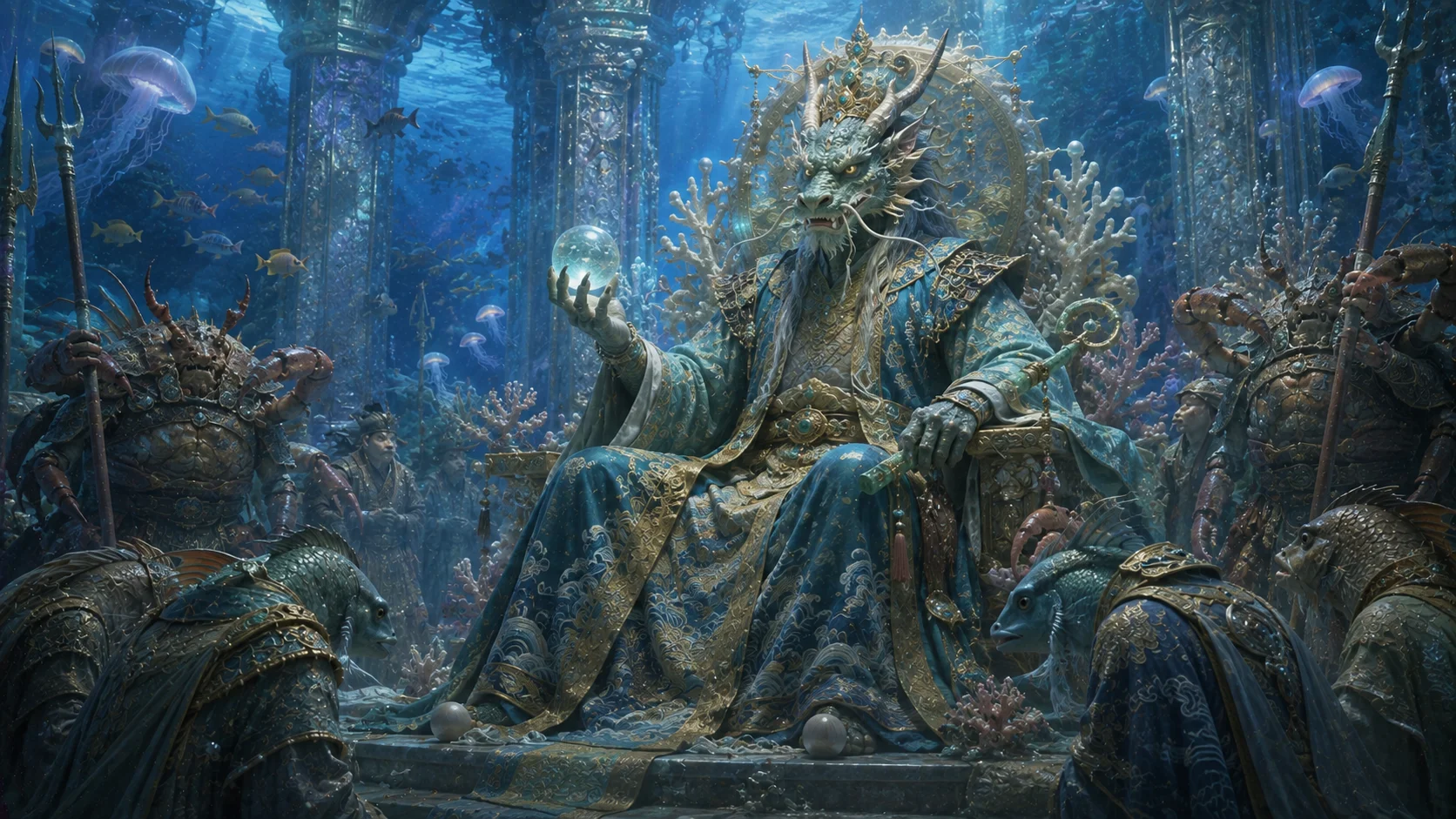
Ao Guang's seat of power is the Shuijing Gong, the Crystal Palace, sunk at the floor of the East China Sea. Journey to the West describes it as a treasure house beyond ordinary imagining: halls glittering with pearls, corridors lined in coral, vaults holding weapons and armor forged for gods rather than men. It is staffed by an undersea bureaucracy in miniature — shrimp soldiers standing guard, crab generals commanding the watch — a court that apes the pomp of any earthly kingdom, only rendered in the textures of the ocean floor. This image did more than entertain; it reinforced the idea of a dragon king as a wealthy, dignified sovereign whose court could be visited, negotiated with, or, as one famous visitor discovered, robbed.
The Monkey Who Emptied the Treasury
No episode defined Ao Guang for later generations more than his encounter with Sun Wukong, the Monkey King. Arriving at the Crystal Palace in search of a weapon worthy of his strength, Sun Wukong demanded tribute from his unwilling host and ultimately made off with the As-You-Will Gold-Banded Staff, an iron pillar once used by the flood-taming hero Yu the Great to measure the depths of the world's waters. What had been a sunken tool of ancient engineering became, in Sun Wukong's hands, the signature weapon of the most famous trickster in Chinese literature. When Ao Guang's brothers arrived from their own seas to help him resist, they too were overpowered, and the humiliated dragon king was forced to add insult to loss: a suit of golden chainmail and a phoenix-feather cap, surrendered along with the staff. It is a story that captures, in miniature, the precarious dignity of the dragon kings throughout Chinese storytelling — vastly powerful, richly appointed, and still perpetually at the mercy of a braver or cleverer visitor.
A Son's Cruelty and a Father's Fury
The most consequential of Ao Guang's stories is not his own humiliation but his son's death. In the beloved legend of Nezha Stirs Up the Sea, Ao Guang's son — remembered in many tellings as Ao Bing — abuses his authority over coastal waters and terrorizes the people who live along them, until the divine child Nezha confronts and kills him. What follows is not a father's private grief but a father's demand for state justice: Ao Guang threatens to drown the mortal town where Nezha's parents live and carries his grievance all the way to the Jade Emperor's court, escalating a local tragedy into a matter for Heaven itself to judge. The crisis resolves only through Nezha's own extraordinary act of atonement, cutting away his flesh and bone to repay the debt his birth had placed on his parents — one of the most striking images of sacrifice in the entire Chinese mythic tradition, and one that only exists because of Ao Guang's wrath.
Investiture of the Gods and a Harsher Portrait
The Ming-dynasty novel Fengshen Yanyi, the Investiture of the Gods, gives this same conflict its fullest and least flattering treatment of the dragon kings. There they appear as proud, quick-tempered rulers of the sea, capable of real cruelty toward the mortals whose rivers and coastlines fall under their authority. This darker portrait sits in open tension with the dragon king's older, gentler role as the bringer of needed rain — a reminder that Chinese myth rarely offers its deities as uncomplicated benefactors. Ao Guang could be, in the same tradition, the answer to a farmer's prayer and the terror of a drowned village, and storytellers across the centuries felt no need to resolve the contradiction.
Rain Sought at the Water's Edge
Behind the palace intrigue and the literary drama lies the older, quieter devotion that never stopped: the plea for rain. Ao Guang and his fellow dragon kings were the deities a farming and fishing society turned to when the skies would not open or the seas would not calm. Longwang Miao, Dragon King temples, stood along rivers, lakes, and coastlines throughout historical China, especially dense in the southern provinces where water governed everything from the rice harvest to the safety of a fishing fleet. During drought, communities carried out processions and offerings at these shrines, treating the dragon king not as a distant literary figure but as a working official whose favor could be petitioned, much as one might petition a magistrate. The Dragon Boat Festival and the broader constellation of coastal dragon-worship rituals, especially strong in Fujian and Guangdong, grew from this same need to placate the powers governing storm, tide, and catch.
The Face Beneath the Crown
Artists and temple sculptors settled on two ways of showing Ao Guang, and both mattered. In his fully serpentine dragon form he is the long of ancient belief, coiled and formidable, master of water in its rawest state. But it is his anthropomorphic form that dominates popular imagery: a dignified dragon-man in imperial dragon robes and a crown, seated as an emperor might be seated, attended by his undersea court. This second image was no accident of taste — it was theology made visible, the clearest possible statement that the sea, too, belonged to the same bureaucratic order that governed the empire above the waves, with its own throne, its own ministers, and its own place in a chain of command running up to the Jade Emperor.
Answering to a Higher Throne
For all his splendor, Ao Guang was never sovereign in an absolute sense. The Chinese pantheon, as it took shape under Taoist influence, was built on rank rather than omnipotence, and the dragon kings occupied a middle tier of it — powerful enough to command armies of shrimp and crab, humble enough to be overruled. Guanyin's intervention in the Nezha conflict, and the dragon kings' periodic scoldings and punishments at the hands of higher powers, illustrate the same point Sun Wukong's raid on the Crystal Palace makes from another angle: authority in this cosmos is always provisional, always answerable, and a dragon king's palace, however dazzling, is still a subordinate office within a much larger court.
Nine and the Weight of Number
Chinese tradition wrapped the dragon king in the symbolism of nine, the number long associated with dragons and with the completeness of imperial power — the nine sons of the dragon, the nine-bend rivers of legend, the nine-dragon screens such as those still standing in the Forbidden City and Beihai Park. Ao Guang inherits this weight of number simply by being a dragon of the highest rank; the recurring nines that surround dragon imagery throughout Chinese art and architecture are, in a sense, a running tribute to kings like him, reminders that his lineage was never merely animal but always bound up with the highest expressions of cosmic and political order.
A King Reimagined for a New Century
The tradition surrounding Ao Guang has never been static, and its most recent transformation came in 2019 with the blockbuster animated film Ne Zha, where he is reimagined with unexpected sympathy — a powerful dragon clan leader whose ambitions for his family's status are drawn as understandable rather than merely villainous. That a story first fixed in Ming-dynasty print could still be reworked centuries later, its central conflict retold with a changed heart, is itself part of what keeps Ao Guang alive: not a fossil of a distant belief system, but a figure still capable of meaning something new to audiences who have never set foot in a Longwang temple, and a testament to how living the tradition around him remains.
Sources & traditions
- EncyclopediaWikipedia — Ao Guang
- TraditionChinese texts, oral tradition and village tellings (China)
Myths change from area to area and from time to time. This chronicle follows the most widely told versions; tellings in other villages, regions and eras may differ.